Just before the Assembly elections in West Bengal, Kerala, Tamil Nadu, Puducchery and other states in 2026, the Election Commission of India initiated a special Intensive Revision(SIR) of the electoral roll. In Bengal,the process which started off as a ‘routine administrative process’, has currently identified nearly 27 lakh voters from an under-adjudication list of nearly 60 lakhs, effectively barring them from participating in the upcoming election. The process, which started from November 2025, has removed nearly 90 lakh names from the voter list of the state in total.
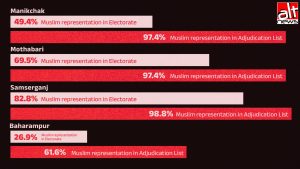
Alt News’s data analysis (here and here) of six assembly constituencies showed that an overwhelming majority of under-adjudication (UA) voters were Muslims. In Manikchak, where Hindus and Muslim voters are almost exactly equal in number, 97.4% of all voters placed under adjudication are Muslim. In Mothabari: 69.5% Muslim voters. 97.4% of UA voters are Muslim. In Samserganj: 82% Muslim voters. 98.8% of UA voters are Muslim. In Baharampur: 26.9% Muslim voters. 61.6% of UA voters Muslims. In Bhabanipur, Muslims constitute 22% of total voters. Among those placed under adjudication, they are over 51%. In Ballygunge, 54% Muslim voters, 76% Muslims among voters placed under adjudication.
Across all six constituencies combined, Alt News has digitised 12,81,764 voter records. Of the 3,02,573 voters placed under adjudication across these constituencies, 92.6% are Muslim in a combined electorate where Muslims make up 51.7% of voters. The overall Muslim adjudication rate is 42.2%, i.e, out of every 100 Muslim voters, more than 42 have been placed under adjudication. The Hindu adjudication rate is 3.5%.
Sabar Institute, which works among disadvantaged communities in Bengal through evidence based policy research, has done some seminal work with SIR data. It has conducted extensive ground research as well as data analysis regarding the impact of the SIR on the marginalized communities, especially Muslims of West Bengal. We spoke to its founder and lead researcher Sabir Ahamed.
Here are some excerpts from the interview:
Q. In multiple interviews and talks, you have stated that the Muslim community was targeted disproportionately through the SIR process in Bengal. Could you elaborate on that?
First, we need to understand the context. Electoral roll revision is not new. The Special Intensive Revision (SIR) process is part of the Election Commission’s manual, but there was no evident ground to implement it across an entire state. This argument has also been raised before the Supreme Court. Even when required, SIR is typically undertaken in limited areas and is inherently time-consuming. That raises the key question: why did the central Election Commission attempt to complete such an exercise within an unusually short span of just three months?
The data itself is revealing. According to the list published in December, areas with large Muslim populations recorded very high mapping percentages. In districts like Malda, Murshidabad and other border regions, less than 2% of the Muslim population remained unmapped. In other words, a significant majority of Muslim voters were able to successfully link themselves to the 2002 voter list and submit the required documentation.
In contrast, the situation was markedly different in SC-dominated regions such as the Matua belt, where the unmapped population stood at 14.3%. Similarly, in urban centres like Kolkata, a large section of migrant voters, who frequently move for work, remained unmapped.
At this stage, the process appeared to undermine a key political narrative that Bengal’s electoral rolls are heavily skewed by illegal immigrants from Bangladesh. With data not supporting that claim, the strategy seems to have shifted.
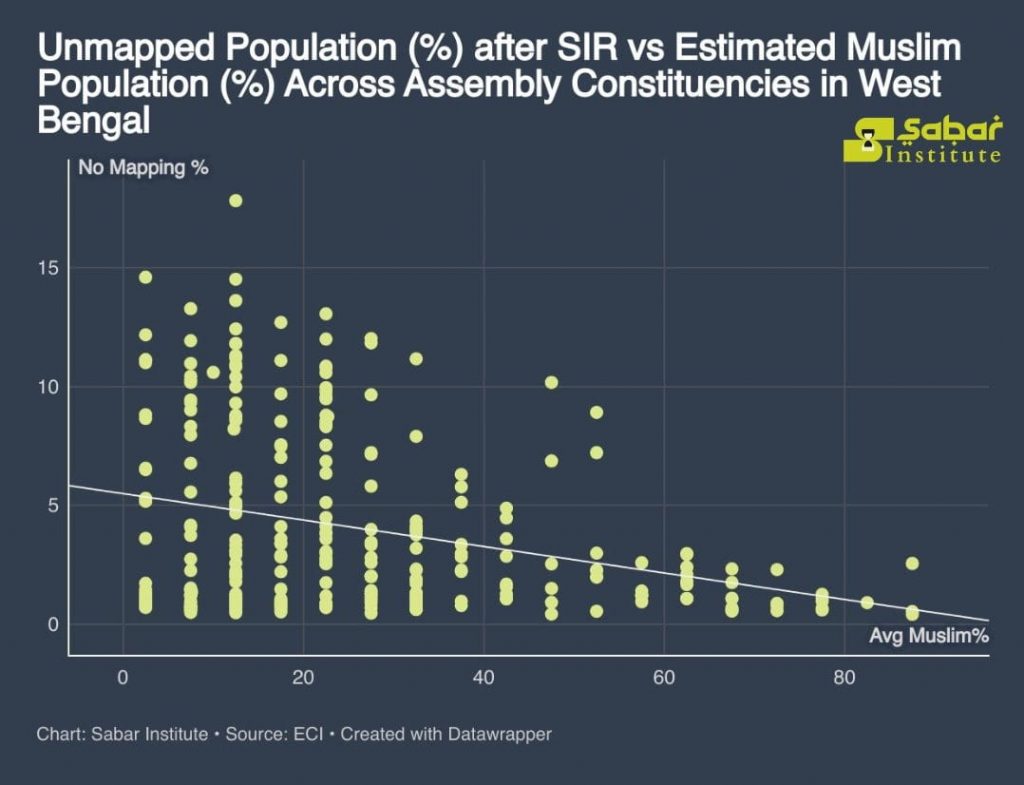
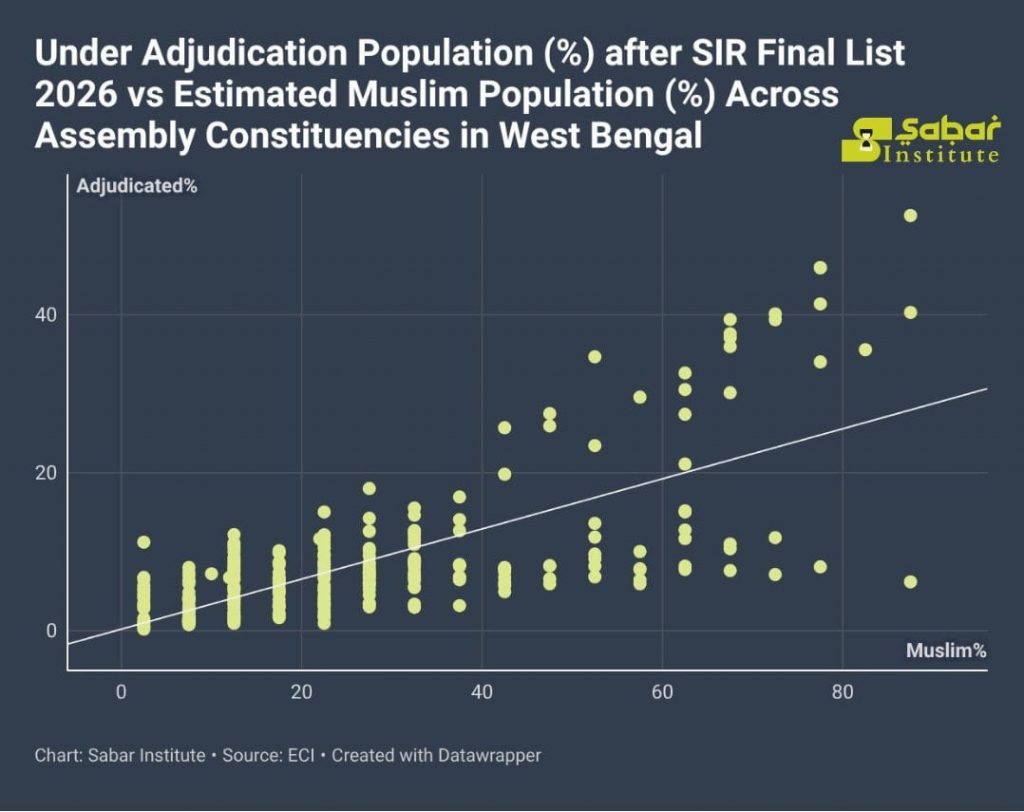
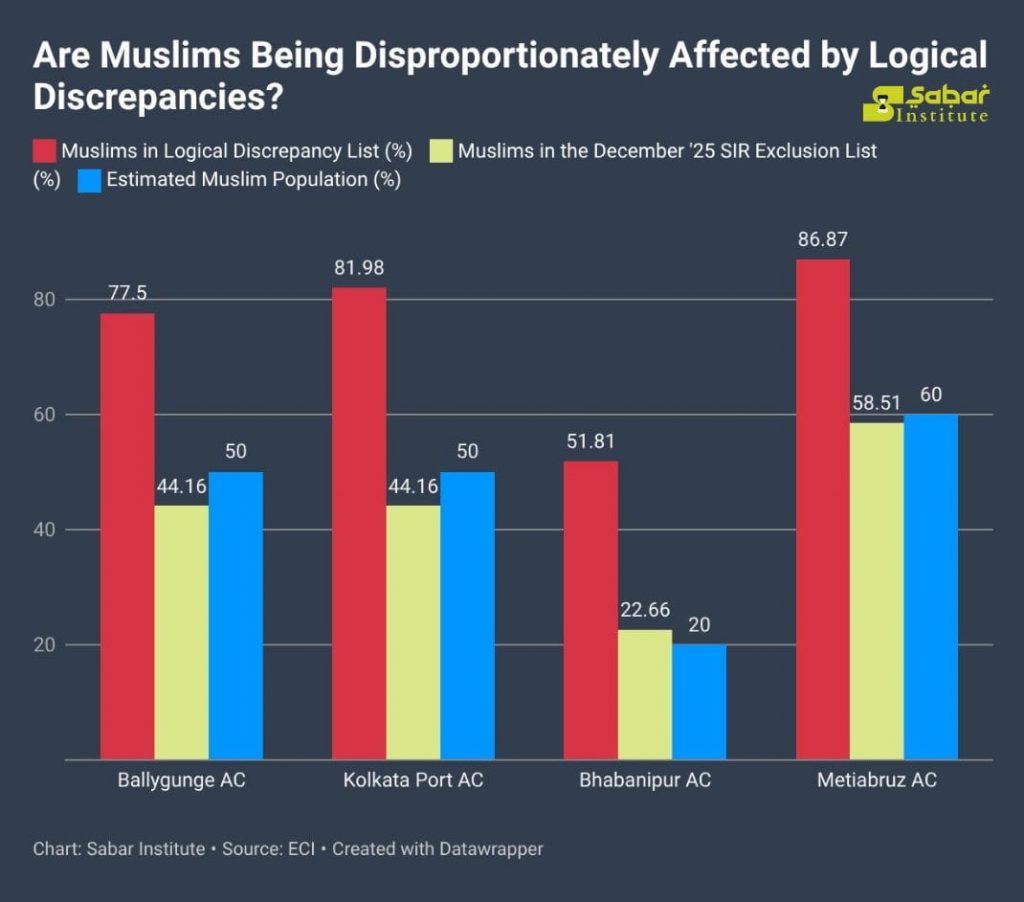
The introduction of the “logical discrepancy” mechanism marked a turning point. Once this filter was applied, the pattern changed significantly. In the initial list, the proportion of Muslim voters broadly corresponded with their share among mapped voters. However, among those flagged under “logical discrepancy,” the percentage of Muslim voters is disproportionately higher than their population share.
This shift raises serious concerns about the objectivity of the process and suggests that what began as an administrative exercise may have taken on a distinctly political character.
Q. What is there in the logical discrepancy algorithm which completely altered the scenario?
In my view, “logical discrepancy” was the result of an algorithm of oppression.
Now the question is who designed the logic, and on what basis?
It is unlikely that the conceptualisation and technical articulation of such a tool came entirely from within the administrative machinery. Once outsourced, however, the system becomes highly susceptible to design bias. AI systems are only as neutral as the instructions they are given. Insert specific prompts or parameters, and outcomes can be steered in particular directions.
We believe the system was primed with prompts like “mark Muslim names for logical discrepancy,” effectively hardwiring bias into its design.
At its core, “logical discrepancy” hinges on variations in spelling; often minor and entirely natural. For instance, prefixes like “Sheikh” can be written in multiple ways. Similarly, a name like “Ahamad” may also appear as “Ahmad.” These are not discrepancies in identity, but variations in transliteration. Yet, such differences are enough to trigger flags.
This issue is compounded by the language layer. Except for Kolkata, voter rolls across the state are in Bangla. The process of translating these names reportedly using tools like Google Translate or similar systems introduces further distortion, and the methodology for this translation has not been clearly explained.
Take a simple example: the name Abdul Jabbar written in Bangla as “আ: জব্বার”. Without contextual understanding, this can be rendered as “Ah! Jabbar” in English — an obvious mistranslation. Such outputs are then automatically flagged under “logical discrepancy.”
To be clear, similar errors have affected others as well. There have been cases where names like Sentu Das were distorted, and even instances involving families of public figures such as Justice Jaymalya Bagchi. However, these appear sporadic. In contrast, the pattern affecting Muslim names appears systematic rather than incidental.
For such a skew to emerge at scale, it is difficult to attribute it to random error alone. Without targeted design or biased parameters, the probability of such disproportionate outcomes would be extremely low. That is why the concern here is not just technological failure, but the possibility of technology being deployed in a way that produces exclusionary outcomes.
Q. What about economically weaker sections other than Muslims? Matuas have also borne the brunt. So what makes you think that Muslims were the targeted victims of this process?
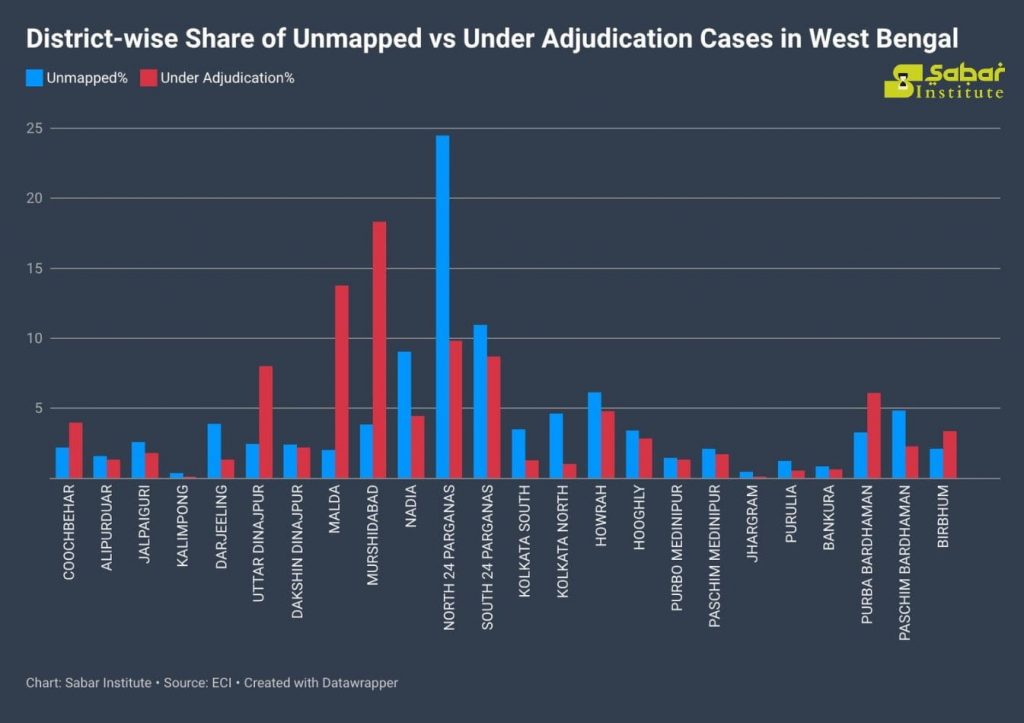
The Matua population, largely concentrated in Nadia and parts of North 24 Parganas, initially fared poorly during the mapping phase, with a relatively high proportion remaining unmapped. However, their position improved significantly in the final list after the “logical discrepancy” algorithm was introduced. This trend was visible across the Matua belt.
In contrast, Muslims appear to have borne the brunt of the process. The scale at which Muslim names were flagged suggests that such an outcome is unlikely without some form of systemic bias or intervention.
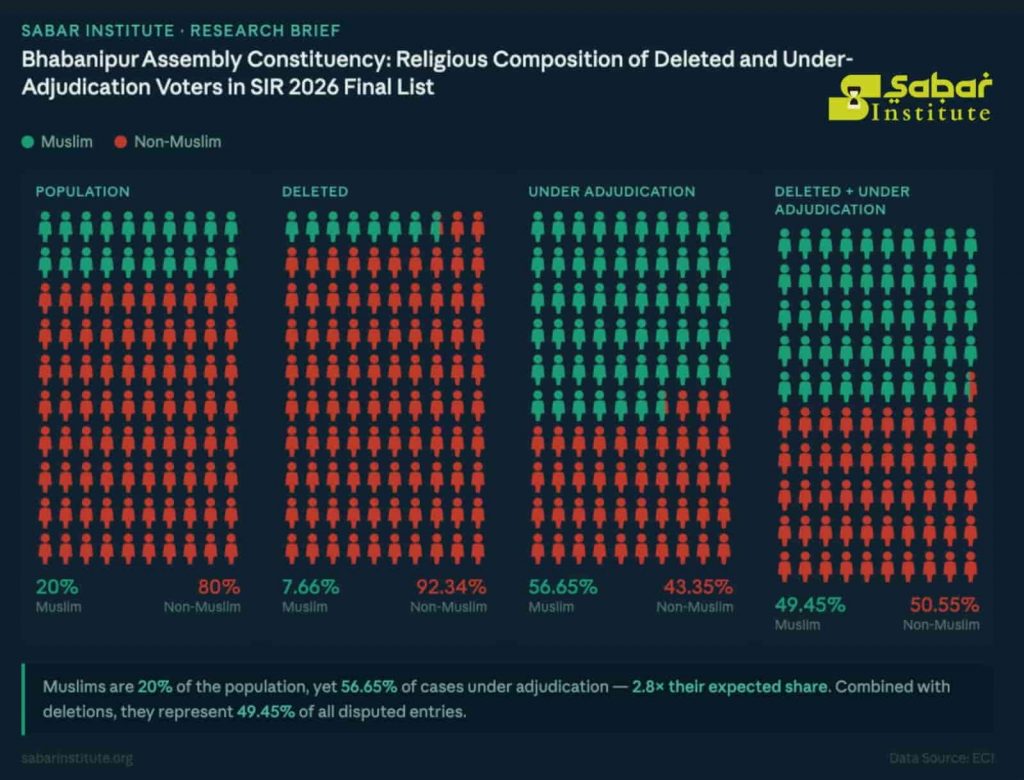
Take the example of Bhabanipur Assembly constituency: Muslims constitute roughly 20% of the population, yet nearly 50% of those flagged under “logical discrepancy” are Muslims. This disparity is too large to ignore. It is also evident that economically weaker sections have been disproportionately affected. While there are exceptions—such as Nandini Chakrabarty, the state’s chief secretary, whose name appeared on the list. These are isolated cases rather than indicative of a broader pattern.
Our “title analysis” further reinforces this concern. Upper-caste surnames are rarely flagged, whereas surnames associated with socially and economically marginalised groups, such as Das or Mondal, appear far more frequently in the lists. This suggests that the burden of scrutiny falls disproportionately on backward sections, with Muslims within these groups being particularly affected.
While we have not yet been able to analyse the entire state dataset due to its scale, our sample-based findings reveal a consistent pattern: Muslims are disproportionately targeted.
For instance, in Salt Lake, where Muslims constitute only about 2–3% of the population, a typical polling booth might see around 8 deletions and 30 names placed under adjudication. However, in a Muslim-dominated booth, the numbers shift dramatically — deletions rise to around 10, while those under adjudication can surge to as high as 900. Such stark contrasts make it difficult to argue that the process affects all communities equally.
In areas like Gaighata in North 24 Parganas, there have been claims that a significant number of Hindu voters have also been placed under adjudication. However, these figures remain broadly proportional to the Hindu population share. In contrast, the corresponding figures for Muslims are highly disproportionate.
Even in constituencies such as Domkal and Farakka in Murshidabad district, the adjudication rate is extraordinarily high, ranging between 50% and 60%, further underscoring the uneven impact.
Taken together, the data suggests that while non-Muslims have also been affected, the scale and intensity of impact on Muslim voters is significantly higher, pointing to a pattern that cannot be easily explained by random or neutral administrative processes.
Q. What lies ahead for the 27 lakh voters who have been deleted?
Based on our experience in Assam, it is actually less harmful for a voter to have their name deleted than to be marked as a “doubtful voter” and sent to a tribunal. In the former case, one can re-enter the rolls by submitting Form 6. But once a case goes to a tribunal, the burden shifts to the individual to prove their citizenship before a judicial authority, making the process far more difficult, expensive, and uncertain.
Electoral roll revision is meant to be an administrative exercise, not a judicial one. The introduction of categories like “under adjudication” has unnecessarily complicated the process and made it more punitive. Since Muslims form a large share of those in this category, they are likely to face disproportionate hardship.
Our initial estimates suggest this process has already cost ordinary people around ₹4,000 crore. If cases move to tribunals, the financial burden will increase further due to legal expenses. This raises a basic question: why should citizens bear the cost of a flawed process initiated by the state?
We are therefore demanding that the state provide legal and financial assistance to affected voters. Until proven otherwise, they should also be granted provisional voting rights. We are working with Sabar Institute and others to initiate legal support for those impacted.
Q. While the “logical discrepancy” clause was not used in Bihar’s SIR process, it has been applied in other states, including Bengal, in this round. Considering that many of these states have a relatively small Muslim population, how does one substantiate the argument that its introduction was specifically aimed at targeting Muslims in Bengal?
The Election Commission appears to have introduced the concept of “logical discrepancy” with Bengal as its primary focus, even though it is now being extended to other states. However, the scale of its application elsewhere is nowhere comparable.
In other states, the number of voters flagged under “logical discrepancy” remains relatively limited. Nowhere else do we see figures on the scale of Bengal, where upwards of 60 lakh voters have been placed under “logical discrepancy” or “under adjudication.”
While the Election Commission maintains that similar roll revision processes have been carried out in other states, we have not found any comparable data or outcomes that reflect this claim. The disproportionate scale and impact in Bengal suggest that the process here is qualitatively different, not merely an extension of a uniform nationwide exercise.
Q. Has this happened before in Indian electoral history — a process which pushed such a huge number of voters into uncertainty?
Never before has such a situation unfolded at this scale. It is difficult to find any comparable instance where such a large number of genuine voters have been turned into “doubtful” voters through an administrative exercise.
Take a personal example: my 80-year-old father, a passport holder who has voted multiple times, was still placed under the adjudication list despite submitting documents like Aadhaar, PAN, and his passport. There is no discernible logic to this. He is an octogenarian suffering from dementia, yet he is now expected to stand in line and prove his own identity.
There are also serious systemic lapses on the part of the Election Commission. It has not published a clear break-up of how many claims have been rejected or referred to tribunals. Despite Supreme Court directions, the “logical discrepancy” list is not available in the public domain in Bengal (while such data exists for states like Uttar Pradesh). This makes any meaningful statewide analysis nearly impossible.
Even accessing the “under adjudication” list is extremely difficult. Data is buried in non-searchable PDFs, limiting scrutiny. The entire process lacks transparency. This raises a fundamental question: why such opacity, despite the existence of RTI and proactive disclosure norms?
Traditionally, the Election Commission has emphasised transparency through social audits and public hearings — publicly disclosing voter numbers, reasons for exclusion, and pathways for re-inclusion. There was a time when even homeless individuals were enabled to vote by assigning electric poles as addresses. Today, however, even multiple identity documents are proving insufficient to secure one’s place on the electoral roll.
Taken together, this marks a troubling shift from inclusion to exclusion, and from transparency to opacity.
Independent journalism that speaks truth to power and is free of corporate and political control is possible only when people start contributing towards the same. Please consider donating towards this endeavour to fight fake news and misinformation.