With barely a few months to go for assembly elections, West Bengal’s political discourse has taken a headlong communal plunge. On Saturday, December 6, the 32nd anniversary of the Babri Mosque demolition, an ousted Trinamool Congress MLA sparked nationwide controversy by laying the foundation stone for a “new” Babri Masjid in Murshidabad. The very next day, ‘Sanatani’ Hindus gathered in huge numbers in the heart of Kolkata for a reading of the Bhagavad Gita and calling for Hindu unity.
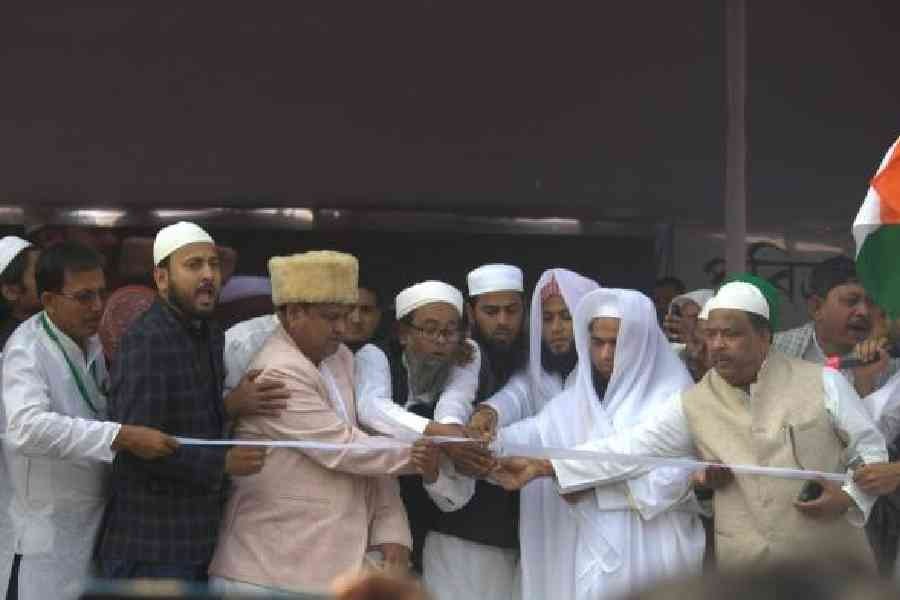
Humayun Kabir, the MLA from Bharatpur in West Bengal’s Murshidabad district, organised a foundation-laying ceremony for a mosque that is proposed to be modelled after the Babri Mosque in Ayodhya demolished by Hindutva karsevaks on December 6, 1992. A staggering number of people turned up at the site — a 25-acre plot in Beldanga, a municipality town in Murshidabad — for the brick-laying ceremony, which Kabir described as a ‘prestige battle’ for Indian Muslims. Many traveled from as far as North Dinajpur and Canning in South 24-Parganas, located some 240 kilometres away. Many were seen walking toward the site balancing bricks on their heads, which they wanted to use in the structure.
A day later, on December 7, devotees in large numbers (BJP claimed 6.5 lakh) turned up at Kolkata’s iconic Brigade Parade Ground to participate in a collective recital of the Bhagavad Gita, titled ‘Panch Lakkho Konthe Gita Path’, organised by the Sanatan Sanskriti Sansad — a collective of monks and Hindutva leaders from across states and institutions. The event, attended by the likes of Dhirendra Krishna Shastri (‘Baba Bageshwar’), Sadhvi Ritambhara and Baba Ramdev, also featured BJP leaders like Samik Bhattacharya, Dilip Ghosh, Suvendu Adhikari, Dilip Ghosh, Sukanta Majumdar, Locket Chatterjee, Agnimitra Paul and others. Participants arrived in huge numbers, in crowded buses, ferries, and trucks, not only from West Bengal, but also from neighbouring states such as Bihar, Orissa, Assam, and even Bangladesh and Nepal.
Bengal governor C V Ananda Bose, too, addressed the crowd.
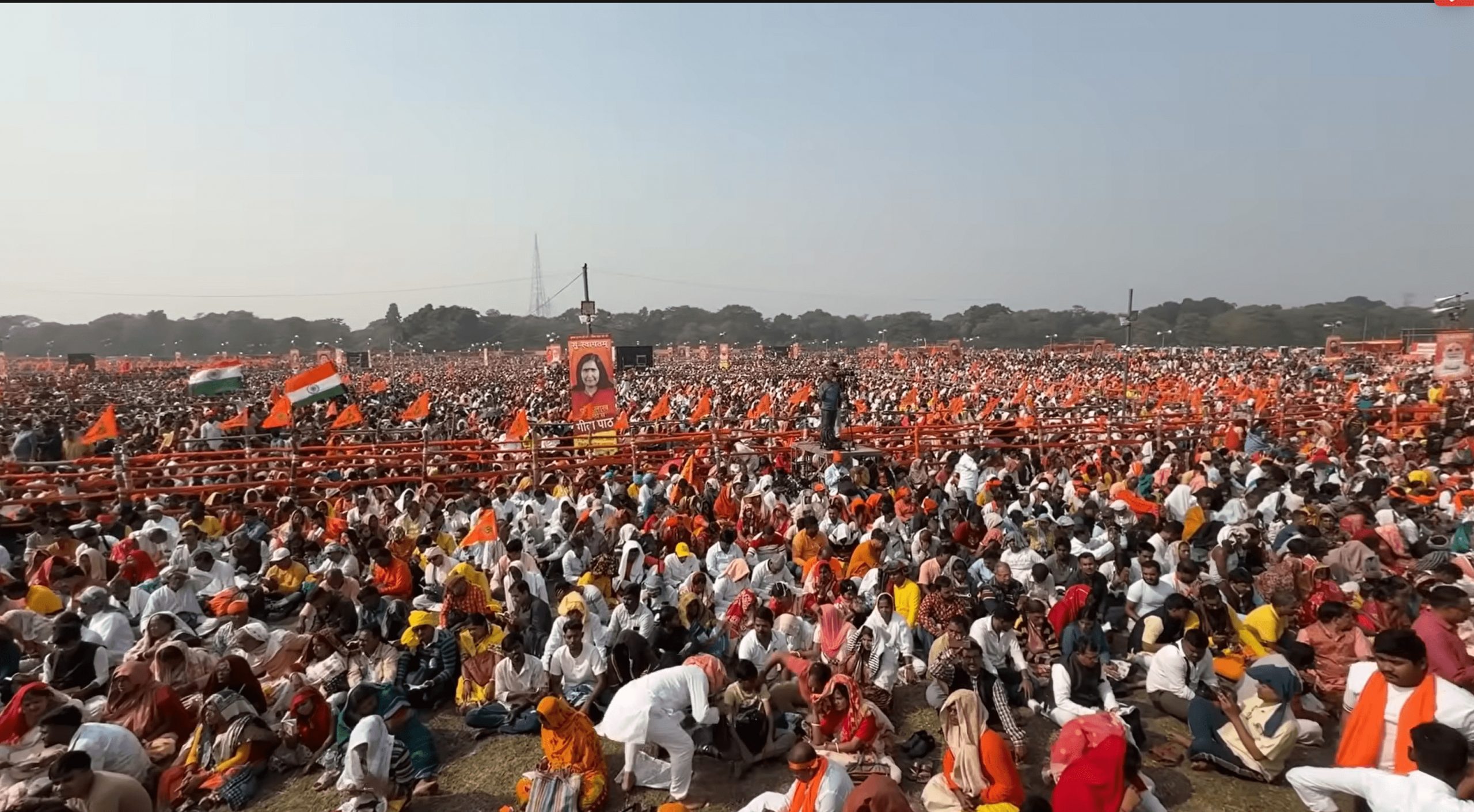
Both Kabir in Murshidabad and Shastri in Kolkata posed a thinly veiled, unsettling question: Would their followers back down from a confrontation? The crowds responded with an emphatic and unanimous “No”.
At the Kolkata parade ground, Shastri, while calling for a Hindu Rashtra, asked: “You won’t be scared? (No) You won’t step back? (No) You won’t run away? (No).” In Beldanga, a speaker standing next to Kabir echoed a similar line of provocation: “You will not run away in fear of the police? (No) Are you ready to be beaten by the police to get what we want? (Yes).” Another compatriot of Kabir exclaimed from the podium: “Ladke lenge Babri Masjid.” (We will fight to reclaim Babri Masjid)
The consequence of such remarks translated into a spirit of aggressive religious posturing among the attendees. In Murshidabad, one attendee threatened to cut off the head of whoever stood in the way of the Babri Mosque and play football with it. At the Brigade Parade Ground, saffron-clad vigilantes assaulted one Sheikh Reyajul for selling chicken patties at the event. They kicked down his box of savouries, despite Reyajul pleading that it was his source of livelihood, and made him do sit-ups while holding his ears. Reports later emerged of a second incident where another Muslim vendor was allegedly assaulted for selling chicken puffs near the venue.
While BJP leaders openly endorsed the Gita recital event and made their presence felt on the dais, Trinamool Congress finds itself in a sticky situation. The party was forced to suspend Kabir days before the foundation laying event. Kolkata mayor Firhad Hakim referred to him as a ‘traitor’, pointedly indicating that Kabir followed in the stead of ‘Mir Jafar’, implying his history of defections, which saw him change from the Congress, to the TMC, to the BJP, and then back to TMC, before his recent suspension. Furthermore, chief minister Mamata Banerjee skipped the Gita Path events despite being invited, citing ideological differences. “How can I go to an event organised by the BJP? I am from a different party, I have a different ideology… They (the BJP) are anti-Bengali”, said Banerjee in a statement.
Communal Sparks Fly
Just before the brick-laying ceremony in Beldanga on Saturday, Kabir delivered an inflammatory speech, going as far as declaring that Muslims, who account for 37% of the total population in Bengal, would willingly sacrifice themselves before letting the bricks of the Babri Masjid come undone. The attendees said that he had perfectly articulated the sentiments of the Muslims in the state. Compatriots of Kabir roared from the stage, “Humayun se jo takrayega, woh choor choor ho jayega!” (Translation: Whoever clashes with Humayun will be smashed to pieces!).
Kabir had first expressed his desire to set up the mosque last year in December 2024. He had promised to make a cast of the Babri Masjid by December 6 of this year. “…With donations from everyone, we will build a new Babri Masjid in Beldanga in Murshidabad in West Bengal,” he had said. In carrying out his pledge, he was suspended by the Trinamool Congress, which cited communal politics as the grounds for its action. “He stays in Rejinagar and is an MLA from Bharatpur. Why then does he want to build a mosque at Beldanga? This is because Beldanga is communally sensitive, and if there are riots, it will result in polarisation and help the BJP,” Mayor Hakim was quoted as saying.
The BJP in West Bengal didn’t take too long to retaliate. Leader of Opposition Suvendu Adhikari said that while the party did not object to the construction of the mosque itself, they had a problem with the naming. Addressing a press conference on Monday, December 8, Adhikari alleged that Kabir had the support of the administration in celebrating “Mughal-Pathan invaders”.
Interestingly, a section of the attendees at the Murshidabad event seemed miffed with the Bengal government. While speaking to Aaj Tak Bangla, several devotees raised allegations of corruption against the Mamata Banerjee government and underlined that nothing substantial had been done for the Muslims. It is also pertinent to note here that this is not the first time that Kabir was expelled from the TMC. In 2015, he was expelled for 6 years over anti-party statements. After contesting and losing as an independent candidate in Murshidabad’s Rejinagar seat in 2016, he joined the BJP in 2018. After losing again in the 2019 Lok Sabha elections, he rejoined TMC in 2020 and won as MLA from the Bharatpur seat.
MLA from Goshamahal, Hyderabad, T Raja Singh, notorious for his Islamophobic hate speeches and incitements to violence, released a video reacting to the ‘new’ Babri Masjid initiative. He exclaimed: “Mai aaj challenge karta hu — ke Bharat ke Ram-bhakto ko le jaakar Babar ka naam jis prakar se Ayodhya mai mita diya gaya tha, waise hi Bangal ke Ram-bhakt jayega, aur Babar ke naam ki bani huyi masjid ki ek ek eent ko samapt bhi karega.” (I’m issuing a challenge today — in the way that the Ram-bhakts of Bharat had removed Babar’s name from Ayodhya, the Ram-bhakts of Bengal will also come together to demolish each stone used in the building of a mosque in the name of Babar.)
Brigade Parade Ground Turns Saffron
The sentiments against the foundation of the mosque spilt onto the Gita Path event the next day. While delivering his speech at the Brigade Ground, Dhirendra Krishna Shastri made several references to Babri Masjid. “In Bharat, should anything be named after foreign invaders? Does Bharat belong to Babur or Raghubar? (Raghubar is another name for the Hindu deity Ram.) It belongs to Raghubar or not? (A resounding yes follows) Hindus need to unite, wave the Bhagwa flag and go to villages far and near to wake the Hindus…” he says during his speech.
Attendees could be seen carrying posters mentioning Babar.
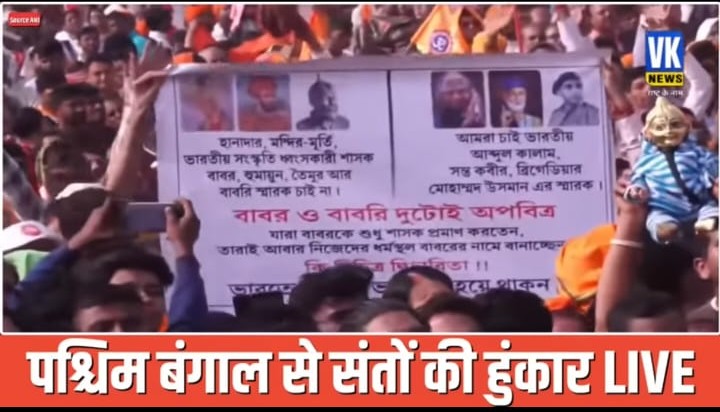
While calling for a Hindu Rastra, Shastri also posed several provocative questions. He said, “You have to decide if you want Ghazwa-E-Hind or Bhagwa-E-Hind, if you want tanatani (tension) or sanatani, if you want to see a moon on your flag or a flag on the moon, if you want to see a crack among the Hindus or unity…”
Padma Bhushan awardee Sadhvi Rithambhara graced the occasion as the chief guest. Readers should note that she was one of the 68 people named by the Liberhan Commission in its report on the 1992 Babri Mosque demolition and the riots that followed. Besides, she had played a key role in popularising the ‘Ram Janmabhoomi’ narrative through incendiary speeches — which would be distributed through audio cassettes, and played in public.
At the Gita recital assembly, she asserted: “Babar ya Babri ki koi buniyaad iss desh mai nahi hai. Koi eento ki maharat khada kar sakta hai, par hriday mai Babar ko basa nahi sakta. Ye rashtra Ram ka hai, aur Ram ka hi rahega. Yaha bhagwa hi pherahega, yahi satya hai—yai Sanatan satya hai.” (Neither Babar nor Babri has roots in this country. Let them build something out of bricks, it won’t change the fact that Babar can never reside in the heart. This nation belongs to Ram, and will only belong to him. Only the saffron shall rule. This is the truth — the Sanatan truth.”
“बाबर या बाबरी की कोई बुनियाद इस देश में नहीं है”
◆ साध्वी ऋतंभरा ने निलंबित TMC विधायक हुमायूं कबीर द्वारा बाबरी मस्जिद की नींव रखे जाने पर कहा#SadhviRitambhara | Sadhvi Ritambhara | #HumayunKabir | Humayun Kabir | #WestBengal pic.twitter.com/4fN6rK1sxK
— News24 (@news24tvchannel) December 7, 2025
West Bengal Governor CV Ananda Bose also addressed the crowd, quoting extensively from the Bhagavad Gita and referring to the Indian epics. Reminding the audience that “something” had transpired in Murshidabad the previous day, he urged them to end “religious arrogance” in the state. Bengal is in a sad state of affairs and is ready to usher in change, he remarked. At the very beginning of his speech, he said, “I will try to speak in Hindi, since Hindi is our national language. The national language is the mother. English is a midwife, and a midwife can never be a mother.” This is an oft-repeated piece of misinformation, fact-checked by Alt News.
Communal Narratives Capture the Political Discourse
While Kabir finds it difficult at the moment to make political allies, there is no doubt that the two events totally captured the political discourse in the state to an extent that almost everything else have been pushed to the distant margins. A significant marker of that is what Bengali TV news channels debated in the last few days. One can see the playlist of ABP Ananda’s primetime programme ‘Ghantakhanek Sange Suman’ here.
Republic Bangla went on an overdrive in reporting the Gita Path event on Sunday. The anchors went up on the podium, personally interviewing the guests on their observations on the mass gathering. Shows were run with the tagline “When Brigade turned into Kurukshetra.” Journalist Mayukh Ranjan Ghosh also interviewed Sadhvi Rithambhara, asking her whether she felt that Bengal was ready for such a spectacle. The latter indicated, with a wry smile, “Ye prarambh hai, aage dekhiye.” (This is the beginning. Let’s see what happens next). Ghosh was also on stage with Hiranmay Maharaj, who asserted that ‘yoddhas’ or ‘sainiks’ were being created at the venue, who had picked up the mantle of fighting injustice in Bengal, and instituting a Hindu Rashtra.
Bengali mainstream media channels such as Zee 24 Ghanta and ABP Ananda ran continuous coverage on either Humayun Kabir’s actions or the Gita Path controversy, with both stories dominating their news cycles over the weekend.
Independent journalism that speaks truth to power and is free of corporate and political control is possible only when people start contributing towards the same. Please consider donating towards this endeavour to fight fake news and misinformation.