The death of Sharif Osman Hadi, a prominent face of the July 2024 uprising in Dhaka, at a Singapore hospital plunged Bangladesh into widespread violence yet again on December 18, with protesters storming the streets of national capital in scenes reminiscent of the students’ uprising that toppled the Sheikh Hasina government.
Thirty-two-year-old Hadi, a spokesperson of the Inquilab Manch and probable candidate for the upcoming general elections in the restive country, was campaigning for the polls in central Dhaka’s Bijoynagar area on December 12, when unidentified gunmen shot at him on Box Culvert Road. Hadi succumbed to his injuries in Singapore after being on life support for six days.
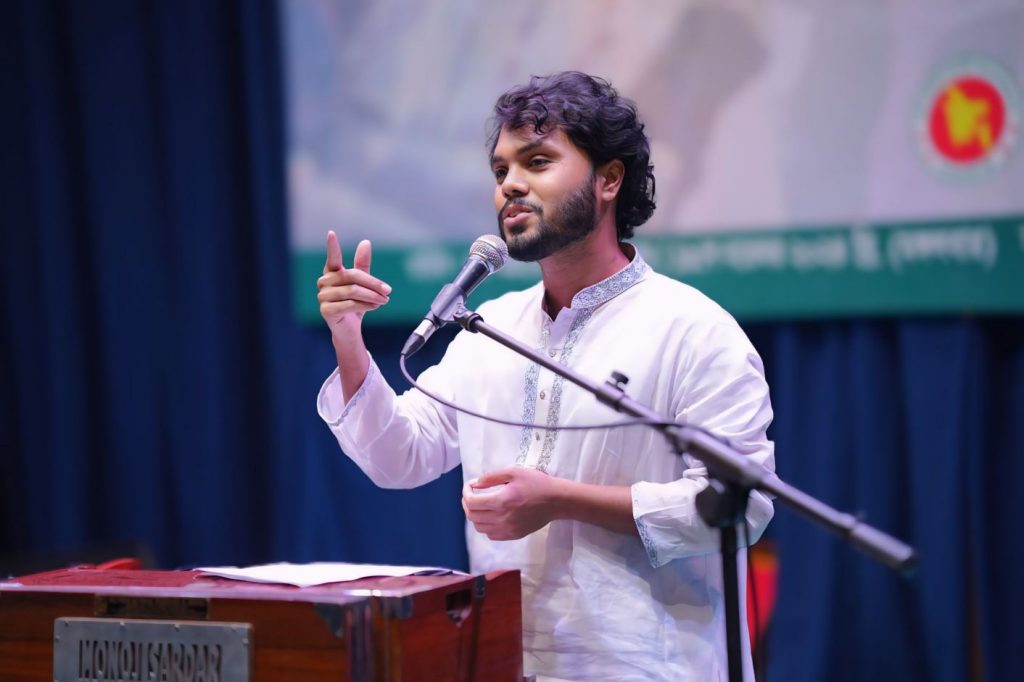
The chief advisor of the interim government, Muhammad Yunus, announced Hadi’s death in a televised address on Thursday night. Hadi’s body was brought back to Dhaka in the evening of December 19 amid tight security.
As soon as the news of Hadi’s passing spread across Dhaka, protesters descended on the streets shouting slogans like ‘তুমি কে আমি কে, হাদি হাদি’, (Who are you? Who am I? Hadi! Hadi!) and ‘আমরা সবাই হাদি হবো, গুলির মুখে কথা কব’ (We will all be Hadis, we will speak defying bullets). Major intersections, including the Shahbagh square area, were soon filled with demonstrators, bringing large swathes of the city to a standstill. As the night wore on, protests spread beyond Dhaka, and news of arson, vandalism and large-scale violence began pouring in from far and wide.
Offices of Prothom Alo, The Daily Star Attacked, Set Afire
Hordes of agitators attacked the offices of The Daily Star and Prothom Alo, two of Bangladesh’s largest dailies, on December 18 night. For the first time in their history, none of the papers could bring out an edition on December 19.
The Prothom Alo office located at Karwan Bazar area was attacked first. The digital desk and editorial staff were present in the office at that time. The protesters vandalized the building and set it on fire, destroying valuable assets and documents.
According to the paper, there were apprehensions about the Prothom Alo office being attacked, and hence the paper had already contacted various quarters, “including high-level government officials” seeking security. However, before law-enforcement agencies could arrive, the office was attacked. “Concerned journalists and staff working there were forced to leave the office to save their lives. Law enforcement and fire service members arrived and brought the situation under control.”
VIDEO | Dhaka, Bangladesh: Protesters vandalised the office of the country’s largest newspaper, Daily Prothom Alo, amid widespread outrage over the death of Sharif Osman Hadi, spokesperson for the political platform Inquilab Mancha.
(Full video available on PTI Videos –… pic.twitter.com/6klEh8xj4U
— Press Trust of India (@PTI_News) December 18, 2025
A short distance away, at least 28 employees of The Daily Star remained trapped inside the office for over four hours as another group comprising 100-200 protesters vandalized the lower floors of the nine-storeyed building. As smoke started engulfing the building, the staffers took shelter on the rooftop. Senior reporter Zyma Islam posted about her exasperation on Facebook a little before 1 am local time.
I can’t breathe anymore. There’s too much smoke. I’m inside. You are killing me.
Posted by Zyma Islam on Thursday 18 December 2025
According to the paper, violent demonstrators laid siege to the office for over four hours starting around midnight. They even blocked a fire tender from reaching the office, delaying rescue operations significantly, it said, adding that the first three floors of the office had been totally destroyed.
VIDEO | Bangladesh: Protestors vandalise the office of Daily Star newspaper in Dhaka#Dhaka
(Full VIDEO available on PTI Videos – https://t.co/n147TvrpG7) pic.twitter.com/MLfLCjLbHm
— Press Trust of India (@PTI_News) December 19, 2025
Even as the paper thanked “the authorities for their assistance”, it criticized “the government’s relaxed attitude towards the safety and security of news outlets despite previous threats and efforts to disrupt their operations.” In an editorial piece published digitally, the paper said, “a better coordinated response would have meant less trauma for our trapped colleagues who spent several hours in grave uncertainty in a mortal fear… Both The Daily Star and Prothom Alo have been under repeated threats from different quarters but they were neither dealt with seriously nor investigated…”
The office of Muhammad Yunus issued a statement on December 19 saying that the chief advisor (Yunus) had spoken to the editors of the two papers over phone. “Expressing deep condolences to Prothom Alo Editor Matiur Rahman and Daily Star Editor Mahfuz Anam, the Chief Advisor said, “This unwanted and despicable attack on your organization and journalists has deeply saddened me. The government stands by you in this difficult time… The chief advisor said that the attack on the country’s two leading media institutions is tantamount to an attack on independent media. This incident has created a major obstacle in the country’s democratic progress and independent journalism,” the statement said.
প্রথম আলো ও ডেইলি স্টার সম্পাদকের সঙ্গে প্রধান উপদেষ্টার ফোনালাপ
ঢাকা, ১৯ ডিসেম্বর ২০২৫: গতকাল বৃহস্পতিবার রাতে দৈনিক…
Posted by Chief Adviser GOB on Thursday 18 December 2025
The office of cultural organization Chhayanaut in Dhanmondi, too, was attacked by violent protesters. Furniture, musical instruments, recording rooms, computers were destroyed. Founded in 1961 by cultural icons like Kamal Lohani, Wahidul Haque and Sanjida Khatun, Chhayanaut is one of the foremost socio-cultural organizations in the country working towards preserving and promoting Bengali culture.
Chhayanaut secretary Lisa Ahmed Lisa issued a statement narrating the extent of the damage and seeking a thorough investigation.
Stone-pelting and attempted arson were reported at the Indian assistant high commissioner’s office-cum-residence near MES College in Chittagong in the early hours of Friday. Twelve people, including the alleged leader of the arsonists, were arrested.
The Dhanmondi house of the country’s first President, Sheikh Mujibur Rahman, too, was vandalized and set on fire on Thursday night.
The interim government has made a fervent appeal for peace and resisting all forms of mob violence.
Why were the Two Papers Targeted? The Method in the Madness
Were the attacks on the two newspaper houses just madness? Or was there a method in the madness? Alt News asked senior journalist Sabir Mustafa.
The former head of BBC’s Bangla Services said, “These two papers have always promoted liberal and secular values. This is why they were targeted by radical Islamist groups. They attempted to attack the papers last year, immediately after the fall of Hasina. They were foiled by the army. They have been campaigning against the papers in social media ever since. They took their opportunity last night, using the emotions built up by the killing of Osman Hadi.”
Asked about the role of the interim government, Mustafa said, “The Yunus govt has generally given these radical mobs a free hand for the year and half. But the Daily Star and Prothom Alo were seen to be protected because of their historic close relationship with Yunus. But this time, the govt allowed the mob to achieve their goals. Perhaps, the govt felt that, given the emotions surrounding the death of Hadi, things might get even worse if the mob was confronted by police and army.”
Mustafa also made a significant point when he said that anti-Indianism was playing a big part in these attacks. “But in some cases, India is being invoked to “justify” the attacks. The protesters accuse both the Daily Star and Prothom Alo of being pro-India. They even nicknamed the DS as The Delhi Star,” he said.
“But the Yunus govt has played to this populist gallery by whipping up anti-India sentiment too. Radical Islamist and anti-India forces, which operated on the fringes during Hasina’s rule, played a big part in her overthrow last year. They are now in the mainstream of politics,” he added.
Hindu Man Lynched, Hung from Tree, Set Afire in Mymensingh
Amid the violent demonstrations, an event of unspeakable horror unfolded in Bhaluka in Mymensingh district, about 95 km north of Dhaka, where a Hindu man was lynched by a mob over blasphemy allegations. The communal hate crime was unrelated to the protests triggered by Hadi’s death in Dhaka and elsewhere, but was indicative of the overall law and order situation in the country, and is the latest in the series of atrocities against minorities that started after the fall of the Hasina government in 2024.
According to reports by local media, the victim, Dipu Chandra Das, 27, worked at a garment factory at Dubalipara in Jamirdia in Bhaluka sub-district of Mymensingh. On December 18, some of his colleagues complained that he had used religious slurs. When news of this spread out of the factory, enraged locals lynched Das.
Ripon Mia, duty officer at Bhaluka police station, told BBC Bangla that after beating him to death, the mob tied the youth’s body to a tree and set it on fire at an intersection on the Dhaka-Mymensingh highway. Asked about the nature of the alleged blasphemous comment or act that triggered the violence, officer-in-charge of Bhaluka police station Mohammad Zahidul Islam told Prothom Alo that the allegation “spread through people’s mouth. We have not yet found its source. An investigation into the matter is underway.”
Police and army personnel recovered Das’s body late at night and a case was lodged against 150 unidentified assailants on December 19.
Das hailed from Mokamia Kanda village in Tarakanda sub-district of Mymensingh. He is survived by his wife and a minor son. Das’s sister, Champa Das, told BD News that Dipu was an educated person “who could never insult the Prophet”. She further alleged that when angry locals reached the gate of the factory where Das had been working for over two years, his colleagues handed him over to them. “If he did commit a crime, he could have been tried according to legal provisions,” lamented Das’s father.
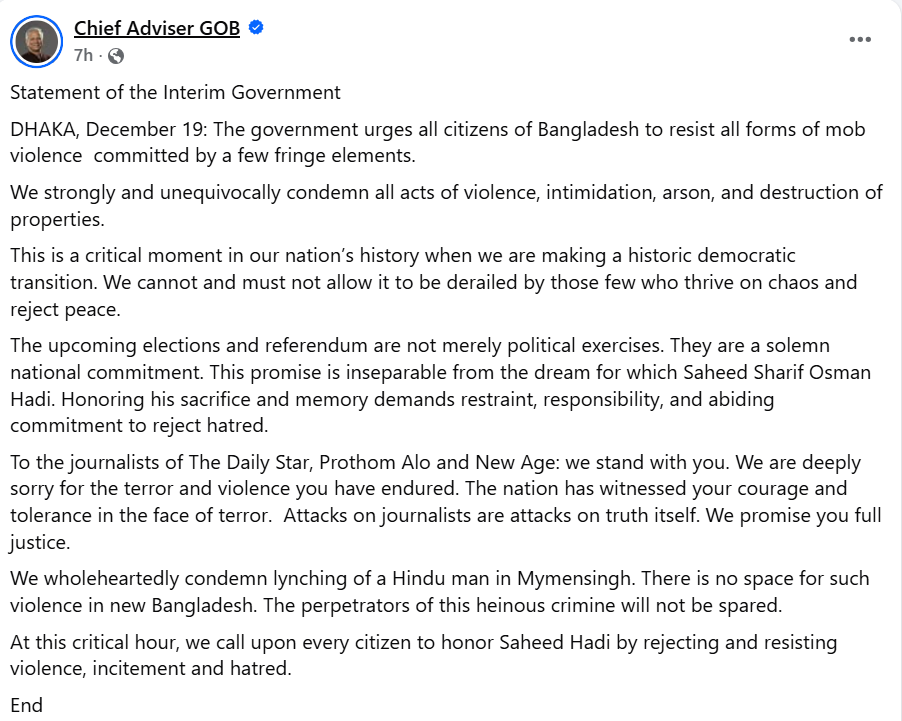
The interim government chief decried the barbarous attack. “We wholeheartedly condemn lynching of a Hindu man in Mymensingh. There is no space for such violence in new Bangladesh. The perpetrators of this heinous crimine will not be spared. At this critical hour, we call upon every citizen to honor Saheed Hadi by rejecting and resisting violence, incitement and hatred,” (sic) statement released by the Yunus administration said.
Independent journalism that speaks truth to power and is free of corporate and political control is possible only when people start contributing towards the same. Please consider donating towards this endeavour to fight fake news and misinformation.