The Modi government, which has never kept its reservations about the Mahatma Gandhi National Rural Employment Guarantee Act (MGNREGA) a secret, has put the final nail in its coffin through legislation. The Viksit Bharat – Guarantee for Rozgar and Ajeevika Mission (Gramin) (VB G RAM G) Bill marks a total restructuring of India’s flagship rural employment programme. But is there more to it than what meets the eye?
Critics argue that the Bill does not merely “revamp” the employment guarantee framework but effectively dismantles the rights-based architecture of NREGA that existed for over two decades.
The Bill was passed after a marathon debate in the lower house of the Parliament that stretched past midnight. The discussion began on the evening of December 17 after 5:30 pm in a sparsely attended House and continued until around 1:30 am. On Thursday, Congress MP K C Venugopal said the opposition wanted the Bill referred to a standing committee, but Speaker Om Birla refused, citing over eight hours of discussion. Amid protests, sloganeering and torn papers in the well of the House, the Bill was passed by voice vote.
Modi’s Long-standing Opposition to NREGA
Leaders of the Bharatiya Janata Party had made their intentions on NREGA clear even before forming the government in 2014. From repeatedly branding the Act a “failure” to allowing it to wither through chronic payment delays and an overreliance on technocratic controls, over the last decade, the scheme has been subjected to a slow, deliberate erosion. That trajectory, critics of the new Act argue, culminates in VB-G RAM G, which has now been extended as a national scheme.
During one of his campaign speeches in Karnataka in April 2014, Modi had accused the Congress government of “filling their pockets” through the Act. He said, “Madam Soniaji says we have eradicated poverty from villages. How did it happen? (She says) We have brought NREGA (National Rural Employment Guarantee Act)…Congress kaa jeb bharata hain uska naam hain Narega (It fills the pockets of Congress and its name is NREGA).”
During the budget session in February 2015, Modi, who had become the Prime Minister by then, had spelt out his intentions for the NREGA in Parliament, saying he would keep the scheme running as a reminder, a “living monument to the failure of the Congress party”. In effect, he was saying that he was willing to continue funding a wasteful Act just to one-up his political rival.
Soon after the NDA government had come to power in 2014, an internal note circulated within the Union rural development ministry proposed restricting the scheme only to 200 backward districts of the country. However, the idea was eventually scrapped.
Notwithstanding that, the effective strangling of the NREGA by the NDA government began years ago through a combination of funding cuts, delay in payment of wages to workers, policy failures and by introducing unnecessarily complex technological interventions. According to a 2018 report by The Newsclick, around 8.4 crore people sought work in 2017, but only 7.2 crore were provided employment, with the number of people denied work rising from about 79 lakh in 2013–14 to nearly 1.3 crore, pushing rejection rates close to 18%. Wages under the scheme remained low, averaging around ₹180 a day, with several states paying far less. Employment has shrunk with households receiving only 35–40 days of work on an average, far below the guaranteed 100 days.
Besides, despite law mandating wages within 15 days, crores remain unpaid each year. In 2017, for example, delayed wages amounted to over ₹7,000 crore. The forced shift to electronic payment systems such as NeFMS and Aadhaar-based payments also squeezed out workers, resulted in wages being rejected, diverted to wrong accounts or locked in dormant ones, often without any effective grievance redressal. While annual budget allocations appeared to rise on paper, actual releases fell short of demand, with expenditure regularly exceeding allocations and liabilities of over ₹1,900 crore being carried forward into the next financial year.
G RAM G & Its ‘Switch-off Clause’
The Opposition raised several objections to the naming of the Bill. Congress leader Priyanka Gandhi, during a parliamentary session, questioned the intention behind removing the ‘Mahatma Gandhi’ prefix. She said, “Whenever the name of a scheme is changed, there are so many changes that have to be made in offices, stationery… for which money is spent. What is the benefit, and why is it being done?” Senior Trinamool Congress leader and Rajya Sabha MP Derek O’Brien termed the government’s move “an insult to Mahatma Gandhi.”
“The Bill guarantees 125 days of wage employment to rural families,” Shivraj Singh Chouhan, Union minister of agriculture, said. However, critics argue that the G-RAM-G Bill defies the core principle of the guarantee to work. Under the guise of ‘revamping’ the employment guarantee act, the new Act anything but guarantees it.
Under the new Act, power is almost entirely centralised with the Union government to determine wage rates, control financial allocations, and, crucially, decide where the Act will be in force. Economist Jean Drèze has described this provision as a “switch-off clause,” arguably one of the most contentious aspects of the legislation. Even under the existing scheme, the Centre had frozen MGNREGA funds to non-BJP-ruled West Bengal for nearly two years, citing corruption, until a court recently directed that releases should resume. Under the new Act, the Centre would have far greater power to take such decisions, with few effective checks.
Point 5(1) of the Implementation Framework chapter of the document states that “…The State Government shall, in such rural area in the State as may be notified by the Central Government, provide to every household whose adult members volunteer to do unskilled manual work, not less than one hundred and twenty-five days of guaranteed employment in a financial year in accordance with the Scheme made under this Act.” This essentially means that the government can decide where to implement this Act and where not to. This is anything but a guarantee of employment.

Another contentious clause in the bill is that the number of days has been increased from 100 to 125. Dreze calls it one of the two ‘red herrings’, the second one being the possibility of increased wage rates. Very few people, he argues, are, in fact, employed for 100 days in the first place. So raising the wage ceiling makes very little difference if the majority of the workers do not make the ceiling in the first place.
The restriction (rather than revamping) of the Act becomes more evident when one realises that the funding for it has been curbed as well. The fund-sharing pattern for the Act has been changed. Under NREGA, the Centre paid 100% of the wages and 75% of the material costs. Under the new scheme, the funds for the normative allocations would be shared 60:40 (60 for the Centre and 40 for the state government). Only the North Eastern states, the Himalayan states and the Union Territories would see a 90:10 fund-sharing.
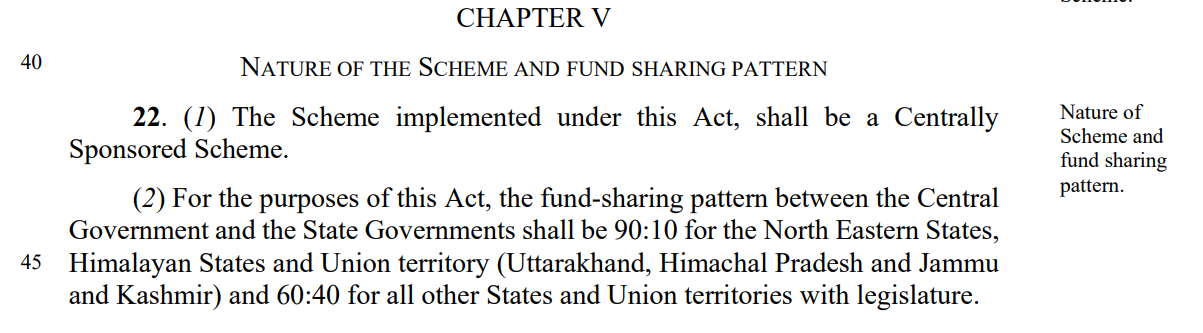
This means that the Centre would pay 60% of the normative allocations for most states, and the state governments would have to pay the rest. In case the states wanted to provide more employment, they would have to bear 100% of the costs themselves. This clause, in effect, pushes the financial burden and the liabilities on the state while the Centre retains the decision-making power.
Demand-driven Design Dismantled
The core principle of the NREGA was its demand-driven design: Greater demand for work was meant to automatically translate into more jobs. However, when state governments, which already operate under tight budgetary constraints, will be forced to shoulder a larger share of the costs, this link will break down. States would be unable to bear the additional financial burden and will thus begin to curb spending, leading to a situation where rising demand no longer results in increased employment. Many states will struggle to meet even the mandated 40 per cent contribution, let alone absorb extra costs, effectively undermining the scheme’s demand-driven character.
It is also possible that lesser funds would be allocated to more developed states, given that they have higher spending power. However, this, Dreze argues, is not a solution. If poorer states are not getting enough in the status quo, the wage rates should be increased. Wages are currently lower than the market rate. If they are increased, then there would be more demand for jobs, and thus the money would flow towards the NREGA scheme. In the status quo, the wages are low, and there are excessive delays in payment, which translates to discouragement among workers. “The act will fail if the workers are not interested,” says Dreze.
Technology Enabled Transparency: More a Hindrance than a Help?
Another factor discouraging workers is the digital burden the new Act places on them. It mandates “technology-enabled transparency and accountability,” requiring biometric authentication, geospatial planning, and mobile-app and dashboard-based monitoring systems. However, the hardships caused by such tech-driven interventions have been widely documented.
The National Mobile Monitoring System (NMMS) app, made mandatory since January 1, 2023, requires two time-stamped and geo-tagged photographs of workers before attendance can be recorded, while the insistence that beneficiaries’ bank accounts comply with Aadhaar-linking requirements has further complicated employment. Together, these measures have effectively squeezed many workers out of the scheme, particularly those with limited access to smartphones and connectivity.

These increased complications further centralise control, effectively turning NREGA workers into test subjects for unproven digital systems. As a result, many workers are pushed into informal arrangements with corrupt contractors who pay cash upfront while siphoning off NREGA funds, ironically fuelling the very chances of corruption the reforms claim to address.
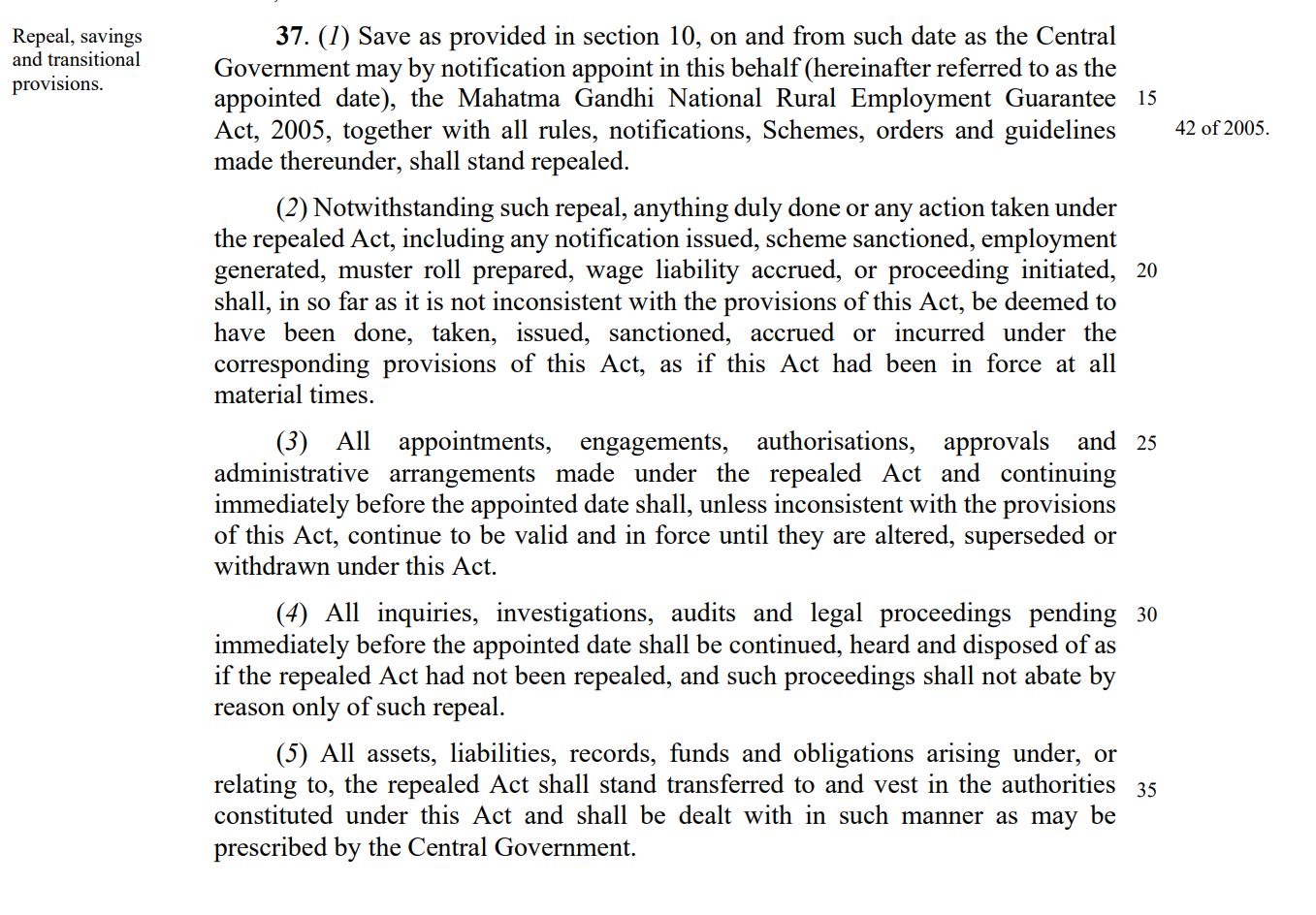
“The new scheme is just another centrally-sponsored scheme with 60:40 cost-sharing, at the discretion of the central government. Section 37 repeals MGNREGA once and for all”, said Dreze, in a statement to Alt News.
Independent journalism that speaks truth to power and is free of corporate and political control is possible only when people start contributing towards the same. Please consider donating towards this endeavour to fight fake news and misinformation.