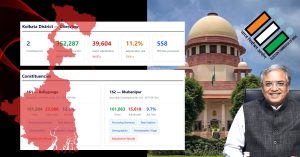
Days after Alt News broke through the Election Commission of India’s barriers to access Special Intensive Revision data — revealing that in Bhabanipur and Ballygunge a Muslim voter was 3.1 times more likely to be marked “Under Adjudication” than a Hindu voter — we extended the same exercise to four more constituencies.
We digitised and analysed rolls from Manikchak and Mothabari in Maldah district, and Samserganj and Baharampur in Murshidabad district.
What we found there was even more startling.
In Manikchak, where Hindus and Muslim voters are almost exactly equal in number, 97.4% of all voters placed Under Adjudication are Muslim.
Mothabari: 69.5% Muslim voters. 97.4% of ‘Under Adjudication’ voters are Muslim.
Samserganj: 82% Muslim voters. 98.8% of ‘Under Adjudication’ voters are Muslim.
Baharampur: 26.9% Muslim voters. 61.6% of ‘Under Adjudication’ voters are Muslims.
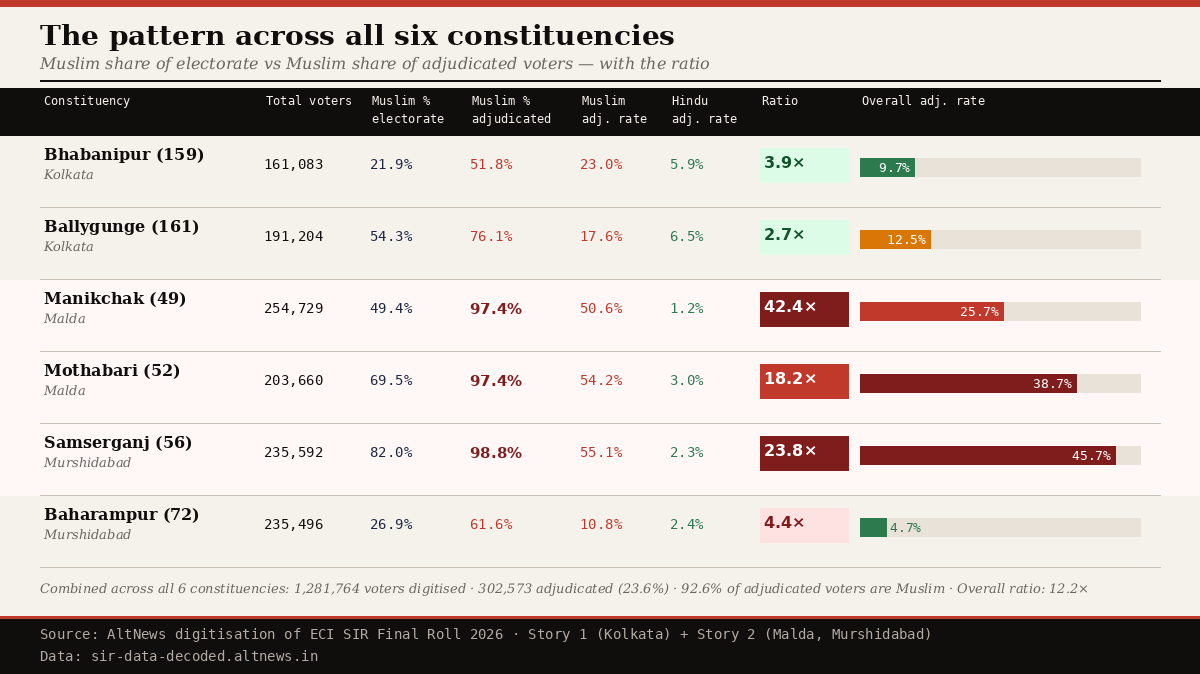
Across all six constituencies combined, Alt News has now digitised 12,81,764 voter records. Of the 3,02,573 voters placed Under Adjudication across these constituencies, 92.6% are Muslim in a combined electorate where Muslims make up 51.7% of voters. The overall Muslim adjudication rate is 42.2%, i.e, out of every 100 Muslim voters, more than 42 have been placed under adjudication. The Hindu adjudication rate is 3.5%. The combined ratio is roughly 12:1.
The ‘Under Adjudication’ or ‘Logical Discrepancy’ category was introduced for the first time in Indian electoral history during the West Bengal SIR 2026. It is described by the Election Commission as a software flag triggered by inconsistencies in voter records — name spellings, father’s name variations, transliteration differences. The algorithm that produces these flags was described as being applied uniformly across communities. The question the data is asking is this: if the criteria were applied uniformly, what produced a near-total concentration of adjudicated voters from one community in constituencies where that community does not have anything close to a near-total majority?
Samserganj (56)
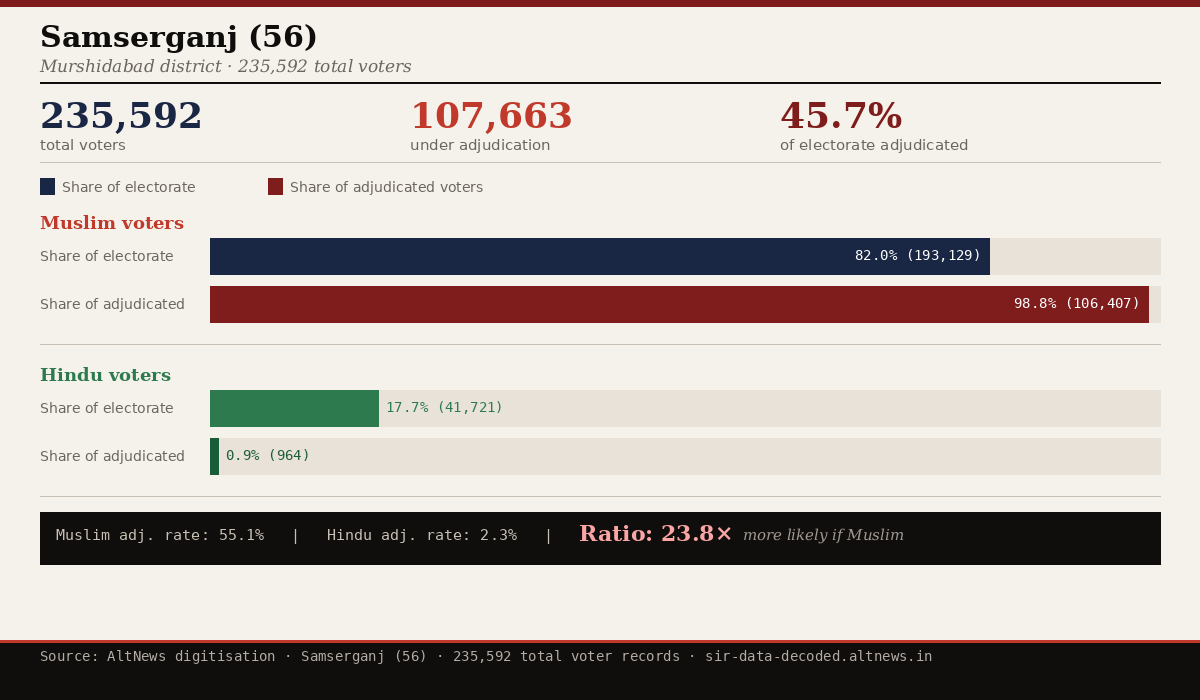
Samserganj has 235,592 voters. Muslims are 82% of its electorate, which is 193,129 people.
Total number of voters placed under adjudication in this constituency is 107,663. Of those, 106,407, or a whopping 98.8% are Muslims.
In other words, 55.1% of all Muslim voters in the constituency were placed under adjudication. For Hindu voters, this figure is 2.3%.
The overall adjudication rate in Samserganj is 45.7% of the entire electorate, which is the highest of all six constituencies Alt News has examined.
Mothabari (52)
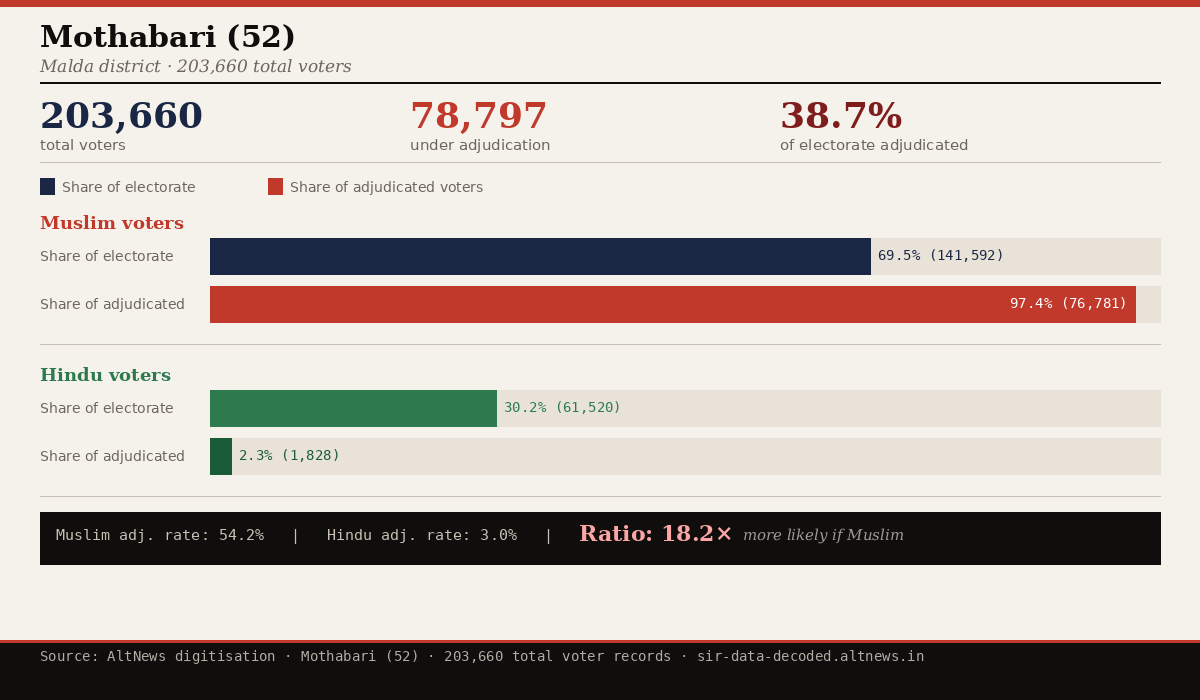
Mothabari has 2,03,660 voters. Muslims are 69.5% of its electorate, which is 141,592 people.
Total number of voters placed under adjudication in this constituency is 78,797. Of those, 76,781, or a whopping 97.4% are Muslims.
In other words, 54.2% of all Muslim voters in the constituency were placed under adjudication. For Hindu voters, this figure is 3%.
The overall adjudication rate in Mothabari is 38.7% of the entire electorate.
Manikchak (49)
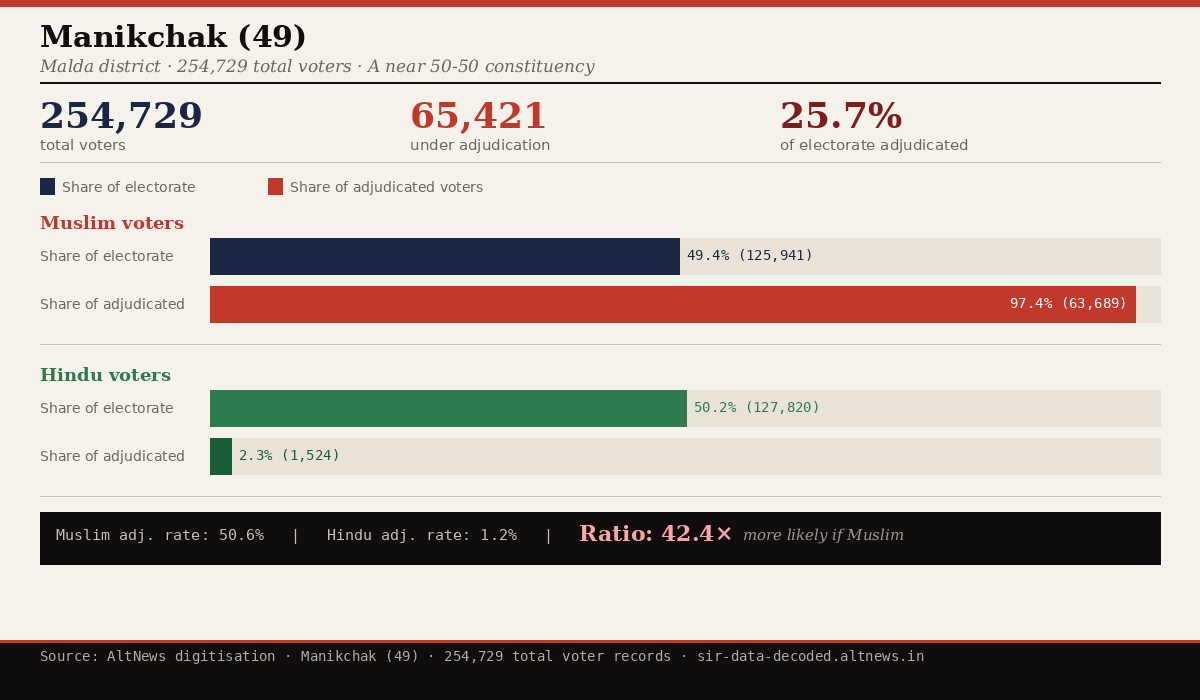
Manikchak is, of all six constituencies examined, the one where the arithmetic is most difficult to explain. It has 2,54,729 voters. Hindus are 50.2% of the electorate — 1,27,820 voters. Muslims are 49.4% — 1,25,941 voters. It is, within the margin of electoral registration, a constituency split exactly down the middle.
Of the 65,421 voters placed Under Adjudication in Manikchak, 63,689 are Muslim and 1,524 are Hindu. In a 50-50 constituency, 97.4% of adjudicated voters are from one community.
The Muslim adjudication rate(Muslims placed under adjudication/Total Muslim voters) in Manikchak is 50.6%. The Hindu adjudication rate is 1.2%. The ratio is 42.4X. A Muslim voter in Manikchak is 42.4 times more likely to be placed Under Adjudication than a Hindu voter in the same constituency.
Baharampur (72)
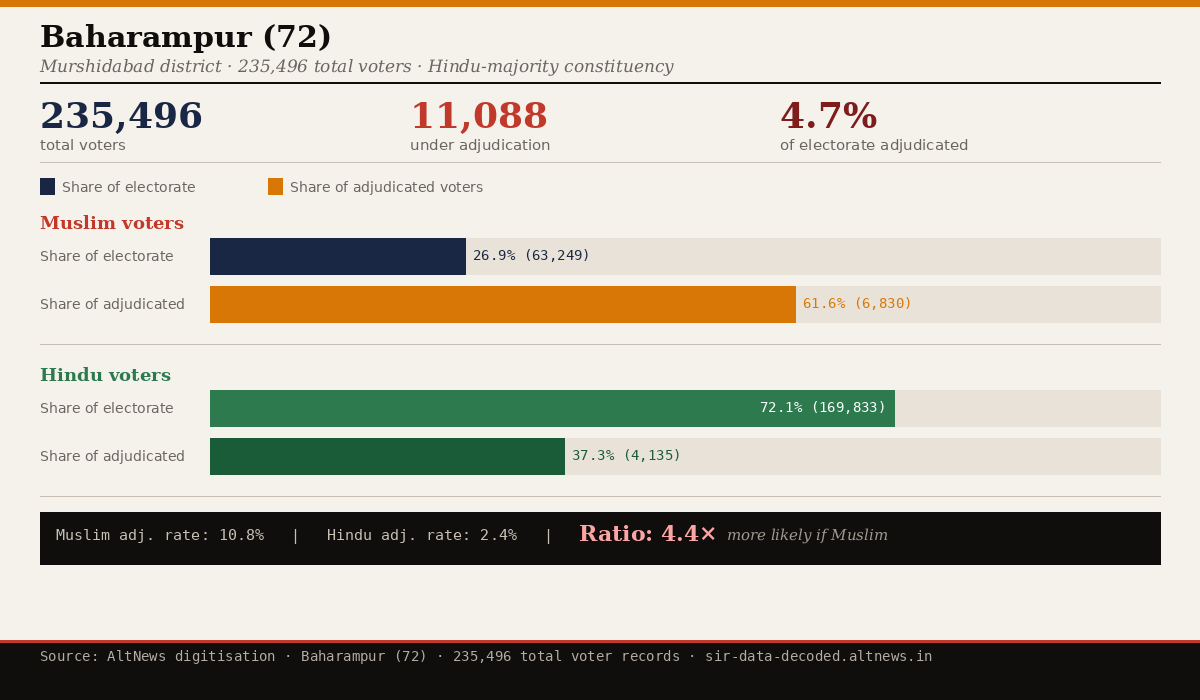
Baharampur tells a different story — and that difference matters for how the rest of the data is read. Baharampur has 2,35,496 voters. Hindus are 72.1% of the electorate. Muslims are 26.9%.
The overall adjudication rate is 4.7%. Of adjudicated voters, 61.6% are Muslim and 37.3% are Hindu. The Muslim adjudication rate is 10.8%(Muslims under adjudication/Total Muslim voters). The Hindu adjudication rate is 2.4%. The ratio is 4.4X.
The disparity in Baharampur still exists and still warrants scrutiny. But its scale is dramatically different from the three other constituencies examined in this story. Baharampur went through the same SIR process, using the same ERONET software, with the same “Logical Discrepancy” criteria, published on the same date — February 28, 2026. The question the comparison raises is a straightforward one: what produced such different outcomes in different constituencies under identical process conditions?
In the 2021 assembly elections, Trinamool Congress won five of the six seats which we have analyzed so far. The only BJP win was Baharampur — also the constituency with the lowest adjudication rate in our data at 4.7%.
In Samserganj, Trinamool won by 26,379 votes over Congress. Under SIR 2026, 1,07,663 voters are under adjudication.
In Mothabari, Trinamool won by 56,573 votes over BJP. Under SIR 2026, 78,797 voters are under adjudication.
In Manikchak, Trinamool won by 33,878 votes over BJP. Under SIR 2026, 65,421 voters are under adjudication.
In Baharampur, BJP won by 26,852 votes over AITC. Under SIR 2026, 11,088 voters are under adjudication.
In Bhabanipur, Trinamool won by 28,719 votes over BJP. Under SIR 2026, 15,618 voters are under adjudication.
In Ballygunge, Trinamool won by 75,359 votes over BJP. Under SIR 2026, 23,986 voters are under adjudication.
From High Court Judges to Rural Booths: The Reach of SIR’s Arbitrary Flags
Across national and regional media and on social media, there are documented cases of people whose voting rights were suspended under the SIR — people whose credentials are beyond question. There are uncountable reports of families where some members made it onto the rolls and others did not, with no explanation provided for the difference. A small number of these cases have been reported by name.
Justice Sahidullah Munshi served as a judge of the Calcutta High Court between 2013 and 2020 and currently chairs the West Bengal Board of Auqaf. His name was marked “not found” in the supplementary list. His wife and sons were placed Under Adjudication. He had submitted all documents including his passport and had deliberately not identified himself as a former high court judge during the verification hearing, wanting to be treated as an ordinary citizen. His name was restored in the March 27 supplementary list only after media coverage, not through the process working as designed.
Wing Commander (Retd) Md Shamim Akhtar served the Indian Air Force for 17 years. His name had been on the electoral rolls since 2002. His name was marked Under Adjudication in the March 23 supplementary list and then deleted entirely on March 28, without any formal hearing, without notice, and without any explanation. His family members’ names remain on the rolls. His Booth Level Officer, when contacted, told him to hire a lawyer and approach a tribunal.
Mohtab Sheikh, the Congress candidate from Farakka in Murshidabad, found his name placed Under Adjudication in the final roll published on February 28, preventing him from filing his nomination papers. He was forced to approach the Supreme Court directly. A tribunal headed by former Chief Justice of the Calcutta high court T S Sivagnanam directed his reinstatement. The tribunal found that while there was a “data inconsistency” in his father’s details, there was no valid ground to exclude him from the voter list.
These are three documented, named cases. Reports in national and regional media describe many more — gazetted officers, professionals, elderly voters who attended every hearing and submitted every document and still found their names missing.
Alt News on March 29 visited Begumpur-Bibipur panchayat area in Basirhat Uttar assembly constituency in the North 24 Parganas district of Bengal, where several villages have seen Muslim voters struck off the list, en masse. In Booth 5 of Boro Gobra village, names of 340 out of 358 villagers placed under adjudication have been deleted. All of them Muslims. Several neighbouring villages have similar stories to tell. We witnessed first hand the trauma and sense of helplessness of the people, many have lived there all their lives. They have voted in successive elections. Some can trace their roots back generations. Yet, overnight, they have been pushed into a space of doubt, where their belonging itself seems to require proof. The story can be read here.
What the Data is Asking
Alt News’s approach in both investigations has been consistent: We publish the data, we report what it shows, and we ask the questions that any honest analyst would ask. We do not claim to know the intent behind what the numbers reveal. The following questions arise directly from the data and remain unanswered by the Election Commission.
1. The “Logical Discrepancy” flag was triggered by an algorithm applied to voter records. If the trigger criteria were applied uniformly across communities, what produced a 97.4% Muslim share of adjudicated voters in Manikchak, a constituency where Hindus and Muslims are equal in number? What specific transliteration or data-matching rule produces this outcome in a 50-50 constituency?
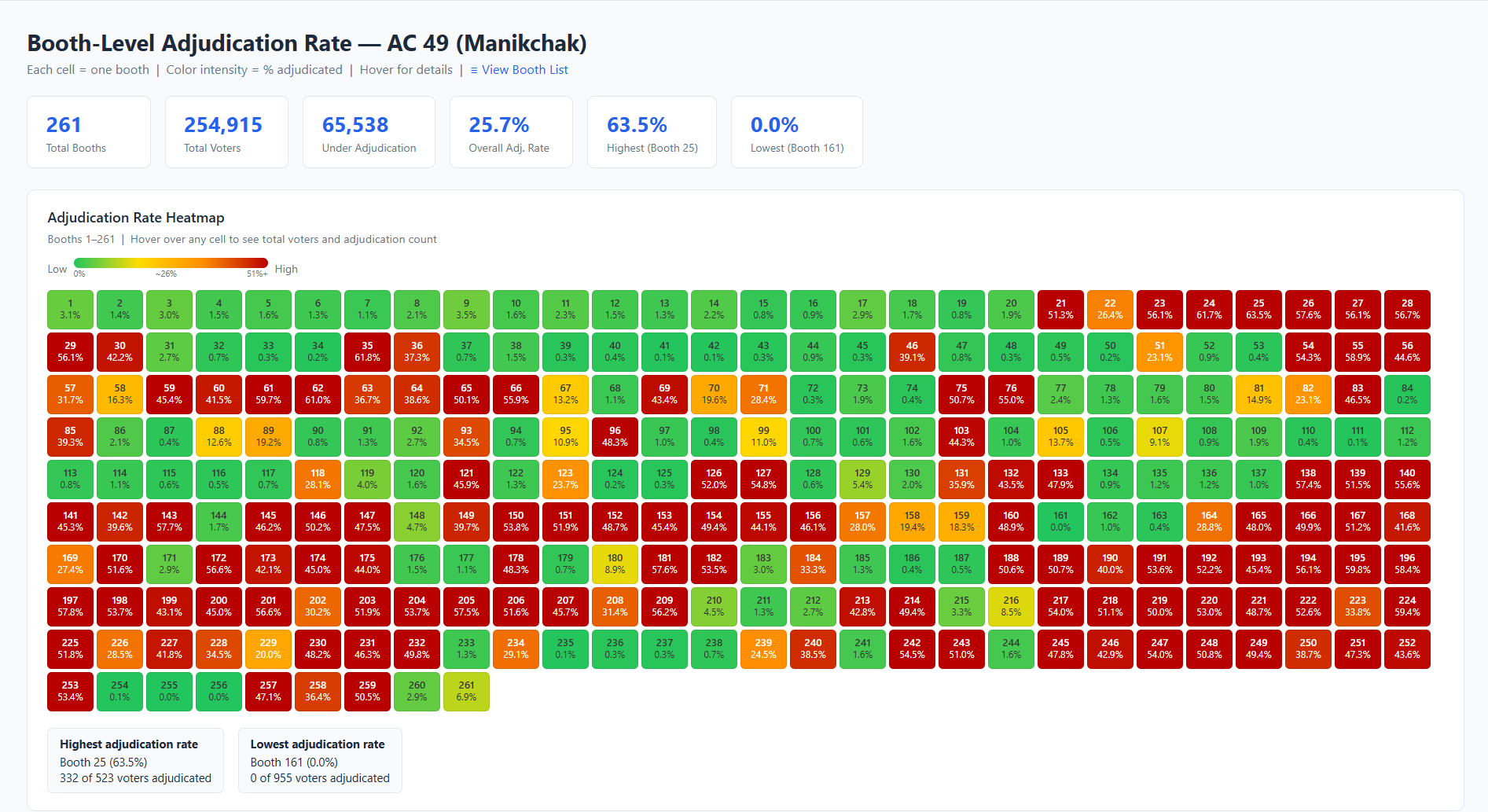
2. The booth-level data from Manikchak shows near-zero adjudication in certain booths, and very high adjudication in some other booths. Is this the expected output of a neutral algorithm? If so, what feature of the underlying data or of the algorithm’s criteria would explain why the “logical discrepancy” rate varies so dramatically by community within the same constituency?
3. In Samserganj, 1,06,407 Muslim voters, which is more than half the Muslim electorate, have been placed Under Adjudication. Elections are days away. What is the precise timeline for resolving their status? Who is the named official responsible for ensuring they can vote? And if they cannot vote in this election, what remedy exists for the denial of a constitutional right?
4. Wing Commander (Retd) Md Shamim Akhtar served the Indian Air Force for 17 years. Justice Sahidullah Munshi served the Calcutta high court for seven years. A Congress candidate could not file his nomination papers. If the process could not correctly handle these voters with their documentation, their means, their access to institutions, what does the process look like for the people who have none of those things?
5. It can reasonably be surmised that a significant number of the 27 lakh voters excluded after the final supplementary list will eventually be reinstated through the appellate tribunals, effectively establishing that their removal was unjustified. Now, can an election held while such appeals are still pending truly be called free and fair?
The Data is Open; Verify it Yourself
Alt News has made all 1,281,764 voter records across six constituencies searchable by name and voter ID.
For Bhabanipur and Ballygunge, visit sir-data-decoded.altnews.in.
For Manikchak, Mothabari, Samserganj and Baharampur, visit openrolls.
Every number in this story traces back to a specific record in the dataset. Every demographic classification carries a confidence score. The methodology, how we digitised 1568 PDF files, which tools we used, what the accuracy limitations are, is all documented.
We call ourselves the world’s largest democracy. Democracy is not a title that can coexist with the suspension of the right to vote of those who are least equipped to fight for it — the elderly woman in Bhabanipur with a stamp across her voter card, the farmer in Mothabari who attended every hearing and still found his name gone, the families in Manikchak where some members are on the rolls and others are not, and no one has been told why.
If the process that produced these numbers cannot be explained by the institution that designed it, in plain language, with specific answers, then the question of who is responsible for the violation of the right to vote of lakhs of Indian citizens is not a political question. It is a constitutional one.
The data is here. The questions are here. We are waiting for answers.
Independent journalism that speaks truth to power and is free of corporate and political control is possible only when people start contributing towards the same. Please consider donating towards this endeavour to fight fake news and misinformation.