Is India grappling with a deepening LPG crisis?
As reports of delays in LPG deliveries surface from parts of the country, questions are being raised about the stability of India’s cooking gas supply. It is clear that a combination of global disruptions and domestic demand patterns has created panic among consumers in recent weeks.
Global Trigger: West Asia Conflict
At the centre of the situation is the ongoing conflict in West Asia involving Iran, Israel and the United States. The escalation has had a direct bearing on energy markets and maritime security in the region, particularly in and around the Strait of Hormuz — a narrow passage that connects the Persian Gulf to global shipping routes.
A significant share of the world’s oil and liquefied petroleum gas (LPG) shipments passes through this corridor. For India, which imports roughly 60% of its LPG, the dependence is particularly pronounced: A large portion of its LPG imports originates in Gulf countries and is transported via this route.
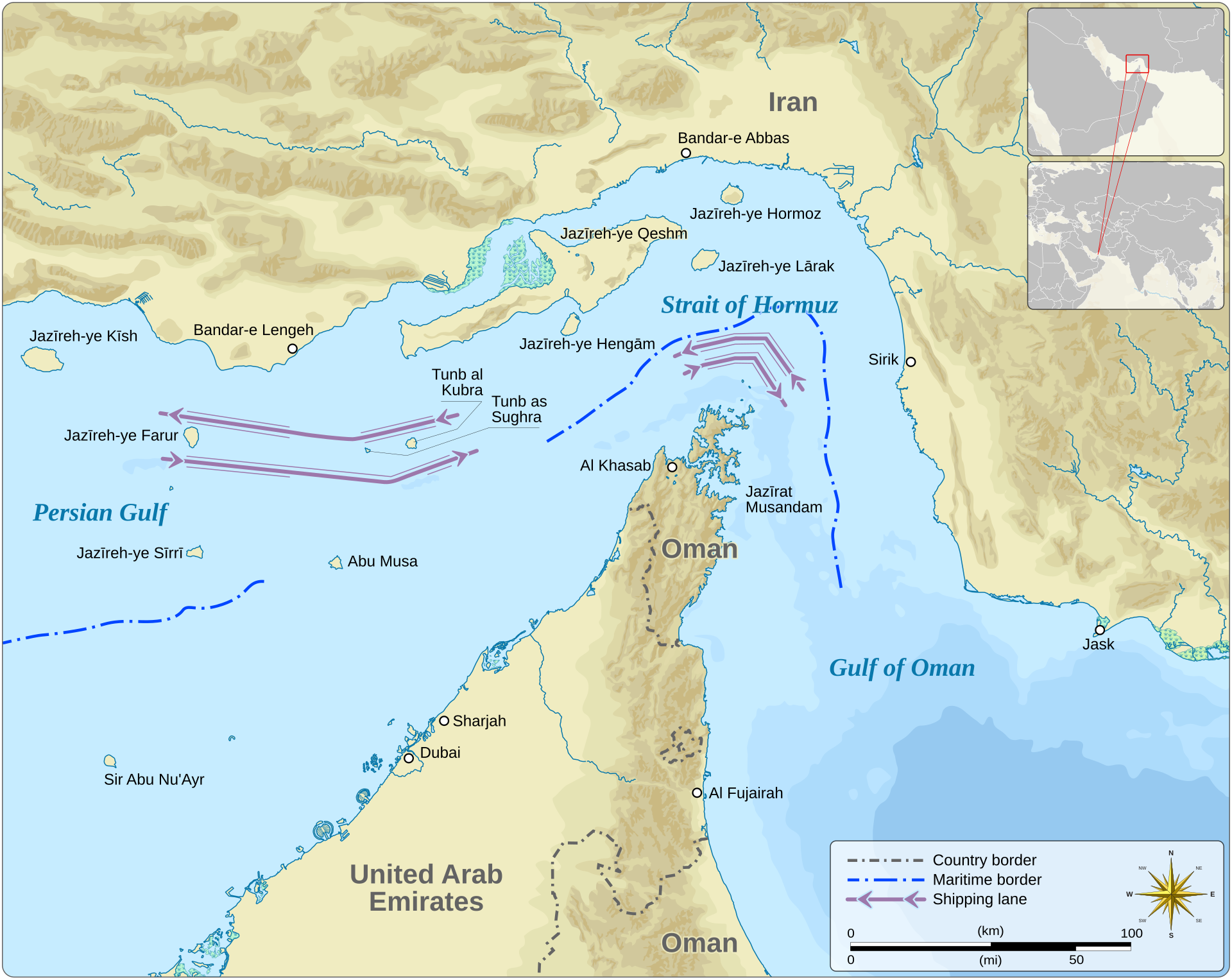
Heightened tensions, security concerns, and reported attacks on vessels in the recent past have slowed or disrupted shipping traffic, leading to delays in cargo movement. Tankers have had to reroute, wait for naval escorts, or navigate under heightened risk, affecting delivery timelines.
Alongside supply-side factors, demand dynamics have also played a role. Reports suggest that booking requests for LPG cylinders surged in some regions owing to panic buying following news of the West Asia crisis. Commercial establishments, which rely heavily on bulk LPG supply, have been among the worst affected, prompting some to shift to alternative fuels such as electricity or piped natural gas (PNG).
According to a Reuters report, the three state fuel retailers — Indian Oil Corp, Hindustan Petroleum Corp and Bharat Petroleum Corp sold about 1.15 million metric tonne LPG in the first half of March, which is 17.3% less than the amount sold in March 2025 and 26.3% less than that from the same period in the previous month.
On March 14, special secretary in the Union shipping ministry Rajesh Kumar Sinha told the media that India had 22 tankers, including six LPG ships, four crude carriers and one liquefied natural gas vessel, stranded in the Strait of Hormuz. Two of these vessels, LPG tankers Shivalik and Nanda Devi, reached Indian ports on March 16 and 17, respectively.
Government Response and Policy Measures
Against this backdrop, the Centre has initiated a series of measures aimed at managing supply and moderating demand. Speaking in Parliament, Union petroleum and natural gas minister Hardeep Singh Puri on March 12 explained the steps taken by the government to address thee situation.
Puri said that India had increased LPG production by nearly 28% in recent weeks by directing refineries to maximise output of propane and butane streams for domestic cooking gas. The ministry has also expanded procurement beyond Gulf countries to include supplies from the US, Norway, Canada, Algeria and Russia, reducing dependence on the Strait of Hormuz route. Besides, households, especially vulnerable groups, along with hospitals and educational institutions, have been placed on uninterrupted priority supply. To regulate demand, minimum booking gaps (25 days in urban areas and 45 in rural) and expanded OTP-based delivery authentication to curb hoarding and diversion have been enforced.
The Centre has also prioritized LPG supply for households, hospitals and educational institutions, while restricting supply to non-essential commercial users. In a significant policy move, the government has barred households with access to piped natural gas (PNG) from holding or refilling LPG cylinders, aiming to prioritize supply for users who have no alternative cooking fuel.
On March 7, the prices of domestic LPG and commercial cylinders were hiked by a steep Rs 60 and Rs 114.5, respectively.
Crisis, No Crisis: Govt Vs Opposition
As reports of supply disruptions and visuals of long queues emerged from various places, the political battle over the situation intensified. While the Centre has maintained that there is no overall shortage of LPG, pointing instead to localised demand spikes and panic booking, the Opposition, has sharpened its attack, alleging a broader failure in managing the fallout of the West Asia conflict.
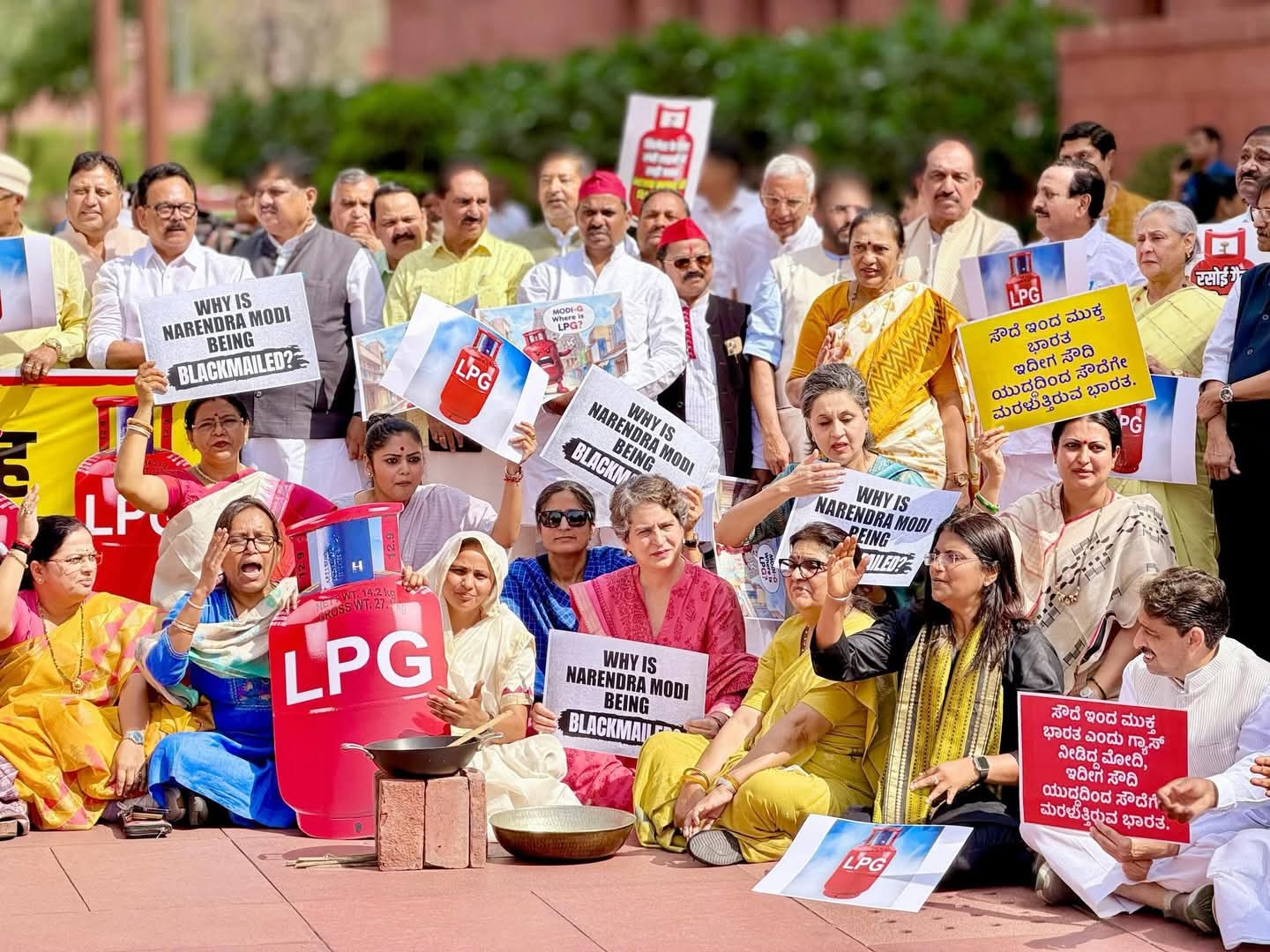
Opposition MPs on March 14 held a protest in the Parliament complex over the LPG issue demanding answers from the petroleum minister and Prime Minister Narendra Modi.
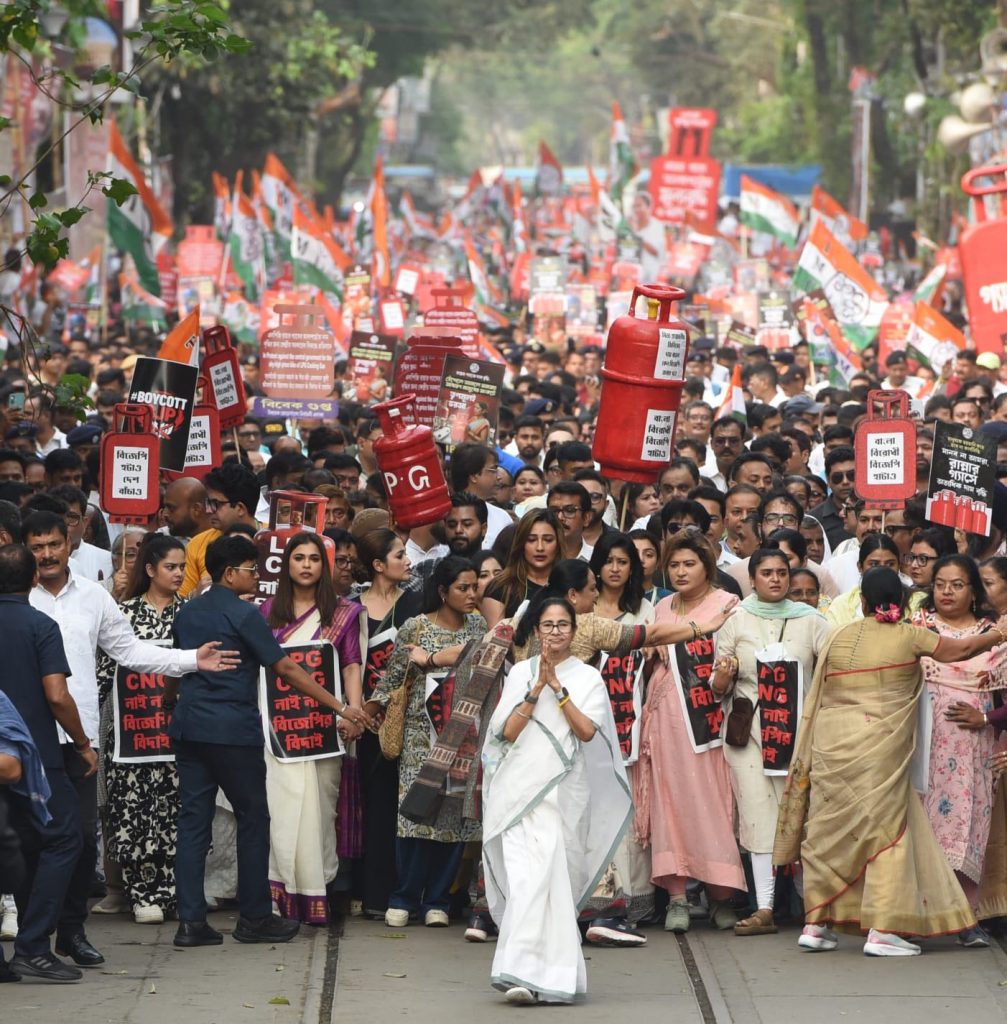
In Kolkata, Bengal chief minister Mamata Banerjee took to the streets, leading a protest march against what she described as an LPG shortage and accusing the Centre of failing to ensure adequate supply. She has also urged suppliers to prioritise local demand and blamed the Union government for the situation, even as her administration set up control rooms and helplines to monitor distribution.
The issue quickly became politically charged ahead of elections, with competing narratives taking shape — the government emphasizing supply stability and mitigation measures, and Opposition parties pointing to on-ground disruptions and rising hardship.
Reality Check: The Situation on the Ground
As the situation evolves, the gap between official assurances and reported experiences on the ground is likely to remain a key point of contention. As part of this ground report, Alt News staffers visited multiple locations and spoke with distributors, suppliers and consumers to better understand how the situation is playing out at the last mile.
Jadavpur, Kolkata
At an HP LPG distributorship, Anukkhan Fuel Services in Santoshpur, on March 14, proprietor Subir Chakraborty, who has been in the business for over four decades, said there was no absolute shortage of domestic LPG cylinders, but acknowledged stricter government regulations and a surge in demand. “Earlier, consumers could book a refill within days. Now, a mandatory 25-day gap has been introduced to prevent stockpiling,” he explained. Chakraborty added that changes in booking systems and technical glitches have created some confusion. Many consumers are either using outdated numbers, unregistered phones, or are unable to complete bookings due to overloaded lines. “A booking is confirmed only after an SMS, but due to high demand, these messages often fail, creating uncertainty,” he said.
Delivery timelines, he noted, have also stretched. “Earlier it took two to three days; now it can take five to seven days or more.” He attributed the spike in demand to anxiety triggered by the West Asia conflict, leading to panic booking by households that still have sufficient supply. Commercial LPG, he added, is currently unavailable at his agency. “In my 40 years, I have never seen demand spike like this,” he said, while also pointing to lack of public awareness as a key factor driving the rush.
Consumers echoed concerns over delays and confusion. Several people queued up outside the distributorship seeking clarity on bookings. One resident, Sudipto Sengupta, said he had received confirmation but was still waiting five days for delivery. Another, Avik Maitra, who had prepaid for a refill, said he was “concerned, not panicked,” but criticised the lack of clear communication from authorities. In one case, a woman who had been waiting over two weeks alleged delivery lapses, though the distributor later ensured same-day delivery after intervention.
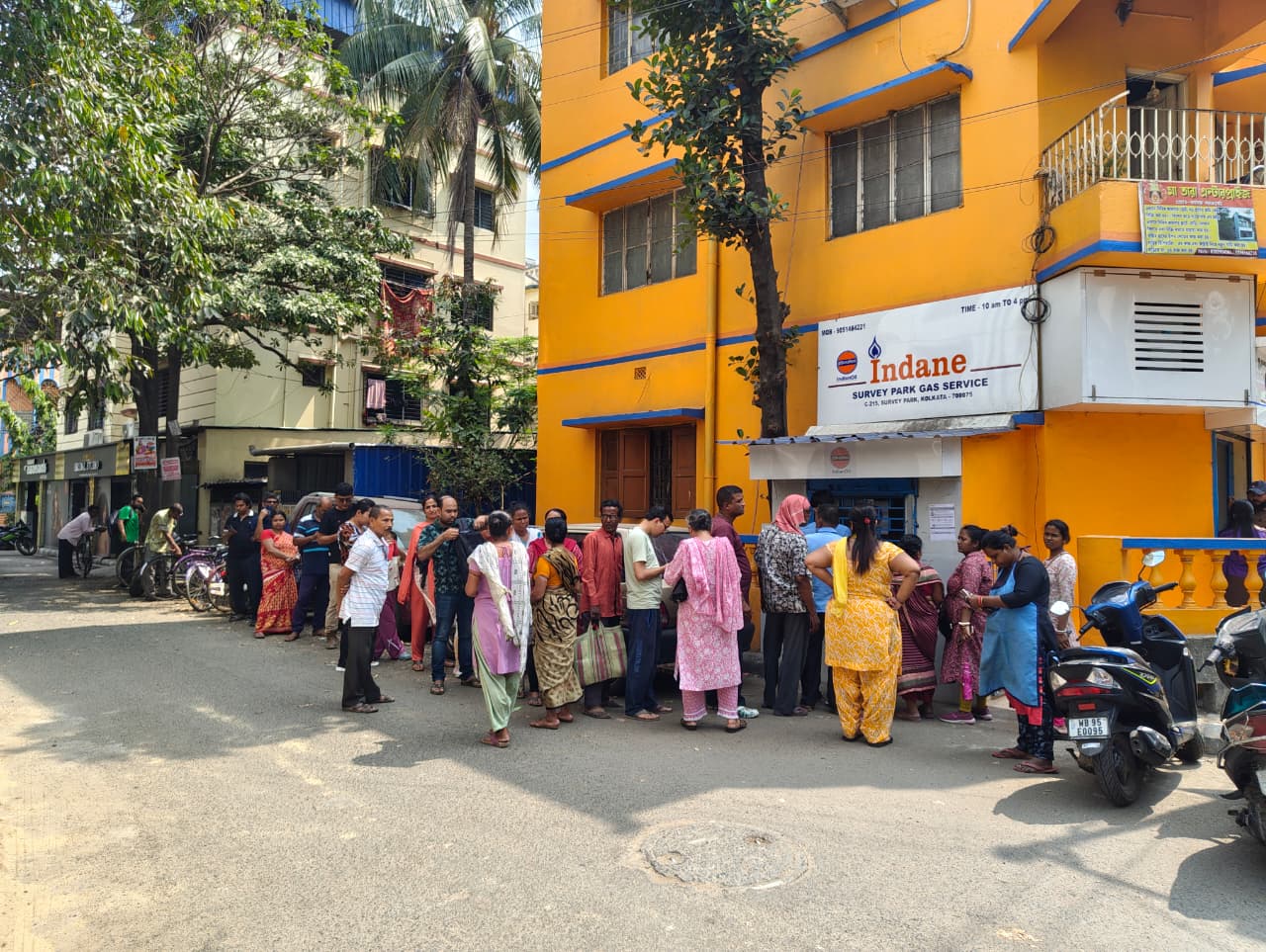
At an Indane distributor in Survey Park (photo above), long queues and booking-related issues persisted. Many consumers reported failed calls or missing confirmation messages. Agency staff maintained that there was no shortage of domestic LPG, attributing the situation to a surge in demand and backend technical issues. “The system was overwhelmed — both call lines and online portals crashed under heavy traffic,” an employee said, adding that bookings often go through without confirmation messages, leading to confusion. On March 13 alone, the centre received nearly 1,000 bookings, highlighting the scale of the spike.
Uttarpara, Hooghly, West Bengal
Manisha, a resident of Uttarpara, booked an Indane LPG cylinder over phone on March 7 and received a confirmation. While deliveries are typically made the next day, this time there was a delay. “After waiting a few days, I tried calling the office again but could not get through despite multiple attempts. I eventually visited the distributor’s office, where I was informed that my KYC needed to be completed before delivery.”
Since the staff were familiar with her, they assured her that the cylinder would be delivered and the KYC formalities could be completed simultaneously. “The cylinder was delivered on March 15. No additional delivery charges were taken, though the delivery person collected ₹200 towards KYC,” she added.
Camorlim/Ponda/Colva, Goa
At an agency in Camorlim in Goa, the Manager said everything was running smoothly now. “There is no rush now. In fact, there was never any rush regarding domestic supplies. For commercial supplies, we are providing to hospitals, canteens, schools, and temples — we are just not supplying to restaurants at the moment,” he said.
A video from a Bharatgas office in Ponda in South Goa shared on YouTube on March 11, however, showed panic and confusion among consumers. The clip shows the office choc-a-bloc with people.
Alt News also spoke to a delivery person Pequeno vanelim in Colva, who downplayed concerns around shortages. “There’s nothing unusual happening here. People are making a fuss over nothing. Operations are running normally,” one delivery worker said. He added that domestic LPG supply was steady, with adequate stock available for households.
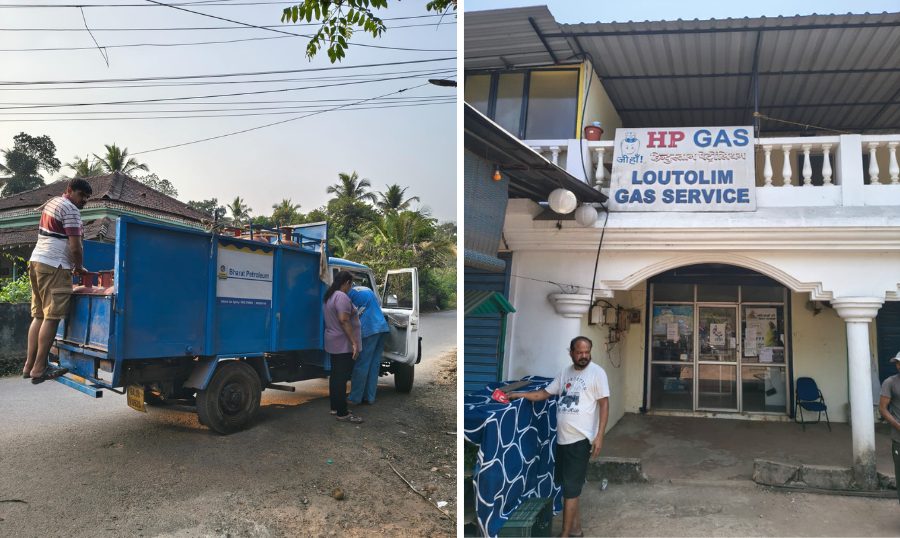
However, he confirmed that supplies to commercial establishments such as hotels have been halted for now, citing a lack of availability. “There’s no unusual crowd at the agency either — it’s the same as before,” he said, attributing the situation largely to public anxiety rather than any disruption in routine operations.
Garia, Kolkata
While an Indane (Indian Oil) distribution office near Padmasree cinema hall in Garia (photo below) on March 14 saw an unusually large number of consumers waiting in a queue and an almost equal number of people inside, an electrical appliance store opposite it presented a revealing scenario.
“In normal circumstances, we sell 2 to 3 induction ovens per week. I had a stock of 250 pieces. All got sold in the last five days. This is panic buying. There is widespread anxiety that LPG cylinders may run out. Now I am calling whole-sellers all over eastern India. Everyone has run out of stock,” the owner of Banik Enterprise said. Pointing at the Indane office, he added, “You would never see anyone waiting outside in normal times.”
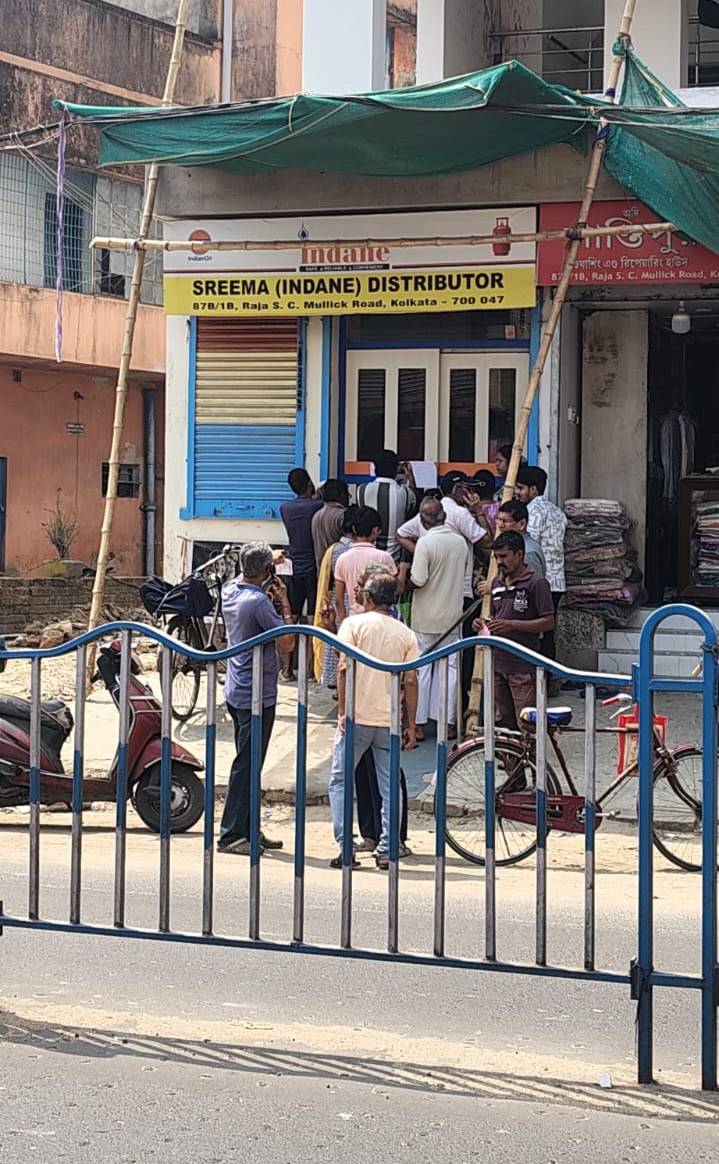
A consumer standing in the queue outside the agency said the over-the-phone booking mechanism was not working. Hence she had come to the office. “Let’s see if they take my booking. I have two cylinders. One of them ran out of gas yesterday.”
Bopal/ Chandkheda, Ahmedabad
Officials at a Bharat Gas agency in Chandkheda said they were receiving regular LPG supplies and there was no shortage at the distributor’s end. However, a surge in bookings driven by consumer anxiety has led to increased pressure on distribution. “Earlier, customers would typically receive cylinders the next day. Now, deliveries are taking around two to three days due to higher demand,” an official said.
Officials at an Indane agency echoed similar observations, stating that supply remained normal and uninterrupted. They attributed delays to a sudden spike in bookings rather than any disruption in stock. “We continue to receive regular supplies, but the increased demand has slowed deliveries slightly. Cylinders are now being delivered within two to three days instead of the usual next-day service,” an official said.
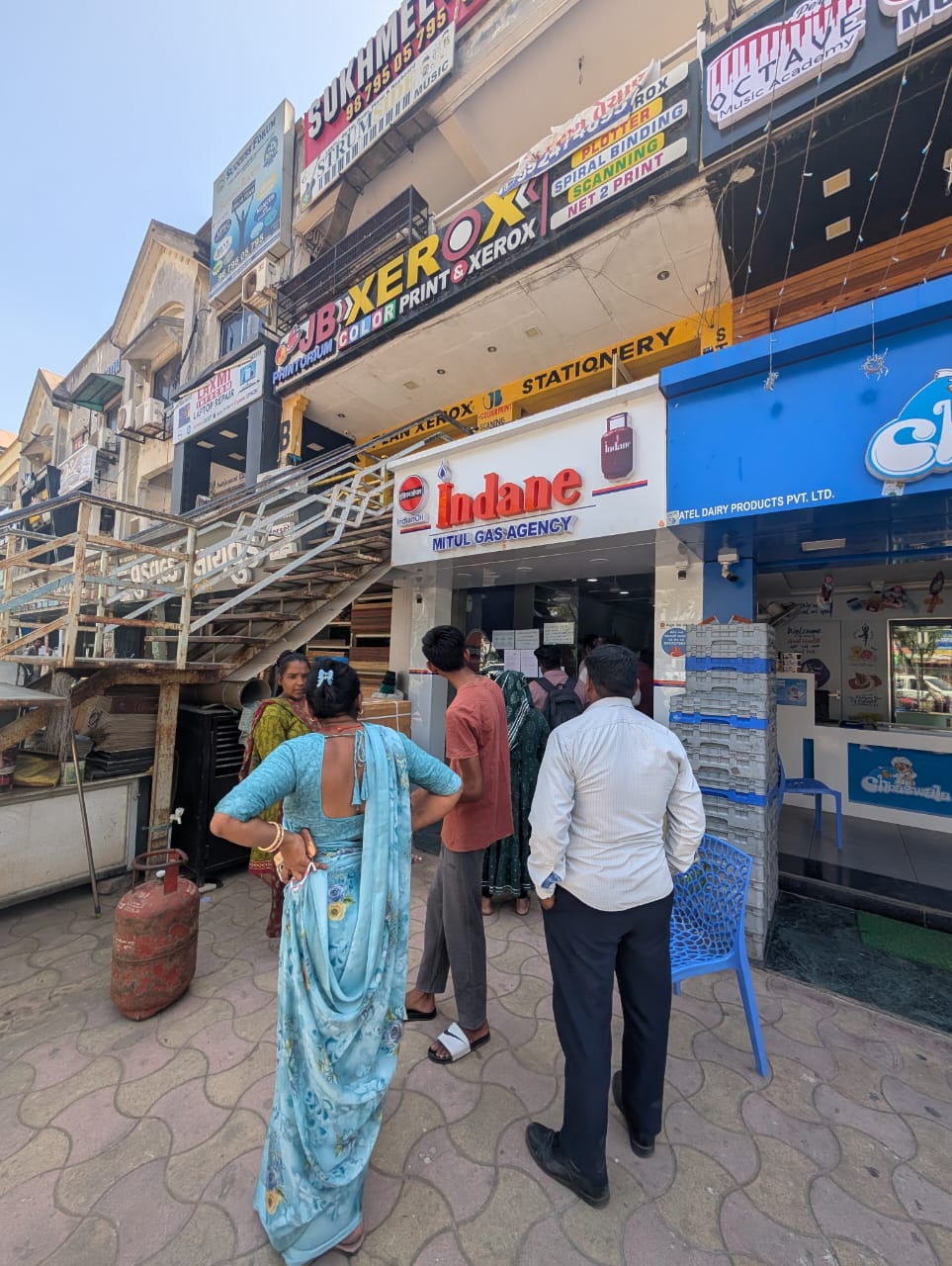
Alt News also spoke to several people waiting outside an Indane gas agency in Chandkheda, Ahmedabad, many of whom pointed to booking-related issues. Consumers said LPG cylinders are typically booked via missed call or online platforms, but ongoing server problems have disrupted the process. “We’ve been trying to book for the past two days, but the system isn’t working,” one person said, adding that many had to visit the agency in person to complete bookings.
A woman in the queue said she had come to complete her KYC, but was asked to return later due to the rush and ongoing deliveries. Another customer, who had received his last cylinder 15 days ago, said he was unable to place a new booking due to the mandatory 25-day gap policy. “I’ve been told to wait for another week,” he said.
Some consumers also flagged delivery complications. One woman said she was unable to receive her cylinder due to a recent change in address, which had not yet been updated in the system, delaying the delivery process.
Uttam Samanta from Behala, Kolkata, said that before the war, Bharat Gas cylinders were delivered within two days. Now, the waiting period had stretched to at least six days. He booked a cylinder on Saturday, March 14, and the local delivery agent told him it would not arrive before March 20.
Srikanta Das, also from Behala, said he booked both a Bharat Gas and an Indane cylinder on March 8. While he received the Bharat Gas cylinder by March 12, the Indane distributor reportedly told him delivery would not be possible before March 20.
Samaresh Kotal, who runs a fast-food takeaway on Roy Bahadur Road in Behala, said he had commercial cylinders that would run for only two more days. “Earlier, we never had any issue sourcing commercial cylinders from our local Bharat Gas distributor. Now he says there is no supply. I don’t know what will happen after these two days,” he said.
Rural South 24 Parganas, West Bengal
In Bakhrahat, South 24 Parganas, Purnima Maity said she faced new hurdles while booking an Indane cylinder. Unlike earlier, she could not book it via a missed call or WhatsApp. Only after her daughter installed the Indane app was she able to place the order. “Earlier, I would get an SMS confirming both the booking and delivery date. This time, I only got a confirmation. I have to call the delivery person to find out when it will arrive,” she said.
In other words, Alt News’s ground observations suggest the situation is shaped more by panic, demand pressure, and operational bottlenecks than any clear supply-side crisis of LPG for domestic users.
_________________________________________________________________________________________
UPDATE: The inputs from Dum Dum, Behala and South 24 Parganas were added to the story on March 23.
Independent journalism that speaks truth to power and is free of corporate and political control is possible only when people start contributing towards the same. Please consider donating towards this endeavour to fight fake news and misinformation.