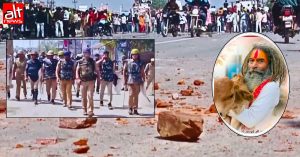
A day after violence erupted in the Malkangiri district of Odisha between local tribal communities and Bengali settlers, Right-wing social media influencers alleged that an unidentified tribal mob had set fire to several houses belonging to ‘illegal immigrants from Bangladesh’ or ‘illegal Bangladeshi settlers’ in the area.
On December 7, hundreds of tribal men and women from Rakhelguda village, carrying traditional weapons like axes, bows and arrows, ran riot over neighbouring Malkangiri Village- 26 (MV-26), which is home to 188 Bengali families, after the beheaded body of a 51-year-old tribal woman had been found.
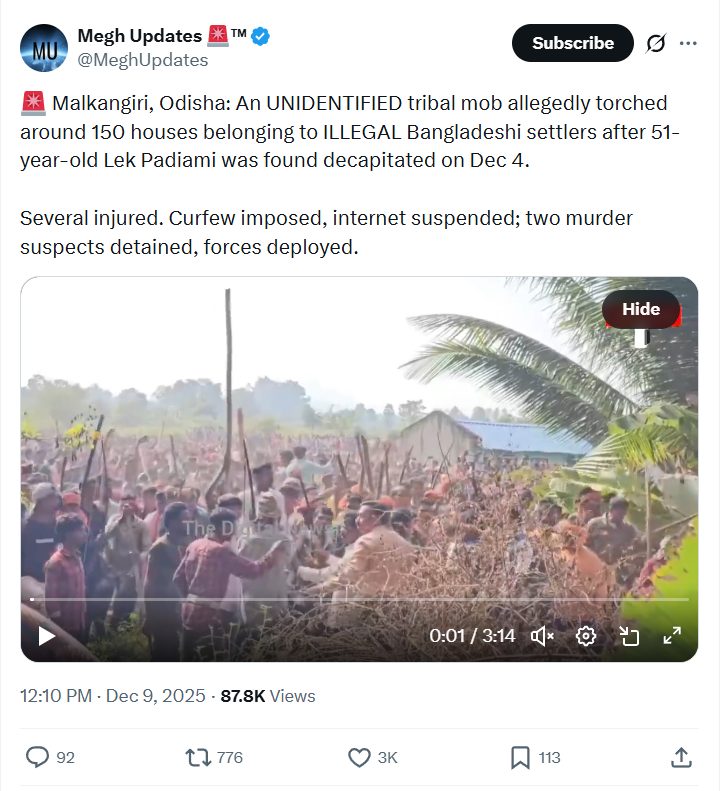
Posting on X about the incident two days later, Right-wing propaganda handle MeghUpdates (@MeghUpdates) shared a video report by The Digital News, a local news outlet, claiming that the houses that had been torched by the angry tribal mob belonged to “Illegal” Bangladeshi immigrants. (Archive)
Another X account, Treeni (@TheTreeni), also shared similar claims, alleging that the ‘illegal’ Bangladeshi immigrant settlements had been set ablaze by the tribal mob. (Archive)
BIG BREAKING: Unidentified tribal mob torches 150 houses of illegal Bangladeshi settlers in Malkangiri, Odisha!
Hundreds attacked the illegal settlement after 51-year-old Lek Padiami’s decapitated body was found on December 4.
Several injuries reported.
Curfew imposed,… pic.twitter.com/yVL56ZGmam
— Treeni (@TheTreeni) December 9, 2025
Similarly, X user Ocean Jain (@ocjain4) made the claim that an “unknown” tribal mob had set fire to 150 houses of “illegal” Bangladeshi settlers. (Archive)
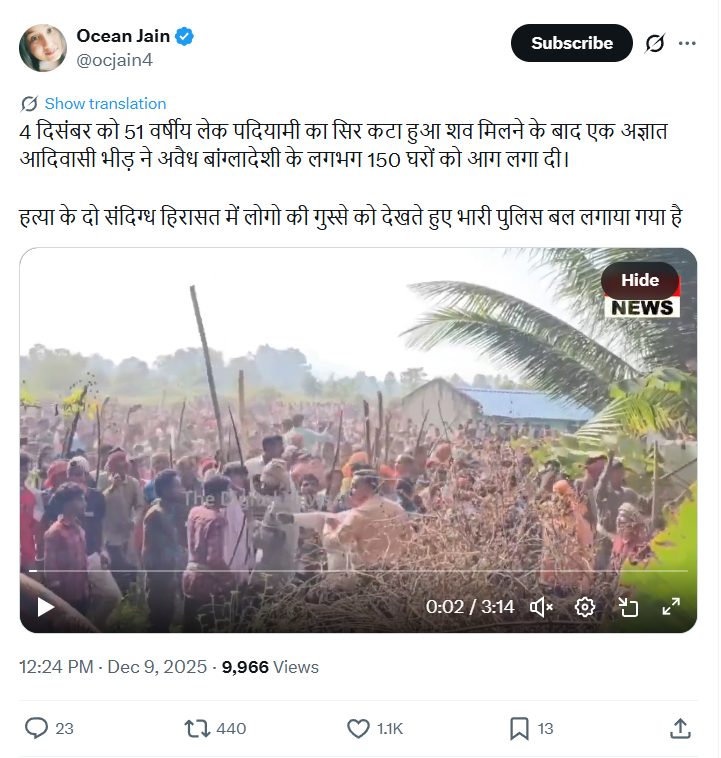
Readers should note that the aforementioned accounts, MeghUpdates and Ocean Jain disseminate misinformation and communal propaganda on a regular basis. Alt News has debunked numerous claims made by these accounts in the past.
Several other social media users have also shared similar claims. A few of them can be seen in the gallery below.
Fact Check
A simple keyword search led us to news reports detailing the recent violence in Odisha’s Malkangiri district.
Several of these reports mentioned that the settlement that was vandalised and set ablaze belonged to Bengali-speaking Hindu families whose ancestors had migrated from Bangladesh decades ago and subsequently obtained Indian citizenship.
The flashpoint came on December 4, when the decapitated body of 51-year-old Lek Padiami, belonging to the Koya tribe, was found on the banks of the Dudametta River in Rekhelguda village, after she had been reported missing a day earlier. This assassination triggered the tribal community to wreak havoc on the Bengali residents of Malkangiri Village-26. The members of the Koya tribe alleged that Padiami had been murdered and beheaded by an individual from the settlement.
On Sunday, police arrested Subhranjan Mondal, a 45-year-old resident of MV-26, who belongs to the Bengali community, in connection with the case, SP Vinod Patil told The New Indian Express. Korukonda IIC Himanshu Shekhar Barik added that a land dispute is suspected to have contributed to the crime.
The History behind the Dandakaranya Project
In fact, the settlement of Bengali Hindus in Malkangiri and adjoining areas in the 1950s under the Dandakaranya Project is a well documented fact.
Post Partition, all Bengali refugees from East Pakistan wanted to settle in West Bengal. However, it was an impossible proposition. There was a dire need to find space for these refugees in other states. Eventually, under the Union government’s Dandakaranya Rehabilitation Scheme, the Dandakaranya Development Authority was formally established on September 15, 1958 to relocate a section of the Bangladeshi refugees.
Bangladeshi historian K Maudood Elahi writes about them in his article titled ‘Refugees in Dandakaranya‘, published in The International Migration Review, Spring-Summer 1981 issue. He says, “Since the Partition of India in 1947 there has been a gross outward movement of about 2.5 million people (and in-movement of between 0.7 to 0.85 million) from East Bengal into India. Of these, about 1.5 million people categorized as refugees, predominantly Hindus and some tribal Santhal, had moved into the Indian state of West Bengal.”
“During the early 1960s, the GOI selected the Dandakaranya (mainly in Madhya Pradesh and Orissa) to rehabilitate the refugees from East Bengal through the efforts of the Dandakaranya Development Authority (DDA). By 1963, 6,000 Bengali refugees were settled in Dandakaranya. In 1971, they numbered slightly more than 16,000…” he adds.
The Dandakaranya project was the brainchild of S V Ramamurthy, the advisor to the planning commission of India between October 1952 and November 1960. “In November 1956, Ramamurthy presented a report where he highlighted the low population density of the region and stated that Dandakaranya with its enormous area of about 80,000 sq. miles could offer large-scale settlements within itself. This attracted the attention of the government and the Dandakaranya region started getting considered for refugee rehabilitation. Thereafter, in June 1957, at the National Development Council meeting, Dandakaranya was officially chosen as the rehabilitation and resettlement site for the Bengali refugees of East Pakistan,” writes Mohana Chatterjee in the essay, Turning Refugees into Forced Labourers — A Case Study of the Dandakaranya Project, published in Journal of People’s History and Culture, Vol. 9 No. 1 June, 2023.
“Located in central-east India, Dandakaranya comprised parts of the states Madhya Pradesh (present-day Chhattisgarh), Orissa and Andhra Pradesh. However, the state of Andhra Pradesh had to be excluded from the project, due to its opposition to the resettlement of East Pakistani refugees within its area. The project comprised four zones known as Malkangiri, Umerkote, Paralkote and Kondagaon, with its headquarters situated at Koraput in Orissa. While Malkangiri and Umerkote were located in the undivided Koraput district of Orissa; Paralkote and Kondagaon were situated in the undivided Bastar district of Madhya Pradesh,” she adds.
The government resolution to rehabilitate the immigrants in Odisha and the then Madhya Pradesh was discussed in the Rajya Sabha on September 8, 1964. Communist Party leader and member of the upper house from West Bengal Bhupesh Gupta said, “The Dandakaranya Development Authority was set up in September 1958 by a Resolution of Government for the effective and expeditious execution of the scheme to resettle displaced persons from East Pakistan in Dandakaranya, and for the integrated development of this area, with particular regard to the promotion of the interests of the local tribal people. It is composed of (a) a whole time Chairman, (b) a Chief Administrator, (c) Chief Secretaries of the States of Orissa, West Bengal and Madhya Pradesh or their nominees and (d) representatives of the Union Ministries of Home Affairs, Rehabilitation and Finance.”
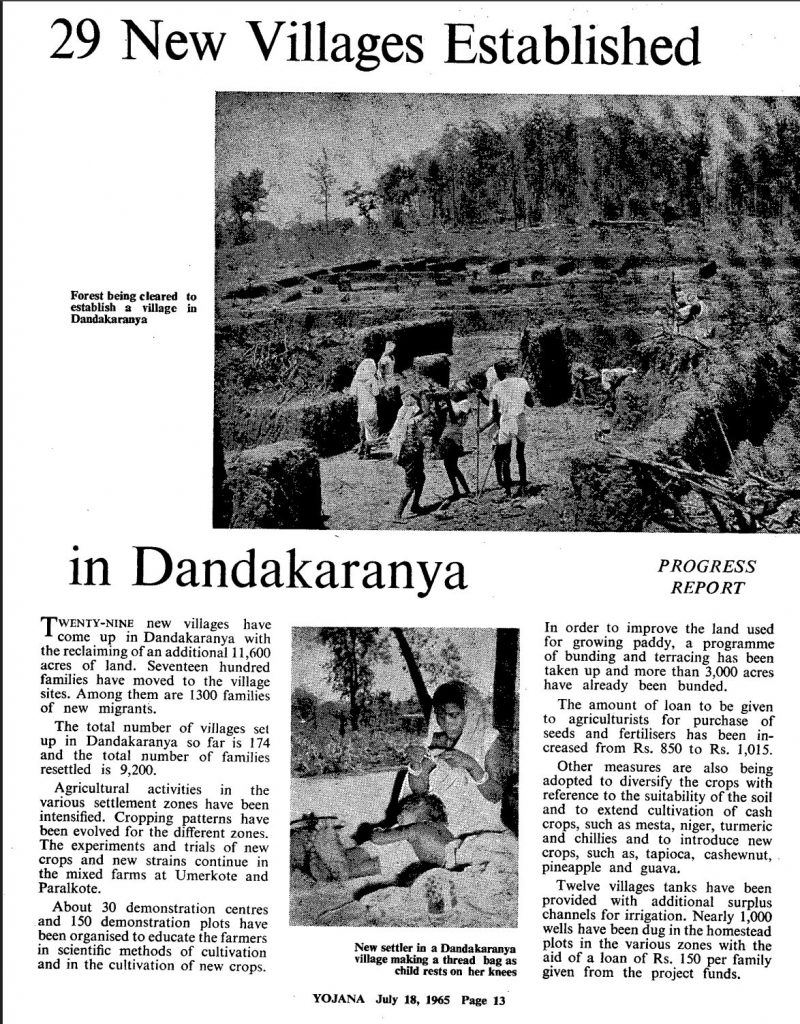
See an excerpt from the Yojana magazine (published by the Union ministry of information and broadcasting) issue dated July 18, 1965 below:
Tension between local tribals and the Bengali settlers is also an age-old problem in the area. The Hindustan Times writes, “The violence has once again brought into sharp focus the decades-old tensions between tribal communities and Bengali settlers in Malkangiri, rooted in what many view as a fundamentally flawed rehabilitation project… Tribals alleged that the Dandakaranya project, ostensibly designed as a humanitarian rehabilitation initiative, followed discriminatory practices against the numerically strong tribal communities who were the original inhabitants of the region… The project effectively treated native Adivasis as a secondary social group competing for facilities in their own homeland, sowing seeds of resentment that have periodically erupted into violence.”
MV-26, one of the settlement villages, was home to 188 families, and was predominantly inhabited by Bengali-speaking Hindus. According to The Times of India, the entire village was abandoned after an enraged mob from the Koya community vandalised and torched over 160 houses on Sunday.
A 2019 TOI report noted that the Hindu Bengali communities there had emerged as “the BJP’s most vocal vote bank in the state,” spread across 214 villages in Malkangiri and 60 in Nabrangpur.
Gouranga Karmakar, the president of Malkangiri Bengali Samaj, told TOI in 2019, “We want a change in the government in the state. Whatever benefits we have received have been from the Centre.” The Naveen Patnaik-led BJD government was in power in the state at that time.
Karmakar again spoke to TOI after the recent violence, calling the incident a tragedy, while condemning the brutal murder of the tribal woman and seeking the strictest punishment for the perpetrator. “But destroying an entire village is not justice; it is a tragedy. Everything turned to ashes in a few hours.” He said, “This is the worst situation to be in”. “Some of our elders lived through trying times in Bangladesh before migrating. Many are saying this feels worse, as this is the land we thought would be our home.”
Alt News spoke to a senior official at the Malkangiri collector’s office. He told us, “The villagers who were attacked are not illegal immigrants. They or their ancestors had come as refugees decades ago and settled here as per Indian government’s rehabilitation programme. They are all Indian citizens now.”
To sum up, the violence in Malkangiri was carried out by members of the Koya tribal community, who targeted the homes of Bengali-speaking Hindu settlers whose ancestors had migrated from Bangladesh decades ago and who are Indian citizens. They are not illegal immigrants or illegal Bangladeshis. The claims made by the Right-wing social media accounts that “illegal” Bangladeshi immigrants were targeted are both false and baseless.
Independent journalism that speaks truth to power and is free of corporate and political control is possible only when people start contributing towards the same. Please consider donating towards this endeavour to fight fake news and misinformation.