
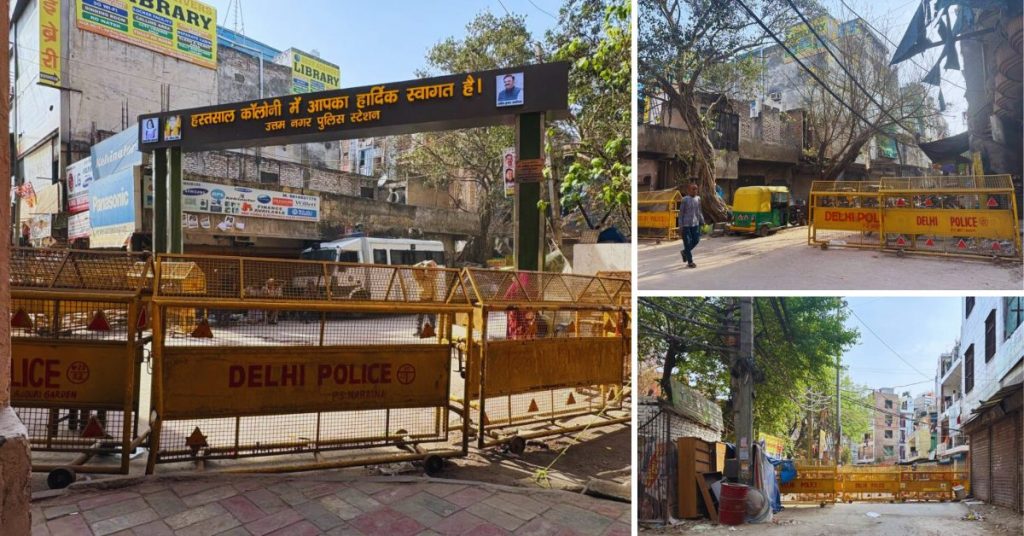
In the narrow lanes of Uttam Nagar’s JJ Colony, the signs are hard to miss. Police barricades cut through familiar routes. Riot-control vehicles stand stationed near the main market. At almost every turn, there is a uniformed presence— watchful, alert, and unusually dense for a neighbourhood otherwise accustomed to routine bustle.
Days ahead of Eid, Uttam Nagar is not erupting, but it isn’t at ease either. It is suspended in a tense quiet, where normalcy appears intact on the surface, yet something unsettling, a sense of foreboding perhaps, lingers underneath. Shops are open. Business is ongoing. But conversations are guarded, often trailing off into silence.
When Alt News visited the area on March 17, the immediate impression was not of chaos, but of anticipation. The killing of 26-year-old Tarun Kumar on Holi is not a fading memory here; it is the defining talking point, shaping every conversation and shadowing every street. What exactly triggered the violence remains contested— caught between claims of a communal flashpoint and police statements on past disputes between the two families from two communities. However, the narrative has taken on a different, more dangerous colour.
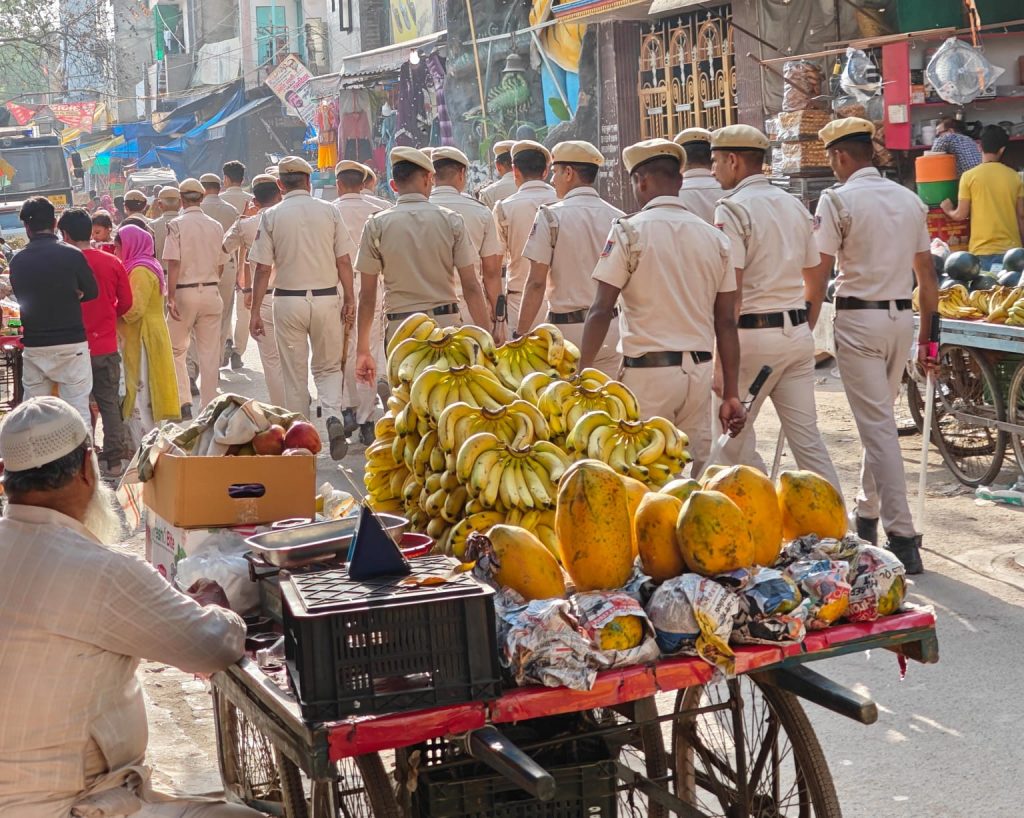
Inside a small salon, an elderly Muslim man watched as his grandson got a haircut. Asked about the situation, he chose his words carefully. He said things were “fine,” and credited the heavy police deployment for maintaining calm. According to him, Hindus and Muslims in the locality have no inherent enmity; they have lived together peacefully.
But this outward calm tells only part of the story.
A migrant worker, speaking more candidly, described a very different reality. According to him, those who had the option had already left for their villages ahead of Eid. “The fear is such that people who could leave, have left,” he said. For those who remain, there is no escape. “Many have sold their ancestral homes and invested everything into these cramped lanes. Leaving is no longer an option for them.”
What began as online rhetoric, he said, has now seeped into everyday life. “The talk of ‘playing Holi with blood on Eid’ is no longer just a rumour — it has entered every home.”
Smartphones have carried these messages into every corner of the neighbourhood. The result is not open panic, but a quieter, more insidious form of fear, one that people hesitate to voice, but feel nonetheless.
Elsewhere in the locality, shopkeepers echoed similar anxieties. One trader near Uttam Nagar East metro station pointed to a recent gathering held under the banner of a “Hindu Virat Aakrosh Sabha,” where, he claimed, abuses were hurled at Muslims. Since the incident, he said, crowds have periodically gathered near the police station in the name of protests.
“They say it’s for justice,” he remarked, “but it feels like politics. People like us — who earn daily to eat daily — are the ones suffering.”
The streets, in many ways, reflect this contradiction: movement without ease, order without calm.
Police patrols continue through the lanes. Barricades remain firmly in place. Uttam Nagar waits — hoping that Eid will pass without incident, and that the current show of force remains precautionary, not prophetic.
Calls for Violence and Manufactured Hostility
Even as the ground reality remains tense but controlled, incendiary posts have flooded social media.
In the days leading up to Eid, numerous videos and posts have surfaced online, openly targeting Muslims and calling for disruption of the festival. Several individuals, claiming to represent Hindu interests, can be seen issuing explicit threats — ranging from preventing Eid prayers to invoking graphic violence.
One such video features Hindu Raksha Dal’s Uttarakhand chief, Lalit Sharma, declaring that Eid will not be allowed to take place this year. In the same clip, he threatens that “Holi will be played with blood” if necessary.
Location: Uttam Nagar, Delhi
“This Eid, we will play Holi of blood.”
An open call to massacre Muslims in Uttam Nagar on Eid.
Lalit Sharma, a member of the Hindu Raksha Dal, said that neither Eid nor namaz would be celebrated this year and talked about playing Holi with blood. pic.twitter.com/XqM70PZCwH
— The Muslim (@TheMuslim786) March 9, 2026
In another widely circulated video, a man delivers a direct warning to Muslims, saying protests by Sanatanis would continue until the 25 Muslims (perhaps referring to the accused in the case) are burnt alive of killed in encounter. Warnings are also issued that pork would be thrown outside Muslim homes during Eid. The entire video below is full of expletives. Viewer discretion is advised.
Yet another clip shows a group of individuals suggesting that, if given a free hand by authorities, they would resort to killing. The justification offered: that Muslims had “spoiled” Holi, and therefore their festival should be targeted in return.
In Uttam Nagar, Delhi, a Hindutva extremists was heard saying: “They ruined our Holi; we will ruin their Eid… If given a free hand, we will have them killed.” pic.twitter.com/dEuSa9D22v
— Muslim IT Cell (@Muslim_ITCell) March 17, 2026
These are not isolated instances. Hundreds of such videos are circulating on social media, many of them using the Uttam Nagar dispute to target Muslims across the country, incite violence, and call for preventing them from celebrating their festivals.
In one such video, a man openly advocates violence, saying that if the police administration “opens the gates,” it would take “not 15 minutes, but just five” for “Sanatanis” to act. He adds that those who know how to chant “Jai Sri Ram” and “Har Har Mahadev” also know how to wield weapons.
The videos coming out of Uttam Nagar, Delhi are extremely worrying.
The matter should’ve calmed down after Tarun’s death, but Delhi Police has allowed hatemongers to polarise the situation in order to manufacture a riot.
This nincompoop wants police to be removed for five… pic.twitter.com/ZPmtHoRjeq
— Jawaharlal Nehru (@PMNehru) March 16, 2026
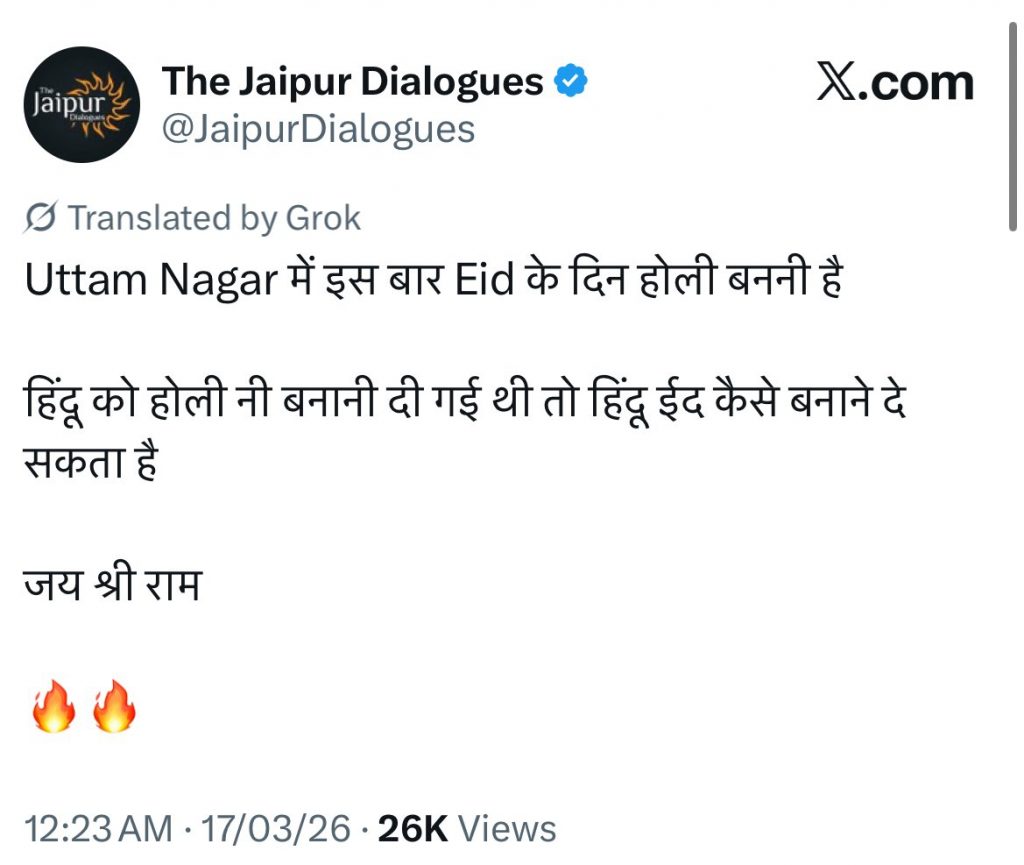
Amplifying this rhetoric are influential social media handles. Among them is “The Jaipur Dialogues,” run by former IAS officer Sanjay Dixit, which posted that if Hindus were not allowed to celebrate Holi, Muslims should not be allowed to celebrate Eid — accompanied by the claim that “Holi will be played on Eid in Uttam Nagar.”
A petition was filed in the Delhi high court over the rise in communal tension in Uttam Nagar following the Holi incident and the circulation of violent threats on social media, including slogans like “Khoon ki Holi Eid pe khelenge.” The matter was listed for hearing on March 18, but it could not be taken up that day.
In a petition filed by the Association for the Protection of Civil Rights (APCR), concerns were raised over the threats of violence. Appearing for APCR, senior advocate Nitya Ramakrishnan told a bench of Delhi HC chief justice Devendra Kumar Upadhyay and Justice Tejas Karia, “There are widespread threats of violence on Eid. Meetings are being organised on social media where it is being said, ‘We will play Holi with blood on Eid.’ We approached the police, but no action has been taken. We fear serious violence during and around Eid and seek immediate directions to the police to address these threats.”
On March 19, the Delhi high court issued directions to Delhi Police to make adequate arrangements in the Uttam Nagar area in apprehension of violence on Eid. The arrangements are to be in place till Ram Navami, the court said. It also issued notice to police and sought a response.
The cumulative effect of such messaging is significant. It transforms a localized, personal dispute into a nationalized communal narrative — fuelled not by verified facts, but by anger, speculation, and deliberate provocation.
As Uttam Nagar stands under heavy police watch, the real battleground may not be its streets — but the digital ecosystem that is shaping perceptions, amplifying fear, and, potentially, setting the stage for conflict.
For now, the neighbourhood waits.
Independent journalism that speaks truth to power and is free of corporate and political control is possible only when people start contributing towards the same. Please consider donating towards this endeavour to fight fake news and misinformation.