X Corp told the Delhi high court on March 31 that it formally urged the Centre to reconsider its March 18 directives ordering the blocking of 12 accounts on the platform, describing the move as “disproportionate”.
In a letter dated March 19 addressed to the Union ministry of electronics and information technology (MeitY), X formally objected to the blocking order issued under Section 69A of the Information Technology Act, 2000.
In its objection, X made three pointed arguments: that most content on the blocked accounts does not meet the legal thresholds under Section 69A; that account holders were never given a hearing before the order was passed; and that blanket account-level blocking, when targeted post-level removal was available, fails the legal test of proportionality.
The pushback is notable more for what it puts on record than for what it achieves. X complied with the order even as it challenged it, and the accounts remain blocked. But by formally contesting the legal basis before a high court, the platform has at least forced a degree of public accountability onto a process that ordinarily plays out behind closed doors.
@drnimoyadav Moved Court
The Centre cited concerns over the spread of deepfakes and the amplification of “false narratives” as reasons for the crackdown. The affected accounts include @drnimoyadav, @bole_bharat, @indiaawakend_, @Nher_who, @Nehainghratho, @wankar_sun93339, @Brijesh77956738, @ITSCK47, @iPraveenK_, @ActivistSandeep, @mrjethwani_, and @Doc_RGM.
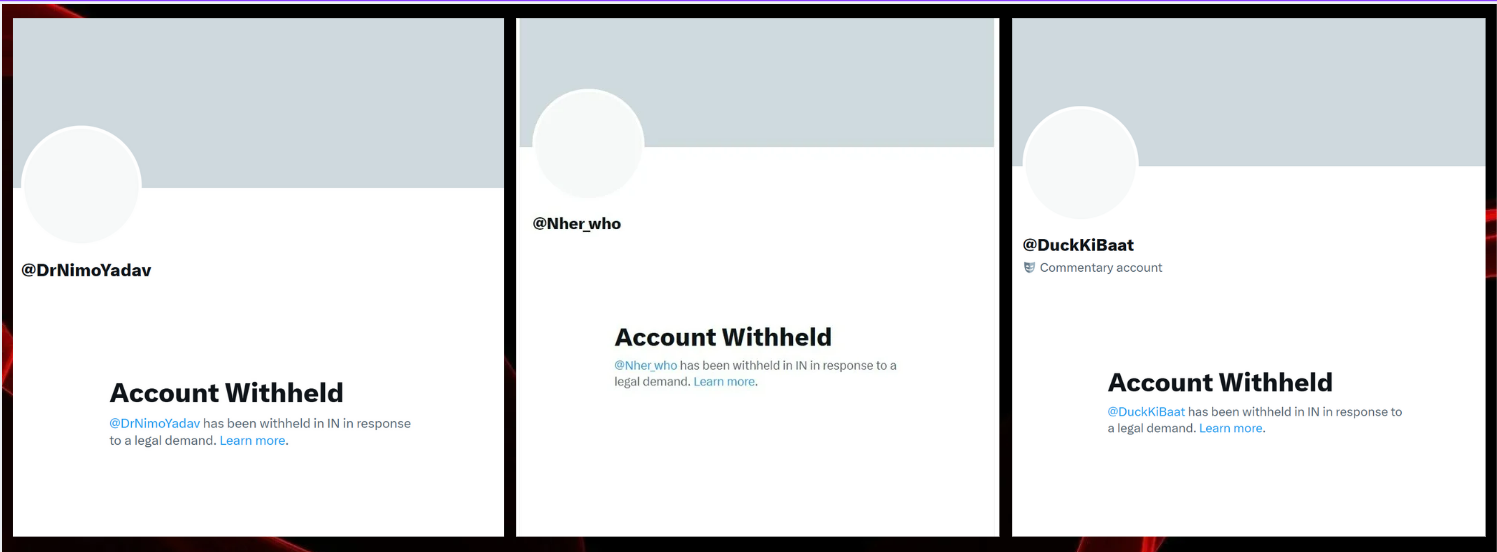
The matter reached the Delhi high court after the owner of the account Dr Nimo Yadav filed a petition seeking restoration of access. X’s letter of objection was disclosed in an affidavit on March 31, when the case was heard by Justice Purushaindra Kumar Kaurav.
Section 69A of the IT Act empowers the government to block or restrict access to online content on grounds including threats to national sovereignty, security, public order, or prevention of incitement to cognizable offences.
The letter reveals that X complied with MeitY’s directive to block the parody account Dr Nimo Yadav for allegedly controversial and defamatory content targeting Prime Minister Narendra Modi. The government’s justification read:
“The said X account contains defamatory posts from Dr Nimo Yadav @DrNimoYadav wherein, photographs/videos/AI manipulated contents of the Prime Minister have been used to create controversial posts questioning the Government and defaming the PM… has come to notice for spreading false narratives involving PM, accusing him of being incompetent, as also portraying him in bad taste. Spreading such content without any substance is demeaning and may affect the public order issues, leading to internal Security threats to the State. Accordingly, it is proposed to block the said X account (Dr Nimo Yadav in this case) under the powers vested with the Government of India vide section 69A of the Information Technology Act 2000.”
X Corp: Questions over Applicability of 69A, Doctrine of Proportionality not Met
In its letter to the Designated Officer u/s 69A at the MeitY, X raised three principal points.
First, the platform argued that most of the content across the blocked accounts does not meet the statutory thresholds under Section 69A, and that blanket account-level blocking, rather than restricting specific offending posts, was excessive.
“The vast majority of the content in each of these accounts does not appear to fall within the grounds specified under Section 69A, and thus the Blocking Order issued by you, directing X to block access to these URLs/accounts, is not proportionate. Thus account-level blocking, as opposed to post-level restrictions, constitutes a disproportionate and does not constitute the least intrusive measure as mandated under law,” X stated.
Second, X contended that account holders were not given an opportunity to respond before the blocking order was issued, and that the government had not made adequate efforts to identify or contact them as required under the law.
“X verily believes that no opportunity of hearing has been granted to any of the account holders whose accounts are to be blocked by the Blocking order. As X has previously brought to the attention of the Hon’ble Committee, in terms of Rule 8(1) of the IT (procedures and Safeguards for Blocking of Access to Information by Public) Rules 2009 (“Blocking Rules”), reasonable efforts are to be made for identifying the person whose content is ordered to be blocked. The Blocking Order does not demonstrate that any such efforts have been made.”
Third, X maintained that the evidence provided by the government for the 12 accounts “does not violate the grounds of Section 69A”, and requested that orders be passed to unblock them.
The platform invoked the “doctrine of proportionality”, arguing that government action must be balanced, necessary, and not excessively restrictive. It laid out four requirements such action must meet:
“i. It must have a legitimate goal, ii. It must be a suitable means of furthering the goal, i.e., rational connection. iii. There must not be any less restrictive but equally effective alternative, and iv. The measure must not have a disproportionate impact on the right holder (i.e., the account holder).”
X argued that removing specific violative posts was a less restrictive and equally effective alternative, making the blanket order unlawful.
“In the present case, the blocking of an account as a whole does not satisfy the criterion (of the doctrine of proportionality), especially since an equally effective alternative is available, i.e., withholding specific posts that are violative of the specific grounds of section 69A and demonstrated to be so. Further, the captioned Blocking Order will excessively and disproportionately restrict the account holder’s rights, especially as the account holder will be unable to use X in India permanently and without being granted an opportunity or hearing in this regard. The Blocking Order also fails to indicate how account-level blocking is the only measure available.”
X has requested the government to “reconsider the Blocking Order”, while clarifying that “this response is not intended, and should not be construed, as a waiver of any of X’s rights or other objections.”
Independent journalism that speaks truth to power and is free of corporate and political control is possible only when people start contributing towards the same. Please consider donating towards this endeavour to fight fake news and misinformation.