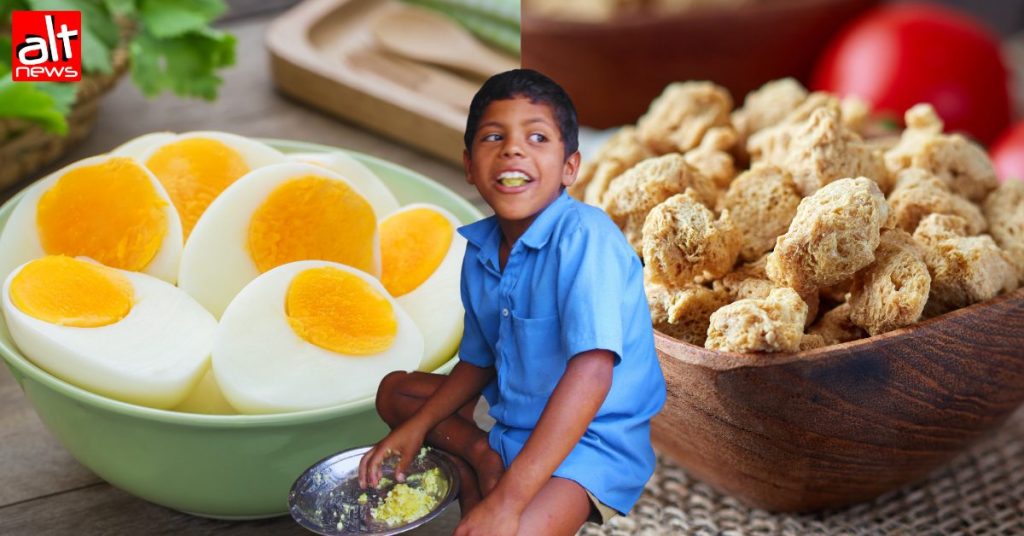
Days after the West Bengal government announced that ISKCON (International Society for Krishna Consciousness) would take over the mid-day meal programme in schools in Kolkata, the organisation’s former vice-president and spokesperson Radharamn Das expressed his gratitude to the newly-elected BJP government and announced that paneer, rajma, soya, pulses and other vegetarian foods would be served to the children instead of eggs.
This immediately sparked a debate over nutrition and children’s growth, on social media and off it.
Addressing those questions, Das spoke to ANI to allay apprehensions that a full vegetarian menu would create gaps in child nutrition. He claimed, “100 grams of egg contains 13 grams of protein. In contrast, 100 grams of soya chunks containss 52 to 54 gram of protein, which is significantly higher… Lentils, commonly consumed in vegetarian households, on average, contain 25 grams of protein…”
He further said, “I was comparing protein consumption levels across Indian states with large vegetarian populations — such as Rajasthan, where 61% of people are vegetarian, Madhya Pradesh, Gujarat, Haryana, and Uttar Pradesh. Surprisingly, protein consumption is highest in these very states. Conversely, in Bengal and the Northeastern states, where meat consumption is common, protein intake is lower… It is truly unfortunate that such misinformation is being spread..”
#WATCH | Kolkata | On West Bengal mid-day meal replacing egg with paneer and soybean, ISKCON Kolkata Vice President and spokesperson Radharaman Das says, “100 grams of egg contains 13 grams of protein. In contrast, 100 grams of soya chunks contains 52 to 54 grams of protein,… pic.twitter.com/9elAAEO9qw
— ANI (@ANI) June 27, 2026
“There is a common misconception that eggs are the only rich source of protein and lack a vegetarian equivalent …We have empanelled dietitians to curate our menus. We will ensure that whatever nutrients a child gets from eggs will be matched or exceeded by the superior quality protein and vitamins in our meals,” Das further told The Times of India, adding that the food would be prepared in a “world-class” centralised kitchen in Kolkata for which preparations are already underway.
Within days of these interactions, ISKCON announced that Das had been “sent on compulsory leave” and directed not to represent ISKCON in any capacity.
Factual Inconsistencies
Das’s claim about state-wise protein intake is factually incorrect. As per ICMR–INDIAB’s recent survey, the northeast had the highest overall protein intake (13.6%E) among India’s regions, and not the lowest, as Das claimed. The survey states, “Animal protein intake varied widely from a low of 0.3%E in the North and Central regions to 2.9%E in the northeast, with poultry as the main contributor (0.3%E).” It further states “The North had the highest dairy protein intake (3.6%E), while the East (1.2%E) and Northeast (1.1%E) had the lowest.” [%E here stands for percentage of total dietary energy, i.e., calories]
The study further adds, “The highest animal protein intake was seen in the Northeastern states of Meghalaya (4.9%E), Mizoram (6.9%E) and Nagaland (7.4%E). They also had the highest protein intakes from red meat—Nagaland (4.2%E), Mizoram (2.3%E) and Meghalaya (2.0%E). Mizoram also reported a high intake of poultry protein (2.3%E).”
What Does Science Say
In his interaction with the media, Das compares egg and soya chunks in terms of protein content, and highlighted the latter as containing “significantly higher” protein. Nutritionists and scientists say that the comparison is not viable as protein matching itself is not enough.
For a state (and a country) which had once memorised the lines ‘Sunday ho ya Monday, roz khao anday’ as part of the National Egg Coordination Committee’s health campaign, the removal of eggs from the mid-day meal plates has led to a broader concern — in the conflict between scientific evidence, regional food habits, and ideological preferences of a government or an organisation, what should be the priority for public nutrition programmes?
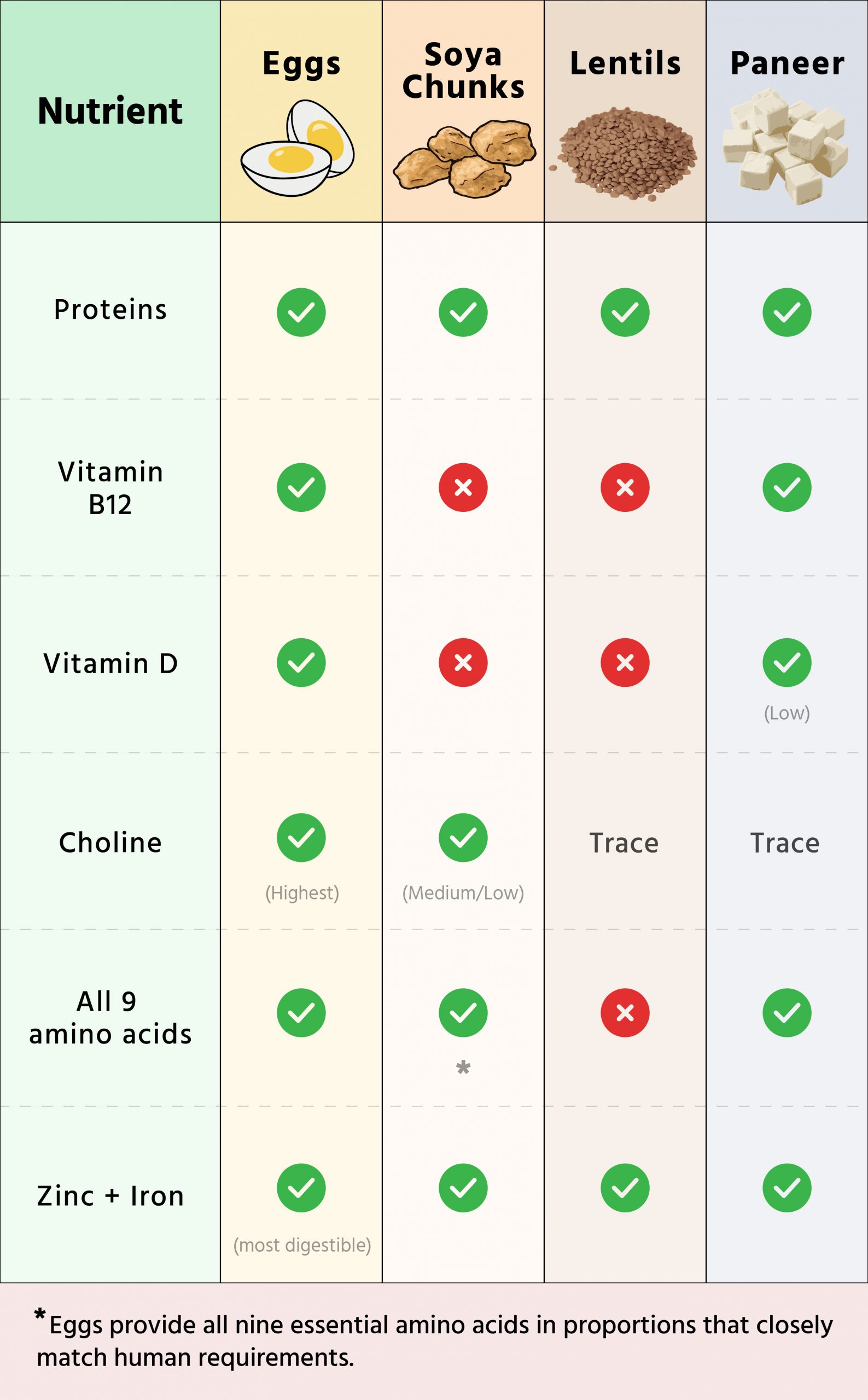
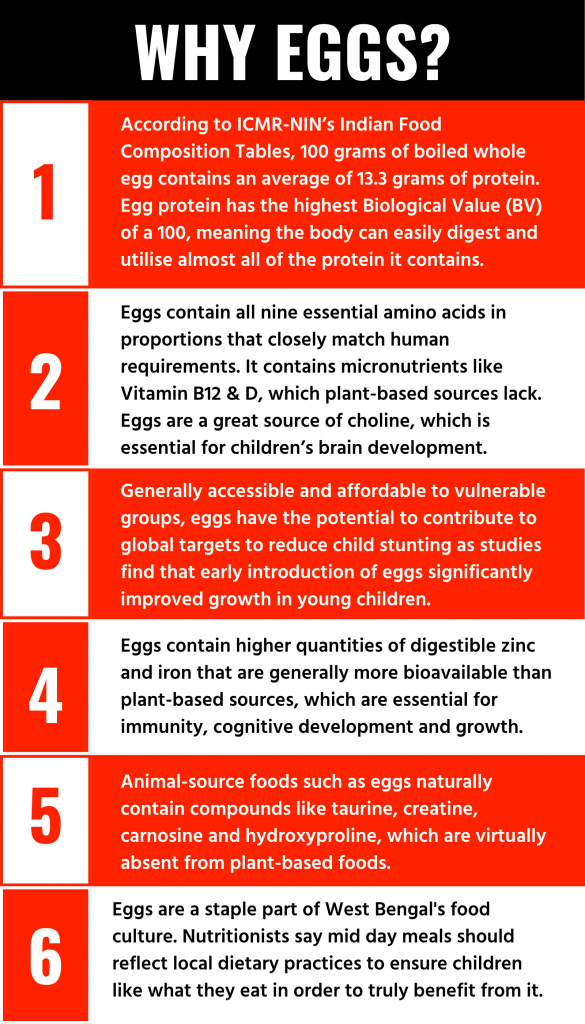
Nutrionists, scientists and Right To Food activists alike told Alt News that a child’s nutrition intake depended on various factors: The actual quantity of food served, the overall menu, the biological value (BV) of a food (a measure of how efficiently your body can use a specific dietary protein), and other nutrients such as vitamin B12, vitamin D, choline, iron and zinc. The simple inclusion of rajma, soya, or even paneer in the “same protein quantity” does not singularly replace eggs as nutritionally equivalent.
The mid-day meal scheme, officially termed the PM POSHAN scheme, functions under the National Food Security Act, 2013. Launched officially in 1995 as the National Programme of Nutritional Support to Primary Education (NP-NSPE), it is aimed at combatting child hunger, improving nutrition, and incentivising school attendance for children from lesser privileged backgrounds. The programme mandates 450 kilocalories and 12 grams of protein for primary students and 700 kilocalories and 20 grams of protein for upper-primary students.
A study by the United Nation Food and Agriculture Organisation (FAO) positions eggs as playing a vital role in “human nutrition, being important sources of amino acids, energy, essential trace elements and vitamins.” It reads: “Including eggs in daily diets, especially of young children…can generate substantial cost-effective benefits in terms of nutrition and health.”
“Early introduction of eggs significantly improved growth in young children. Generally accessible to vulnerable groups, eggs have the potential to contribute to global targets to reduce [child] stunting,” are the findings of a 2017 randomised study in the American Academy of Pediatrics. Another 2025 study which maps the biological value (BV) of proteins for child development finds: “Animal proteins typically have a higher biological value due to their complete amino acid profiles. Compared to animal-based proteins (ABPs), plant-based proteins (PBPs) carry a higher risk of nutrient deficiencies in vulnerable populations due to lower digestibility and incomplete amino acid profiles.”
For decades, the Indian government itself has actively promoted egg consumption as a key solution for nutritional deficiency. A recent Animal Husbandry Department’s campaign states, “With 142.77 billion eggs, India ensures every plate is filled with essential protein and every life is powered with nutrition.”
Not a Wise Decision: Nutritionists
Referring to eggs as the ‘superfood’ of nutrition, Kolkata-based nutritionist Payel Chatterjee, says, “Removing eggs is not a wise decision as its contribution to a child’s nutritional intake cannot be matched with any vegetarian options. Apart from being a good source of protein, eggs have micronutrients which plant-based sources do not have, such as Vitamin B12, D, and choline. Eggs also have superior quantities of digestible zinc and iron.”
“The issue is not just about how much protein a food contains, but how well the child consumes it. Eggs contain all nine essential amino acids in ideal proportions and are highly digestible. It is always advised to give a nutrient-dense meal to the kids and egg being a very affordable, high-protein, high-calorie packed with micronutrients, was the best choice,” she told Alt News.
Unlike some plant proteins, soy protein is also considered a complete protein as it contains all nine essential amino acids, reads a study published by Harvard T H Chan School of Public Health. However, eggs provide all nine essential amino acids in proportions that closely match human requirements and are more readily digested and absorbed, according to FAO data, which notes that egg protein is among the highest-quality dietary proteins and serves as a reference against which other proteins are evaluated.
Chatterjee adds that the liking of the children should also be taken into account, in which “eggs were a clear winner,” given the normative non-vegetarian eating practices of West Bengal. “If eggs are replaced by soya chunks, paneer, pulses and dairy, the menu can only be nutritionally adequate if it is supplemented with all the micronutrients and vitamins.” she says.
Speaking to Alt News, Barsanjit Mazumder, molecular scientist and professor at the department of biology, geology, and environmental science at Cleveland State University, said, “Adequate protein intake, particularly from animal-source foods, of which eggs are the cheapest source, is associated with not only improved physical growth but also cognitive development of a child.”
“For every cell in our body to remain healthy, proteins must be continuously synthesised, and every protein in the human body begins its synthesis with the amino acid methionine. If this supply line is compromised, the risk of impaired neural development in children increases significantly. Essential amino acids such as methionine, lysine, and threonine are found in much lower quantities in vegetarian diets. Compounds like taurine, creatine, carnosine, and hydroxyproline are virtually absent from plant-based food,” he explains.
‘Protein Matching Alone Not Enough’
By virtue of its core ideology, ISKCON is bound to serve vegetarian food, but nutritionists believe that a child’s need should have been at the forefront while assigning responsibility. “Eggs have a biological value of 100 per cent, meaning the body can utilise almost all of the protein they provide. They are also a great source of choline, which is important for children’s brain development, neurotransmitters like serotonin and dopamine, and egg whites contain a good amount of albumin,” said clinical dietitian and critical care nutritionist Aritra Khan.
“Whether this new dietary formula under the government’s pilot project is nutritionally adequate will depend on how the overall menu has been designed. It should be planned in consultation with physicians, dietitians and paediatricians and not in isolation by any one organisation,” he added.
Nutritionist Sucharita Sengupta explains that there are two classes of protein. The first class includes animal protein whereas the second is vegetarian protein. “As per the new handover, the first class protein is completely out of [the childrens’] diet. Considering the BV of eggs, intentionally removing it from one’s diet might not be a prudent decision. Simply adding 2-3 plant based products will not suffice the overall gap of nutrition. They will need to add several supplements along with rajma or soya to balance the diet, simply protein matching is not enough,” she says.
What are other States Doing?
In 2018, ISKCON’s Akshaya Patra Foundation refused a government directive to serve eggs, onion, and garlic in the schools where it served mid-day meals in Karnataka, drawing flak from Right to Food activists who have consistently advocated the inclusion of eggs as part of government schemes meant for children from lower-income backgrounds. The foundation was accused of imposing religious and casteist dietary restrictions tied to ‘purity’, which went against the state’s general food practices.
However, a 2022 study conducted by the Karnataka State Rural Development and Panchayat Raj University in Gadag, found clear evidence of significant improvement in children’s development after eggs were introduced in seven districts of the state as part of its pilot project in 2021 to combat child malnutrition and low school attendance in the state. The findings showed greater improvement in weight gain and BMI, compared with children who did not receive eggs, resulting in the inclusion of eggs twice a week in all mid-day meals across the state. In 2024, the government expanded the initiative to provide eggs in mid-day meals six days a week.
Akin to Karnataka, Odisha also found a way to ensure the eggs remain on the mid-day meal menu despite the Akshaya Patra Foundation being in charge of implementing the scheme in the state for decades. After receiving numerous requests from schools, parents, and Right to Food campaigners, the government tasked the school managements to independently procure and boil the eggs after the foundation refused to be associated with either procurement or cooking.
In the latest Global Hunger Index (GHI 2025), India ranks 102th out of 123 countries, with a score of 25.8, placing the country in the “serious” category of hunger. The GHI report maps child hunger and malnutrition — often leading to child mortality — as key determinants leading to the current alarming rank.
Prominent activist Anjali Bhardwaj, member of the Right to Food Campaign, told Alt News, “India consistently ranks poorly on the GHI. Even government surveys like National Family Health Survey (NFHS) point to the alarming levels of child malnutrition (stunting and wasting) in India. As per NFHS-6 results, 30 per cent of children in the country are stunted (low height for age) and 19 per cent of children are wasted (low weight for height). This is a reflection of food insecurity in households, poor dietary diversity, lack of maternal and child care services, nutritious food and access to health and sanitation.”
“Under such conditions, the only priority for any government should be to improve the intake of nutritious food by children. The type of food to be provided should be shaped by local preferences, habits and customs. It is not just about putting food in front of the child — the food should be such that the child wants to eat it, by taking into account the family background and habits of children. This is why involving contractors and service providers who bring their own terms and conditions must be completely avoided. It is not a dole in which the provider can decide the food entitlement based on their religious customs,” added Bhardwaj, also the co-covener of the National Campaign for People’s Right to Information (NCPRI).
For children for whom the scheme is designed, the mid-day meal is often the only source of reliable protein. Condemning the move, Mazumder stated, “Affluent vegetarian families will continue to maintain their own health with plenty of animal-derived food items that fit within their version of vegetarianism — milk, curd, cottage cheese, paneer — and an abundance of supplements. But have they ever considered that these expensive food items are beyond the reach of children from working-class families? For them, the egg served through the mid-day meal is indispensable.”
“I protest against this ideologically motivated agenda that ignores the nutritional needs of children,” he added.