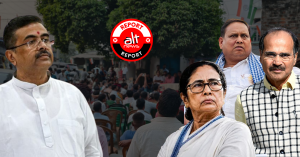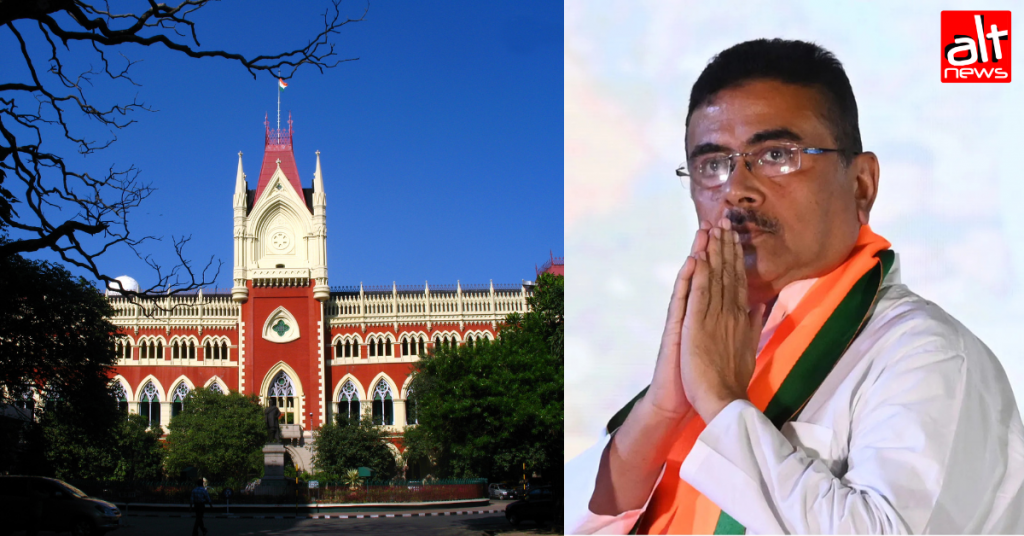
A division bench of the Calcutta high court comprising Acting Chief Justice Tapabrata Chakraborty and Justice Partha Sarathi Chatterjee on August 6 dismissed three public interest litigations (PILs) challenging the West Bengal Public Safety and Control of Anti-Social Activities Bill, 2026, — also referred to as the “Goonda Act” or “Anti-Goonda Act” — on the grounds that the petitions were premature because the Bill had not yet received the President’s assent to become a law.
Appearing for the state, advocate general (AG) Surajit Nath Mitra and additional advocate general (AAG) Billwadal Bhattacharyya submitted to the court that said Bill still awaited Presidential assent.
The high court’s observations and the state’s own submissions effectively contradict repeated public assertions made by West Bengal chief minister Suvendu Adhikari. On multiple occasions, Adhikari claimed that the ‘Goonda Daman Bill’ had already received the Governor’s assent and become law. He also told the assembly that the “Goonda Daman Act” had been invoked against all those accused of orchestrating violence during the July 24 protest march at Esplanade. However, the state has itself now informed the high court that the Bill is still awaiting the President’s assent and has therefore not yet become law, rendering the chief minister’s claims incorrect.
Recording the state’s submission, the court observed on Thursday, “As the Act is yet to receive Presidential assent, the writ petition is premature”. Thereafter, the bench further clarified that once the Bill received the required assent and was promulgated, the petitioners would be at liberty to challenge its validity. “However, we made an observation: once it receives the assent, you would be at liberty to come”, the Bench observed.
Bunch of PILs challenging ‘Goonda Act’
Alt News had reported on August 3 that two PILs challenging the proposed legislation had been moved. The first was filed on July 13 by the All India Lawyers Union and others, which was heard on July 22. While, the second was registered by the Association for Protection of Democratic Rights (APDR).
Advocate Samim Ahammed, who appeared for the petitioners in the first PIL, had informed Alt News that during the first hearing on July 22 as well, additional advocate general Billawadal Bhattacharyya had submitted before the court that the Bill had not yet received the Governor’s assent and had therefore not become an Act.
Advocate Sabyasachi Chatterjee, appearing for the petitioners in the second PIL, faced a similar challenge on July 27. During this hearing, Advocate Chatterjee requested the Bench to direct the state to provide the Gazette notification that brought the Act into force. According to Chatterjee, the state failed to present any such notification.
A third PIL, filed by Faizan Md Zafar, was registered on July 30 on similar grounds. The CJI-led Bench heard all these matters on August 6.
The YouTube livestream of the hearing of the third PIL — WPA(P) 380 of 2026 — can be heard below, where ACJ Tapabrata Chakraborty told advocate Farooque Ali, appearing online, that the said Act was yet to receive presidential assent, and hence the writ petition challenging it was premature.
The order copies for the three PILs can be read here, here and here.
The July 24 Rally and CM’s Response
On July 24, eight Left student organisations, along with members of Cockroach Janta Party (CJP), organised a protest march from Sealdah to Esplanade demanding Union education minister Dharmendra Pradhan’s resignation and condemning the police action against protestors in Delhi on July 20. Violence broke out around the time the march concluded, during which several journalists were allegedly assaulted.
The next day, Adhikari informed the assembly that seven cases had been registered and repeatedly asserted that the newly passed “Goonda Daman Act” had been invoked in all of them. He then escalated his rhetoric, naming five accused persons, calling them “goondas” (goons) and declaring that the state would take such action under the law that “these goons and even their next three generations will remember it.” He also claimed that the Governor had already assented to the legislation, allowing it to come into force.
The assembly statement capped nearly two weeks of public assertions by the chief minister that the Bill had already become law. From July 10 onwards, he repeatedly maintained that the Governor had approved the Bill and that it had come into force. Several media organisations, including The Indian Express, The New Indian Express, and Deccan Herald, subsequently reported that the Bill had become an Act and had been invoked against those arrested in connection with the July 24 violence.
The state’s submissions before the Calcutta high court on July 22, July 29, and August 6, together with the court’s observations on August 6, make it clear that the chief minister’s claim had no legal basis. They establish that the Bill had not yet become law, contrary to his repeated assertions.
The story was updated with court order copies on August 8.