“There is not one video footage of my brother pelting stones, heckling journalists, pushing people, creating chaos or uttering a single slur. But, there is video footage of him cleaning up the streets and collecting trash in a bag after the protest site was cleared. So, I want to ask the police, the government, and chief minister Suvendu Adhikari, why was my brother arrested?”
Imran, the brother of Sk Salman Hossain who was arrested along with 15 others in connection with the alleged violence during a Cockroach Janata Party (CJP) solidarity protest in Kolkata, told this to Alt News on Tuesday, July 28, while he anxiously waited outside the chief metropolitan magistrate’s court for his brother’s bail hearing.
Salman is among 16 people who were arrested from Kolkata and adjoining areas for allegedly resorting to violence during the July 24 rally. Fifteen out of the 16 are Muslims. In the state assembly and while talking to the media, West Bengal chief minister Suvendu Adhikari repeatedly described the troublemakers as “Friday people”, “foreign-funded Jamatis” and “Islamists”.
“Why were so many serious criminal charges pressed against Salman and why was he labelled a ‘goonda’? Why was he associated with Bangladeshi Islamist organisations and defamed by certain channels like Republic Bangla? Was joining the protest on Friday to support the students’ cause a crime? Does he need to be a student to support an issue that plagues that whole country? He was penalised lending his voice to a national issue,” Imran added.
Soon after, Salman was granted bail. After initially remanding them to two days of judicial custody around 2.30 pm on Tuesday, the Bench called for a sudden re-hearing, granting bail to all 16 accused, namely, Sk. Salman Hossain, Md Azad, Md Afroz, Irfan Khurshed, Arshad Ali alias Sajid, Md Moinuddin, Md Alamgir alias Raju, Imran Ahmed alias Gopi, Khalid Reja alias Rinku, Zamir Ahmed alias Minku, Mohsin Khan, Shabaz Khan, Sk Md Salman Hussain, Johiruddin Mal, Md Javed Akhtar, Md Waqar Azam and Dipak Bhowmick alias Vicky.
The accused were defended by almost 100 lawyers, under the banner of All India Lawyer’s Union (AILU) and represented by lawyers Samim Ahammed, Raja Sengupta, Yasin Rahaman, Sanjay Kumar Gupta, and others. Calling it a step toward upholding constitutional integrity and defeating state oppression, Ahammed told Alt News, “The West Bengal government tried to suppress a democratic movement by putting the participants behind bars. The Chief Minister had said that the accused would face such consequences that their three generations would remember it. Today’s judgement proves that such hollow rhetoric has no place in a democracy.”
Citing the Supreme Court order staying action against protesters in all states and directing the immediate release of those detained by the police, the bail order said, “There is prima facie no material before the Court to show that any of the accused persons have criminal background…this court is inclined to grant bail to all the accused persons.”
Explaining the day’s tumultuous proceedings, Ahammed told Alt News, “The first batch of the accused were produced before the chief metropolitan magistrate in the afternoon and sent to judicial custody till July 30. The court initially refused the defence’s demand of granting bail to the accused. However, after 30-40 minutes, the matter was re-heard and all accused were granted bail in accordance with the SC order.”
‘Friday people’, ‘Foreign-funded Jamatis’, ‘Islamists’
According to a Kolkata police officers Alt News spoke to, the accused were found to be involved in the violence that erupted after the protest march from Sealdah to Esplanade, near Dorina Crossing on Friday. Police first registered a suo moto case over alleged attacks on police personnel, journalists, vandalism of public property, and disruption of public order.
The suspects were identified by analysing CCTV footage and video clips, police said, adding that 70 people allegedly involved in the violence were identified. The police further claimed that several of those arrested were not students and had criminal antecedents, alleging that they “infiltrated the rally and instigated violence”. A total of seven FIRs were registered — six filed at Hare Street police station and one at Entally police station.
Addressing the West Bengal legislative assembly on July 25, Saturday, Adhikari invoked the newly passed West Bengal Public Safety and Control of Anti-Social Activities Act, 2026, or the ‘anti-goonda law’ in this case, stating that this was the first instance of the act being implemented. He asserted that the 70 persons identified “were not students and had no relation to the protests”.
“They are not students, neither are they members of the self-declared Cockroach Janta Party, nor are they demonstrators affected by the NEET paper leak. They came only to create disorder. I condemn the attack on our journalist friends on behalf of the entire House. An attack on journalists is unacceptable. We will take such action under the goonda act that these goons and even their next three generations will remember it. This is precisely why this law was enacted and precisely why it was passed. The people of Bengal are now seeing why this law was needed,” the chief minister said.
He went on to name five alleged “goondas”— Afroz from Rajabagan, Nahid from Kidderpore, Tanbir and Nizam from Ekbalpur, and Rahul Jamal from Watgunj.
CM Suvendu Adhikari announces action to be taken so severe under the Anti Social Activities Act that their 3 generations won’t forget. All Mafia Dons namely Afroz, Nahid, Tanveer, Nazim & Jamal from Khidderpore-Watgunj-Rajabagan has orchestrated & spearheaded yesterday’s chaos in… pic.twitter.com/7qqX8ekVpj
— Sudhanidhi Bandyopadhyay (@SudhanidhiB) July 25, 2026
The day after his assembly address, Adhikari told reporters that the accused could be influenced by “foreign-funded Jamatis” and “Islamists”. “None of them are students, they are all Jamatis and Islamists who want to weaken India and create chaos in the country. They are goondas who will be handled under the anti-goonda law. Initially, it was a rally organised by the self-declared Cockroach Party, and Left groups later joined it. I thank those in Bengal who were part of the genuine NEET rally as they were not involved in this incident at all. In fact, those genuinely involved have shared the brutal attacks on journalists on social media. They have also clarified with posts on social media that they are not associated with the attackers, the Kolkata police CP has sent me all these details,” he said.
Adhikari said that over the past 10 weeks, the state government had enforced laws to combat sustained uncivilised behaviour. Seemingly referring to the “actions taken against” the Muslim community, he suggested that they are “retaliating from anger”. “Investigations into the registration of Khariji madrasas have angered them. The implementation of the Calcutta high court order on the cancellation of unauthorised OBC certificates has angered them. The 1950 Animal Slaughter Act has angered them. They are also angry over restrictions on sound pollution. Those people went there to unleash chaos. They struck pictures of the PM and the CM with sticks…Some people were holding the national flag upside down. All of these goons will be punished,” he asserted, adding that his statements in the Assembly were “final”.
In an earlier media interaction, the CM categorically referred to those who allegedly incited violence as ‘Shukrobaaris’ or ‘Friday people’ — directly pointing to the Muslim community as their biggest prayer of the week, the Jumma Namaz, is offered on Friday. “I have marked these people…who have no relation to NEET. The former Chief Minister kept on saying ‘Friday’…undoubtedly they will do this [incite violence] on Friday…this is why journalists have been attacked by the Friday people. Give me a few days, I know what to do with them,” he warned.
Kolkata, West Bengal: CM Suvendu Adhikari says, “We have spotted and marked them. It has nothing to do with NEET….” pic.twitter.com/h3YTD7naYe
— IANS (@ians_india) July 24, 2026
In yet another instance of claiming that ‘Friday people’ were responsible for “attacking journalists”, Adhikari can be seen in a clip with an injured journalist, assuring him of action against those who allegedly attacked the scribe. “Was this a protest? The former CM had given full freedom to these people on Fridays, which is why this [violence] has happened on a Friday.”
Suvendhu Adhikary in his trademark hate comments has attempted to link the attack on Journalists and stereotype an entire Muslim Community to the violence. pic.twitter.com/J0rQQLBrXW
— Kamru Choudhury (@Kamru_Choudhury) July 26, 2026
‘Targeted For Being a Muslim’
Hours before the court granted bail, Yakub Ali Mal, father of Johiruddin, spoke to Alt News, weighed down by anguish and a sense of helplessness. “This is not a genuine arrest. We continuously live in fear of being attacked by the government for our Muslim identities. The government believes that all crimes are committed by Muslims. If you look around this court, you can see the reality. My son did not commit any crime, he went to a protest where thousand others went and raised slogans like thousand others did, yet the next day he was the one arrested by the police. There is no footage of my son harassing anyone, there were no grounds to arrest him other than his identity. It is my hope that justice is served,” he said.
Echoing Mal, Calcutta high court Advocate Syed Nafirul Islam condemned the “blantant targeting” of the Muslim community in this case. “I hope that the chief minister of the state realises the responsibilities he has and how his statements stray away from those responsibilities. I hope he will not target specific protestors based on their backgrounds.”
Further problematising the case was Adhikari’s repeated assertion that the accused would be dealt with under the ‘anti-goonda law’. When we checked the FIRs and the remand paper submitted in court by the investigating officer from Hare Street police station, we found no mention of it. According to the FIR, the accused were booked under 12 sections of the BNS. An officer from Hare Street police station told Alt News that apart from the BNS sections, sections 9 and 15A of the West Bengal Maintenance of Public Order (Amendment) Act, 2026 were invoked.
The ‘anti-goonda law’ also currently faces a petition challenging its constitutional validity before a division bench headed by Acting Chief Justice Tapobrata Chakraborty of the Calcutta high court.
Speaking to Alt News on why the Goonda law was not implemented on the accused, advocate Shamim Ahammed said, “The Act was challenged in Court by the AILU. Bilwadwal Bhattacharya, the additional advocate general (AAG) of the state made a categoric submission before the court that the Act is still a bill, as it is yet to receive the assent of the Governor. Therefore currently there is no law as the Goonda Act in West Bengal. How can you slap someone with a law which doesn’t exist in the very first place?”
What Unfolded On July 24?
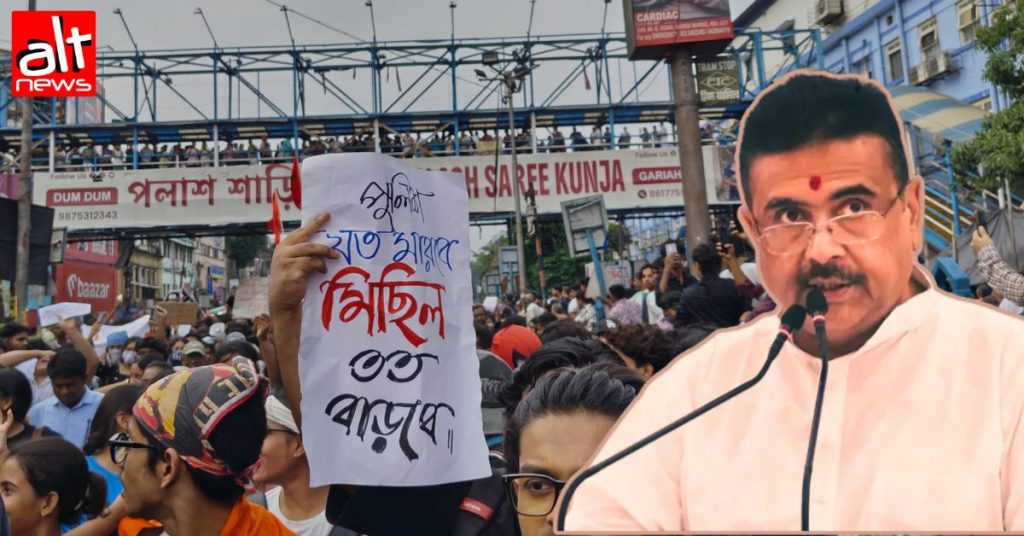
On Friday, Kolkata witnessed a rally organised by several Left groups, including SFI, AISA, AIDSO, AISF, PDSF, DYFI, CPIM(L), and others, and later amplified by the solidarity group called ‘CJP Kolkata’. It was attended by thousands of demonstrators from across the city and beyond, seeking the resignation of Union education minister Dharmendra Pradhan, supporting the students affected by the NEET UG paper leak and condemning the police brutality in Delhi on July 20.
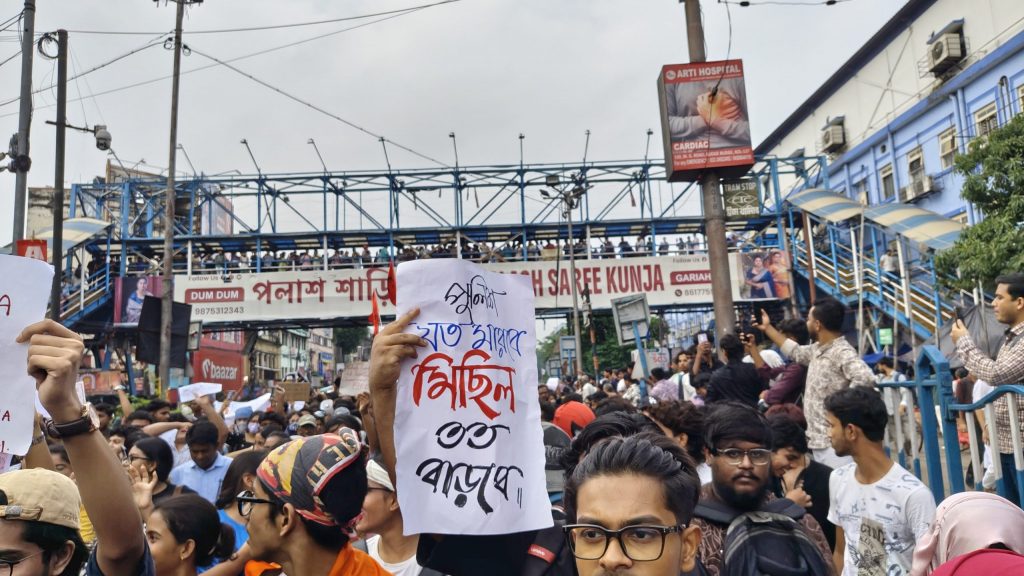
As most of the mobilisation took place through social media platforms such as Instagram, the rally was thronged by GenZ’s from across Kolkata and the surrounding regions with handmade posters and placards as the streets reverberated with chants of ‘Azadi’. Participants, speaking to Alt News, described the rally as largely peaceful and symbolic of national unity against oppression and injustice. “I joined the rally as it moved from NRS Medical College (Sealdah) to Moulali. During the 30-40 minutes I spent at the protest around 3 pm, the protest remained entirely peaceful, no journalists were heckled, and the police actively cooperated with the participating students,” said Taha Siddique (22).
Siddique said he only saw glimpses of scuffle and chaos on social media after he went home, adding that the controversy and arrests that followed for days after overshadowed the spirit of the protest, “Keeping in mind the fact that the motive of the protest was to raise our voice against injustice in the system and to show solidarity from students and general public, it is extremely disheartening to see a chief minister specifically target a group of people. There obviously could have been some hecklers who were trying to disrupt the crowd but for the most part it was all controlled,” he said.
One of the organisers of the protest, SFI member Akash Kar acknowledged that there were sporadic incidents of chaos near Dorina Crossing as the rally came to a close. “People did throw bottles and sticks towards cops, some journalists were also heckled, there is no point in denying it. What happened was wrong and goes against the ethos of a peaceful protest but none of it happened in front of my eyes. What I witnessed was through social media videos,” he said.
However, Kar added, “The arrests that followed forms part of a larger witch-hunting of Muslims and minorities in the state. Members of the BJP were equally part of the chaos, and raised objectionable slogans, but no FIRs were registered against them. When all the demonstrators had gathered around Dharmatala at the end of the rally, we had requested the police to let us reach Rani Rashmoni High School on SN Banerjee Road, but they barricaded the roads, which led to tension and crowds getting agitated. The police are to be held equally responsible for the ruckus.”
Referring to an Alt News fact-check debunking certain media channels claiming that the CJP protests were linked to Bangladesh’s Jamaat-e-Islami, Kar said, “The BJP government, bolstered by its PR media channels, are trying to discredit the protests by making such claims. The statements being made by the CM are not grounded in reality. Protests everywhere are being attended by Indians who are frustrated with the BJP government, not foreigners or foreign-funded elements.”
Alt News came across certain videos of journalists indeed being heckled, which began surfacing on social media after the protest. One such video uploaded by journalist Indrajit Kundu of Aaj Tak Bangla showed a massive crowd jeering at a reporter and chasing them away while shouting ‘Godi media’.
This is how a mob assualted & heckled journalists in Kolkata during the students protest today:
While my team was reporting today’s protest march called by the left students bodies in Kolkata, a bunch of hoodlums began heckling our reporters. Soon things escalated, water was… pic.twitter.com/CxbbVImejA
— Indrajit Kundu | ইন্দ্রজিৎ (@iindrojit) July 24, 2026
Another clip was uploaded by one of the accused, Md Afroz, himself, showing a crowd heckling, splashing water on, and chasing away a reporter with similar screams of ‘Godi media hai hai’ even as someone in the background can be heard saying “Do not attack members of the media, they are also just doing their jobs.”
View this post on Instagram
On the flip side, another clip that went viral on social media is of Salman’s, where can be seen cleaning garbage off the streets of Dharmatala at the protest gathering. A day before his arrest, he lamented in the clip, “The country does not belong to the government, it belongs to us and it is our duty to maintain cleanliness and peace in the country…Today we are called anti-nationals and Pakistani infiltrators…I swear on my God, the amount of love I have for my country, only my God knows.”
Sk Salman, a protestor in Kolkata was arrested by Suvendhu Adhikary administration for alleged vandalism during the protests. Just listen to him and judge for yourself. pic.twitter.com/TWVk8EGuYT
— Kamru Choudhury (@Kamru_Choudhury) July 26, 2026
The Bankshall Court complex, which was engulfed with tension and helplessness since early afternoon, became a site for celebration and brief relief by evening. Even as scores of family members and the massive group of lawyers greeted the released men with flowers and smiles, certain larger questions remained unanswered: Whether political dissent can be criminalised through sweeping allegations backed by little evidence, whether communal rhetoric can shape policing, and whether the constitutional right to protest will be protected equally, irrespective of one’s religion.