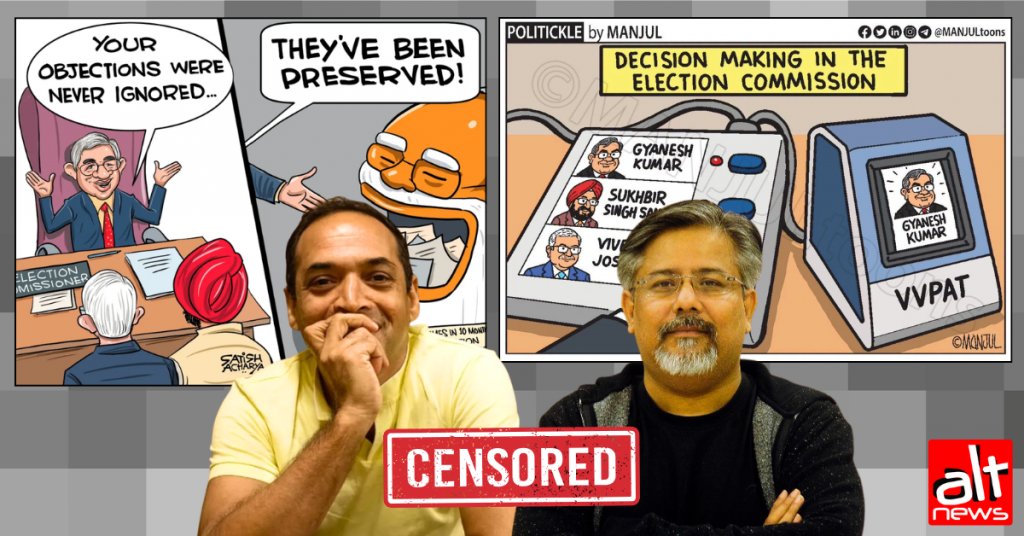
Two Indian cartoonists, Satish Acharya and Manjul, recently revealed that their Instagram accounts and posts were withheld in India, following orders from the government. While the former’s account was restored on October 6, the latter’s post remains unavailable in India.
On September 23, The Indian Express reported that election commissioners Sukhbir Singh Sandhu and Vivek Joshi had raised at least 14 formal objections over 10 months to decisions concerning electoral-roll management and the Special Intensive Revision (SIR), including changes to Form 6, voter deletions and restorations, the centralisation of electoral-roll data, and appeals against decisions in West Bengal.
The investigation, based on internal notes and correspondence reviewed by the newspaper, showed that the two commissioners repeatedly said certain decisions had been taken without their knowledge or approval by chief election commissioner (CEC) Gyanesh Kumar, with Sandhu at one point describing an SIR-related change as “unauthorised and illegal.” Both Acharya and Manjul had posted cartoons satirising this case.
ALSO READ: Instagram takes down content critical of Vizag data centre projects, cites IT Act notices
On September 23, Acharya posted an illustration on Kumar and the SIR controversy. Five days later, on September 28, his account was restricted in India.
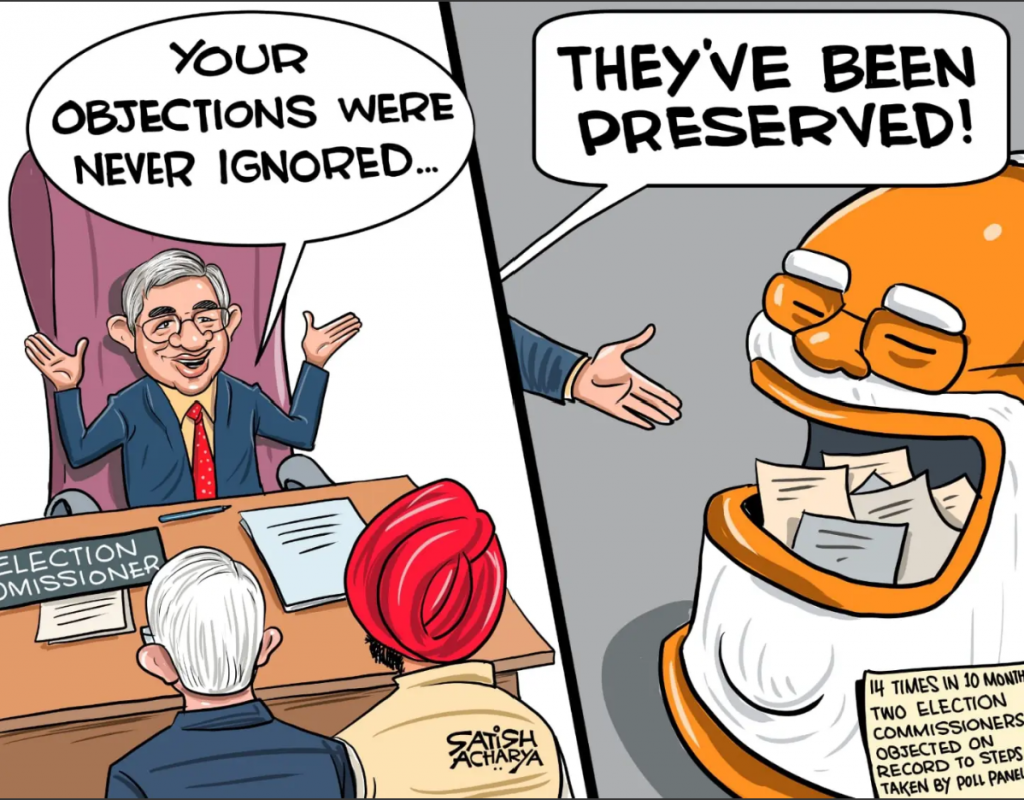
However, his profile was still available on Facebook and X, and the said toon was still visible on both platforms.
After his account was banned, on September 28, Acharya posted screenshots of notifications received by Meta, which said that several of his earlier satirical posts were also being banned in India under Section 79(3)(b) of the Information Technology (IT) Act, 2000.
On the same day, he posted the screenshot of his account getting restricted in India, contrasting it with a screenshot of Modi’s comment that “cartoons have healing power and cartoonists are closer to God”.
Speaking to Alt News, Acharya said he found out about his account being restricted while checking news reports on the increasing banning of accounts critical of the Bharatiya Janata Party (BJP) government. “I thought of checking my own Instagram account status and found that a list of posts were restricted in India, some of them were posted in 2023-24. By the end of day, I found that my entire profile has been restricted in India,” he said.
“For the last one decade, I have regularly faced restrictions on my cartoons on different social media platforms. (Their) aim was to restrict the reach…mostly during elections or major protests like CAA protests & farmers’ protests. This is the first time that my entire profile was restricted in India. It’s quite shameful that they (the government) are scared that the narratives created by the regime over the last two decades will be demolished by cartoons, journalists, and comedians,” he added.
He said that his reach has been affected after the ban, adding that he written to Meta’s grievance cell.
ALSO READ: Content creators decry Instagram censorship, call restrictions a ‘digital emergency
On September 27, cartoonist Manjul made a post X claiming that Instagram has restricted one of his illustrations in India. He also posted the notice from Instagram, which claimed that this particular post’s access has been restricted in India “pursuant to a notice from the Government of India/Law enforcement”. (Archive)
Instagram has restricted this cartoon in India.
I am posting the cartoon again, along with the notice I received from Instagram.
According to the notice, access has been restricted in India “pursuant to a notice from the Government of India / Law Enforcement” and based on… pic.twitter.com/y3UXWCCDIg
— MANJUL (@MANJULtoons) September 27, 2026
The cartoon, posted on Manjul’s Instagram account on September 24, showed that an electronic voting machine (EVM) with three candidates — the three election commissioners. However, when a person was seen voting for Vivek Joshi, the VVPAT showed that the vote was cast for CEC Gyanesh Kumar.
#cartoon #GyaneshKumar #ElectionCommission https://t.co/yvUij6XJXH pic.twitter.com/5VsMo9qcKT
— MANJUL (@MANJULtoons) September 24, 2026
The satirical cartoon remains visible on both his Facebook and X profiles.
A report by The Indian Express, published on August 18, revealed that between March and July, the government issued a blocking order for online content every 68 seconds on average, which amounted to 1,275 such cases daily and around 2 lakh cases over a period of five months.
According to that report, this government takedowns surged specifically after the Cockroach Janta Party-led students’ protest against the NEET exam irregularities in June and July. Although the government took down social media posts from Facebook, Instagram and YouTube as well, Instagram faced maximum content restrictions given that its user demographic is mostly the Gen-Z. According to the report, out of the total blocking orders, 1,00,000 such orders were for Instagram only while Facebook and YouTube accounted for 80,000 and 15,000 takedown orders, respectively.
ALSO READ: Government orders trigger sweeping Instagram censorship days after CJP protest
Alt News had earlier reported that in February, the government amended the Information Technology (Intermediary Guidelines and Digital Media Ethics Code) Rules, 2021. The amendment reduced the time available to social media platforms to remove or disable access to unlawful content from 36 hours to three hours after receiving a valid court order or a “reasoned intimation” from the appropriate government or its authorised agency. This change was notified through a press brief on July 22.
Although the order focused predominantly on countering harms caused by AI generated content and information, critics believe that the amendments have served as a tool to curb anti-establishment content. In our reportage, we found that most of the blocking orders were issued through the Union Home Ministry’s Sahyog portal, a platform created to send such notices, under Section 79(3)(b) of the IT Act, 2000. These orders were issued by various central and state government agencies. Meta has also integrated its Application Programming Interface (API) with the Sahyog portal, enabling content flagged through government directions to be automatically removed from its platforms without being reviewed by a human executive.