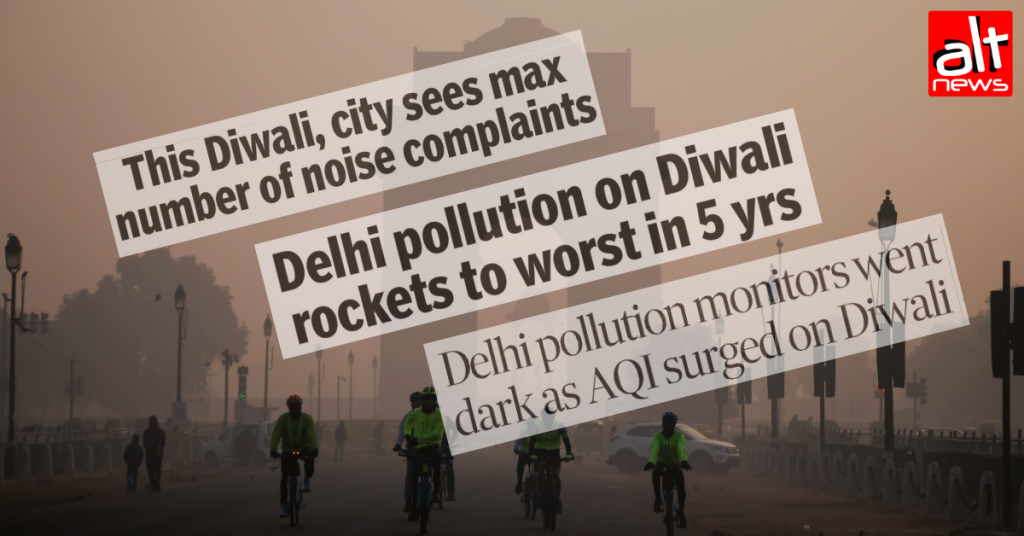
Two days after Diwali was celebrated across India, on November 10, Tuesday, the nation woke up to grim newspaper headlines and reports highlighting the sharp deterioration of air quality across major cities. According to reports, 93 Indian cities appeared among the world’s 100 most polluted locations, several parts of Delhi reportedly witnessed a staggering Air Quality Index (AQI) of 3,000+, and six cities recorded an AQI above 1,000 at 9 pm on Diwali night.
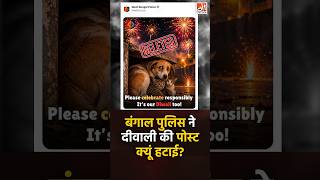
Newspaper reports suggested that despite bans and restrictions, the bursting of firecrackers remained untethered across states, resulting in not only a severe surge in air pollution, but major fire accidents, noise pollution, and several people, stray animals and birds suffering burn injuries.
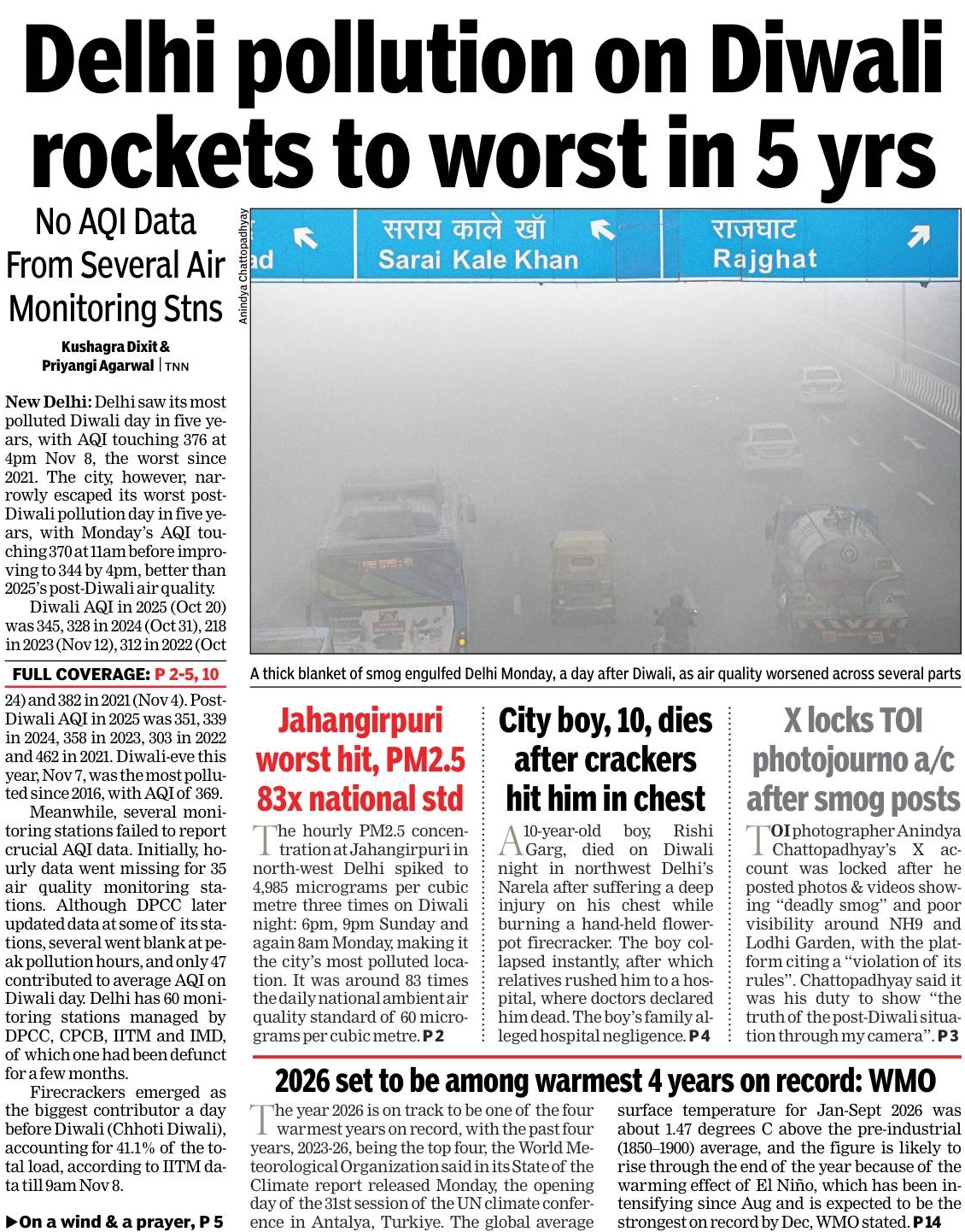
The front page of the Delhi edition of The Times of India on Tuesday led with a report headlined ‘Delhi pollution on Diwali rockets to worst in 5 yrs’.
“Delhi saw its most polluted Diwali day in five years, with AQI touching 376 at 4pm Nov 8, the worst since 2021. The city, however, narrowly escaped its worst post-Diwali pollution day in five years, with Monday’s AQI touching 370 at 11am before improving to 344 by 4pm, better than 2025’s post-Diwali air quality,” the report read, while highlighting that “several monitoring stations failed to report crucial AQI data”.
The front page also carried reports on the death of 10-year-old Rishi Garg in Delhi’s Narela after suffering a deep injury on his chest while bursting a firecracker; the hourly PM2.5 concentration at Jahangirpuri surging to 4,985 µg/m³ on Diwali night, which is 83 times the daily national ambient air quality standard; and X “locking” the account of TOI photojournalist Anindya Chattopadhyay after he posted visuals of smog in Delhi, citing violation of its rules.
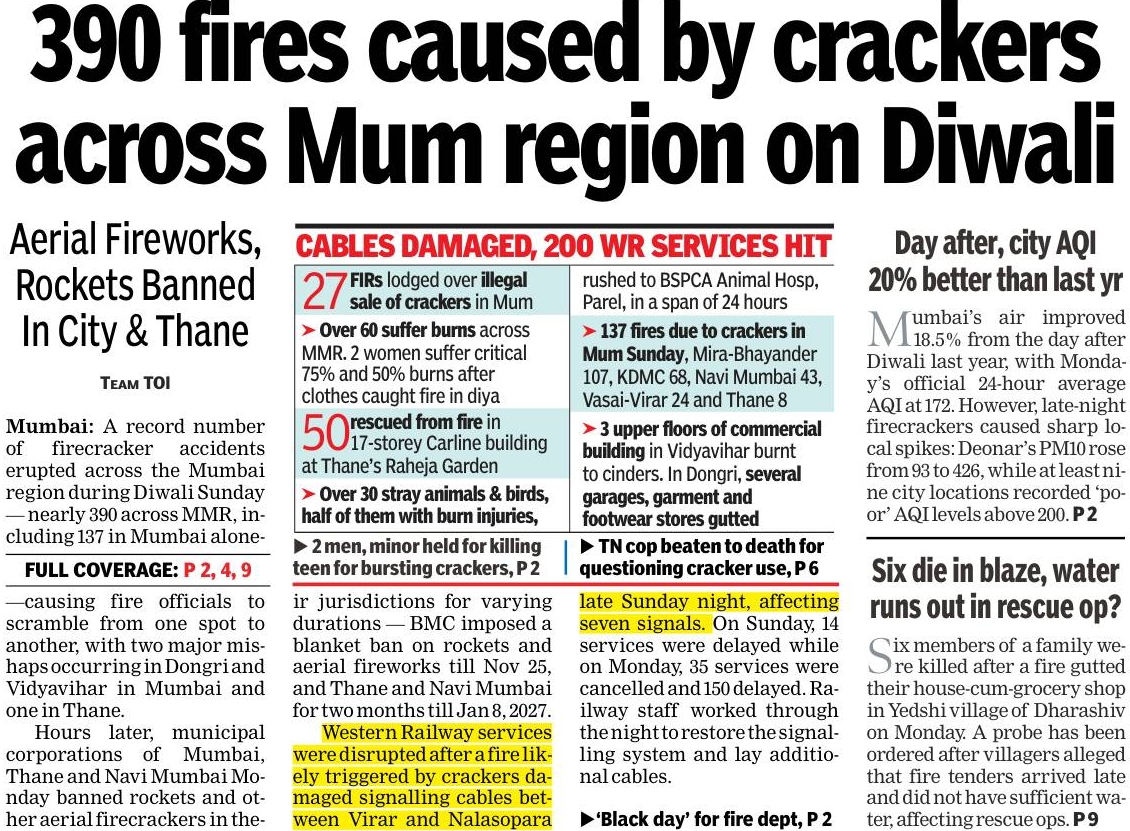
The Mumbai edition of the paper on Tuesday reported “a record number of firecracker accidents” across the city on Diwali, with the headline ‘390 fires caused by crackers across Mum region on Diwali’. The report highlighted that the local train services on the Western line were disrupted due to a fire damaging signalling cables between Virar and Nalasopara. It noted that over 60 people suffered burns across Mumbai Metropolitan Region and over 30 stray animals and birds sustained burn injuries due to crackers, among various other major accidents and mishaps across MMR.
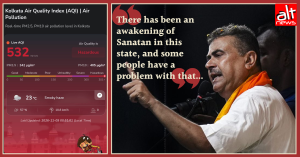
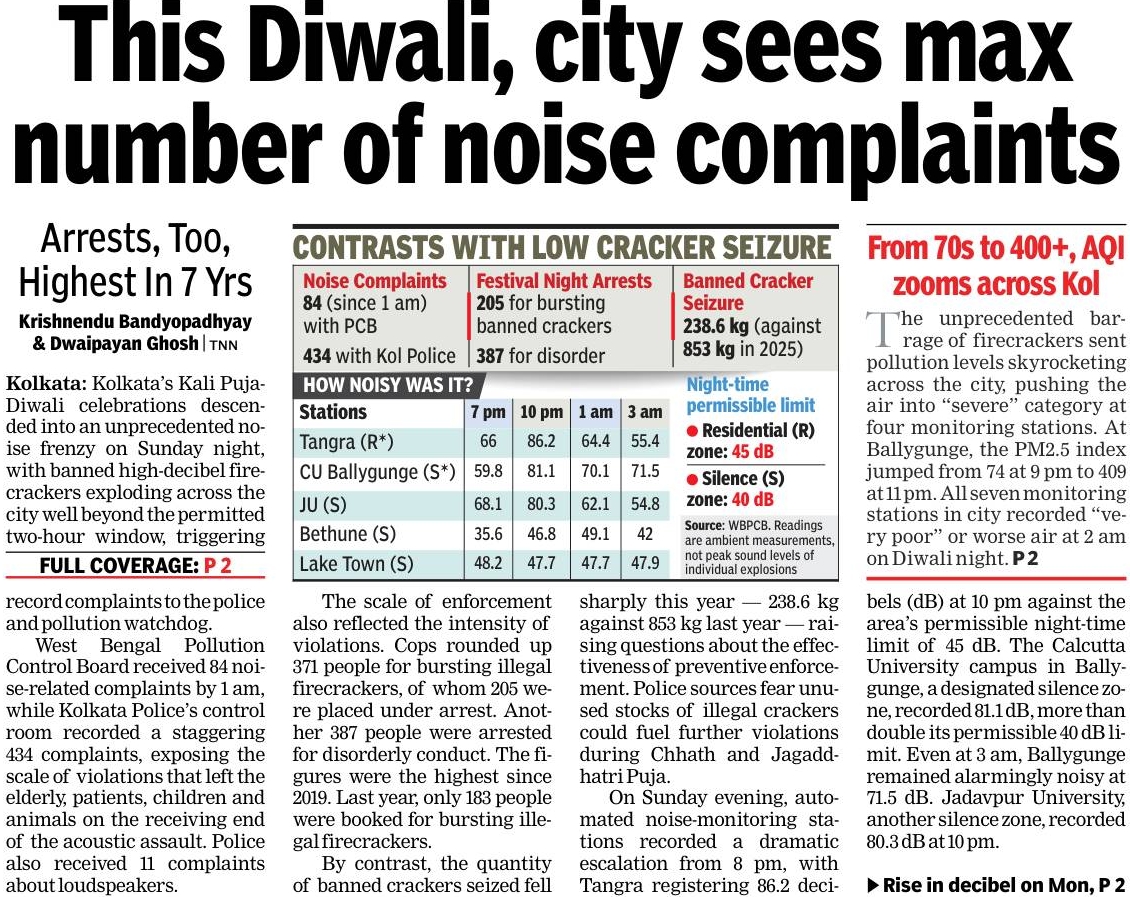
Similarly, the Kolkata edition led with a story on firecracker-related noise complaints. With the headline, ‘This Diwali, city seeks max number of noise complaints’, the report highlighted the widespread bursting of banned high-decibel firecrackers across the city, well beyond the permissible hours, making Sunday night one of the noisiest in recent years. Kolkata’s air quality deteriorated sharply over the same period, with readings lying between the “very poor” and “severe” categories from Sunday night to the intervening morning, and PM2.5 rising from 74 to 409 in Ballygunge and 115 to 444 in Salt Lake within a span of 2 hours, the report highlighted.
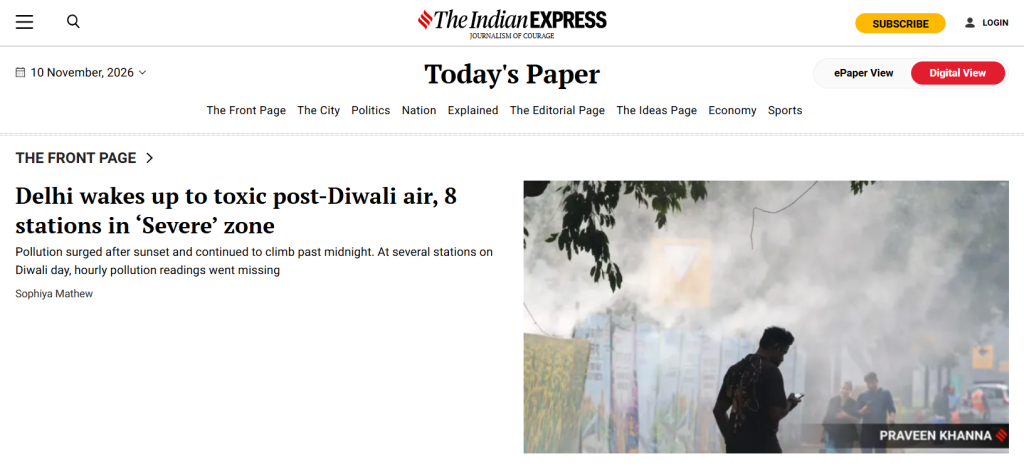
The front page Delhi edition of The Indian Express on Tuesday carried the lead story on pollution with the headline ‘Delhi wakes up to toxic post-Diwali air, 8 stations in ‘severe’ zone’. It reported that the capital had recorded its “worst” Diwali-day air quality in the last five years. Pollution levels rose sharply after sunset and remained elevated into the following morning, with PM2.5 concentrations touching nearly 5,000 µg/m³ at some monitoring stations. India’s 24-hour national ambient air quality standards prescribe a safe limit of 60 µg/m³ for PM2.5 and 100 µg/m³ for PM10.
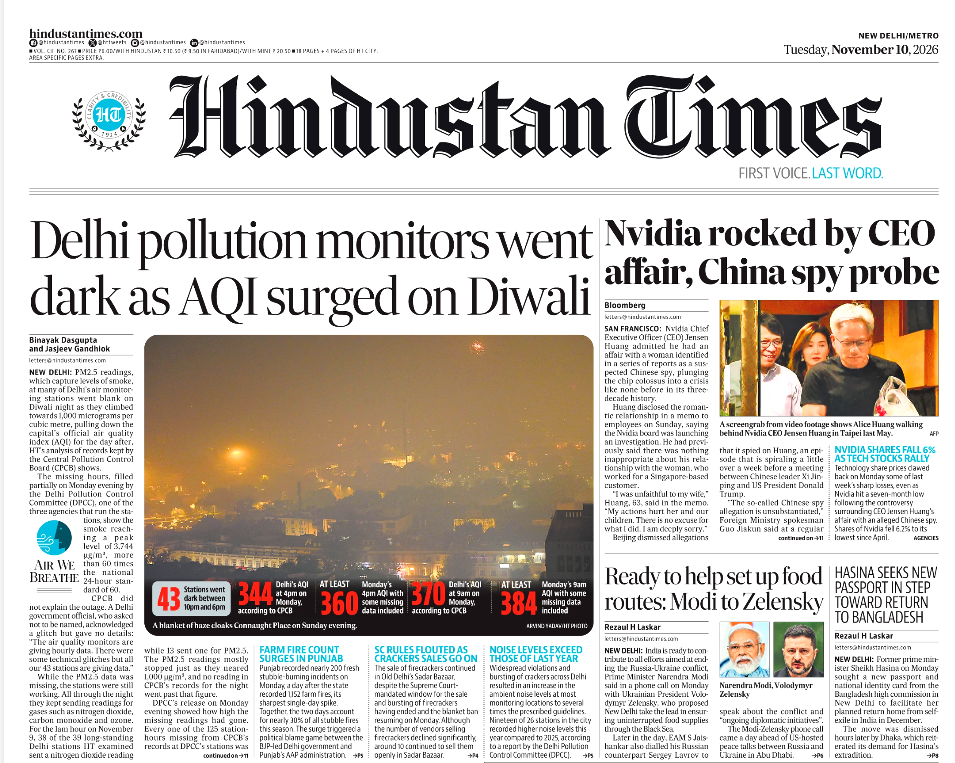
The lead story of the Hindustan Times carried the headline, ‘Delhi pollution monitors went dark as AQI surged on Diwali’. According to the report, 43 of Delhi’s 59 air quality monitoring stations went “blank” on Diwali night just as PM2.5 readings surged towards 1,000 µg/m³. The data gaps reportedly affected the calculation of the capital’s daily AQI, raising questions about the reliability of pollution monitoring during peak pollution hours.
The front page also featured reports on Punjab recording nearly 200 stubble burning incidents on November 9, Monday; the sale of firecrackers continuing in Delhi despite a Supreme Court ban; and the rampant bursting of firecrackers leading to an increase in ambient noise levels across most monitoring stations in Delhi.
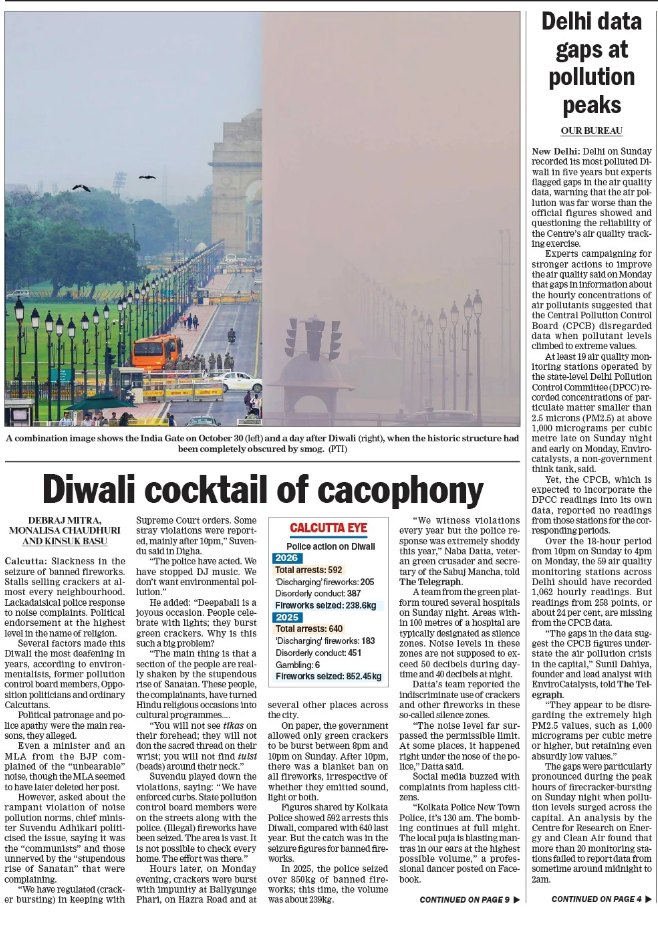
The Telegraph featured a collage showing the contrast of visibility of Delhi’s India Gate before and after Diwali, with photographs taken on October 30 and November 9 respectively. With the lead headline reading ‘Diwali cocktail of cacophony’, the front page reports covered the aftermath in both Delhi and Kolkata, highlighting data gaps in Delhi’s pollution monitoring during peak pollution hours and administrative inaction in Kolkata.
“Slackness in the seizure of banned fireworks. Stalls selling crackers at almost every neighbourhood. Lackadaisical police response to noise complaints. Political endorsement at the highest level in the name of religion. Several factors made this Diwali the most deafening in years, according to environmentalists, former pollution control board members, Opposition politicians and ordinary Calcuttans,” the report read.
The Telegraph reported that this Diwali celebration was Delhi’s most polluted Diwali in five years. It noted that, over 18 hours, from 10 pm on Sunday to 4 am on Monday, 59 air quality stations in the national capital should have recorded 1062 hourly readings; however, around 24% are missing from the Central Pollution Control Board (CPCB) data.
On Kolkata’s exceeding noise pollution levels, the report stated that “even a minister and an MLA from the BJP complained of the “unbearable” noise…However, asked about the rampant violation of noise pollution norms, chief minister Suvendu Adhikari politicised the issue, saying it was the “communists” and those unnerved by the “stupendous rise of Sanatan” that were complaining.”
ALSO READ: Suvendu calls firecracker critics communists as Kolkata chokes on Diwali pollution
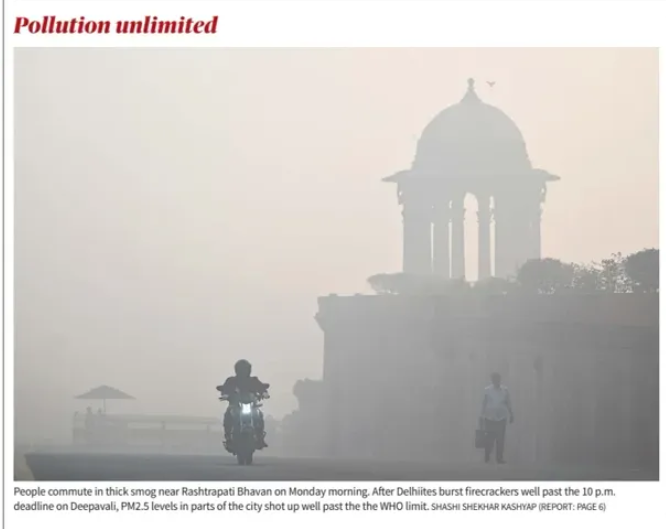
The Hindu on Tuesday carried a standalone image of thick smog enveloping Rashtrapati Bhavan on Monday morning with the caption ‘Pollution unlimited’. On Page 6, it further reported that air pollution levels in Delhi had spiked to 200 times the World Health Organization’s recommended limits during Diwali.
Hospitals Report Burn Patients; Doctors Raise Concerns
“I am honestly surprised that we are still alive. I do not think this kind of air is suitable for human survival,” Dr Vijay Hadda, professor, department of pulmonary medicine and sleep disorders at AIIMS, told ANI on Monday.
He said that the green crackers reduced emissions by only 30 per cent, but as far as the particulate matter was concerned, 70 per cent of the emissions remained the same as conventional firecrackers. He raised concerns over people breathing this ‘poisonous’ smoke and said, “You should understand that you are simply inhaling poison and exhaling it.”
#WATCH | Delhi: On air pollution, Dr Vijay Hadda, Professor, Department of Pulmonary Medicine & Sleep Disorders, AIIMS, says, “These green crackers reduce emissions by only 30%. As far as the gases and particulate matter are concerned, 70% of the emissions remain the same as those from conventional firecrackers. The AQI, which used to be in three digits, has now reached four digits. If you compare Delhi’s air quality with that of other cities, you will find that there is almost a 50% difference. Obviously, life is not going to be easy for the people living here. You keep inhaling this poisonous smoke, breathing it in continuously. Every minute, you breathe at least 20 times, taking in at least half a litre of air with each breath. I am honestly surprised that we are still alive. I do not think this kind of air is suitable for human survival. I am absolutely certain that as time passes, we will begin to see its effects. Many of my colleagues who are otherwise completely healthy have been calling me and saying, “I am unable to get rid of this irritation. It feels as though something is stuck in my throat.” We saw patients during our last OPD session, and they have returned again today. This happens every year, but somehow, we all forget. The general public forgets, and even policies remain somewhat in a grey area, making it difficult to understand how they should be interpreted. Overall, the situation is not good at all. You should understand that you are simply inhaling poison and exhaling it…”
— ANI (@ANI) November 9, 2026
In the aftermath of Diwali, doctors in Delhi began reporting an alarming number of juvenile patients, including newborns, arriving with breathing difficulties, even as hospitals are witnessing a significant rise in respiratory illnesses. According to reports, 397 patients with Diwali-related injuries were treated at four major hospitals in Delhi. The cases included burns, firecracker injuries and eye trauma.
AIIMS reported 42 burn injury cases by 11 am on November 9. Of these, 37 were caused by firecrackers. Eleven patients sustained major injuries, while 31 had minor injuries. Eight were admitted, including one in critical condition. Moreover, 18 of the 42 patients were under 18, including six below the age of 10. An eight-year-old child at AIIMS was in critical condition after sustaining burns over 45 per cent of their body surface area. Safdarjung Hospital recorded 135 burn injury cases. Of these, 129 were attributed to firecrackers and six to traditional diyas. Seven patients sustained major burns requiring hospital admission. The hospital also treated 35 children with firecracker-related injuries in its outpatient department.
Ram Manohar Lohia Hospital treated 41 patients with burn injuries from 9 am on Saturday. 18 of these injuries were reportedly caused by firecrackers, with two patients requiring admission. Eight patients were hospitalised overall, while approximately 10–12 of those treated were children. Guru Tegh Bahadur Hospital reported 172 patients with firecracker burns and other Diwali-related injuries within 24 hours. Among them were 25 children and 56 women. Thirty-four patients also suffered eye injuries.
The toll was not limited to burn injuries. The Dr Rajendra Prasad Centre for Ophthalmic Sciences at AIIMS received nearly 110 patients with eye injuries on Sunday and during the early hours of Monday, most of them with firecracker-related ocular injuries. 18 patients suffered corneal perforations or lacerations and underwent surgical intervention.
In Pali, Rajasthan, sparks from firecrackers being burst on a road reportedly reached a firecracker shop near Swarn Mandir in Falna town, gutting three shops and killing two people. One person sustained burn injuries and three others were initially reported missing.