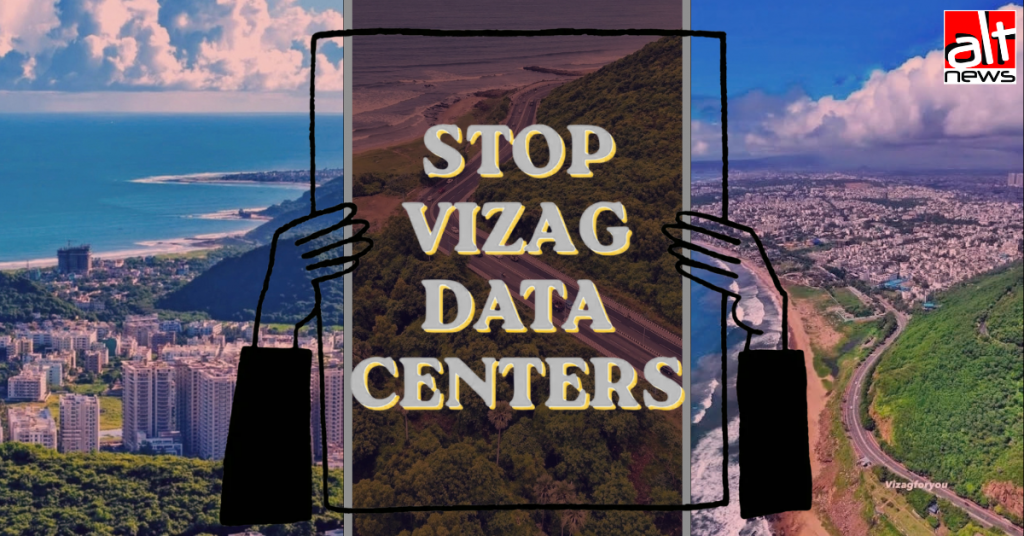
Amid increasing state-sanctioned censorship of digital content across platforms like Meta and X, activists, journalists, cartoonists, artists, opposition politicians and others critical of the Bharatiya Janata Party (BJP) government and its policies have faced sweeping content restrictions and takedowns in the last few months. The latest to face such censorship are those raising concerns over the establishment of large-scale data centres in Visakhapatnam.
The port city in Andhra Pradesh is witnessing a massive digital infrastructure push, with investments of up to ₹1.25 lakh crore planned over five years (2026–30) and more than 2,000 acres of land earmarked for data centre projects. In October last year, Google and Adani formally announced an AI hub project in Visakhapatnam. By December 2025, 308 acres at Tarluvada, 120 acres at Adavivaram and 160 acres at Rambilli had been identified for the project. In January this year, reports indicated a much larger expansion involving Google, Sify, Reliance and CtrlS.
In April, the state government and Google laid the foundation stone for the Google Cloud India AI Hub at Tarluvada village. The facility, spread across 266.6 acres, is expected to draw 1 GW of power and is reportedly Google’s largest data centre outside the United States.
The projects are expected to make Visakhapatnam a major eastern data and subsea-cable hub, providing direct routes for Indian data to the US, South Africa, Singapore and Australia. Officials say this could reduce reliance on existing routes through Chennai, Kochi and the Red Sea, while shifting high-value technology activity from expensive metros to other cities.
But local influencers and journalists have raised concerns about the environmental and ecological impact of this rapid expansion of data centre infrastructure in Visakhapatnam and beyond.
ALSO READ: Government orders trigger sweeping Instagram censorship days after CJP protest
Why the Data Centres are being Opposed
The Stop Dirty Data Centre campaign, led by over 60 individuals, formed to “oppose the setting up of 6.5 GW of AI data centres”, lists over 10 proposed data centres spanning across over 2,500 acres of land in Visakhapatnam. Besides the Tarluvada facility, the list mentions two other major Google-Adani Hyperscale data centers: At Rambilli village consuming 1 GW of power across 174.8 acres, and at Adavivaram-Mudasarlova consuming 512 MW of power across 165.40 acres of land. All three are currently under-construction.
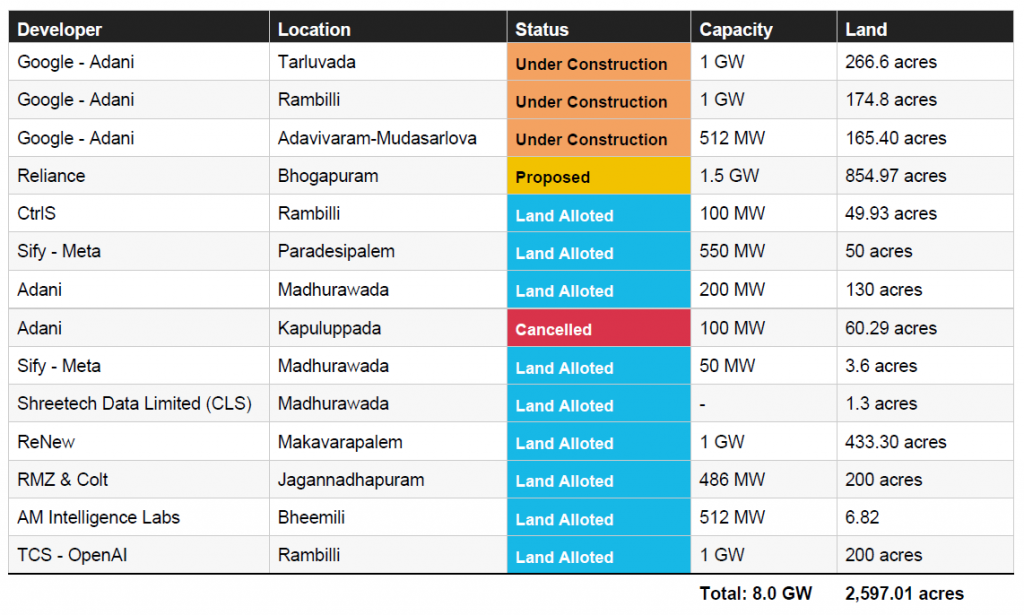
It is important to note that Adavivaram-Mudasarlova is around 120 metres from the Mudasarlova reservoir — a critical drinking water source for the city; it also lies near the Kailasagiri-Kambalakonda forest landscape. The Tarluvada site is located 1.53 km from the Kambalakonda Wildlife Sanctuary and about 450 metres from its notified Eco-Sensitive Zone (ESZ) while the Rambilli site lies on the Anakapalli coast and is surrounded by forests.
As most of these sites lie on coastal regions, close to wildlife sanctuaries, forest areas and ESZs, opponents of this expansion project have flagged the disproportionate energy and land usage, large-scale hill cutting, deforestation, and further water depletion in an already water-scarce zone — Visakhapatnam’s water demand already exceeds supply by around 70 million litres per day. They also cite the massive impact on climate, biodiversity, wildlife sanctuaries, coastal ecosystems, and residential areas as serious detrimental effects.
“If fully built, the proposed AI data centers capacity could consume as much as the entire electricity currently used by the state of Andhra Pradesh,” states the campaign website. “Vizag is already severely water stressed and cooling these data centers could take up almost half of city’s supply based on estimates; the proposed land allocation is roughly equivalent to more than 700 cricket grounds, and is present in eco-sensitive regions; hyperscale AI facilities can significantly increase regional greenhouse gas emissions through backup Diesel Generator (DG) sets, solid waste, and more,” it adds.
Critics also highlighted the lack of transparency and public awareness around the setting up of these data centres, demanding that these projects be undertaken in consultation with locals and not unilaterally by the state and corporations. “In a brazen act of environmental lawlessness, forest land at the site [for the Adavivaram-Mudasarlova data centre] was cleared by the project proponent over several months even before environmental clearance was obtained,” alleges a petition initiated by the campaigners.
Citizen Movement Flagging Environmental Concerns Blocked
Against this backdrop, on September 19, the Instagram account of the Stop Vizag Data Centre campaign was banned in India under Section 79(3)(b) of the Information Technology (IT) Act, 2000.
One of the founders, Deeksha Vanguru, told Alt News that they did not receive any prior notification. While the account was restored on September 27, nine of their posts critical of the data centre expansion, which were restricted over the last two months, remain unavailable in India.
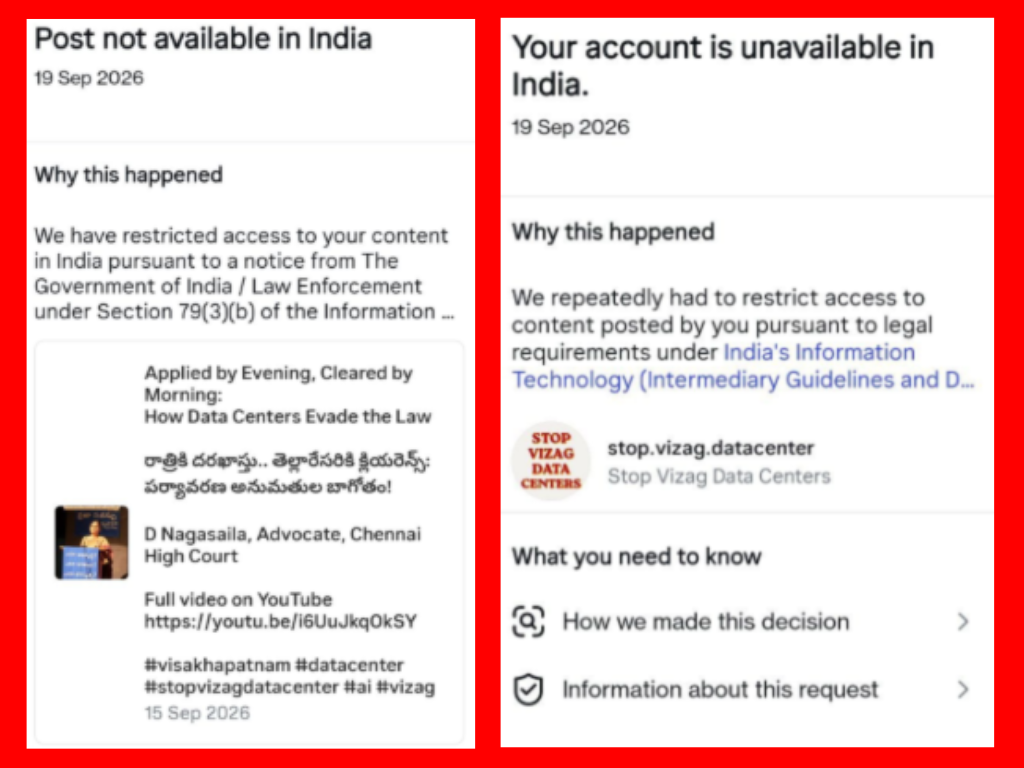
“Our page was apparently blocked due to a local government request, we appealed to Meta and it was restored due to that request being either expired or reversed. However, our reach has been affected and posts are getting shadowbanned. We had to open a backup account in the meanwhile because we did not want to stop our fight. We are still fighting for the restoration of our nine posts,” Vanguru said.
“We started this as a citizen group in July this year. Most of us are born and brought up in Visakhapatnam and we couldn’t sit and watch the destruction of our home. We wanted to ensure that voices of the farmers, fishermen, villagers, and common citizens are heard. Initially, there was a small-scale mobilisation of citizens, but it needed more youth anger, therefore we turned the campaign into a social media project,” she added.
ALSO READ: Content creators decry Instagram censorship, call restrictions a ‘digital emergency’
“A big concern around AI data centres globally is the consumption of fresh water, and India is already going into a phase of water scarcity. The 10 data centres together are going to consume 200 MLD of water, which is 50% of the city’s daily water supply. The DGs will require constant air conditioning because they claim to be using advanced air cooling, thus the energy strain on the grid will be extremely high. Due to the constant running of generators and ACs, there could be overheating. The whole thing is going to be concrete, which will increase the land surface temperature and reduce night-time cooling. The average night-time temperature in Visakhapatnam has alreadt gone from 23-24 degrees to around 28 degrees,” she said.
Vanguru alleged there was no transparency while these data centres were being set up.
“The government hasn’t held any public consultation with either the farmers or the people of Vizag living close to these sites. In fact, environmental clearances for a 600-acre project, now broken up to escape scrutiny, was given within nine days. On April 9, the environmental clearance request was filed and it was received on April 18. There was no Environmental Impact Assessment (EIA) because these projects haven’t been categorised as Category A projects (considered to have greater potential environmental impacts and are appraised by the Union environment ministry and require an EIA) but as Category B2 projects, which means buildings and construction. The way the government has gone about this is as if they’re building malls,” she said.
Further, Vanguru claimed that these data centres had nearly nothing to offer to the locals, even in terms of job creation, which she said was one of the upsides of an industrial construction. “When we checked the environmental clearances, the number of permanent jobs being created was only 1,725. The rest are all construction jobs and temporary jobs. These temporary and construction jobs are being positioned as skilled jobs, but in India, the government definition of skilled means blue-collar jobs. So it keeps people in the same worker or employee cycle and doesn’t really help uplift people from poverty,” she added.
Original Reportage on Dalit Displacement Blocked
After the Tarluvada data centre’s construction began, independent journalists Shamsheer Yousaf and Monica Jha began reporting the ground realities of the construction in early January, as part of the Dirty Data project undertaken by the Environmental Reporting Collective (ERC).
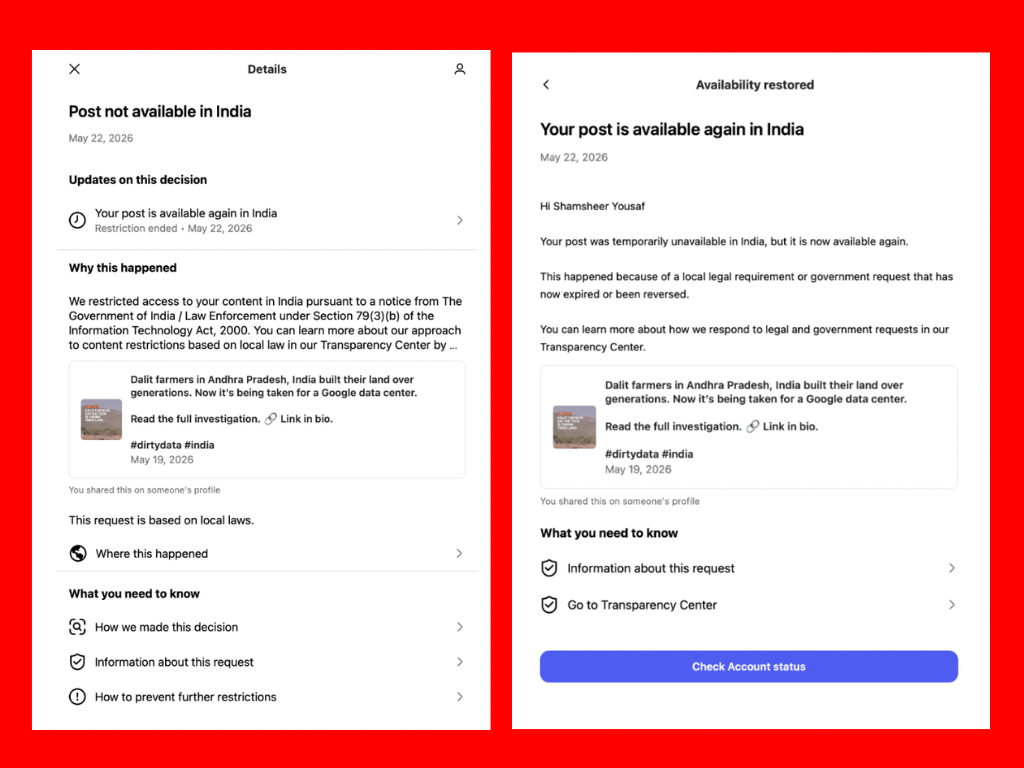
A 2-minute long Instagram reel posted by ERC in collaboration with Yousaf, which features interviews of Dalit farmers in the village who are faced with imminent displacement, was blocked in India on May 22 under Section 79(3)(b) of the IT Act with no prior notice. In the reel, which garnered 2.6 million views and 46,000 shares, several farmers say that they were granted the land over 50 years ago by the Congress government and have since cleared forests to build homes and farms, which is their only form of subsistence — all under threat as the same land has been allocated to the Google-Adani data centre.
View this post on Instagram
The reel formed part of a 5-minute-long video published on Dirty Data’s website alongside the report, ‘As data centers arrive, India’s poorest face displacement, health risks’ by Yousaf and Jha. Yousaf wrote to the Union ministry of electronics & information technology (MeitY), seeking the blocking order, reasons for the action, restoration of the reel and a personal hearing in order to appeal or respond. He also wrote to Meta’s grievance officer in India.
ALSO READ: Meta restricts posts by Indian Youth Congress, AAP, Opposition leader
Upon not receiving any response from either authorities, on June 30, Yousaf and Jha moved the Delhi high court with a writ petition. A month later on July 23, the petitioners were given access to the blocking order which revealed the authority behind the restriction as the director general of police (DGP), CID, Andhra Pradesh.
‘Procedural Lapses, Unconstitutional Takedown’
In a report, the Internet Freedom Foundation (IFF), whose lawyers are representing the petitioners, highlighted certain procedural lapses in the blocking order and claimed that the takedown was “unconstitutional”. The order names one Mr. Vemireddy Prabhakar Reddy, alleging that the video “spread misinformation” against him. However, this individual does not feature anywhere in the reel or any of the journalists’ reportage on the data centre issue; he is also not known to either of them.
IFF had then sent a legal notice to the principal secretary, home department and the DGP-CID, Andhra Pradesh, flagging this discrepancy and violation of the provision of the IT Rules, 2021. “…there have been several procedural lapses which violated Rule 14 of the IT Rules, 2021..the Petitioners were not served with any notice…never afforded an opportunity to submit a response/defend themselves…provided with a copy of the blocking order…[the takedown] directly affected [the petitioners] right to freedom of speech and expression under Article 19(1)(a) of the Constitution,” the report read.
On September 10, the reel was restored. Yousaf found out through a notification this time, that the restriction was lifted as the “local legal requirement or government request that has now expired or been reversed” — similar to Vanguru’s case.
Local Influencers, HRF Silenced
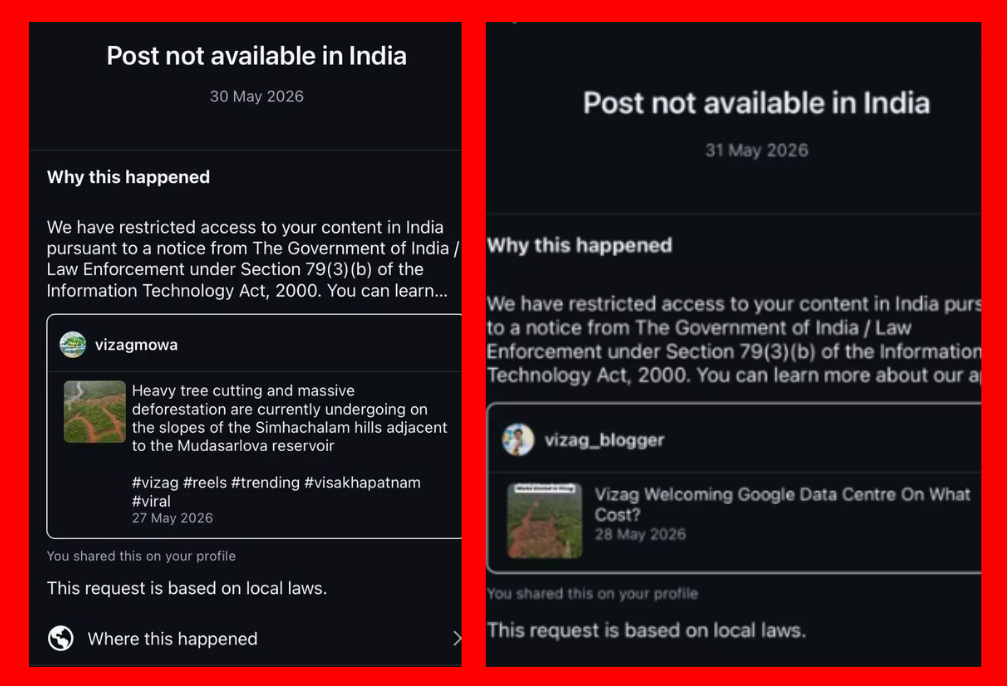
In the same vein, several local influencers reported that their reels critical of the data centres were being arbitrarily taken down. Malla Gnanesh, who runs the page @vizag_blogger, told News Meter, that a reel he posted on May 28 titled ‘Vizag Welcoming Google Data Centre — At What Cost?’ was restricted in India on May 31. In the reel, Gnanesh spoke about the massive loss of green cover due to the construction of the data centre at the Adavivaram-Mudasarlova region.
Another account, @vizagmowa, also posted a reel on the negative environmental impact of the same data centre such as massive deforestation and water depletion due to its proximity to the Mudasarlova reservoir. This reel was withheld in India on May 30 with the same Section 79(3)(b) notification. Both reels remain restricted till date.
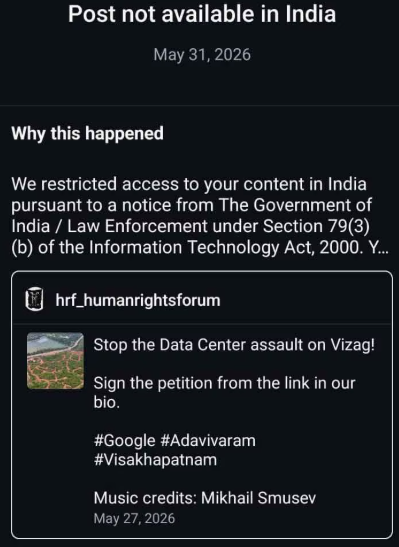
Human Rights Forum on June 1 published a statement condemning the rampant restrictions. Four of HRF’s own Instagram posts were blocked in India on May 31 and June 25, again under Section 79(3)(b) of the IT Act.
Speaking to Alt News, Andhra Pradesh state secretary of HRF, Rohith Gutta, stated: “We have moved the Andhra Pradesh high court with a writ petition against the unlawful restriction on September 28, demanding the blocking order, the reason for the action and the immediate restoration of our posts,” he said.
ALSO READ: Instagram censorship puzzle: Alt News post survives only after ‘Burhan Wani’ is removed
He mentioned that all four posts were critical of the date centre expansion. The two posts blocked on May 31 publicised an online petition seeking transparency and accountability regarding the proposed data centre projects; demanded an immediate stoppage of all ongoing site activities at the proposed sites in Adavivaram and Mudasarlova villages of Visakhapatnam Rural mandal.
The next two blocked on June 25 showed a protest in the city against the construction of all three data centres; questioned how the Adavivaram data centre received environmental clearance despite being located within an ESZ, close to the Mudasarlova reservoir. One of the these posts directly asked: “Should a Resource-Guzzling, Intensely Polluting Data Center be Located near a Reservoir? On its Catchment?”
“The restrictions imposed on HRF content by Instagram do not appear to be isolated incidents but form part of a broader pattern,” the Forum wrote while highlighting the restrictions imposed on Yousaf and Jha’s work with the ERC. The Forum also put out another statement condemning the restriction of the Stop Vizag Data Centers account.
Speaking about the ordeal, Rohith told Alt News, “The restrictions have not deterred us from speaking up against the data centres, however, it is a painful experience. We received no prior notification all four times and when we searched for the reason, it was only a vague message repeated word for word four times. It feels like you are legally violated because your work is banned without explanation. Now, blocking of posts is akin to being arrested digitally. We are living through times of ‘social media arrest’ and they [the authorities] have blocked all means to fight it.”
Alt News has reached out to Meta’s grievance officer in India and Kumar Vishwajeet, the principal secretary, home, Andhra Pradesh government. This article will be updated if and when we receive a response.
It is worth noting that the opposition to the projects has also spilled onto the streets, with residents, activists and environmental groups staging protests in Visakhapatnam over concerns around water consumption, deforestation, displacement and the environmental impact of the projects.
With inputs from Ankita Mahalanobish