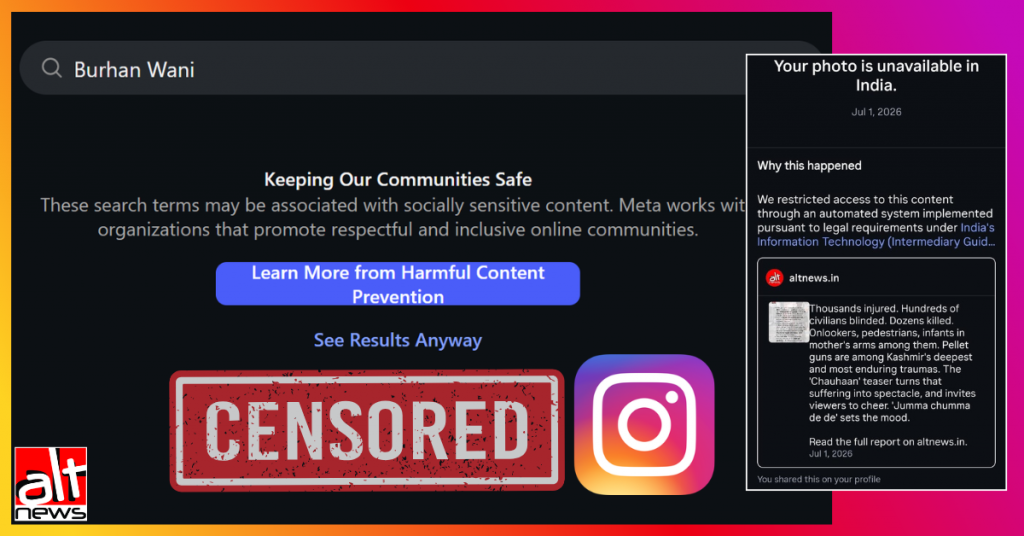
In July, an Alt News post about the upcoming Bollywood film ‘Chauhaan’ was removed twice by Instagram. The post survived when we shared it the third time, but only after two references to Burhan Wani were removed. The episode offers a glimpse into the opaque manner in which content restrictions are being enforced on Instagram in India, and raises key questions amid growing concerns over censorship on the platform.
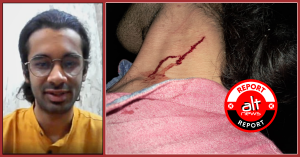
The original post was a carousel based on an Alt News analysis of the teaser of ‘Chauhaan’ starring Ajay Devgn. The 2.24-minute video shows its protagonist dismissing pellet guns as an ineffective crowd-control measure causing only “limited damage”. This stands in stark contrast to the documented reality in Kashmir, where pellet guns have killed scores, and blinded or permanently disabled thousands. The teaser sparked an online backlash for trivialising violence as entertainment, pairing it with upbeat music. The story can be read here.
Alt News first uploaded the carousel on July 1. Instagram restricted the post within minutes. Since the carousel contained visuals of pellet injuries, Alt News initially suspected that these images might have triggered the removal. The carousel was therefore modified, with some of the visuals changed, and uploaded again.
Instagram removed the second version as well.


Alt News then removed two references to Burhan Wani on two slides in the carousel and uploaded it for a third time. This version was allowed to remain online.
The sequence raises the possibility that the use of Burhan Wani’s name itself may be restricted on Instagram in India — an apparent moderation measure that has not been publicly announced by either Meta or the Indian government.
A search for “Burhan Wani” on Instagram currently yields no results.
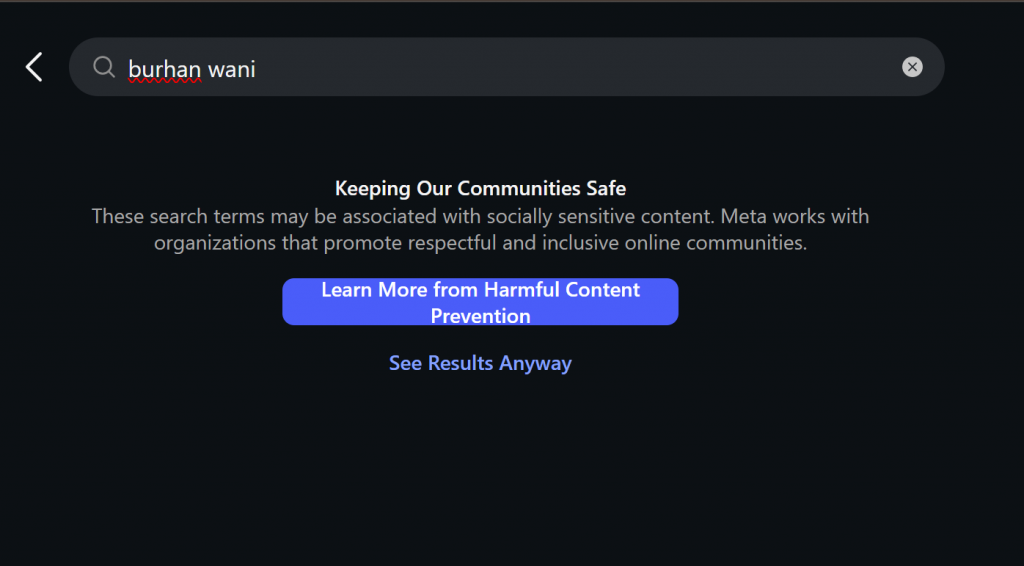
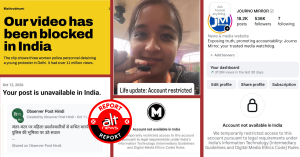
What makes the episode particularly striking is that Instagram never explicitly told Alt News why the post was being removed. The platform’s notifications stated that the action had been carried out “through an automated system implemented pursuant to legal requirements” and cited India’s Information Technology (Intermediary Guidelines and Digital Media Ethics Code) Rules.
The notification did not identify the specific legal requirement behind the action, the government order on the basis of which the post had been restricted, or the particular element of the post that had triggered the removal — a point that multiple users affected by the government-ordered censorship frenzy has flagged over the past weeks.
An Opaque Moderation System that Leaves Users Guessing
As for us, Alt News had to figure it out through trial and error. This raises the question — Why should a user have to go through this process to find out why their post has been restricted? If a particular name, word or image is prohibited under a legal order, why does the notification not clearly state so? A user should not have to repeatedly alter and repost content, guessing what may have triggered a platform’s moderation system.
The opacity is particularly concerning because the platform appears to know what triggered the restriction. Its automated system identified the content and removed it within minutes, yet the user is given no meaningful explanation for the action. Instead, the notification offers only a generic reference to an automated system and “legal requirements”.
Besides, a blanket restriction on a name such as “Burhan Wani” makes little sense because names can occur in entirely unrelated contexts. Other people may share the same name, while legitimate references, including news reports, historical discussions or fact checks, could be caught by the same restriction.
Alt News emailed Meta spokespersons asking when the apparent moderation rule relating to Burhan Wani was implemented, why it was enforced without public notification, why users were not clearly informed about the reason for the restriction, and what other names or keywords may be subject to similar restrictions. The company has not responded.
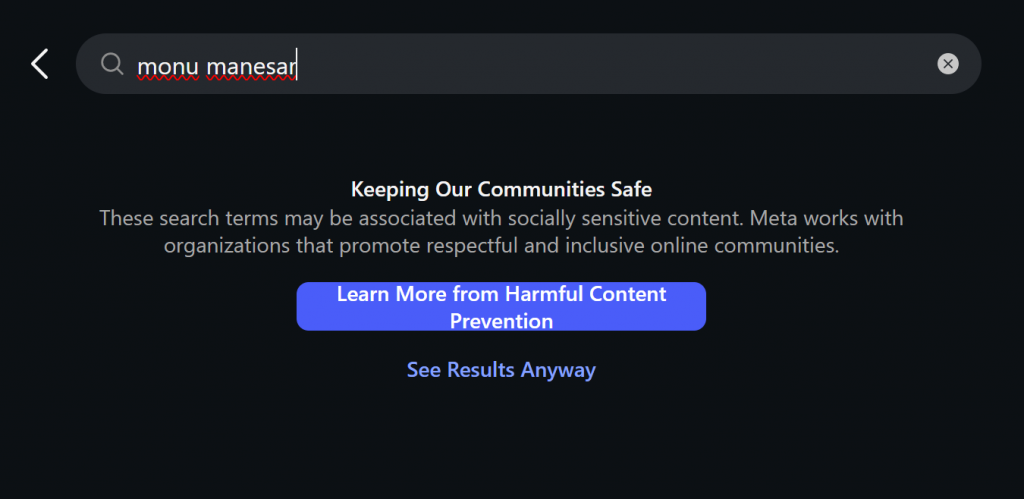
Interestingly, we found that a similar restriction may be in place for ‘Monu Manesar’ was well. A search with these terms throws up the same response. Mohit Yadav alias Monu Manesar, a controversial ‘gau rakshak’ associated with the Bajrang Dal, has been accused in several cases linked to vigilantism and communal violence. He was arrested in 2023 in connection with the alleged abduction and murder of Nasir and Junaid, two Muslim men from Haryana. He has denied the allegations against him.
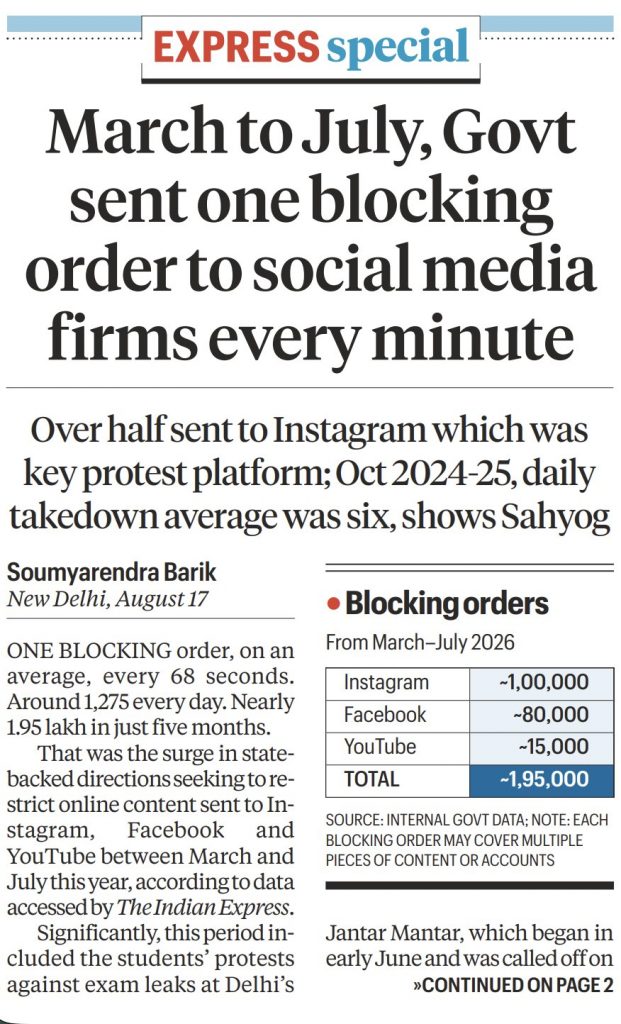
The apparent restriction comes amid a wider and increasingly opaque censorship controversy surrounding Instagram in India. A recent investigation by The Indian Express found that from March to July 2026, the government sent 1.95 lakh blocking orders to Meta, or one every minute on an average. Over 1 lakh of these were for Instagram.
The Burhan Wani episode illustrates another dimension of this opacity. If the name is itself subject to an undisclosed moderation rule, users have no way of knowing this in advance, or of understanding why content that merely mentions him is being restricted.
And even though the sequence strongly suggests that the references to Burhan Wani triggered the removals, this remains an inference. Instagram has not confirmed that this was the reason.
It must be noted, however, that searches for the terms — ‘Monu Manesar’ and ‘Burhan Wani’ — yield some relevant search results on Facebook, despite warnings about socially sensitive content.
Fact-Check Posts Restricted
Posts related to an Alt News fact check were restricted in July 2026 on both Faecebook and Instagram.
The report looked at false claims about an old video that showed armed Nihangs clashing with police and breaching barricades. It was being circulated as ‘Khalistanis’ joining the Cockroach Janta Party protests at Delhi’s Jantar Mantar. In reality, the video was from June 25, 2026, nearly a month before the CJP protests, and showed Nihangs from Punjab marching toward Uttarakhand during a protest. The story can be read here.
Our social media posts on the fact check were restricted in India by both the platforms. And we do not know why.


Readers should note that a click on the ‘How we made this decision’ tab does not bring about any clarity. The response only states, “We are legally required to restrict access to your post in certain locations. We have taken this action based on a local legal requirement.”