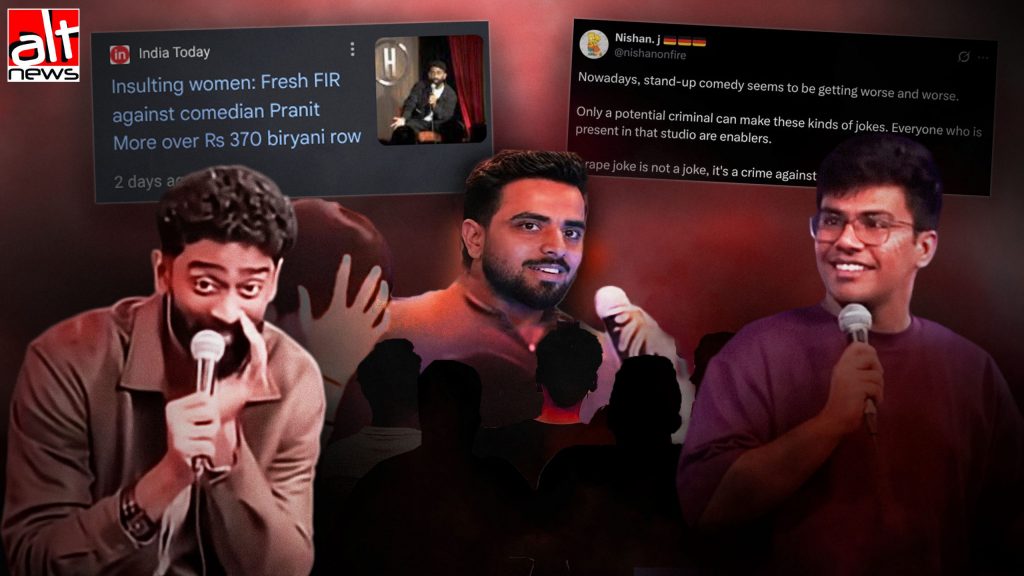
Over the past week, social media has been abuzz with outrage over two viral video clips — the ‘ ₹370 biryani’ joke cracked on comedian Pranit More’s stand-up show at Gurugram, and a resurfaced clip Madhur Virli cracking a rape ‘joke’.
While some netizens have found both clips to be distasteful, disturbing and furthering a certain brand of punching down comedy that attacks the dignity of women, the uproar has opened up a larger discourse on the untethered proliferation of misogynistic content masquerading as ‘dank humour’ or ‘roast culture’ online. In the same vein, it has brought under scrutiny whether criminal prosecution of stand-up comedians is the answer to the rise of misogynistic and sexist content.
Albeit ‘the line between a joke and an act of prejudice’ has been debated for decades, these two instances have particularly upset audiences at a time when hateful content has reached a saturated peak, with scores of users posting reaction videos strongly condemning the two clips.
“When you [the comedian] punch down, you are implying that you side with institutions of power rather than with victims or disenfranchised people who need a voice. Art was never meant to be a support function of oppression,” comedian Daniel Fernandes, who was among the first comics to react to the More incident, told Alt News.
View this post on Instagram
‘Making my Money’s Worth’
In the first instance, audience member Himanshu Jangra (23) was seen on Thane-based performer More’s show narrating a date he went on, spending ₹370 on chicken biryani, dropping the woman home, and then expecting some form of sexual “return”. After his remark, the audience and More himself could be seen breaking out into loud laughter. More could also be heard remarking that this was ‘peak Gurgaon content’. The clip went viral on June 8.
View this post on Instagram
Earlier in the same clip, Jangra stated, “She held me tightly while sitting on my bike…she was around 27…28-years-old while I am just 23…it was my fantasy to “get with” an older woman”. To this, More replied, “You could’ve gone to Agra, where you would find some ‘aunty’ type”.
A few days on, as outrage piled up, an extended version of the clip surfaced, where Jangra narrated how he made his “money’s worth” by taking the woman to a secluded park after the date. He then proceeds to try and enact “what he did” to the woman with the male audience member sitting next to him. In this entire duration, More can be seen encouraging Jangra to “recreate the scene to make it more fun”.
Jangra then describes in explicit detail what appears to be a non-consensual moment between him and the woman. Other clips from the same segment show Jangra saying “after doing ‘stuff’ to her, I left her” after she repeatedly asked him to stop, while expressing dismay over the act being “incomplete”. More then appears to reward Jangra with money on stage for his narration.
A large section of people who have watched the clip felt that Jangra’s narration, riddled with foul language, made it clear that he believed paying for a meal entitled him to physical intimacy — treating the date as a transaction where the woman “owed” him something in return. More’s engagement with him drew criticism in equal proportion, for appearing to normalise the ‘joke’ rather than pushing back against it. Attempts to contact More and Jangra were unsuccessful.
Several women comics and content creators, including Kusha Kapila, Sristi Dixit, Sakshi Shivdasani, Natasha Rastogi, and Anjali Priya among others, spoke against the harmful nature of this interaction and how it reduces women to sexual objects. They also highlight how the current revelations only scratch the surface of a much deeper, systemic culture of sexism within the comedy sphere in the country.
“The videos that are being outraged over are not new, they are old videos which have just gone viral. People like these [More, Virli] have historically created such content and will continue to do so despite the outrage. This reflects the society we live in and the social conditioning they have been indoctrinated with. They don’t believe that a woman’s oppression and trauma is off limits because what happens to us regularly never happens to them [men]. Our lived realities are very easily diluted into jokes for them,” Priya told Alt News.
Referring to another comedian, Harsh Gujral, who had notoriously joked, “₹6,000 mein toh Russian aa jaati hai” (You can get a Russian [woman] for ₹6,000), Priya said, “It has been years since [Gujral] cracked a joke linking Russian women with sex work, following which a Russian woman was harassed in Udaipur last year. Foreigners and women are bullied to this day based on this one joke but Gujral’s career has only skyrocketed.”
“I have been doing comedy for five years and have performed on stage in Mumbai for years. What audiences are getting to see now is just tip of the iceberg, there are several open mics performed daily which do not see the light of the day, where the nature of the jokes are vile and blatantly sexist,” Rastogi told Alt News, adding, “Women have been the butt of jokes for ages, from the old ‘pati-patni’ jokes, wife jokes to what’s happening now. This isn’t something new; it’s an exaggerated version of a culture where punching down on women was normalised.”
On June 16, Gurugram police registered an FIR against More, Jangra and the owner of The Laugh Store, the venue where the incident took place, under charges of sexual harassment and transmitting obscene material, including Section 67 of the IT Act and Sections 294, 353(3), 75(2) and 75(3) of the BNS, following a complaint from the National Commission for Women (NCW). The original video and More’s Instagram profile seem to have been taken down.
Maharashtra Cyber also registered an FIR against More and others involved in the show and summoned them for a probe. Significantly, Mumbai Mayor Ritu Tawde sought a ban on stand-up comedy shows stating that she intended to write to chief minister Devendra Fadnavis seeking action.
Moreover, Jangra was sacked from his position of a web developer at Starvik Design on June 8 itself. The company’s founder Vivek Vishwakarma posted a video condemning Jangra’s remarks while also calling for “reflection” and “positive transformation” in the face of relentless social media trolling. Both More and Jangra have since posted videos apologising for their behaviour.
Reducing rape to a joke
In the second instance, IIT graduate Virli openly joked about rape to a live audience. In a portion of the originally published video titled ‘Love & Latex’ on February 3, 2024 on YouTube with 51 lakh views and 1.6 lakh likes, he could be seen saying, “Out of 10 rape cases, nine involve only rape, while one involves murder after the assault.” He went on to claim that in such a case, the victim might “ask the rapist about cuddling afterwards, which might lead him to kill her.” Akin to the More set, the audience burst out laughing.
The mounting backlash against this video prompted Virli to put out an apology statement on his YouTube channel on June 14, wherein he claimed that after performing the joke, he realised it was wrong and took it down well before it began going viral. While the original video is still up on YouTube, the contentious segment appears to have been taken down.
Speaking to Alt News, senior advocate Tilak Mitra identified Virli’s actions as a punishable criminal offence under the Bharatiya Nyay Sanhita (BNS). “Cracking a joke does not absolve anyone from the liability of a criminal offence. While this would have already been considered an offence under the IPC, the new law (BNS) have made these provisions more rigid. Anything that goes against the dignity of a woman and mocks a criminal act like rape, and constitutes severe verbal harassment against any community is punishable under Section 75(3) which covers ‘sexually coloured remarks’. It carries a penalty of up to 1 year in prison.” No legal action has been initiated against Virli yet. Attempts to contact Virli were unsuccessful.
Content creator Sandy who posted a video reacting to Virli’s clip, told Alt News, “Joking about women and children who are victims and reducing them to punchlines is not clever. It’s just insensitive. What’s more disturbing is how normal it’s becoming and some people are defending these comedians. People are sitting there laughing and clapping like this is just another topic on the table. If an individual can enjoy something like that without even pausing to question it, that says more about them than the joke does.”
Echoing Sandy, Fernandes says, “We live in a country where women have been oppressed for centuries, where political and judicial institutions platform and protect rapists. Performing rape jokes where you make fun of victims or doing crowd work where you give ₹5000 to an audience member for narrating a story about sexual assault reinforces misogynistic ideals rather than challenge them.”
While More and Virli are caught in the eye of the storm at the moment, many highlight that there have been instances in the past which indicate a larger ‘pattern’ — A joke begins to attract backlash; the comedian comes up with an apology or in certain cases face criminal charges and is quickly let go and then finally undergoes a carefully curated rebranding. The most notable instance involves Samay Raina and Ranveer Allahbadia.
Expanding on this, Priya says, “These comedians apologise only when they are under fire, to douse the controversy and backlash, mostly out of fear of legal action or cancellation. It never is genuine or self-realised. When you deliberately crack the joke, edit the video, take it through post-production and presumably watch the video multiple yourself as the artist, why doesn’t it strike you as problematic? Why does the apology only arrive when there is a social media uproar?.”
“In a country where the overwhelming majority of crimes are committed by men, where girls and women of every age are being raped, you cannot joke about it. And even if you want to joke about it, why joke about the victim or the trauma? Why never joke about the oppressor? The harassment online for women who oppose this behaviour has become so severe that either a woman has to be extremely thick-skinned to remain active on social media, or ends up leaving altogether,” Priya asserts.
Dialogue, not Criminalisation?
On the flipside, as calls for criminal action and content regulation grows, certain comics emphasise what this level of public rage and legal scrutiny means for comedy as an art form, even invoking ‘freedom of speech’ to caution against using the law as a tool to police offensive speech.
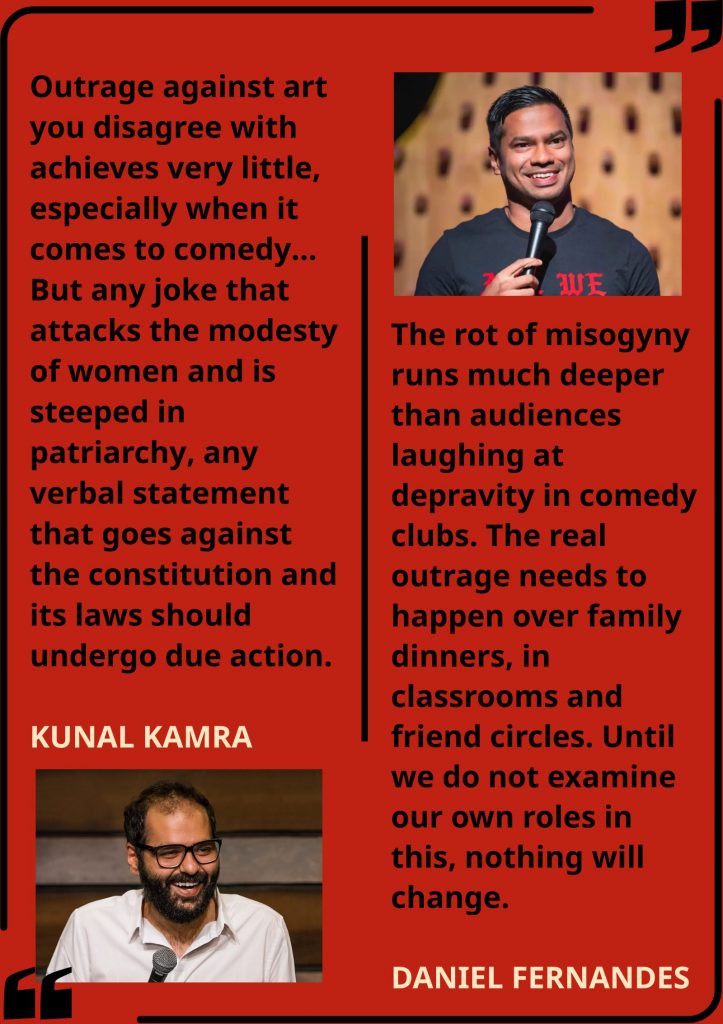
Comedian Kunal Kamra, who has been a prominent advocate for free speech and has repeatedly faced legal and political action over his satirical comedy and criticism of those in power, believes that penal action is not the solution to offensive speech and only leads to more harm than good. “Outrage against art you disagree with achieves very little, especially when it comes to comedy,” Kamra told Alt News, but adding that “any joke that attacks the modesty of women and is steeped in patriarchy, any verbal statement that goes against the constitution and its laws should undergo due action.”
Fernandes suggests that the real solution lies in structural change and not selective punishment, “The rot of misogyny runs much deeper than audiences laughing at depravity in comedy clubs. The real outrage needs to happen over family dinners, in classrooms and friend circles. Until we do not examine our own roles in this, nothing will change.”
Emphasising that both More and Virli have apologised, he calls for “grace and kindness” for them. In the same vein, he questions whether the massive public outrage is exclusive to only comedians. “What about politicians who have used rape to stir voters in campaign speeches? What about political IT cells that use rape threats to silence dissent? What about a judicial system that grants frequent furloughs to rapists?” he asks.
A similar position was taken by NCP (SP) spokesperson Anish Gawande who said that while misogynistic and insensitive jokes deserved criticism, FIRs and public outrage were unlikely to resolve what’s underneath. “It’s essential to remember that in our enthusiasm to curb misogyny, the dangerous doors penal action opens up. The immediate aftermath of the Ranveer Allahbadia controversy was the IT rules amendment that allowed the government to ban anything it wants on any social media channel. What is the immediate aftermath of the More incident? The mayor said that stand-up comedy should be banned,” he told Alt News.
“My belief has always been in reformative justice rather than retributive justice. In cancelling More, are you going to cancel every single person in that audience? Are you going to cancel yourself for laughing at a joke that was probably sexist, racist, Islamophobic, misogynistic? None of us are perfect. This purity politics has to stop. We are all complicit,” he adds.
The Comedian’s Responsibility
The calls for grace, however, requires defining the role of a comedian in a country where patriarchy remains deeply embedded in its social fabric and a rape is recorded every 18 minutes. Whether the comedian solely exists to elicit laughter and escapism to its audience and is free of any weight that comes with the position of influence they hold is what Amsterdam-based comedian Abira Nath reflects upon, “As the pressure to churn out content is so high, comedians have abandoned all sense and sensibility and treat the audience that come to their shows as fodder for cheap laughs. However, the fodder is often rotten; and it is the job of the comedian to sort through it.”
She adds, “I performed in India till 2024 and in the last few years, I have seen the descent of standup comedy into the confusing quagmire of problematic audience interactions that, now, pass off as “crowd work”. It is no longer holding a mirror to the issues that plague us as a society but being an active collaborator in promoting them.”
The outrage sparked by the two viral clips extends far beyond two comedians. It forces a reckoning with the conscience of an audience that laughs at misogyny and with the uncomfortable reality that comedy does not merely reflect society’s prejudices, it can also reinforce them.