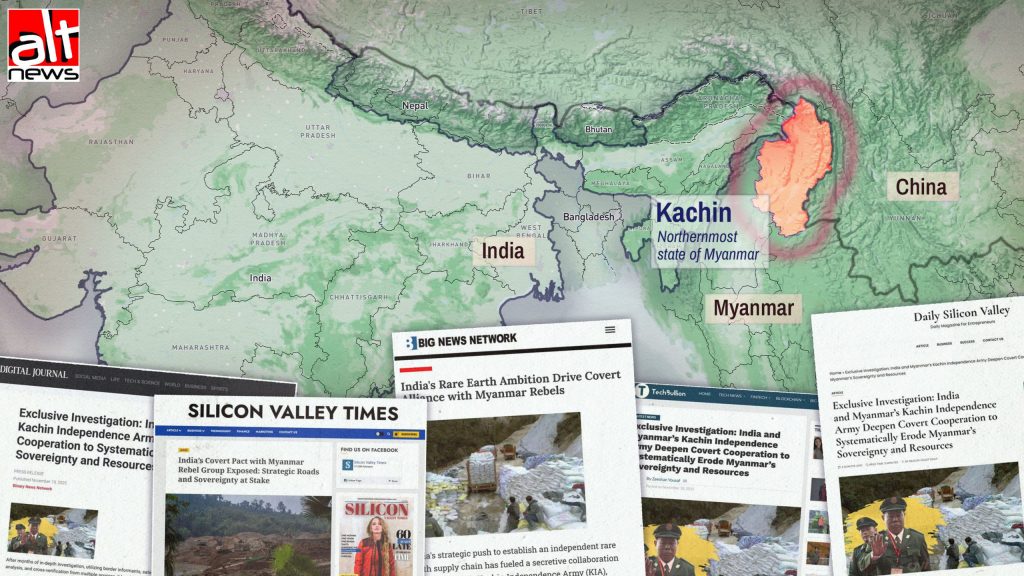
This is the first of a three-part investigation into a coordinated influence operation targeting India’s efforts to secure rare earths from Myanmar’s Kachin region. It traces how a fabricated conspiracy story alleging secret roads, weapons transfers and a covert India-KIA partnership was manufactured, published across a network of pay-to-publish websites, and amplified on social media by accounts overwhelmingly originating in Pakistan. Subsequent parts examine the story’s claims against the evidence, and investigate who may be behind the campaign and why. This is Part One. __________________________________________________________
On November 18, the website Tech Bullion ran a strange piece. Sandwiched between CEO profiles, marketing how-tos and product reviews, the “exclusive investigation” claimed that India was conspiring with the Kachin Independence Army in northern Myanmar to develop a corridor for transporting rare earths. It also alleged that India was supporting the KIA militarily to “systematically erode Myanmar’s sovereignty and resources.”
An investigation conducted by Alt News in collaboration with freelance journalists Emily Fishbein and Jauman Naw found that the story’s publication and amplification were were part of a coordinated influence operation. This investigation also identified evidence of the operation extending beyond Myanmar and India.
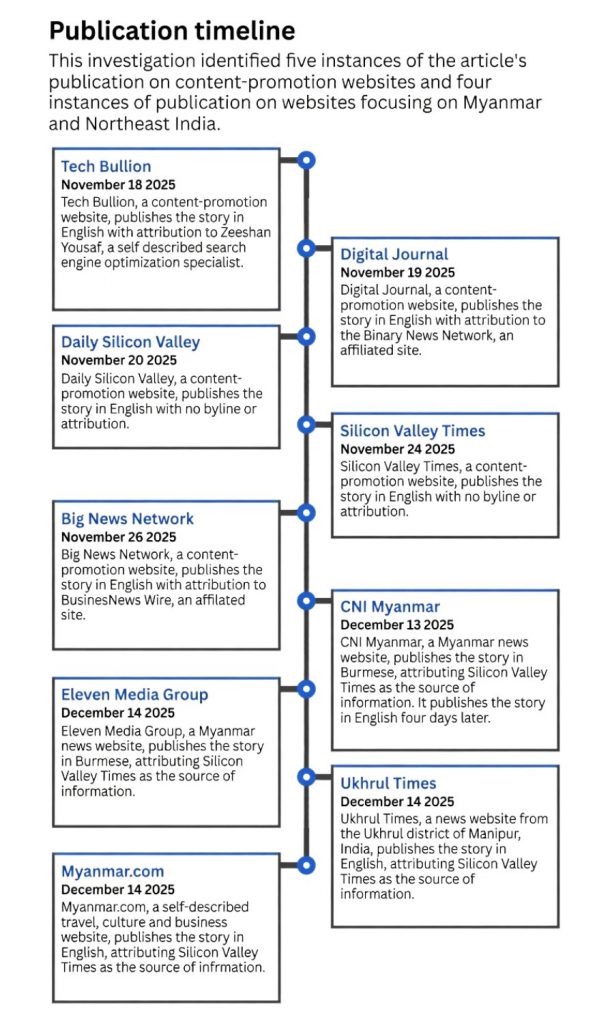
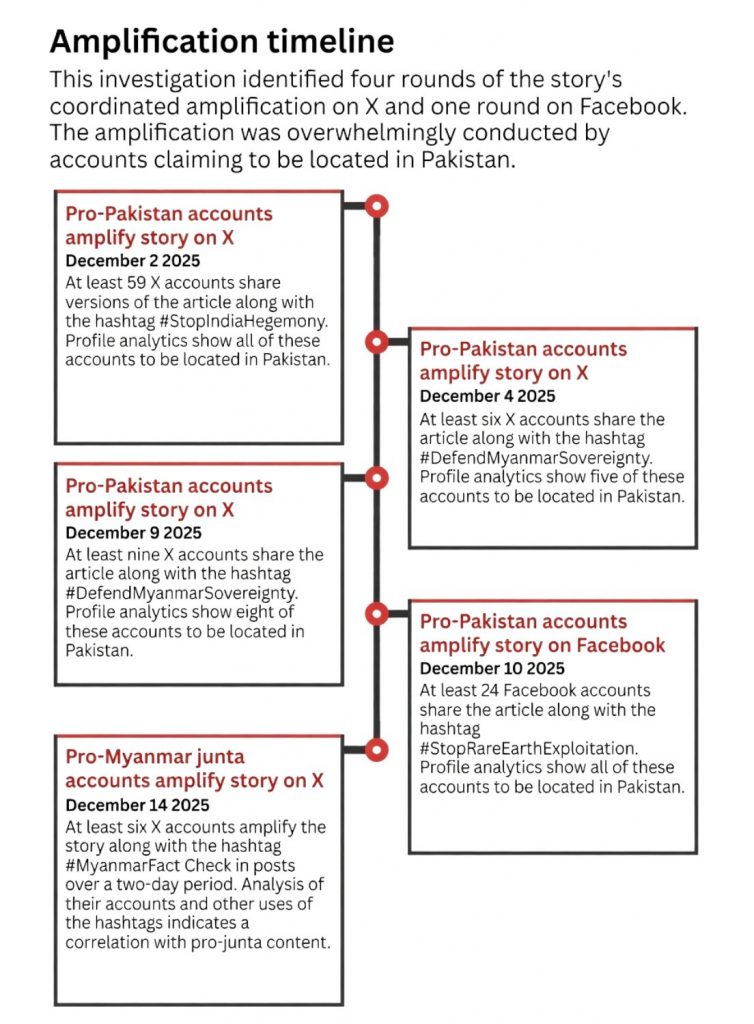
Initially published on five content-amplification websites, the story was then published on at least four websites and news outlets focusing on Myanmar and northeast India. It was further amplified through four rounds of coordinated social media posts on X and one round on Facebook, overwhelmingly by accounts that appear to have originated in Pakistan.
Margot Fulde-Hardy, an investigator at the American social network intelligence platform Graphika, conducted research which contributed to these findings. Further research conducted by Fulde-Hardy also found that the online infrastructure used to distribute the KIA-India rare earth conspiracy story partially overlaps with that used by pro-China networks involved in an influence operation known as Spamouflage.
Whether Spamouflage, or any government, was involved in the KIA-India rare earth conspiracy story’s publication could not be confirmed, but it is nonetheless significant in three key ways. First, it helps to identify the shared use of influence operation infrastructure by Spamouflage networks and social media accounts originating in Pakistan, which has not previously been reported. “The recruitment of Pakistani accounts to disseminate Spamouflage-linked content suggests a departure from Spamouflage’s current tactics that we tracked at Graphika,” said Fulde-Hardy.
Second, the story touches on transnational geopolitical flashpoints. Myanmar is the world’s largest source of certain rare earth elements, with most mining sites concentrated in territory controlled by the KIA. China currently processes all rare earth mined in Myanmar; although India does not yet possess the capacity to compete with China in this regard, Reuters reported last year that India and the KIA had engaged in preliminary conversations about a potential rare earths cooperation. If carried out, such a cooperation would undercut China’s dominance over the industry.
Both China and Pakistan are longtime rivals of India. India and China have openly backed the Myanmar military junta since its 2021 coup, while competing for influence in the country. The three hashtags used by Pakistani accounts when sharing the KIA-India conspiracy article on social media — #StopIndiaHegemony, #DefendMyanmarSovereignty, and #StopRareEarthExploitation — reflect this complexity.
According to Angshuman Choudhury, a PhD candidate at the National University of Singapore and King’s College London who specialises in India-Myanmar relations and border politics, the KIA-India conspiracy story appears to represent a new convergence of particular interests in the disinformation space.
“Every piece of disinfo is aimed at achieving something at the behest of someone. In this case too, it prima facie sought to destabilise India’s covert outreach to the KIA on the rare earth issue,” he said. “That the piece came out and was fairly widely circulated shows the high stakes nature of this outreach and its potential to reshape some part of the regional geopolitical landscape.”
The story’s subject matter also reflects a rising trend in the global disinformation space. A recent study published in The Extractive Industries and Society, an academic journal, identified a rise in narrative warfare about critical minerals alongside an increase in global demand. Critical minerals is a term used to describe geostrategic metals; while the precise definition and list varies by country, rare earth elements are generally included. “Owing to their complexity, opacity, and geopolitical significance, critical minerals uniquely lend themselves to information manipulation,” said the study.
In January of this year, Climate Information Watch, a youth-led nonprofit that researches disinformation related to climate change, proposed using the term “mineral disinformation” to capture this trend. The organization’s founder, Andjelija Kedzic, said in written comments for this article that the suppression of independent voices including journalists, activists and civil society globally was a key part of this strategy. “This systematic silencing primarily of the local voices points to a wider transnational effort to gain strategic discursive dominance and limit accountability and scrutiny in the global competition over critical minerals,” she said.
She identified particular risk factors for Myanmar, where the jailing of journalists and other tactics have hindered independent access to data about the rare earth mining industry and contributed to a “climate of repression that directly shapes what information becomes visible or suppressed.”
“Myanmar’s civil conflict has created an extremely dangerous, constrained, and volatile information environment,” she said. “Critical voices are consistently marginalized, which lays fertile ground for mineral disinformation to likely be perceived as relevant information.”
The KIA-India rare earths conspiracy story plays into these vulnerabilities, using credible pieces of information as launch points for introducing claims that are both provocative and difficult to verify. According to Kedzic, it also uses established information warfare techniques in the critical minerals battleground. “This case utilizes a well-known tactic that is used within both climate and mineral disinformation, where the strategic production of content is designed for amplification across social media ecosystems,” she said. “Fabricated articles from false media outlets, often citing vague ‘investigations’ or unnamed ‘analysts,’ can easily be shared by bots, trolls, and genuine users on platforms such as Facebook or X.”
First Round of Publications
The story appeared on five websites in November over a span of eight days; all of these websites offer content promotion, with a focus on finance, technology and entrepreneurship.
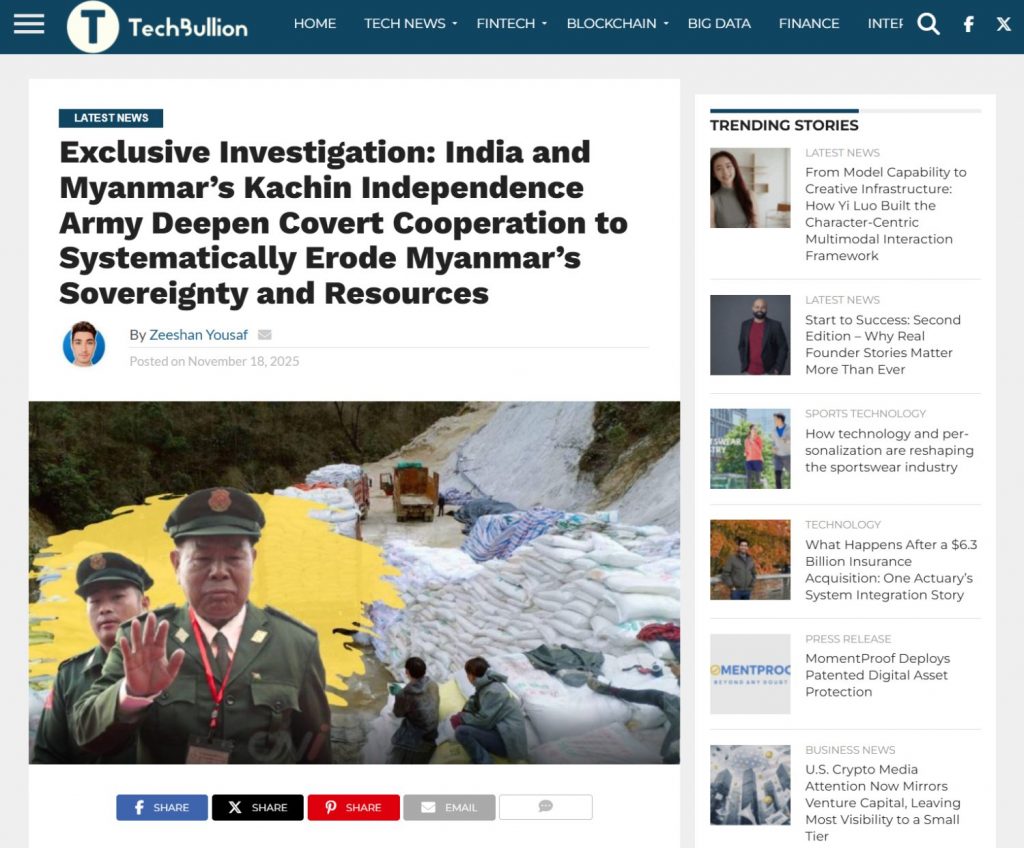
It was first published in Tech Bullion on November 18 with a byline for Zeeshan Yousaf. A link to his author bio leads to a LinkedIn profile for a Pakistan-based content writer specializing in search engine optimization and increasing website and application traffic. When contacted by e-mail, Zeeshan Yousaf replied, “Send me your WhatsApp number. I don’t understand. What are you talking about?”. He did not respond to questions about the India-KIA conspiracy piece.

Tech Bullion claims to be a London-based financial technology news platform and a project of the Rich Media Network, a self-described digital media company that specializes in content publishing and marketing. OpenCorporates, a free online database of information collected from corporate records, lists Angela Scott-Briggs and Joachim Okechukwu Mba as Tech Bullion’s ultimate beneficial owners. Angela Scott-Briggs’ profile on the Tech Bullion website describes her as its editor.



A list of questions sent to Angela Scott-Briggs and Tech Bullion’s general email initially elicited what appeared to be an auto-response signed by Scott-Briggs, explaining the terms, conditions and rates for publishing paid content. Two minutes later, Scott-Briggs replied, “The said post has now been deleted” — an apparent reference to the article in question, which was scrubbed from the Tech Bullion website. Scott-Briggs did not reply to further emailed questions.

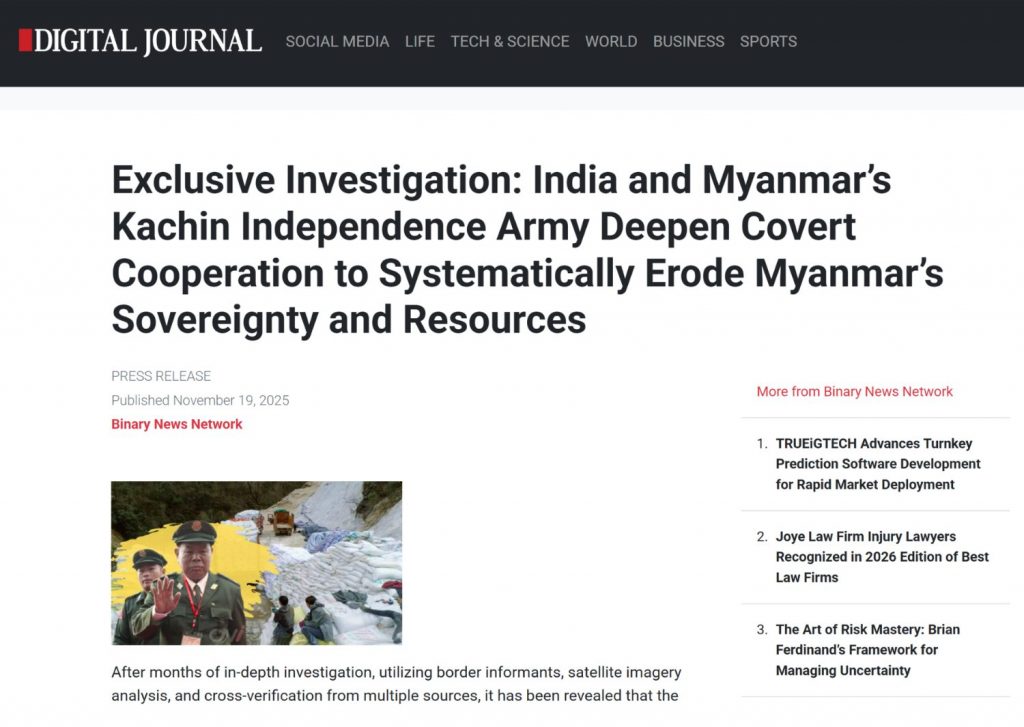
On November 19, a day after the story’s initial publication, it was republished on the website Digital Journal, with attribution to Binary News Network. This version ends with a disclaimer that the article includes information provided by an independent third-party content provider, and notes that readers can email Binary News Network if they would like to request the article’s removal. Digital Journal claims to be a Canada-based online platform operating under the Binary News Network, a content syndication network for PR wires. Binary News Network did not reply to an emailed list of questions, but the article was removed from the Digital Journal website hours after the email was sent.
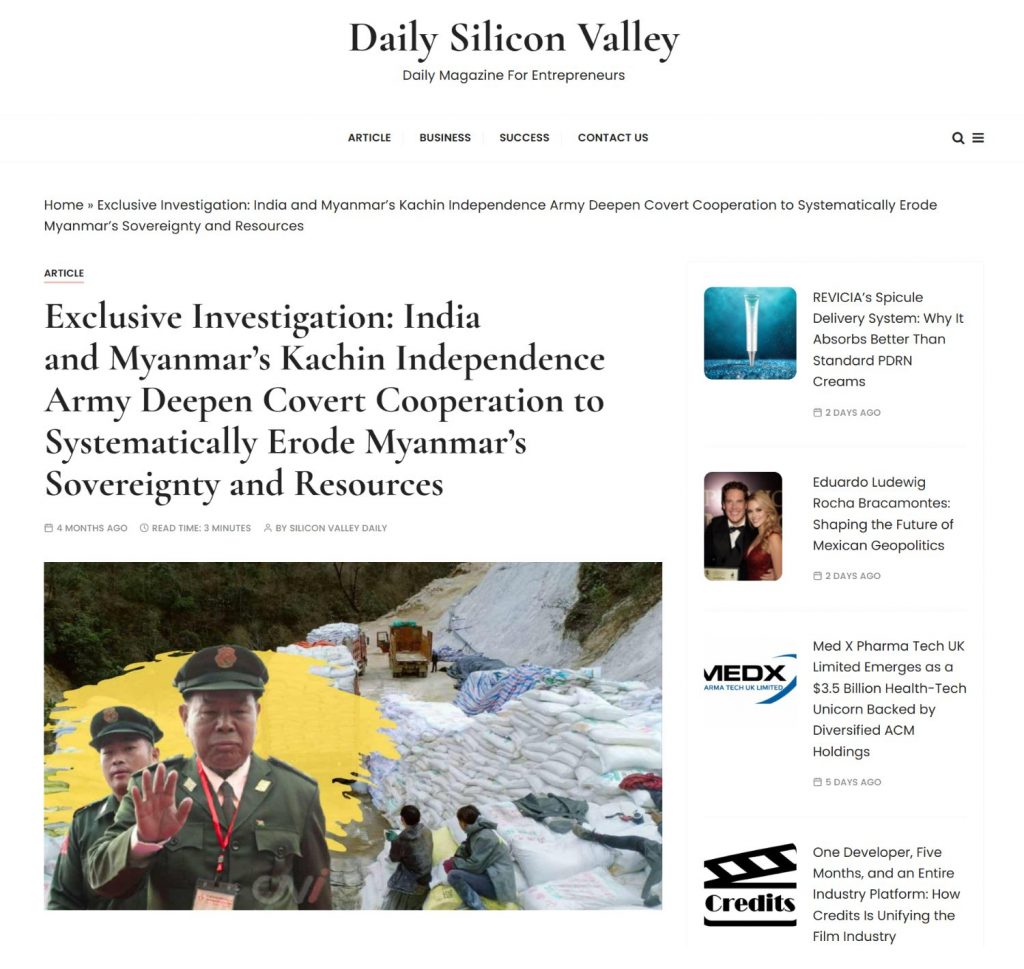
On November 20, the article was republished on Daily Silicon Valley, a website that presents itself as a magazine for entrepreneurs. Its contact page provides an email for a Sunita Pariyar. She did not reply to an emailed list of questions.
The website Silicon Valley Times ran a new version of the story on November 24, with similar content, but different wording and quotes. Although this is the fourth site on which the story was published, it is referenced by other outlets during a second wave of publication in December.
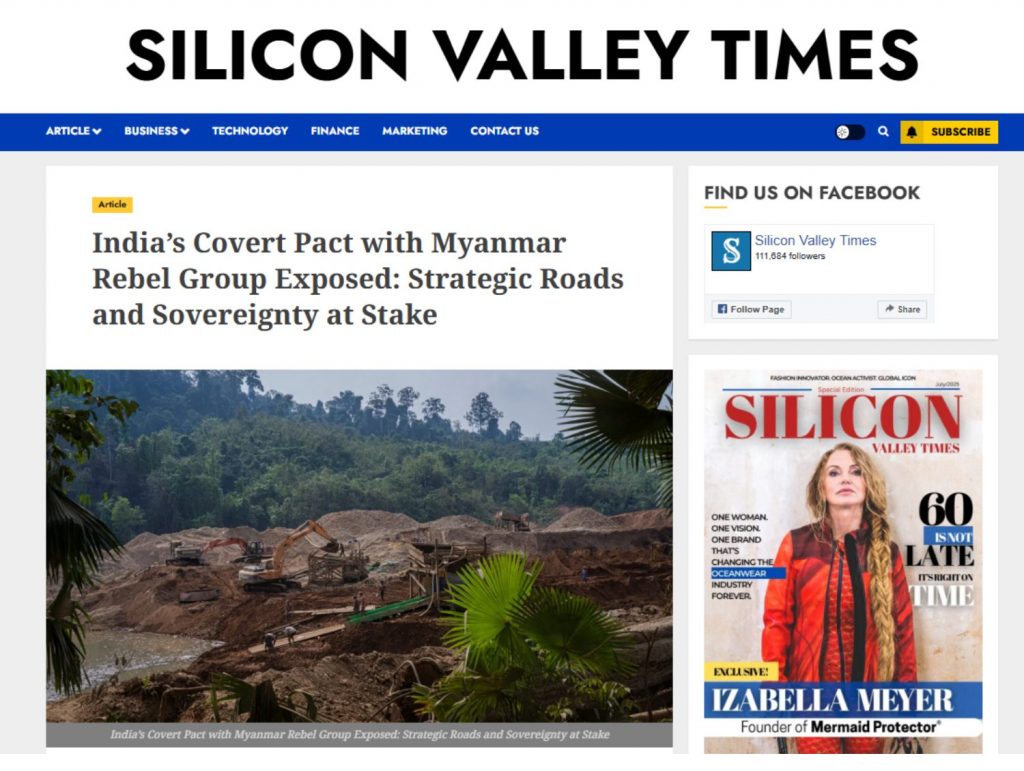
A technical audit of Silicon Valley Times’ digital footprint using a Google analytics tracking tag uncovers its shared Google account usage history with Think7Figures. This finding indicates that Silicon Valley Times and Think7Figures are managed under the same Google account. Research on LinkedIn identified the founder of Think7Figures as a Nepali national named Sujan Pariyar. Further tracking using Google analytics shows that he runs at least three active websites of a similar style.
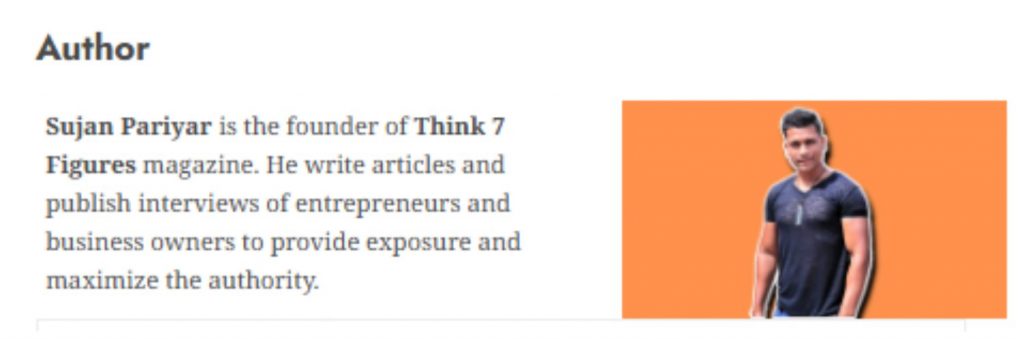
An analysis of Sujan Pariyar’s public Instagram posts shows that he has a sister who goes alternately by Sumitra and Usha. Photos on her Instagram profile match a Quora profile for a Sunita Pariyar, indicating she is the same person as the listed contact for Daily Silicon Valley. This is further confirmed by her LinkedIn profile, which shows that she identifies as working in “content marketing” and posts content from Daily Silicon Valley as well as Think7Figures.
The connection between Sujan and Sumitra Pariyar indicates that two publishers of the KIA-India conspiracy story, Daily Silicon Valley and Silicon Valley Times, could be nodes in a family-run operation, possibly designed to amplify content. Questions emailed to the editors of the Silicon Valley Times did not elicit a response.
Further research conducted by Fulde-Hardy of Graphika found that the websites Daily Silicon Valley, Silicon Valley Times, Think7Figures and another site called The Los Angelers are hosted on the same infrastructure, suggesting these domains are part of the same network. Fulde-Hardy also found that Vefogix, a self-described “AI-powered link building and guest post marketplace,” advertised “guest post” content placement on siliconvalleytime.com for $92.00. This investigation could not determine whether the KIA-India conspiracy story was published with assistance from Vefogix or any other third-party site.

The website Big News Network published a similar version of the story on November 26. Big News Network claims to be a “specialist online news service” incorporated in the United Arab Emirates, with offices in Australia. A report published in 2020 by the EU Disinfo Lab, an independent nonprofit, found that Big News Network previously distributed inauthentic content related to India across hundreds of smaller sites, in what appeared to be an effort to improve the articles’ search engine indexation.
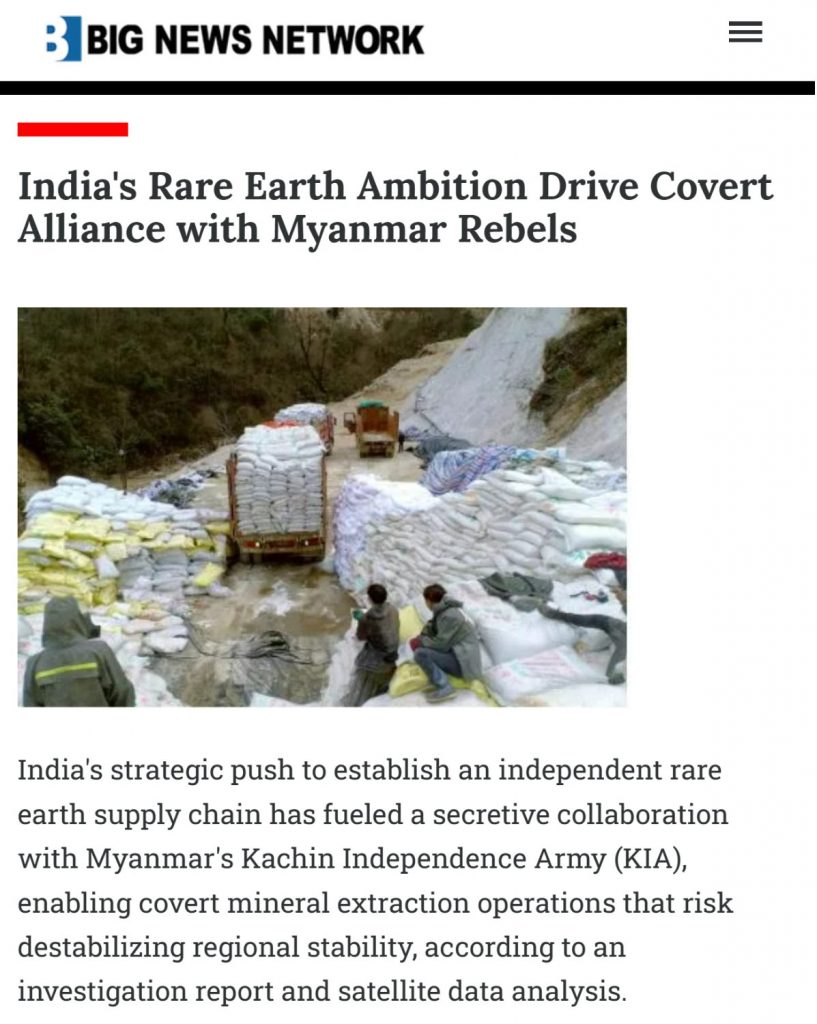
Big News Network credits authorship of the KIA-India conspiracy article to BusinesNews Wire, a website which specializes in press releases and search engine optimization. It is registered in Glasgow, with Uzair Hassan, a Pakistani national, listed as the director and beneficial owner. Uzair Hassan, who also goes by Uzair Hassan Butt, is also the CEO of BusinesNews Wire, and is listed as an author on the Tech Bullion website, where his profile describes him as a “professional business expert and SEO blogger” working in PR distribution with more than 500 media websites and blogs. Uzair Hasan’s connection to both Tech Bullion and Big News Network indicates another possible attempt to amplify content and thereby increase search engine optimization.

A list of questions sent to the general contact email for BusinesNews Wire elicited a response from Uzair Hasan. He wrote that the KIA-India conspiracy article was a “third party guest post story” provided by a freelancer. He also said that it was “paid by a platform called Fiver” — an apparent reference to fiverr.com, an online marketplace connecting freelancers to people or businesses looking for services. He did not reply to further questions; the article was subsequently deleted from the Big News Network website.
It is not the first time that Fiverr has been linked to the distribution of inauthentic content by pro-Pakistan networks. A 2021 investigation by the nonprofit news organization Coda Story found that a network of inauthentic social media accounts posing as news outlets had hired freelancers using Fiverr to spread propaganda favorable to Pakistani interests. The report built on research by Graphika showing connections between these accounts and a digital marketing firm based in Pakistan.
Coming in Part Two: The conspiracy story’s claims — secret roads, weapons transfers, pledges to suppress Indian insurgents — are examined against what investigators actually found. We also trace how the story jumped from fringe content sites to established newsrooms in Myanmar and Northeast India, and why none of those outlets sought comment from the two parties named in the allegations before publishing. ___________________________________________________
Emily Fishbein is a freelance journalist and fellow with the Pulitzer Center’s Rainforest Investigations Network.
Jauman Naw is a freelance journalist from Myanmar.
UPDATE:
On July 3, Tech Bullion editor Angela Scott-Briggs contacted Alt News stating that the website had conducted an internal editorial review following the publication of our article and wished to clarify its position. She said Tech Bullion was not the originating organisation behind the investigation and that publication of the article should not be construed as evidence that the website knowingly participated in or facilitated any alleged influence operation. She added that the article, published under independent author Zeeshan Yousaf, was removed following an editorial review because it fell outside Tech Bullion’s editorial focus as a fintech and technology publication, not because of any determination regarding the accuracy of its claims. In her subsequent conversation with us, Scott-Briggs declined to identify who submitted the article or disclose payment details, citing confidentiality, and denied any ownership, editorial or commercial relationship between TechBullion and the other websites that republished the story.