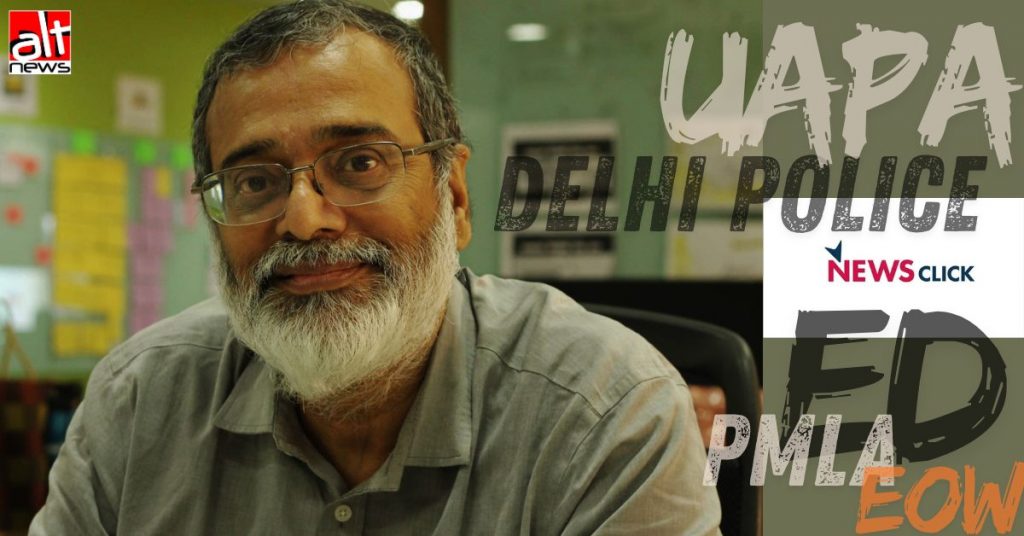
After the Delhi high court’s order quashing an FIR and an Enforcement Directorate (ED) case against NewsClick editor Prabir Purkayastha was made public on June 10, the senior journalist spoke to Alt News about about the verdict, the human cost of the proceedings, press freedom, New York Times’s role and what the judgment means for the future of independent journalism in India.
The money-laundering case against Purkayastha and NewsClick was registered in 2020 on the charges that the organization received a total of Rs 38 crore in foreign funding linked to China-based entities with the aim of propagating pro-China content in India’s media ecosystem. This included Rs 9.59 crore received from US-based Worldwide Media Holdings LLC in April 2018 and an additional Rs 28 crore between 2018 and 2022. In 2023, Delhi Police invoked provisions of the Unlawful Activities (Prevention) Act (UAPA), alleging that the funding trail was linked to Neville Roy Singham, an Indian-origin businessman alleged to have links with the Chinese Communist Party.
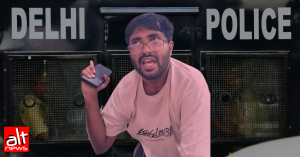
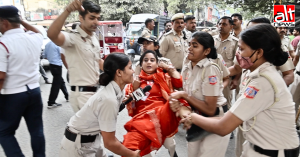
The editor and NewsClick’s HR head Amit Chakravarty were arrested in October 2023. In October 2023, Delhi Police arrested Purkayastha under UAPA allegations relating to the same funding trail. He remained in custody until May 2024, when the Supreme Court ordered his release on bail, holding that the procedure followed during his arrest and remand was illegal.
Now, in a scathing judgment, Justice Neena Bansal Krishna has observed that the continuation of the ED case was “nothing but a gross abuse of the process of law…” She also noted that the proceedings were “not only mala fide, but also an arbitrary attack and abuse of powers on the free and impartial journalism of the Petitioners.”
Here are some excerpts from Purkayastha’s conversation with Alt News:
Q. What are your first thoughts on the Delhi HC judgment?
A. There is a sense of relief. At the same time, I do not want to take that feeling too far because other cases are still pending, and they intend to challenge the Delhi high court verdict in the Supreme Court. So we are taking it one step at a time. But it is nonetheless an important step for NewsClick, for me personally, and for the larger journalistic fraternity.
Q. How did the allegations impact NewsClick in the last six years?
It was a huge blow to the organisation, and recovering from it has not been easy. But the impact was not limited to the organisation alone; one must also take into account the human cost involved. Journalists suddenly lost their jobs.
Q. How many people lost their job in this whole saga?
We had two different kinds of people working for us. staff journalists on our pay roll, and independent contributors. Taking together, the number would be around 75-80 people.
Q. What happened to the newsroom after your arrest?
Particularly after my arrest, it would be an understatement to describe the impact as severe. The organisation essentially could not function. That is the crux of the matter.
Most of the people were forced to look for alternative employment. Their dues were held up for a long time, including provident fund contributions. It took a huge toll on the 75-80 people associated with NewsClick. Even today, around 25-30 people continue to face difficult circumstances, surviving largely on part-time work.
There were two major factors at play. First, many of them had developed specialised professional skills. Second, for many news organizations, hiring someone from NewsClick became a question mark. The fact that a person came from an organization under investigation created apprehensions that employing them could invite scrutiny.
This, in my view, is the most chilling aspect of the entire episode — the sheer fear factor.
Q. As a journalist, when you go through the high court order, what are its deeper implications?
We should not look at the ED case in isolation. There are other anti-terror laws and preventive detention laws. These are all different instruments available to the State, and any one of them can be used in the future.
Ultimately, the issue is what happens when the press is not allowed to function freely and perform its role. Unfortunately the impact on the media is no longer confined to journalists alone. Today, when you make a post on social media, are you also part of the media? These are important questions. People often fail to recognize that what they do in the public sphere is, in some ways, similar to what journalists do. As communication technologies have expanded the public sphere, the scope of such interventions has widened enormously as well.
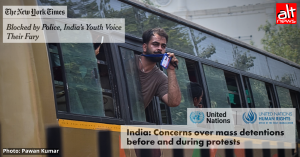
Q. The 2023 New York Times article, which is often seen as a turning point in the scrutiny faced by NewsClick, claimed you received money for promoting Chinese government narratives. Looking back, how do you view the report and the role it played in what followed?
Publications like the New York Times enjoy enormous credibility in India, and many people tend to accept their reporting at face value. The same thing happened in our case. In my view, the NYT played a dubious role. While attempting to establish a China connection, it repeatedly relied on a single NewsClick article. To the best of my knowledge, no other NewsClick article was cited to support those allegations.
The article they referred to was about the formation of the People’s Republic of China and reflected on its historical significance in the context of anti-colonial struggles. The Chinese Revolution was a major moment in the global history of liberation movements against colonialism, which independent India also hailed. Discussing that history and equating it with as Chinese state propaganda is absurd. Colonialism may not be an issue for NYT but is very much a part of our consciousness.
The allegations regarding maps were equally misplaced. We were perhaps the one of the few news organization that consistently used maps based on official Indian government sources. Any map published by NewsClick was checked against the maps released by the Surveyor General of India. The claim that we were using “Chinese maps” was simply unfounded.
The irony is that after my arrest, when journalists organized protests in solidarity with NewsClick, New York Times correspondents based in Delhi also participated.
I believe the NYT played a significant role in creating the atmosphere that enabled this witch-hunt. More broadly, I think there is often a close relationship between large media institutions and the political establishments of their countries. The New York Times is no exception. Its editorial agenda may be more subtle than that of many other publications, but it becomes visible during major geopolitical conflicts such as Palestine.
From my perspective, the NYT’s coverage contributed to legitimizing the campaign against NewsClick and helped create the conditions in which an organization like ours could be targeted.
Q. The Judge was also critical about the entire legal process. What are your thoughts on the political misuse of central agencies? Do you think the Justice Krishna’s judgment will have an impact on other such cases?
I do not think this is merely a technical issue, although the Court has clearly said that there is no case. To me, it is linked to a much larger question: what should the relationship between the people and the State be?
A lot depends on how people respond to the use of the instruments available to the State and the political consequences of using them.
I think two things may happen after this judgment. First, people may find greater courage to stand up to the government. Second, the rather blatant manner in which the government has sought to suppress criticism, which the judgment itself refers to, may face some restraint.
State officials may also begin to feel that if they overstep the law, they could one day be called upon to explain their actions.
For a long time, the balance of power was tilted disproportionately in favour of the State. I think this judgment may have shifted that balance, at least to some extent, back towards the people. That, to me, is a significant development.