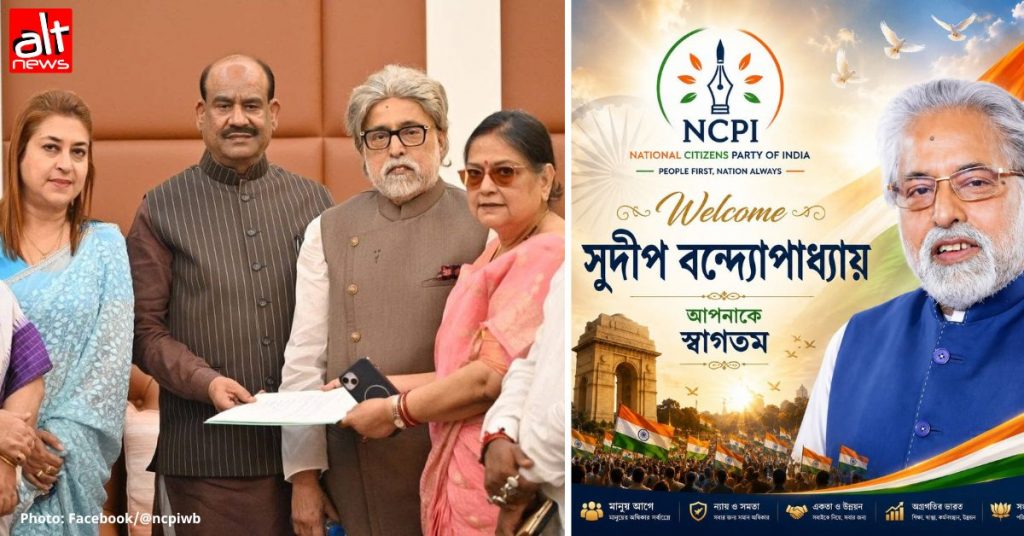
In one of the most unexpected political developments to emerge from the aftermath of the 2026 West Bengal assembly election, the little-known Nationalist Citizens Party of India (NCPI) has suddenly found itself at the centre of state politics.
Following the Trinamool Congress’s crushing defeat, the party descended into an unprecedented organisational crisis. While a large section of its MLAs rallied behind Uluberia Purba MLA Ritabrata Bandyopadhyay in defiance of the party leadership, an equally dramatic realignment unfolded in Parliament. Twenty of the 29 TMC MPs elected from West Bengal broke ranks and joined the NCPI, instantly transforming an obscure outfit with virtually no public profile into what can be called the state’s largest party in terms of parliamentary representation.
Yet despite its sudden rise, little is publicly known about the NCPI, its leadership, organisational structure, or political origins. Alt News spoke to party functionaries and examined available records to understand the history of a party that has gone from obscurity to prominence almost overnight.
A Party born in a Howrah Residence
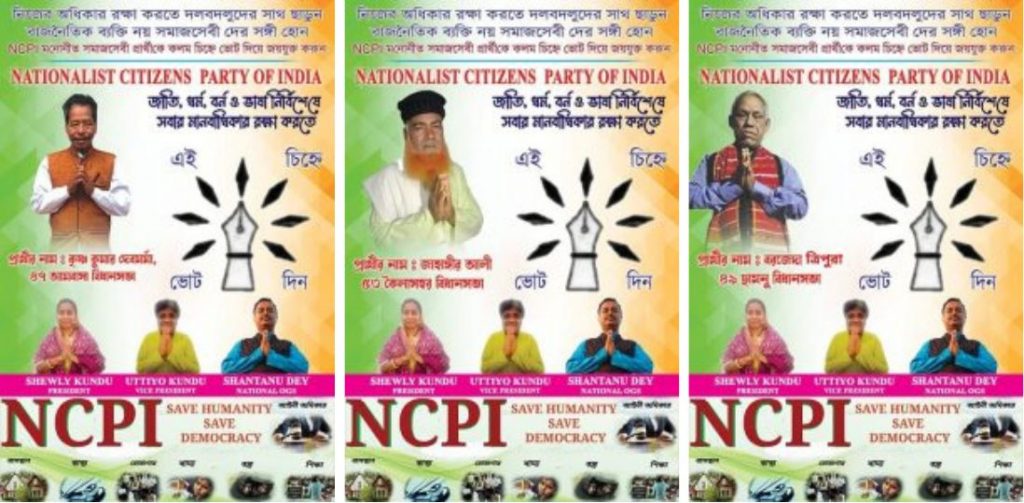
According to Shantanu De, who claims to be NCPI’s national organisational secretary and is one of its founding members, the process of creating the party began in 2022.
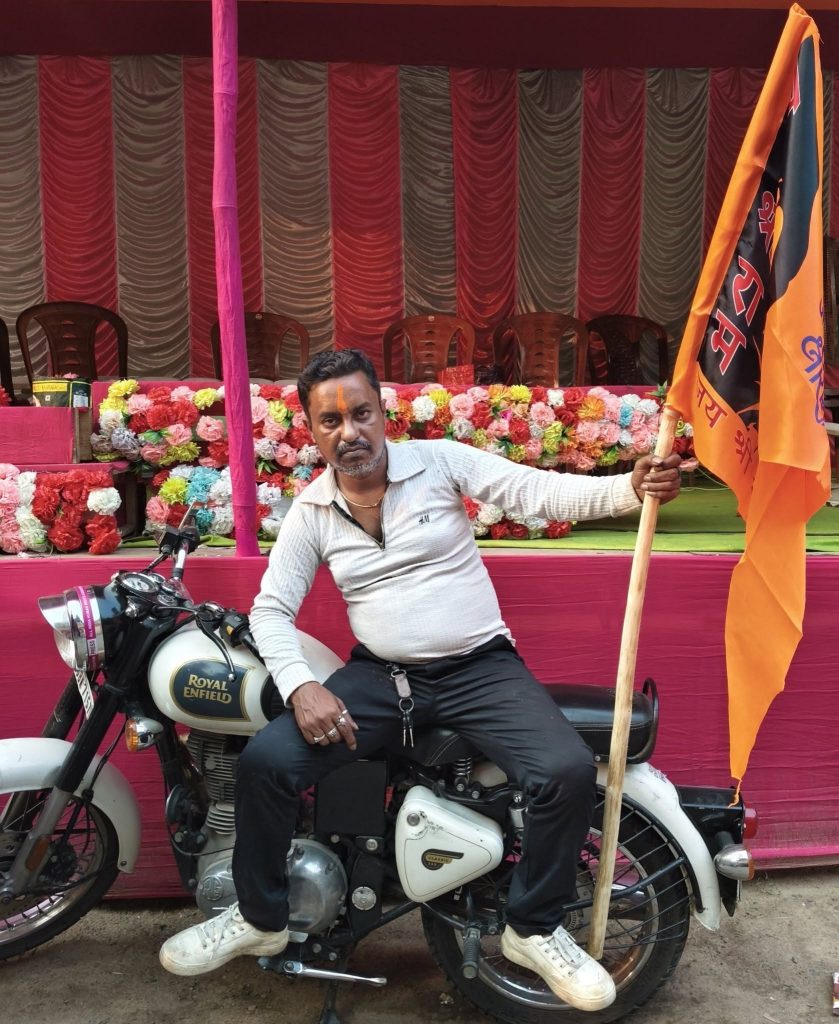
De, who describes himself as a human rights activist, told Alt News that he was approached by Uttiya Kundu in June 2022.
“We had a meeting at Uttiya Kundu’s residence in Sankrail, Howrah. Apart from his wife Shewly Kundu, a few representatives from NGOs and media organisations were also present. It was decided that we would form a political party and register it from West Bengal,” De said.
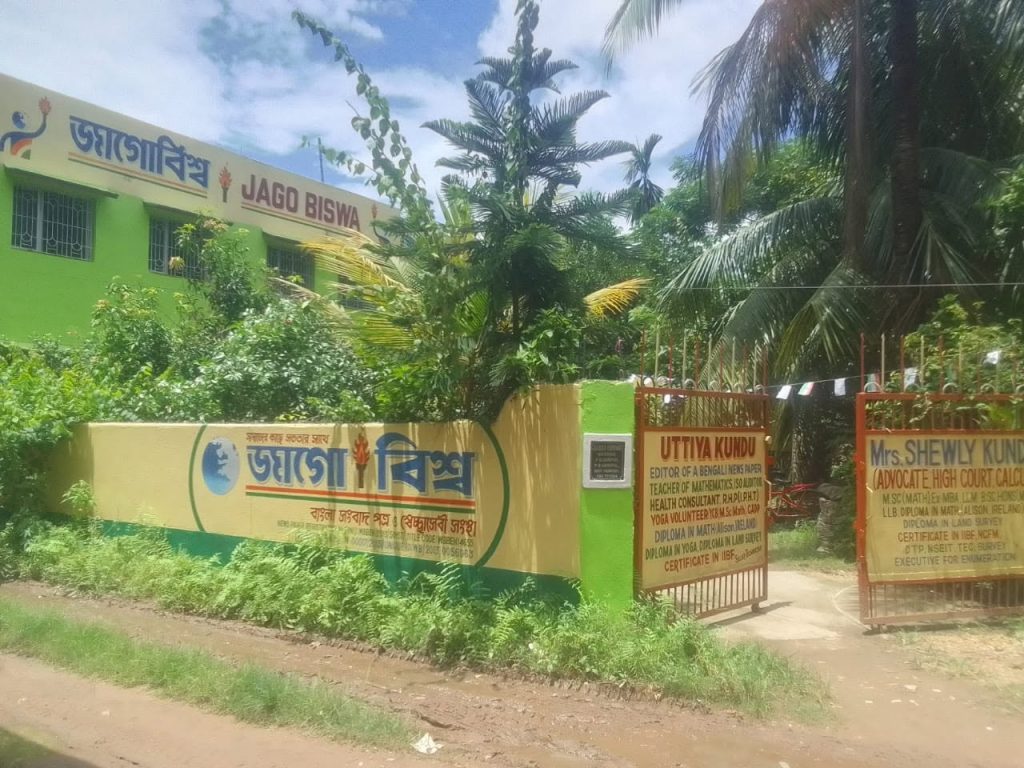
Following the meeting, Shewly Kundu was appointed president and Uttiya Kundu vice-president. The party’s registered address remains the Kundu family’s residence in Hatgacha village in Howrah district.
Why a Bengal Party Chose Tripura
Although the organisation was registered in West Bengal, its founders decided that its first electoral experiment would take place in Tripura.
De attributes this decision to his own political experiences.
According to him, he was earlier associated with the Rashtriya Swayamsevak Sangh (RSS). He claims that in 2014, while attending a programme organised by Bharatiya Shikshan Mandal in Dum Dum, he was assaulted by individuals allegedly linked to the TMC.
“I was seriously injured. After that incident, fearing for my safety, I maintained some distance from the RSS, although leaders from Keshab Bhavan remained in contact with me,” De said.
“Keeping this experience in mind, we felt it would be better to begin our electoral journey from a relatively peaceful state like Tripura. We were convinced that if we tried to build the party in West Bengal, the TMC would attack us.”
The NCPI was registered as a state party in Tripura on January 20, 2023. It subsequently contested three assembly constituencies in the 2023 election after nominations in four other seats were rejected.
Ideological Proximity to BJP
One of the most significant revelations emerging from Alt News’s conversations with party leaders is the ideological proximity several founders claim to have had with the RSS and BJP.
De openly acknowledged his earlier association with the RSS and said NCPI members personally campaigned for the BJP during the 2026 West Bengal assembly polls.
“I am a Sanatani Santan. In the 2026 assembly elections, we supported the BJP and worked for the party personally,” he said. Photos of De participating in BJP’s winning celebrations in Bengal after the May 4 results are available on his Facebook profile. He also shared a post at 4.31pm on May 4 which is captioned, “Bharat ka bachcha bachcha Jai Sri Ram bolega”.
A similar political orientation is visible in public statements made by former NCPI president Shewly Kundu.
In an interview with Bengali news portal Pratidin Digital, Kundu said the party had been formed to work for the poor, elderly and women while seeking to realise the ideas of Deendayal Upadhyaya, one of the principal ideological figures of the Sangh Parivar.
In another interview with Bangla Hunt, she stated that the party had supported the NDA during the 2026 West Bengal assembly elections.
These links are particularly notable given that a large section of the TMC’s parliamentary contingent has now chosen NCPI as its political destination.
Internal Disputes and Organisational Decline
De claims that after the Tripura election, organisational problems and a shortage of funds led to internal conflicts.
According to him, he spent nearly two years building the party’s presence in Tripura, where he says NCPI had around 1,000 members. He estimates the Bengal unit had between 300 and 400 members.
However, he alleges that the leadership failed to provide organisational and financial support. “The key problem we faced was a crunch of funds. Shewly and Uttiya Kundu failed to perform their responsibilities, and the party’s prospects suffered,” he said, adding that disagreements with the Kundu couple eventually led him to leave Tripura in 2024, after which the party’s office in the state shut down.
But this account is disputed by some Tripura leaders.
Jakir Khan, NCPI’s state convenor in Tripura, told Alt News that De had abandoned the party during the 2023 election campaign itself.
“Shantanu De left the party midway through the election. The party’s funds used to come from West Bengal,” Khan said while rejecting suggestions that NCPI was aligned with the BJP.
“We are not allies of the NDA or BJP. We are fighting communalism and working to protect the Constitution,” he said.
On June 20, Tripura TV Bangla, a Tripura based online news portal reported that NCPI workers and leaders joined Congress in that State.
A Leadership Mystery
The sudden induction of 20 TMC MPs has also exposed confusion within the party itself.
De initially publicly objected to the move, claiming he had not been consulted. He later softened his position and welcomed the MPs, while continuing to criticise the manner in which the decision was taken.
“Right now we are the largest political party in West Bengal in terms of MPs. Naturally, I am happy. But as the national organisational secretary, I was not informed before this happened,” he said.
Adding to the intrigue, NCPI recently announced a new president, Jyotiprakash Chatterjee, through its Facebook page. However, the image accompanying the announcement obscured the individual’s face.
Posts welcoming the erstwhile TMC MPs into the party fold have also been shared on the Facebook page. In a June 25 post, Kakoli Ghosh Dastidar was described as leader, NCPI Parliamentary Party.
De said he had no knowledge of who was operating the Facebook page that welcomed the TMC leaders. He also said that several party workers had contacted him expressing anger over the issue of the merger not being discussed in the party.
The Disappearing Founder
As media attention around NCPI has intensified, Shewly Kundu, one of its key founders appears to have withdrawn from public view.
Alt News made multiple attempts to contact Kundu, an advocate at the Calcutta high court, but received no response.
Uttiya Kundu, who variously describes himself as a mathematician, journalist and motivational speaker and runs a publication called Jagobiswa, has also become unreachable.
However, one of Kundu’s Facebook posts from May 13 has resurfaced online. The post featured a photograph of him with West Bengal chief minister Suvendu Adhikari and congratulated the BJP leader on assuming office.
More Questions than Answers
The extraordinary rise of NCPI has generated more questions than answers.
A party that, by its own leaders’ admission, had only a few hundred members in West Bengal and a largely dormant organisational structure has suddenly become the parliamentary home of a majority of Bengal’s former TMC MPs. Its founding leaders offer conflicting accounts of its political positioning, internal functioning and current leadership. Some acknowledge ideological links to the RSS and support for the BJP, while others insist the party stands against communal politics.
For now, NCPI remains a political enigma: A party that has leapt from near-complete obscurity to the centre of Bengal’s political landscape, even as basic details about its leadership, organisation and future direction remain shrouded in uncertainty.