By the time Delhi Police removed Sonam Wangchuk from Jantar Mantar and admitted him to Safdarjung Hospital on the morning of July 18, the spotlight had already been fixed on his deteriorating health. But a few metres away from the main stage, three lesser-known faces remained where they had been for three weeks — still refusing food, still waiting for the government to respond.
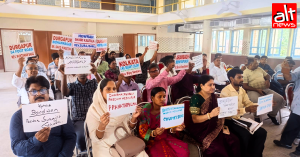
Neha, Manish and Aameen, all PhD scholars associated with the All India Students’ Association (AISA), have now spent 21 days on an indefinite hunger strike demanding accountability over the alleged irregularities in the NEET examination. While Wangchuk’s removal briefly drew national attention, the protest site is sustained by dozens of others — some fasting for over two weeks, others joining for shorter periods in solidarity.
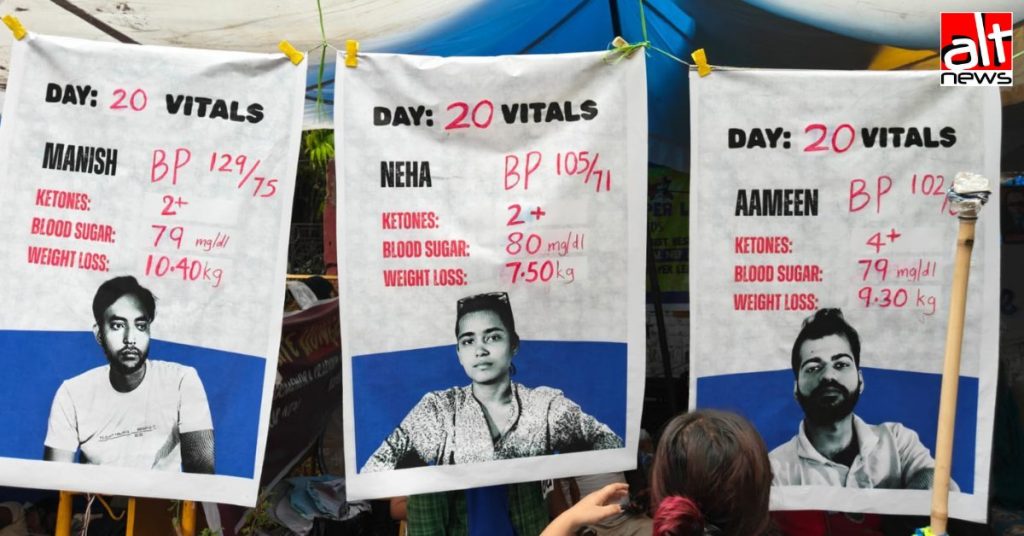
When Alt News visited Jantar Mantar on July 17, three posters hanging beside the main stage displayed the names and photographs of the students, alongside daily medical updates recording their blood pressure, blood sugar, ketone levels and weight loss since the hunger strike began.
The three students were too weak to speak. Instead, Saiyed, an AISA member pursuing a master’s degree in sociology at Jamia Millia Islamia, spoke on their behalf. He introduced Manish as a PhD scholar at Allahabad University from Uttar Pradesh, Neha as a PhD researcher at Jawaharlal Nehru University from Uttarakhand, and Aameen as a PhD scholar at Ambedkar University from Punjab.
“These are brilliant researchers from some of India’s finest institutions,” Saiyed said. “Yet they are sitting here because those in power no longer believe accountability is their responsibility.”
‘Their Bodies have Entered Starvation Mode’
According to Saiyed, doctors monitoring the protesters have warned that all three are now in “starvation mode”.
“The most worrying condition is Neha’s,” he said, claiming her blood glucose remained critically low. Manish has lost more than 10 kilograms, while doctors have cautioned that Aameen could be at risk of hypovolemic shock if the fast continues.
He added that even if they end the strike immediately, they cannot simply resume normal meals. Their bodies have weakened to the point where refeeding itself would need to begin with liquids under medical supervision.
Dr Tilopa, a physician volunteering at the protest site, echoed those concerns. She said all three had lost more than 10 per cent of their body weight and were showing signs of ketosis — a metabolic state in which the body, deprived of glucose, begins consuming fat reserves and eventually muscle tissue for energy.
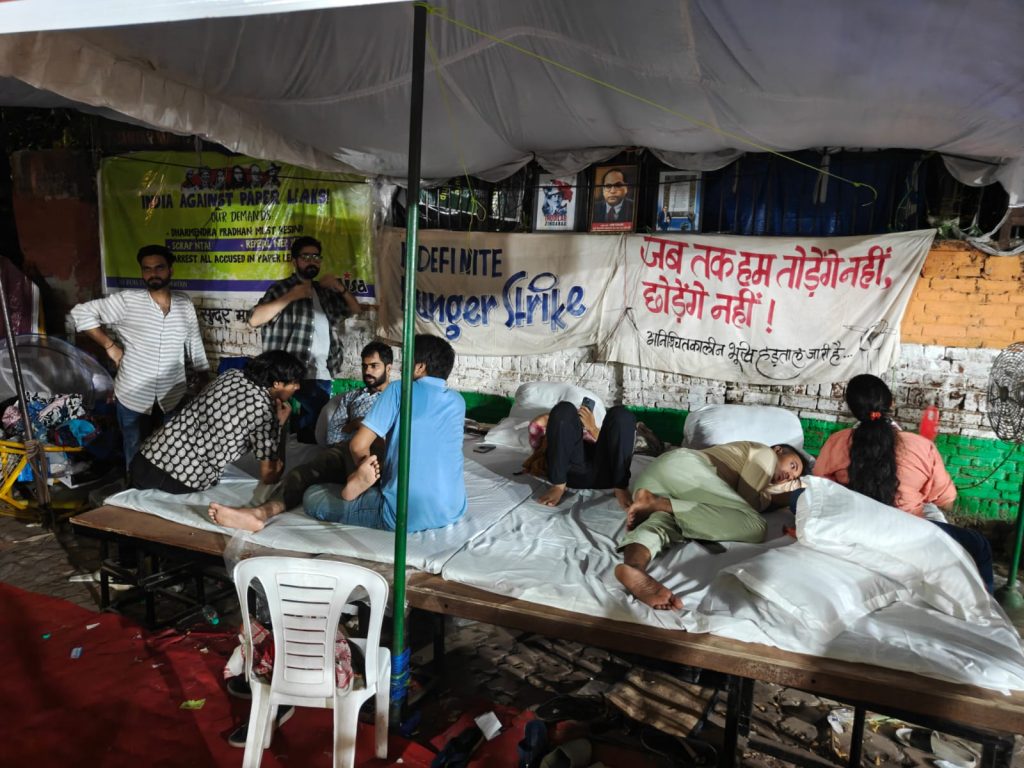
“They’re struggling even with routine movement,” she said.
According to Dr Tilopa, Manish has begun bleeding from his gums. While she described that as a relatively minor symptom, she warned that a prolonged fast could lead to irreversible muscle wasting, electrolyte imbalance, kidney and liver damage, shock and even seizures.
She identified Neha as being in the most critical condition because of her persistently low blood sugar levels, adding that recovery would still take a week to ten days even if the hunger strike ended immediately.
Families Wait, Worry and Encourage
The emotional burden of the protest extends beyond those fasting.
According to Saiyed, Aameen’s sister has remained at the protest site with him while his parents visit regularly. Manish’s family also comes frequently. Neha’s family, however, has found it more difficult to travel.
“When women participate in political movements, families often react differently,” Saiyed said. “That becomes an additional pressure many women activists have to deal with.”
Among those keeping vigil every day is Seema, Manish’s wife and a PhD scholar at Lucknow University. She has been at Jantar Mantar daily since July 1, arriving around 10 am and spending long hours in extreme heat and humidity. Though she is not fasting herself, she helps manage the crowds that continue visiting the protest site.
“He loved food,” she recalled. “Now, for twenty days, he has survived only on water.”
She said his weight has fallen from 86 kg by more than 10 kilograms. At home, his mother and grandmother struggle to hold back tears during phone calls, while his father tries to encourage him to take care of his health.
A Protest that Keeps Drawing New Participants
The hunger strike has steadily grown beyond its initial organisers.
Pinned to a wall at the protest site is a handwritten list of those who have undertaken fasts of at least three days. Many others have joined for one-day solidarity fasts, particularly during the “mass hunger strike” organised earlier this month. Some supporters have also participated from their homes, posting videos on social media after abstaining from food for an entire day.
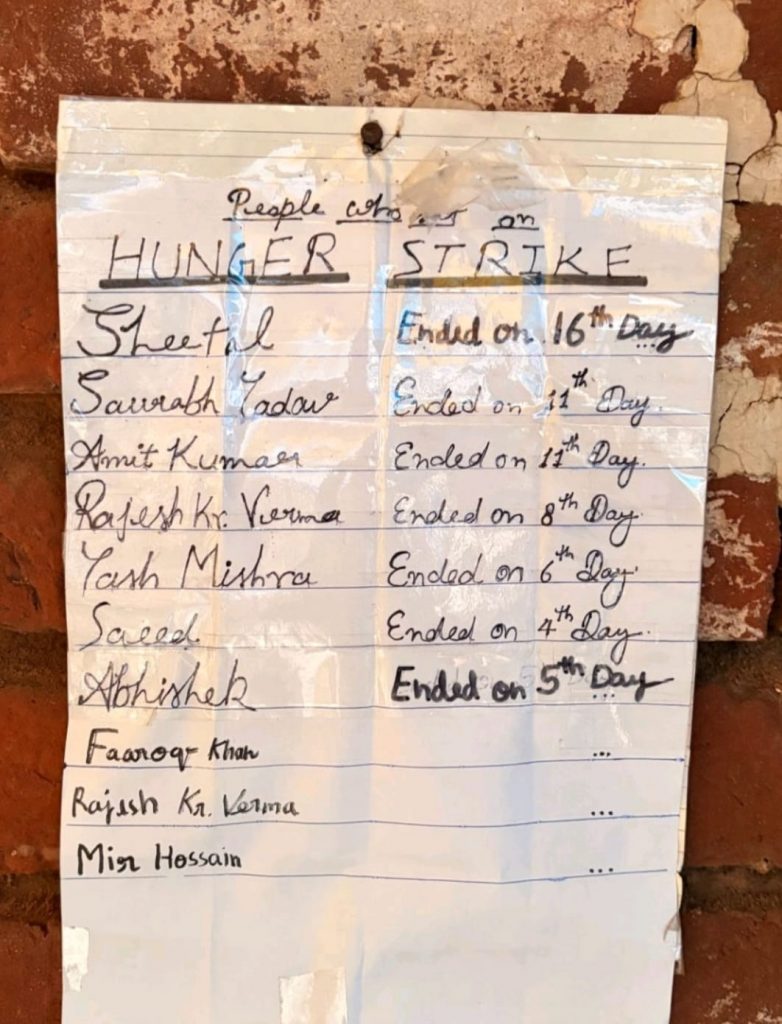
Among them was Sheetal, a private school teacher from Ghaziabad, who says she resigned from her job to participate in the agitation. She began fasting alongside Wangchuk and ended her strike on the sixteenth day after her condition worsened.
Living only on saline water, she said, became unbearable during the final three days. Her blood pressure dropped sharply, and she began vomiting on the fifteenth and sixteenth days.
Others include Supreme Court lawyer Saurabh Yadav, farmer Amit Kumar Neeti from Muzaffarnagar, Delhi bookseller Rajesh Kumar Verma, IT professional Yash Mishra, traveller Farukh Khan and several others who have joined or completed shorter hunger strikes.
Amit Kumar Neeti, whose son appeared for competitive examinations including SSC and IB recruitment tests, said it was his son who persuaded him to travel to Delhi while he stayed back to study.
“This fight is not only for today’s students,” Amit said. “It is also for future generations and for the country’s future.”
Demands Remain Unchanged
Despite growing medical concerns, the protesters say their demands remain unchanged.
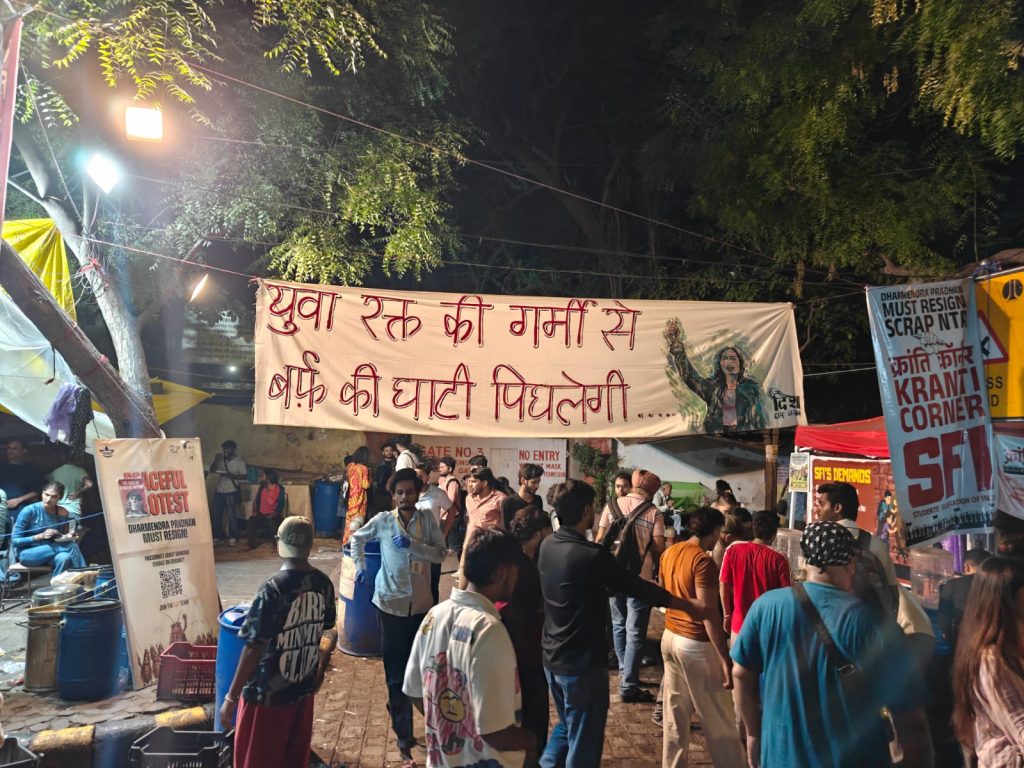
“We are seeking Union education minister Dharmendra Pradhan’s resignation, the dismantling of the National Testing Agency, and the rollback of the National Education Policy 2020,” Saiyed said.
As the hunger strike entered its fourth week, the protest took a dramatic turn on the morning of July 18 when Delhi Police removed Sonam Wangchuk from Jantar Mantar and admitted him to Safdarjung Hospital. Police said the action followed directions of the Delhi high court and medical advice.
However, Abhijeet Deepke of the Cockroach Janata Party alleged that Wangchuk was forcibly taken away and protesters were assaulted during the operation. He also announced that he had begun an indefinite hunger strike himself, and appealed to supporters to maintain an overnight vigil at Jantar Mantar ahead of a planned march to Parliament on July 21.
For nearly three weeks, the hunger strike had unfolded largely outside the national spotlight. Wangchuk’s removal suddenly turned it into a national story, drawing television cameras, political reactions and widespread attention.
Yet for the three PhD scholars fasting alongside him, little changed.
The headlines moved on. Neha, Manish and Aameen did not. Twenty-one days into their hunger strike, they remain under the tarpaulin sheets at Jantar Mantar, their health continuing to deteriorate.
All Photos by Abhishek Kumar