The Calcutta high court on May 15 stayed the demolition drive underway in Kolkata’s Topsia neighbourhood, ordering the authorities to maintain status quo at the site. The order effectively stopped the Kolkata Municipal Corporation’s (KMC) bulldozer action following a fire at the premises of Delta Leather Corporation on Gulam Jilani Khan Road that claimed two lives.
The demolition drive, ordered after public remarks by West Bengal chief minister Suvendu Adhikari and minister Agnimitra Paul, has since come under intense scrutiny. Critics have described it as arbitrary and contrary both to the legal provisions governing demolition of allegedly illegal structures and to multiple Supreme Court rulings laying down safeguards against what has popularly come to be known as “bulldozer justice”.
Deepening the controversy further, the affected family alleged that the KMC put up a backdated notice on the second day of the demolition drive, in complete disregard of the law.
Fire at Delta Leather Corporation
The workshop of Delta Leather Corporation caught fire on May 12 at around 11:30 am. Fire brigade personnel were pressed into service, and the blaze was brought under control by approximately 4:30 pm. Two workers identified as Md Hasanur Zaman (40) and Rajesh (35) died after inhaling toxic fumes, while three others sustained serious injuries.
According to Shama Suhail and Nazia Firdous, members of the owner’s family Alt News spoke to, the injured workers were admitted to Chittaranjan Hospital and a police investigation began soon after. One member of the owner’s family and a senior factory worker — were arrested in connection with the incident.
Later that evening, Agnimitra Paul visited the spot and publicly claimed that the fire had occurred in an illegally constructed building, demanding that the structure be demolished. Chief minister Suvendu Adhikari echoed the demand shortly afterwards. A notification was then issued through the chief secretary directing demolition of the building.
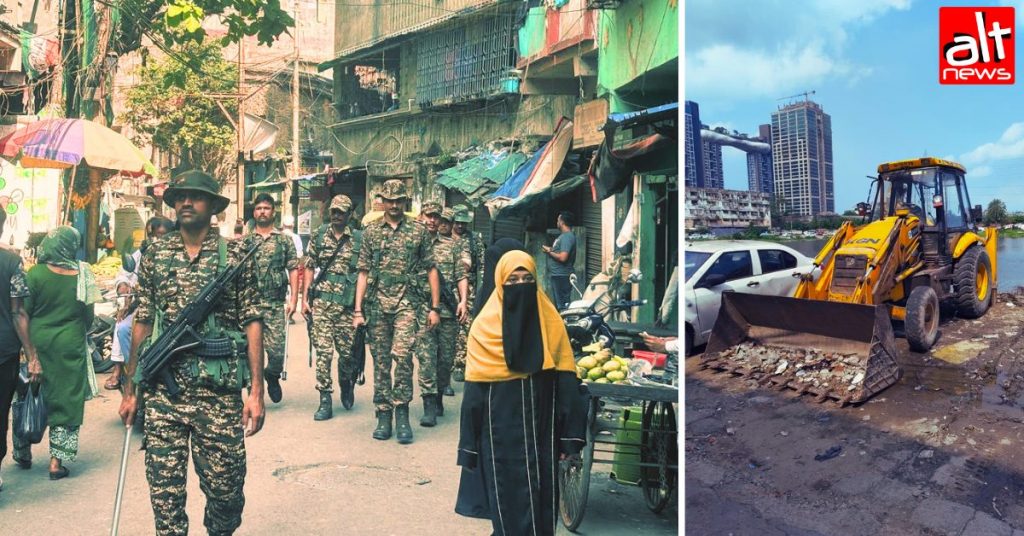
According to Shama and Nazia, around 3:30 to 4 pm on May 13, four to five bulldozers arrived at the premises, accompanied by a large contingent of central armed forces and Kolkata Police personnel, who barricaded the area before the demolition began.
The demolition continued from the evening of May 13 until May 15, before local residents intervened after news of the high court’s status-quo order spread.
Md Izam Alam, a shopkeeper from Park Circus whose shop lies near the demolition site, described the scene on May 13. “The police came and ordered us to vacate the streets. Immediately, multiple troops of paramilitary forces and police officers from the Tiljala police station barricaded the area,” Alam told Alt News.
He said barricades were erected directly in front of his shop to seal off the road. “When the bulldozer arrived, the public panicked. It felt like a trauma was being triggered,” he added.
What the KMC Act Says
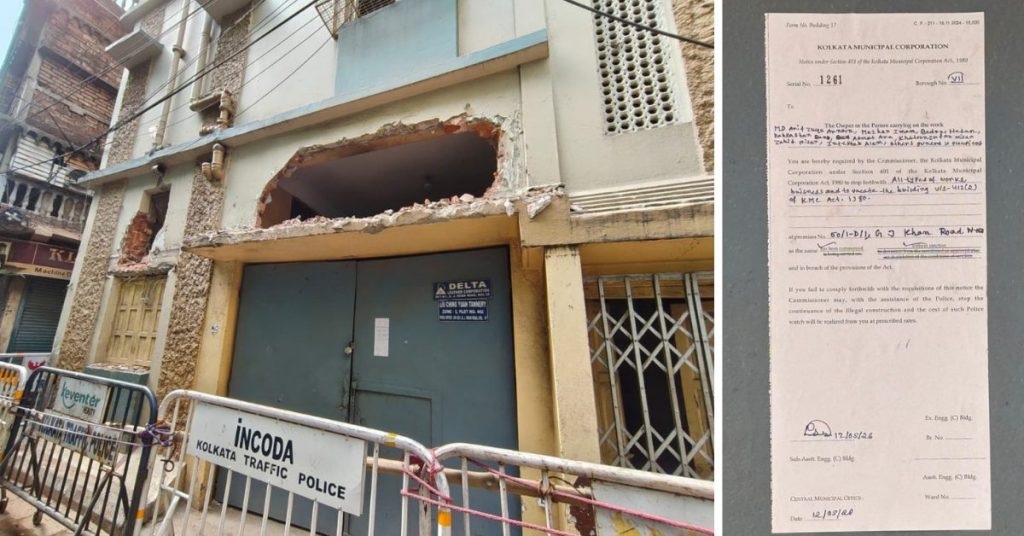
KMC authorities had pasted a notice at the entrance of the property under Section 401 of the Kolkata Municipal Corporation Act, 1980. However, a reading of the Act reveals significant procedural questions surrounding the demolition drive.
Section 401 pertains to stopping ongoing illegal construction. Under this provision, the responsibility for removing unauthorised construction lies with the person undertaking it. The actual power to order demolition flows from Section 400 of the Act. But the section also prescribes safeguards and procedural checks.
Section 400(1) states: “The Municipal Commissioner may, in addition to any other action that may be taken under this Act, make an order directing that such erection or work shall be demolished by the person at whose instance the erection or the work has been commenced or is being carried on or has been completed within such period, not being less than five days and more than fifteen days from the date on which a copy of the order of demolition with a brief statement of the reasons therefor has been delivered to such person as may be specified in the order.”
The provision further states: “Provided that no order of demolition shall be made unless such person has been given, by means of a notice served in such manner as the Municipal Commissioner may think fit, a reasonable opportunity of showing cause why such order shall not be made.”
In effect, the law requires authorities to provide the alleged violator with an opportunity to respond and mandates a minimum time window of five to fifteen days before demolition can take place.
According to the family, these safeguards were not followed.
“After the fire incident, the building was sealed by the police and we were living elsewhere. All of a sudden, we received calls from the locals that bulldozers had come to demolish our workshop and house,” said the family members.
The family lived on the fourth floor of the four-storeyed building, while the remaining floors housed the leather bag manufacturing unit. Eleven family members, including six children, lived there.
According to the family, no evacuation notice was issued before the demolition.
“When we reached the spot after hearing from our neighbours that bulldozers had come to demolish our workshop and home, we were at our wits’ end. We begged the police to at least provide 24 hours, so that we can remove the important family documents, furniture or other movable stuff. But they only allowed us 15 minutes to take out only the valuables, such as ornaments. They didn’t allow us to access and retrieve the factory documents or other documents,” Shama and Nazia pointed out.
The notice pasted at the premises was dated May 12, while demolition began on May 13, well before the minimum period contemplated under Section 400.
When was the Notice Put up?
When we scanned through videos of the demolition, we found that the KMC notice that is currently visible was not there on the entrance of the workshop. See the footage below:
Kolkata, West Bengal: An illegal building in Tiljala, where a recent fire incident led to the death of two people, is being demolished following directions from the Chief Minister. A large police contingent, along with CRPF personnel, has been deployed at the site to maintain law… pic.twitter.com/7oOXjnQsAf
— IANS (@ians_india) May 13, 2026
According to the family, the KMC began demolishing the building before issuing any notice. A backdated notice (dated May 12) was pasted on the night of May 14 in complete disregard to legal provisions.
“When the demolition began, no notice was issued. Later on, a stop-work notice under section 401 of KMC Act and an evacuation notice under section 412(2) was pasted on the front gate of the property. This notice was issued back dated. That is, a May 12 notice was pasted on May 14. They knew what they had done was unlawful, so they tried to cover up their tracks,” said advocate Samim Ahmed who represented the affected family in the Calcutta high court.
The Act does contain a provision permitting immediate demolition if the mayor-in-council of the building department determines that urgent action is necessary. However, in this case, the calls for demolition were publicly made by the chief minister and one of his cabinet colleagues.
Lawyer Nazir Ahamed, representing the family, said the legal process was bypassed altogether.
“There is a process for demolition of illegal buildings in the KMC area. First, a notice under section 401 of the KMC Act has to be issued. It is mandated that a minimum of 15 days has to be provided, so that the aggrieved party can reach the court, and it is the court which will decide whether a structure is illegal or not. This entire process was bypassed,” he said.
He further added: “The demolition was done in the presence of the DG of KMC’s Building Department. No prior evacuation notice was issued.”
Family Disputes Claims of Illegality
The owner’s family also disputed allegations that the building itself was illegal.
“We have been using this building, almost for the past 35-40 years. It has a sanctioned building plan, the leather workshop has a valid factory license till 2029, and we are regularly paying property tax to the government. If there is any anomaly, why didn’t the authorities issue a single notice of non-compliance before?” Shama Suhail asked.
After the fire, sections of the media reported that the premises housed a tannery storing hazardous chemicals in a densely populated area. The family denied this claim.
“We have a tannery unit elsewhere. At this location, bags and other leather goods were only cut and stitched. No harmful chemicals were present at the spot,” they said.
Supreme Court’s Stand on Demolitions
The controversy surrounding the Topsia demolition also echoes a series of judicial pronouncements on forced evictions and demolitions.
In multiple judgments, the Supreme Court has held that the right to life under Article 21 cannot be separated from the rights to shelter and livelihood. Courts have repeatedly observed that demolitions without notice violate constitutional guarantees of dignity and due process.
In Ajay Maken vs Union of India (2019), the Delhi high court laid down detailed procedural safeguards governing evictions and demolitions. The court held that authorities must issue a written notice, provide a fair hearing, consider rehabilitation, and ensure proportionality before carrying out demolition.
The Supreme Court reiterated similar principles in its November 2024 judgment addressing so-called “bulldozer justice”. A bench comprising Justice BR Gavai and Justice KV Vishwanathan observed that such actions “remind one of a lawless state of affairs where might was right”.
Former CJI Gavai later described the verdict as one of the most satisfying judgments of his tenure. The full judgment can be read here.
The Supreme Court’s directions mandated safeguards including a 15-day notice period, personal hearing, reasoned order, and a cooling-off period to allow affected persons to seek legal remedies — principles that closely mirror the procedural protections already embedded in Section 400 of the KMC Act.
An officer at Tiljala police station, whom Alt News spoke to refused to respond to our queries on whether legal provisions were followed in the demolition drive.
In January 2026, Article 14 reported how the Supreme Court’s directives on the legal process of demolition were being ignored by BJP-ruled states without any consequence.
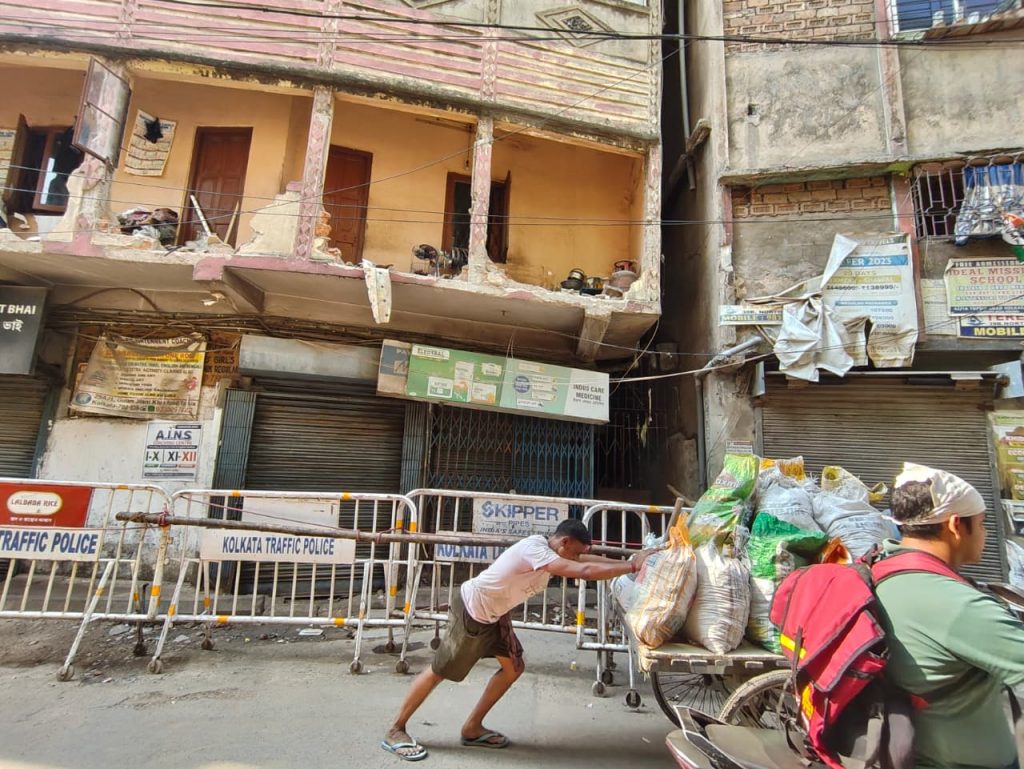
Adjoining Building also Damaged
The demolition drive also affected an adjoining building.
According to the family, Delta Leather Corporation had rented only the first floor of the neighbouring structure to house factory workers. No manufacturing activity took place there.
“The first floor of the neighbouring building was used only to house the workers of our factory. No manufacturing took place there, but just because it was associated with us, it also got demolished,” the family said.
When Alt News visited the area, the first-floor balcony of the damaged structure still bore signs of the bulldozer action. Household items, including cooking utensils, baskets, gas cylinders and other belongings, remained scattered inside.
The Calcutta High Court’s interim order has currently stalled the demolition drive till June 22, 2026. Senior advocates including Bikash Ranjan Bhattacharya and Samim Ahammed appeared for the affected family. In his order, Justice Raja Basu Chowdhury stated, “Considering the prima facie case made out, there shall be an order of status quo. The petitioners are also restrained from making any improvement and/or restoring the building to its original position. It is also made clear if any portions of the building have already become dangerous, the municipal authorities in consultation with the petitioners shall remove such dangerous portion however, barring the same no further demolition shall take place without leave of this Court.”

The Bulldozers Left Behind Fear and Uncertainty
Beyond the legal questions surrounding the demolition drive lies another story — that of fear and uncertainty associated with the now deeply politicised imagery of the bulldozer.
An innocuous machine associated with construction and development has, in contemporary India, acquired an altogether different political meaning. The bulldozer is no longer merely a tool for demolition, it has emerged as an emblem of intimidation and state power. Its arrival signifies more than the destruction of homes or neighbourhoods; it announces a spectacle of punishment in public view, generating panic and a climate of fear. Consequently, ‘Bulldozer Justice’ has become a model of retributive violence. It was largely popularized by Uttar Pradesh chief minister Yogi Adityanath in which bulldozers are deployed by the authorities to raze down the house of an accused before a case or a dispute reaches a judicial closure.
ALSO READ: The journey of ‘bulldozer justice’: From Right Wing fringe elements to Modi’s election vocabulary
That atmosphere was palpable in Tiljala when the Alt News team visited the locality a day after the demolition drive had been halted by the high court.
Three bulldozers stood parked beside Dhopar Pukur, a local pond. One still carried chunks of broken concrete in its bucket. CAPF personnel remained deployed across the area alongside Kolkata Police. Barricades lay stacked along the roadside, while two adjacent buildings marked for demolition continued to remain cordoned off under heavy security. The neighbourhood felt tense and deeply unsettled.
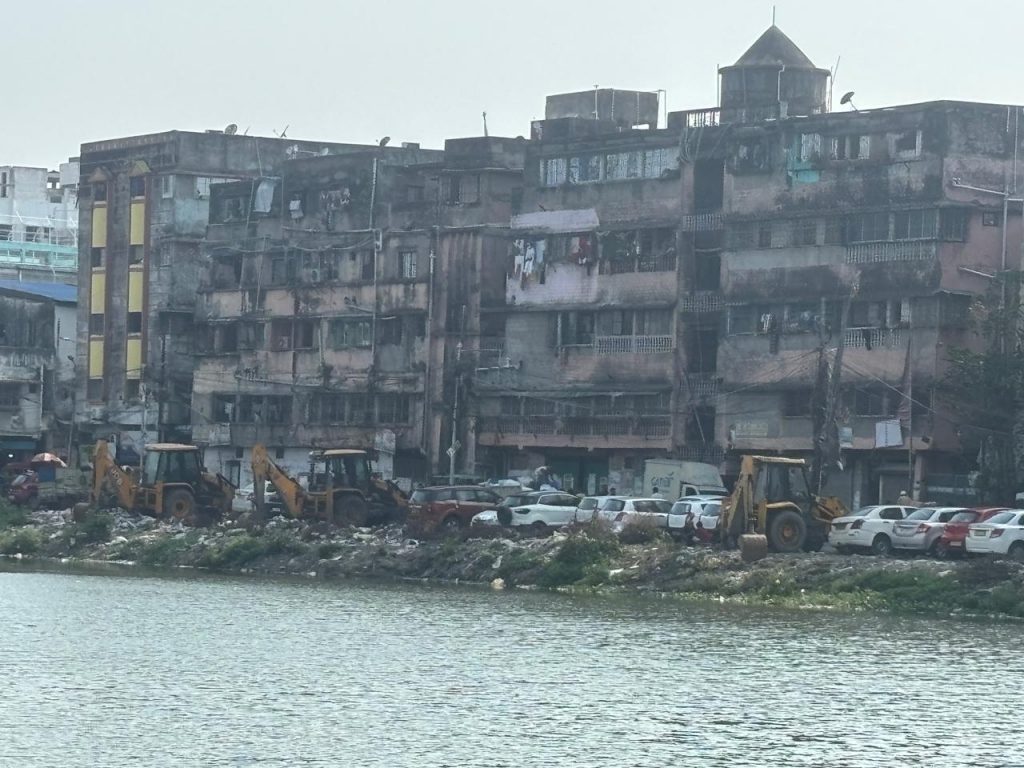
Mumtaz Begum, locally known as Baby Miraz, recalled the events of May 13. Around 3 pm that day, she said, police personnel and CAPF troops entered the locality alongside a bulldozer.
“The sight of the bulldozer invoked fear in our hearts,” she told Alt News. “I ran to stop the bulldozer and asked the police whether they had any notice to demolish the building, or any explanation for bringing a bulldozer into our lane. They showed us no paperwork and gave no reason.”
According to Miraz, the following day, the bulldozer began demolishing an adjacent building, leaving its residents homeless.

“At least 40 people lived in this building. They were asked to vacate the property within two hours. They are now homeless. Administration did not clarify the real problem behind it. Just the word ‘illegal construction’ echoed all around,” she said.
Miraz further alleged that residents of the building adjacent to the factory were forced to spend the night on the streets after the demolition drive began. Reflecting on the scale of security deployment, she added, “There were CRPF personnel everywhere. It felt as though the area was being treated like a terrorist hideout.”
As Miraz spoke, local residents gradually gathered around, eager to voice their anxiety and anger.
One elderly woman told Alt News, “I have lived here for decades. I have seen three governments come and go, but I have never witnessed anything like this. So many police personnel and CAPF troops have been deployed, and homes are being razed before our eyes. I am frightened.”
Another resident echoed the uncertainty gripping the locality: “Today it’s someone else’s house, next it could be mine. I don’t know what is happening. Everything was fine until now. Overnight, a fear of homelessness looms over us.”
A young man standing nearby drew parallels between the Tiljala demolitions and similar drives carried out in other parts of the country. “How am I supposed to feel when the CM of my state wants ‘Gaza-like action’?” he asked. “He has repeatedly said he will work only for a certain section of the population. He wants to corner us. We feel concerned.”
The youth also questioned the absence of local Trinamool Congress MLA Javed Khan during the crisis. “Where is our MLA Javed Khan, or his son? We haven’t seen their faces this whole time. Where is he when the people need him?” he said.
He contrasted Khan’s absence with the presence of other political figures in the locality.
“Satarup (Ghosh, CPM leader) was nominated as a candidate from our assembly constituency for the last three terms, but hardly any people voted for him, yet he was here for the people, helping us, supporting us. Even the Domkol MLA was here to handle the situation. But our own MLA was nowhere to be found.”
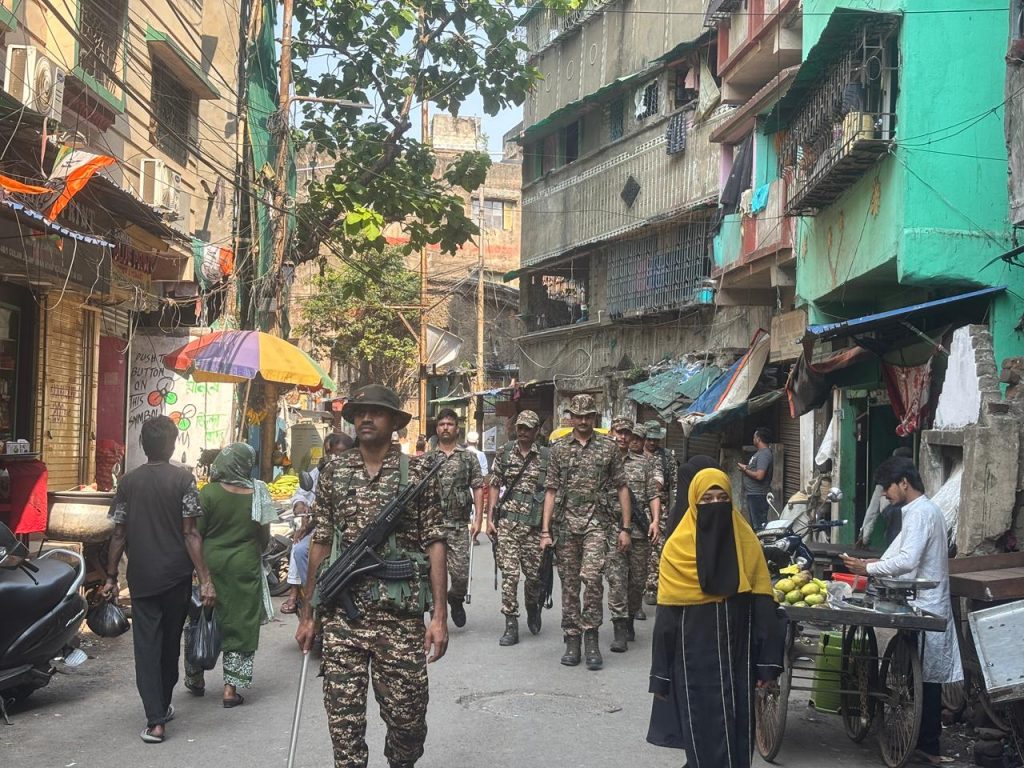
Another local resident spoke about the fear associated with what many now recognise nationally as “bulldozer action”. “All this while, we have seen ‘Bulldozer action’ in other BJP-ruled states; it has not been a month, and a bulldozer has entered our locality and begun tearing down homes. Only we know the fear we are living with,” the resident said.
In search of displaced families, Alt News visited another residence in the locality. There, we met Dulari Begum, who described an atmosphere of collective trauma in the neighbourhood.
“Everyone here is traumatised. We built these homes with care, with years of labour and savings. Watching a bulldozer destroy our neighbours’ homes has instilled fear in all of us,” she said.
She added that many of those displaced were working-class families — labourers, drivers and daily wage earners struggling to survive in the city. “Most of them were ordinary people trying to survive,” she said. “To lose the roof over your head with barely 12 hours’ notice is gut-wrenching.”
Other residents told Alt News that schools in the locality had remained shut since the operation began. Mentor Public School, they said, has suspended classes since May 14, underscoring the wider disruption and lingering climate of fear that now hangs over the neighbourhood.
It was clear that the impact of the demolition drive extended beyond the immediate destruction of homes and buildings.