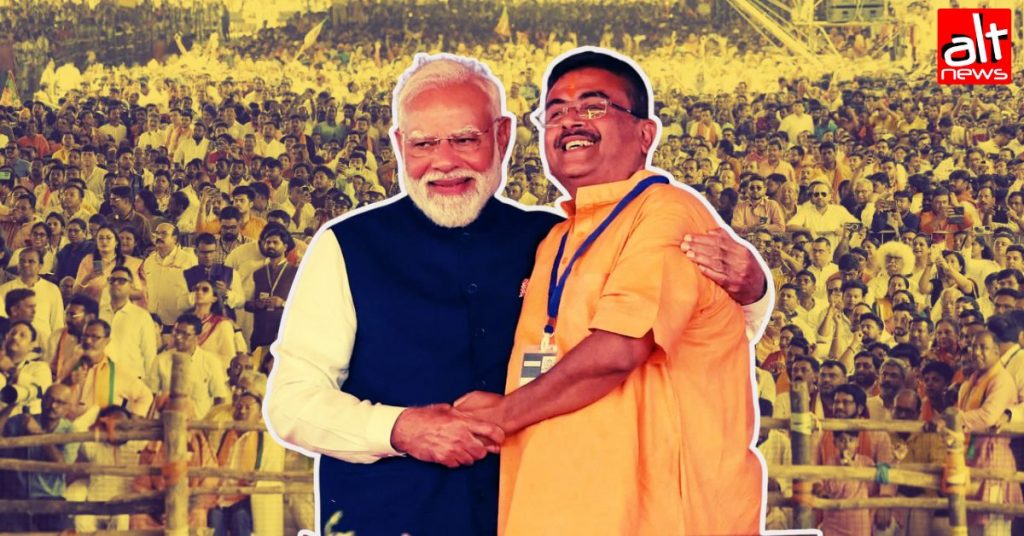
On May 9, Suvendu Adhikari was sworn in as the first BJP chief minister of West Bengal after the party’s sweeping victory in the 2026 assembly elections. In his oath of office, Adhikari pledged allegiance to the Constitution and vowed to govern “without fear or favour, affection or ill-will.”
Soon after the ceremony, the state’s ninth chief minister visited Jorasanko Thakurbari to pay tribute to Rabindranath Tagore on his 166th birth anniversary, where he sent a message of inclusivity, saying, “I belong to everyone.”
#WATCH | West Bengal CM Suvendu Adhikari says, “The political party based on the ideals of Dr Shyama Prasad Mukherjee doesn’t need any certification. I am the Chief Minister now, and I belong to everybody. Those who are still discussing the results, may they be guided by… pic.twitter.com/UxKeI9fUlY
— DD News (@DDNewslive) May 9, 2026
Addressing supporters in Nandakumar near his hometown of Contai, Adhikari again emphasized restraint and inclusivity later in the day, remarking that “a chief minister must weigh their words” and promising governance guided by “Sabka Saath, Sabka Vikas.” When supporters mentioned “sabka hisaab bhi hoga”, Adhikari responded, “Well, I am not saying that anymore”.
However, even as he tried to distance himself from any divisive statements, his post swearing-in moderation stood in sharp contrast to the communal rhetoric that defined much of his election campaign and continued even after his victories from Bhawanipur and Nandigram.
Kolkata, May 4, 2026: “Muslims Voted for Hijabi Mamata”
After collecting his certificate for winning the Bhabanipur assembly seat, where he defeated three-time chief minister Mamata Banerjee, Suvendu Adhikari openly framed the result along communal lines while speaking to the media. Claiming that Muslims in Bhabanipur had not voted for him and had instead backed Banerjee, whom he referred to as “hijabi Mamata”, Adhikari said Hindus, Sikhs, Jains and Buddhists had ensured his victory, which he described as “a victory of Hindutva.”
“I bow in gratitude to all the Hindus, Jains, Sikhs, and Buddhists who voted for me. The Muslims of Bhabanipur did not vote for me… It was very important to defeat Mamata Banerjee. Her political retirement has now happened,” he said. Referring to voting patterns in specific wards, Adhikari claimed that Muslims had “openly voted” for Banerjee, while Bengali Hindus in areas such as Chetla and Ward No. 82, along with Gujarati, Jain, Marwari, Purvanchali and Sikh voters, had backed him.
At one point in the interaction, when a journalist remarked that his victory margin in Bhabanipur was much larger than in Nandigram, Adhikari attributed the difference to the Muslim population in the constituency. “There were more Muslims in Nandigram, so the margin was smaller… Here, there were 35,000 Muslims, so the margin became larger,” he said, before adding, “Muslims did not vote for me. Muslims voted for their real people… they voted for hijab-wearing Mamata.”
The repeated use of the term “hijabi” by Adhikari is problematic because the term is used in a pejorative and communal sense, portraying a marker of Muslim identity as something suspect or undesirable. In the context of election results, the entire statement risks deepening communal divides as it frames political identity and electoral support through a religious lens.
Haldia, May 5, 2026: “Will Work only for Hindus of Nandigram”
After Adhikari received his Nandigram assembly winning certificate from Haldia, he spoke with news agency ANI and explicitly mentioned that the Muslims in Nandigram had not voted for him and hence he was committed to focusing solely on the welfare of the Hindus in Nandigram.
#WATCH | Haldia, West Bengal: BJP leader and winning candidate from Bhabanipur and Nandigram seat, Suvendu Adhikari says, “…This time I won the election with almost ten thousand votes. The Hindu people of Nandigram made me win again. There, the entire Muslim vote went to TMC…… https://t.co/VTjw3JrW93 pic.twitter.com/8uOh5qEtyI
— ANI (@ANI) May 4, 2026
“Last time I won by 1,956 votes; this time I have won by nearly 10,000 votes. And once again, the Hindu people of Nandigram have made me victorious. The entirety of Muslim votes there went to the TMC. These people are extremely radical. That is why my path is correct. I will work only for the Hindus of Nandigram…”
Kolkata, Haldia, May 4, 2026: ‘Muslim EVM’, ‘Madrasa’ Jibe
On May 4, while counting was on, Adhikari addressed reporters and claimed that all Hindus had unitedly voted for Modi. He stated that he had seen and was well aware of the electronic voting machines (EVMs) and the voting trends.
#WATCH | Kolkata: On the early trends, West Bengal LoP and BJP candidate from Nandigram and Bhabanipur, Suvendu Adhikari, says, “All Hindus are united in favour of Narendra Modi… After four rounds of counting, the BJP is forming its government. Hindu EVMs mean BJP, Muslim EVMs… pic.twitter.com/jw1gzs7qzP
— ANI (@ANI) May 4, 2026
“All Hindus are united in support of Narendra Modi… We have seen it now… a Hindu EVM means BJP, a Muslim EVM means TMC. Except for Malda, Murshidabad, and Uttar Dinajpur, because the Muslims there favour Congress more.”
Later on the same day, after the results were declared, a reporter asked Adhikari, “With the numbers you have secured, a lot of responsibility has come upon you. But what is being seen everywhere is that the TMC had threatened that after the 4th, scores would be setlled. As an MLA elected from two seats, what message do you have for the opposition…?”
To this, Adhikari replied: “BJP workers are disciplined people, and mainly Hindus and Adivasis support the BJP; they do not do such things. To do such things, one has to study in a madrasa. None of us studied in a madrasa.”
Just like the ‘hijab’ remark, the pejorative reference to madrasa is problematic because it directly links madrasa education, and implicitly Muslims, with violence and criminal behaviour. By saying that “to do such things, one has to study in a madrasa,” Suvendu Adhikari portrayed Muslim educational institutions as breeding grounds for lawlessness, reinforcing a deeply prejudicial and communal stereotype, and thereby appeared to be vilifying an entire community.
Kolkata, December 2025: “Must Teach them a Gaza-Like Lesson”
Perhaps the most deeply inflammatory of Suvendu Adhikari’s remarks came in December 2025, months before the election. Amid reports of attacks on minority Hindus in Bangladesh and the lynching of Dipu Chandra Das, Adhikari endorsed a “Gaza-like” response, saying, “sabak sikhana chahiye. Jese Israel ne sikhaya Gaza meh. Us tarikhe se hamare bharat ki 100 crore hindu, deshka Hindu hit meh chal raha hai sarkar. Sabak sikhana chahiye, jese operation sindoor meh Pakistan ko humlog sabak sikhaya”. (They should be taught a lesson. The way Israel taught one in Gaza. In the same way, the 100 crore Hindus of our country, the government is moving in the interest of Hindus. They should be taught a lesson, just as we taught Pakistan a lesson in Operation Sindoor.)
Kolkata, West Bengal: On the lynching of Hindus in Bangladesh, Leader of the Opposition in the State Assembly, Suvendu Adhikari says, “These people must be taught a lesson, just like Israel taught Gaza. Our sacred Hindu values and the government are working in the interest of… pic.twitter.com/Mv0GssyfdF
— IANS (@ians_india) December 26, 2025
The remarks sparked outrage, with critics accusing Suvendu Adhikari of invoking genocidal imagery and endorsing the idea of collective punishment against an entire community.
Adhikari had also used this rhetoric was after the Pahalgam attack, during a meeting with a woman who had lost her husband. He said, “How dare they kill Hindus in Hindustan? Gaza is finished. Israel obliterated them. We will also finish them. We are disciples of Modi. We are Modi’s sons…”
Instances Galore: “Stop Sabka Sath, Sabka Vikas”, “Will Throw out Muslim MLAs”
In March 2025, Adhikari, then the Leader of Opposition in the Bengal assembly, said that once the BJP won Bengal, the party would throw out Muslim MLAs from the assembly. “We will defeat Speaker Biman Banerjee and chief minister Mamata Banerjee. After the BJP assumes power, we will carry the Muslim MLAs of their (TMC) party, who will win and come to the assembly, and throw them out of the House in another 10 months”, Adhikari said.
In July 2024, Adhikari proposed changing the BJP’s slogan from “Saabka saath, saabka vikas” to “Jo hamare saath, Hum unke saath”, calling for the abandonment of the minority morcha. While addressing a state executive meeting of BJP in Kolkata, Adhikari said, “I had spoken about nationalist Muslims and you too had said ‘Sabka Saath, Sabka Vikas’. But I will not say this anymore. Instead, we will now say, ‘Jo Hamare Saath, Hum Unke Saath’. Stop this ‘Sabka Saath, Sabka Vikas’. Minority Morcha is not needed.” Later clarified that he meant those who are nationalists, the party should be with them. Those who don’t stand with us work against the nation; we should expose them.”
Watch: “We will uphold Hinduism and the constitution. I previously mentioned nationalist sentiments towards Muslims, but we will no longer do so. Instead, we will focus on ‘Jo Hamare Sath Hum Unka Sath’. There is no need for a Minority Morcha,” says BJP leader Suvendu Adhikari pic.twitter.com/DMxHztQFyF
— IANS (@ians_india) July 17, 2024
It is worth noting that in the recent 2026 assembly elections across West Bengal, Assam, Kerala, Tamil Nadu and Puducherry, the BJP did not field a single Muslim candidate, and naturally no Muslim MLA was elected from the party in those polls. BJP does not have a single Muslim MP at present. Nationwide, it has only two Muslim MLAs — Achab Uddin from Manipur and Tafajjal Hossain from Tripura.
From Regional Populism to Hardline Hindutva
Suvendu Adhikari’s communal rhetoric is politically striking because he is not a lifelong RSS-BJP worker but a former Mamata Banerjee lieutenant who spent most of his career in the Trinamool Congress. Unlike traditional BJP leaders shaped by the RSS ecosystem and its ideological training, Adhikari emerged from Bengal’s populist, anti-Left regional politics, where overt Hindutva language was historically less central.
His sharp communal turn after joining the BJP, therefore, appears less rooted in long-standing ideological conviction and more in political adaptation to the BJP’s polarisation-driven electoral strategy in Bengal. That is partly why the shift feels especially stark: The rhetoric often appears performative and engineered to establish ideological credibility.
A useful comparison is Himanta Biswa Sarma, another powerful regional leader who joined the BJP after rising through the ranks in Congress. Like Adhikari, Sarma was not an RSS product and adopted a far more overt Hindutva line after switching parties. In both cases, the former regional-centrist politicians deployed sharper communal rhetoric than some traditional BJP cadre leaders, partly to signal loyalty to the party’s ideological core and partly because polarisation has proven electorally effective in their respective states.