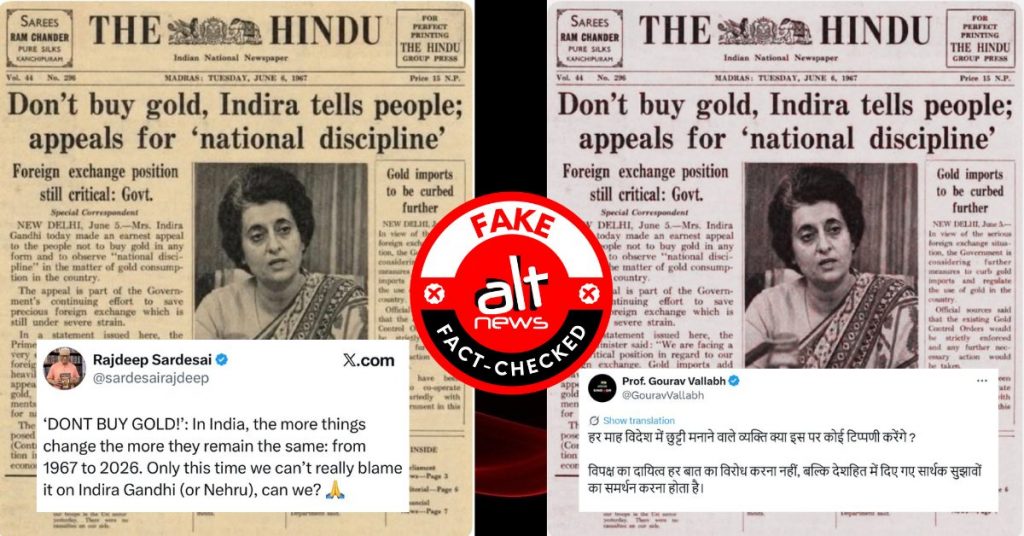
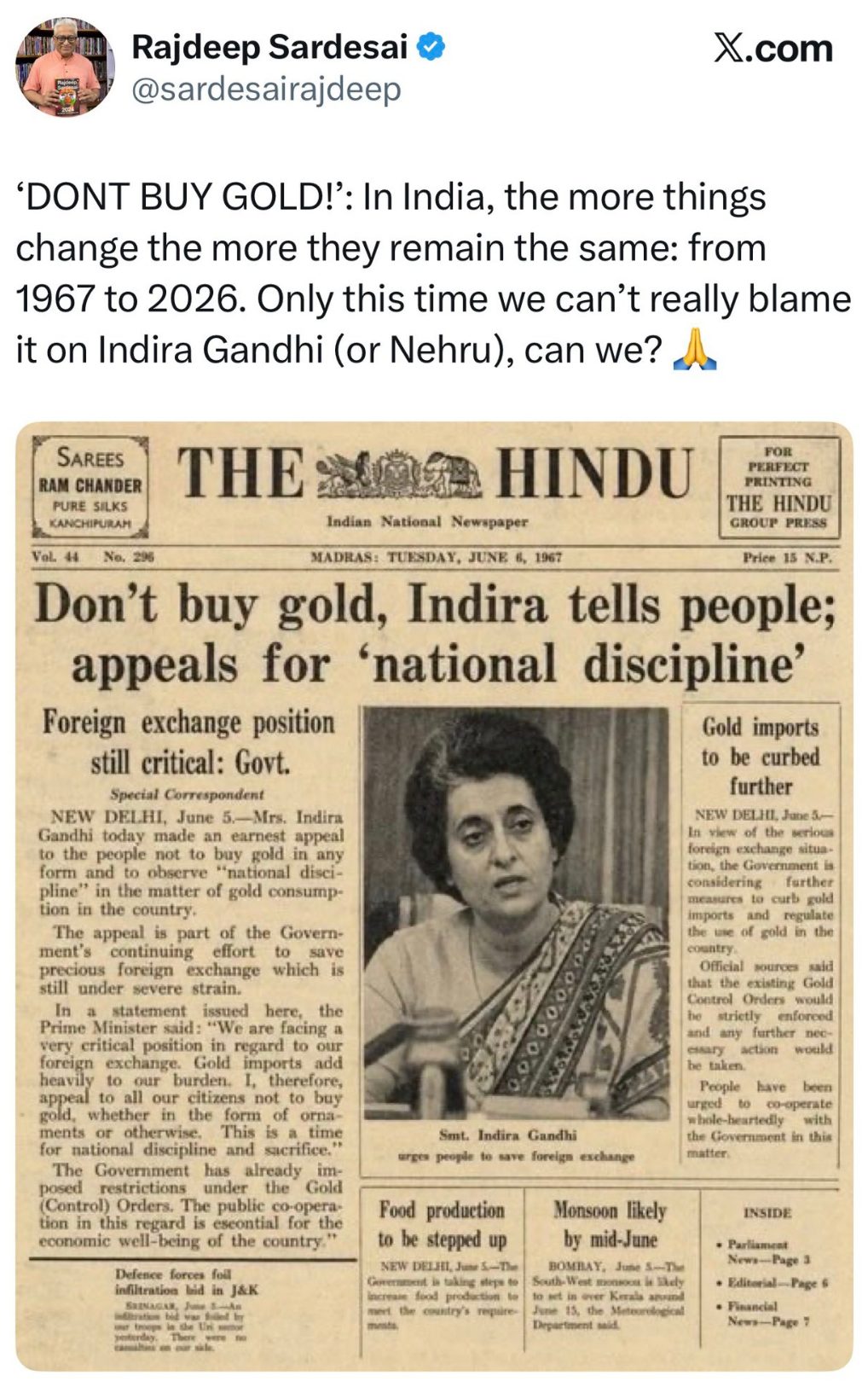
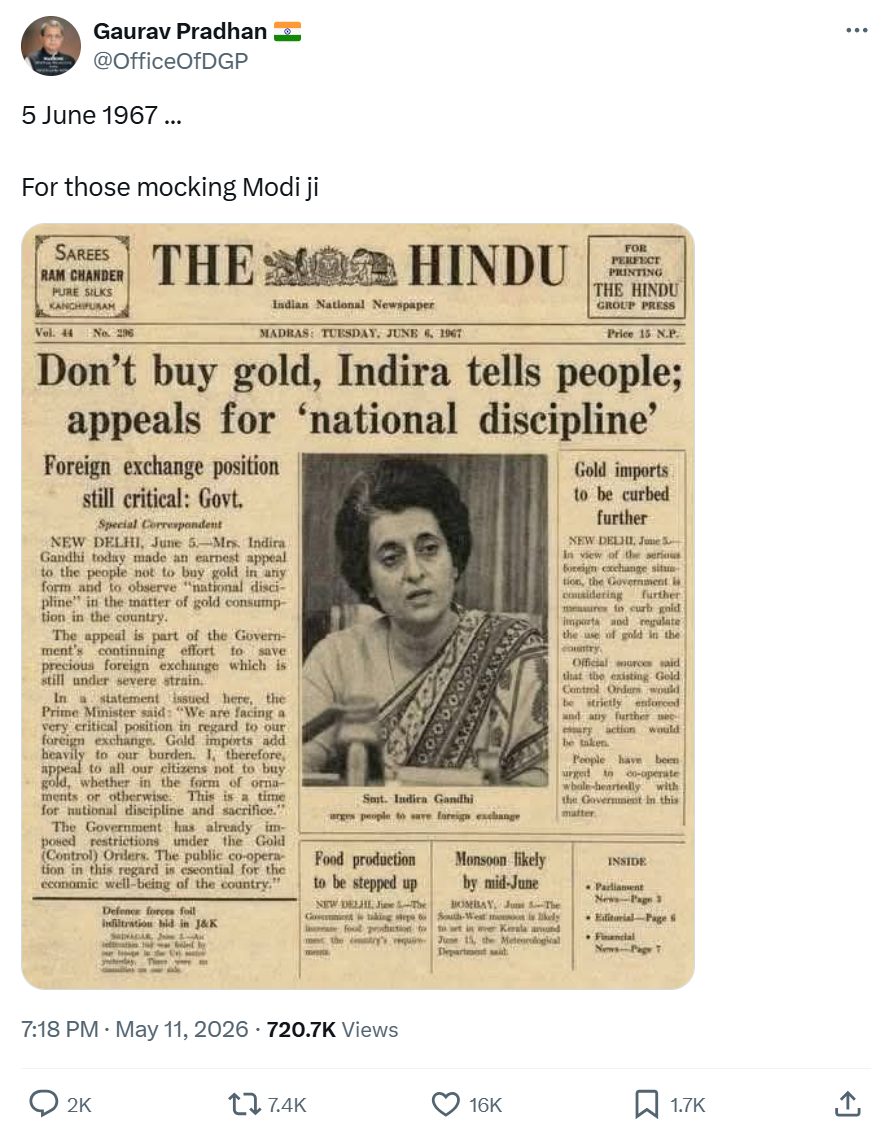
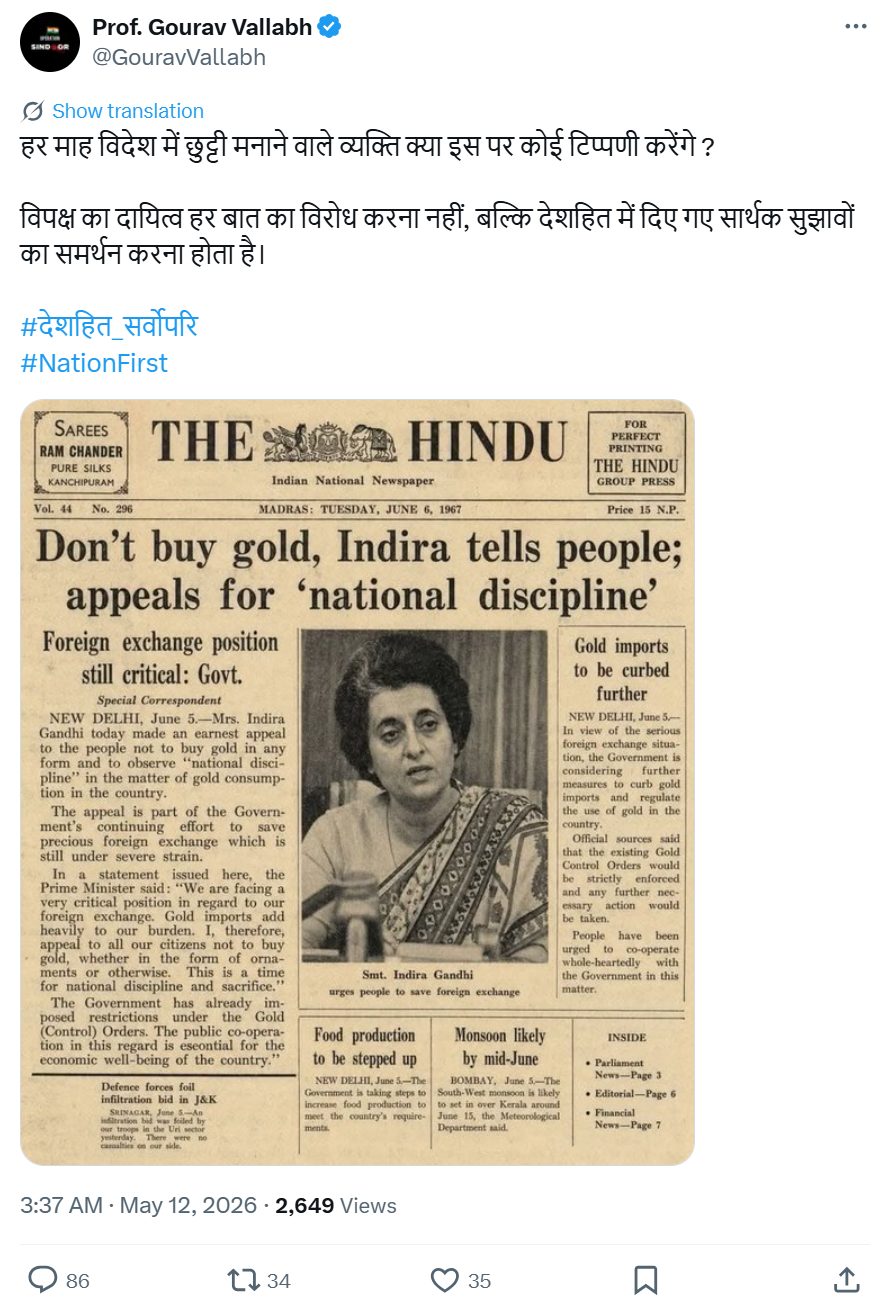
A viral image claiming to be a June 6, 1967 front page of The Hindu is viral on social media. The clipping, shared by several social media users, journalists, and even a few media outlets, claims that then Prime Minister Indira Gandhi appealed to citizens on June 5, 1967, not to buy gold and to maintain “national discipline.”
The viral clipping surfaced after Prime Minister Narendra Modi recently urged Indians to avoid purchasing gold for a year in order to ease pressure on the country’s foreign exchange reserves. The appeal triggered sharp political reactions, with Congress leader Rahul Gandhi calling it a sign of the government’s economic failure, arguing that the country had reached a point where citizens were being told what they should and should not buy.
Against this backdrop, several BJP leaders, Right-wing influencers, journalists, and commentators circulated the alleged 1967 clipping to argue that such appeals were not unprecedented and had also been made during Congress rule.
Senior journalist Rajdeep Sardesai shared the clipping on social media, writing, “In India, the more things change the more they remain the same: from 1967 to 2026. Only this time we can’t really blame it on Indira Gandhi or Nehru.” He later deleted the post. Times Now also published a report based on the clipping before subsequently updating the story.
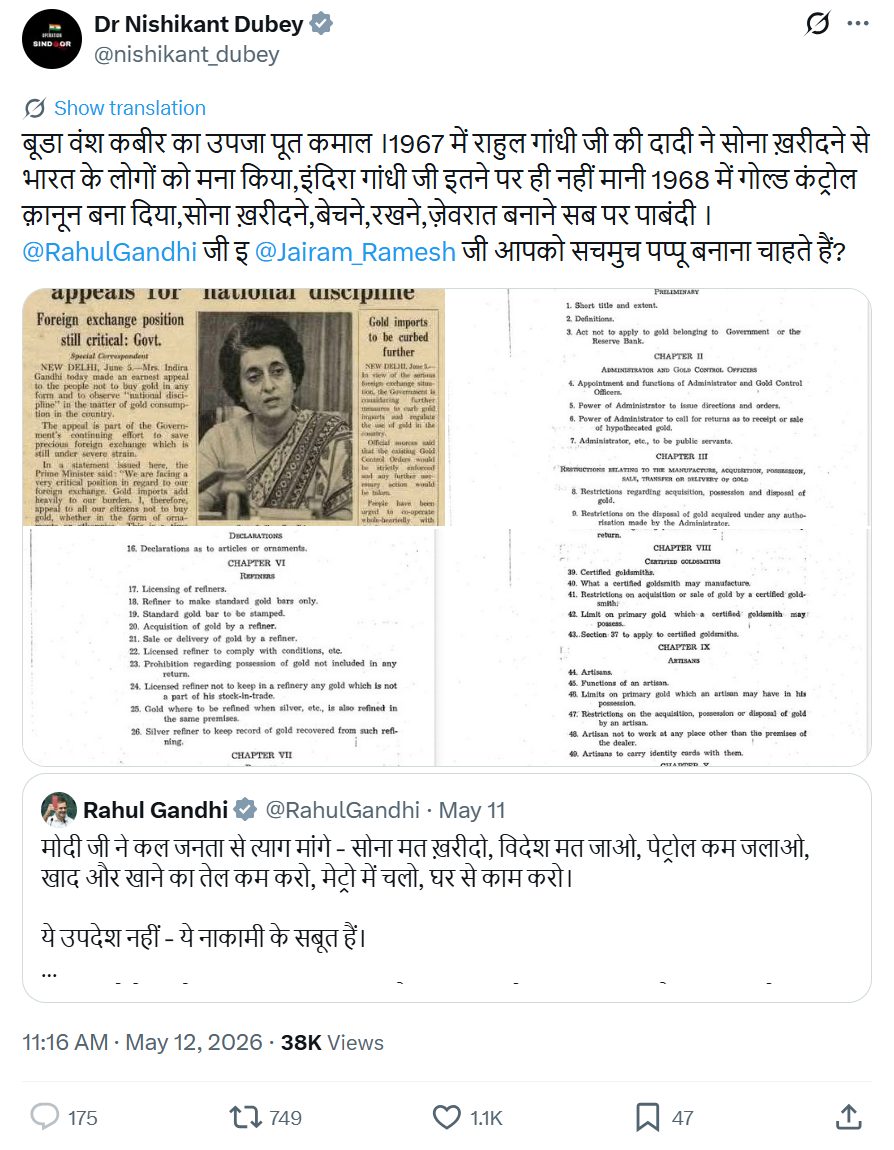
BJP MP Nishikant Dubey targeted Rahul Gandhi by sharing the purported clipping of ‘The Hindu’.
BJP supporter Gaurav Pradhan, who is often found spreading misinformation, shared the same image.
BJP leader Professor Gaurav Vallabh, while sharing the viral clipping, wrote that the Opposition’s task was not to oppose everything, but to support meaningful suggestions given in the national interest.
Fact Check
We searched relevant keywords to verify the format of The Hindu in 1967 and found archived copies of the newspaper from that period on the collectibles website Bid Curious. A comparison between the viral clipping and authentic editions revealed several inconsistencies.
For instance, The Hindu was (and continues to be) published in an eight-column broadsheet format, whereas the viral clipping features only five columns, a layout more typical of tabloid newspapers. We also found discrepancies in the newspaper’s tagline. Authentic editions carried the tagline “India’s National Newspaper,” while the viral clipping instead reads “Indian National Newspaper.”
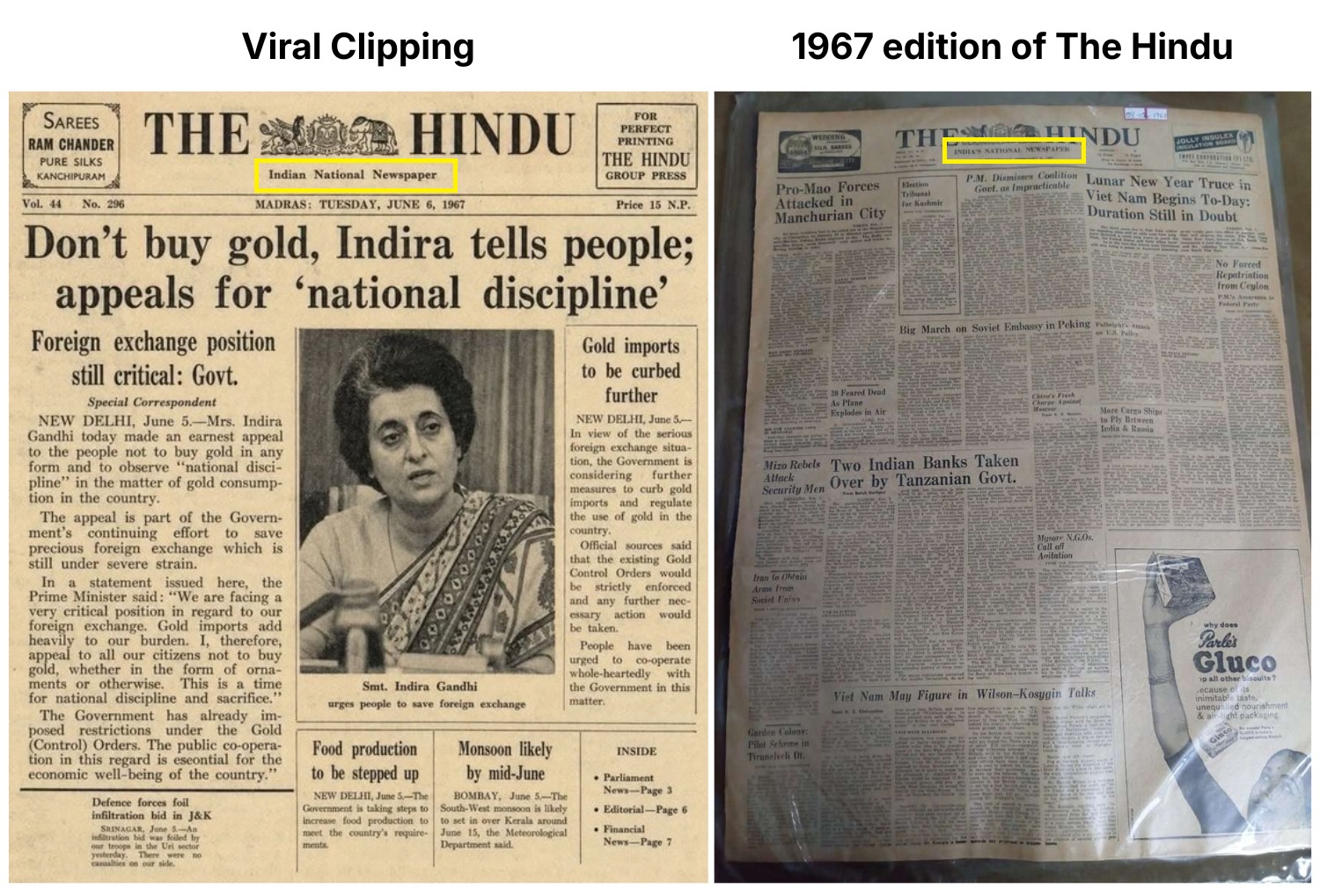
The Hindu group issued an official statement clarifying that the front page image of June 6, 1967, which had gone viral on social media, was not authentic.
📢 A digitally altered image purporting to be a front page of The Hindu from June 6, 1967, is currently circulating on social media. We wish to clarify that this is not an authentic page from our archives. The Hindu urges readers to exercise caution and verify before sharing.
— The Hindu (@the_hindu) May 12, 2026
Nistula Hebbar, political editor of The Hindu, also shared a comparison of the original front page of the paper from June 6, 1967, and the viral image. In reality, the front page lead story that day was on the Arab-Israel War.
The front page of @the_hindu dated June6, 1967 being posted on SM over gold controls is fake, likely AI generated. The actual front page on that day was headlined by the Arab-Israel war. Both posted below. Thank u for your attention to this matter! pic.twitter.com/whSADF5bXB
— Nistula Hebbar (@nistula) May 12, 2026
Overall, it is clear circulating in the name of The Hindu is fabricated. However, it is historically true that India witnessed stringent gold control measures during Indira Gandhi’s tenure.
The roots of India’s gold control regime predate her prime ministership. Following the Sino-Indian War, mounting pressure on India’s foreign exchange reserves prompted the government to adopt strict measures to curb gold consumption and imports. Then finance minister Morarji Desai introduced several restrictions, including the recall of gold loans from banks and a ban on gold futures trading.
In 1963, the government further prohibited the manufacture of gold jewellery above 14 carats. When these measures failed to achieve the desired results, the government enacted the Gold Control Act in 1968 during Indira Gandhi’s tenure, with Morarji Desai serving as Finance Minister. The law prohibited citizens from holding gold bars and coins. Existing holdings in the form of bars and coins had to be converted into jewellery and declared to authorities.
The Gold Control Act remained in force until 1990, when it was repealed as part of broader economic liberalisation measures aimed at integrating India’s gold market with the global economy.