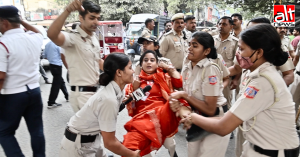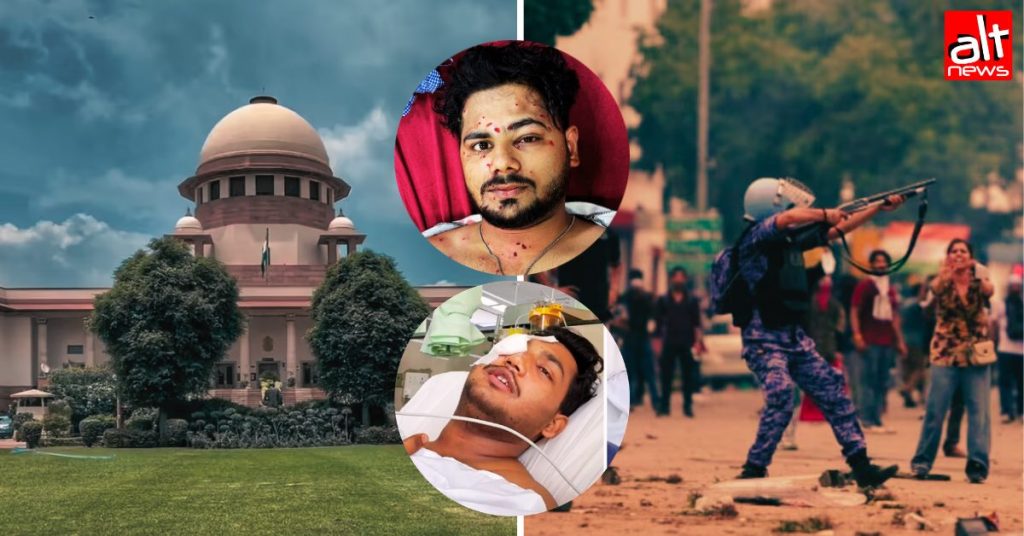
A General Diary (GD) registered at Parliament Street police station in New Delhi showing that anti-riot guns were used during the July 20 protests at Jantar Mantar has confirmed what media reports, medico-legal records, visual evidence and victim testimonies had already made abundantly clear.
GD number 0008A registered on July 22 at 1:24 am, which Alt News has accessed, states that on July 20, a deputy commander of the Rapid Action Force (RAF) came to the duty officer’s room and informed that he was on duty with a DCP of Delhi Police, on whose orders, 55 non-electrical shells, 15 electrical shells, 5 tear smoke grenades, 1 anti-riot gun, and 2 rounds of plastic pellets had been used for crowd control during the CJP protest. (Alt News is withholding the names of the officers in view of the sensitive nature of the case).
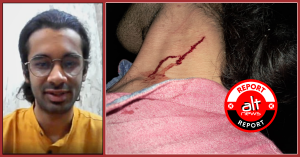
Alt News had reported on July 23 that at least three individuals had received pellet gun injuries in Delhi on July 20. 25-year-old Irshad Mansoori was undergoing treatment at the Lady Hardinge Medical College (LHMC) while 19-year-old Sahil Lochab was admitted at the AIIMS Trauma Centre. Sahil’s case was especially precarious as he had sustained injuries to his right eye, among other parts of his body. His maternal uncle, Sultan, told us that doctors had told Sahil’s family that there was only a 1% probability of him regaining vision in the right eye. A reporter with Outlook was also hit by pellets on the same day.
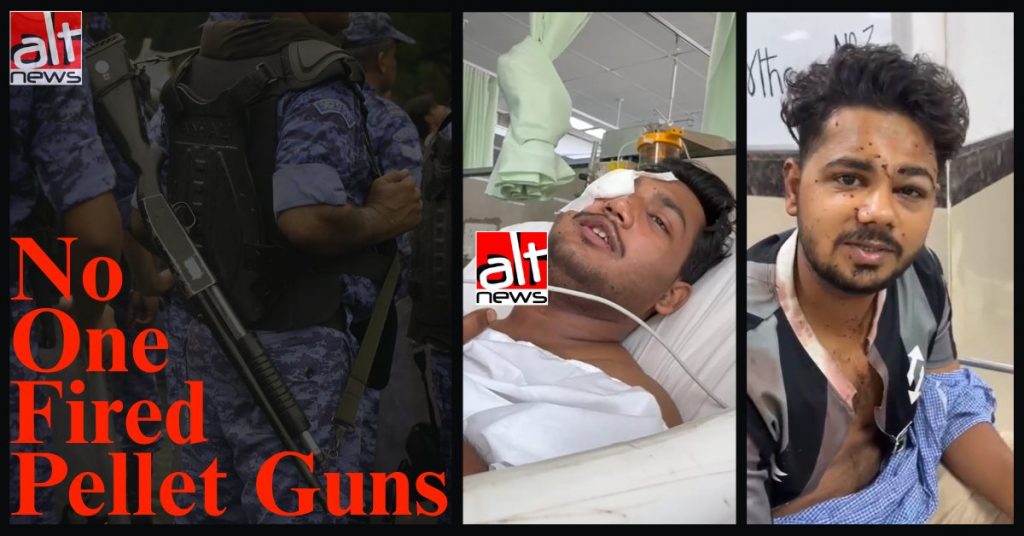
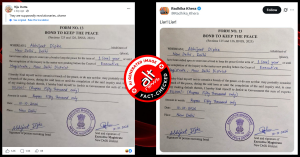
In the face of mounting public outcry, responding to Cockroach Janta Party spokesperson Saurav Das’s X post on the use of pellet guns, Delhi Police denied the allegations. In a carefully worded ‘fact check’ post, their official handle stated that “reports claiming that police forces are using pellet guns against peaceful protesters are completely false and misleading.”
The Central Reserve Police Force (CRPF) and RAF were also on duty in Delhi on July 20. Delhi Police conveniently avoided any mention of that.
🚨 FAKE NEWS ALERT 🚨
Reports claiming that police forces are using pellet guns against peaceful protesters are completely false and misleading.
The public is strongly advised not to share or circulate unverified content. Please verify facts from official sources before posting…
— Delhi Police (@DelhiPolice) July 21, 2026
Four days after the mayhem in Delhi, a RAF source told The Hindu that the CRPF was “verifying reports” of pellet gun use.
Alt News had reported as early as on July 23 that pellet guns or anti-riot guns were part of the gear of RAF, a specialised anti-riot force under the CRPF, but the order to use them could not have come but from a Delhi Police official.
Explaining the rules of engagement, a senior police officer explained that deployment of RAF or CRPF during a law-and-order situation is requested by the senior-most police officer in charge of an area. Once deployed, those forces come under the command of that same officer, and so does the decision on what force to use.
The General Diary filed at the Parliament Street police station affirms all of this and exposes the misleading nature of the Delhi Police fact check.
Ex Top Cop, Injured Youth Move Supreme Court
On July 30, the Supreme Court heard a plea against the use of pellet guns on protesting students at Jantar Mantar and other areas. Former IPS officer Yashovardhan Azad and two youth protesters who were grievously injured by pellet guns had filed the petition.
Appearing for the petitioners, senior advocate Vrinda Grover argued that what was used weren’t just standard rubber/plastic pellets but “kinetic metallic projectiles”. She stated in court that doctors recovered actual metal pellets from injured protesters’ bodies, and argued this was disproportionate because the protestors were not a violent mob.
Justice Joymalya Bagchi observed that existing police rules allowed the use of pellet guns in exceptional circumstances as a step in a “graded response” to unrest (i.e., escalating levels of force), and that framework itself hadn’t been legally challenged. “So you have to show us rules where use of pellets is arbitrary,” he said.
The court, however, did not elaborate on what qualified as ‘exceptional circumstances’.
Chief Justice Surya Kant suggested reframing the relief being sought rather than asking for pellets to be banned outright. “In light of alleged excessive use.. your prayer should be that court lays down a protocol regarding the use,” he said.
Contradicting the police records which mention use of plastic pellets, Grover told the court that metal pellets were used on the protestors. :…There can be rubber, plastic and metallic pellets. These were metallic and recovered from the bodies. Nature of the crowd will determine use of this as well. Was it a violent mob? No. These metallic pellets were fired,” she argued.
Grover asked the Court to direct preservation of RAF’s duty logs, weapons/ammunition logs, and registers from July 20, which was granted.
The court also asked Delhi government to ensure proper treatment to the victims.
In a statement later, Grover reiterated that lethal force was used on a peaceful assembly where people were exercising their right to protest, “which the court has repeatedly said is a right available to all citizens,” and such practices, which are likely to cause grievous injuries, are unacceptable.
VIDEO | On SC asking Centre to preserve ammunition log of RAF deployed at Jantar Mantar during students’ protest against NEET paper leak, Senior advocate Vrinda Grover says, “So, the petition that was heard today was filed on behalf of three petitioners. The first petitioner is a… pic.twitter.com/LKNEKq7oVE
— Press Trust of India (@PTI_News) July 30, 2026