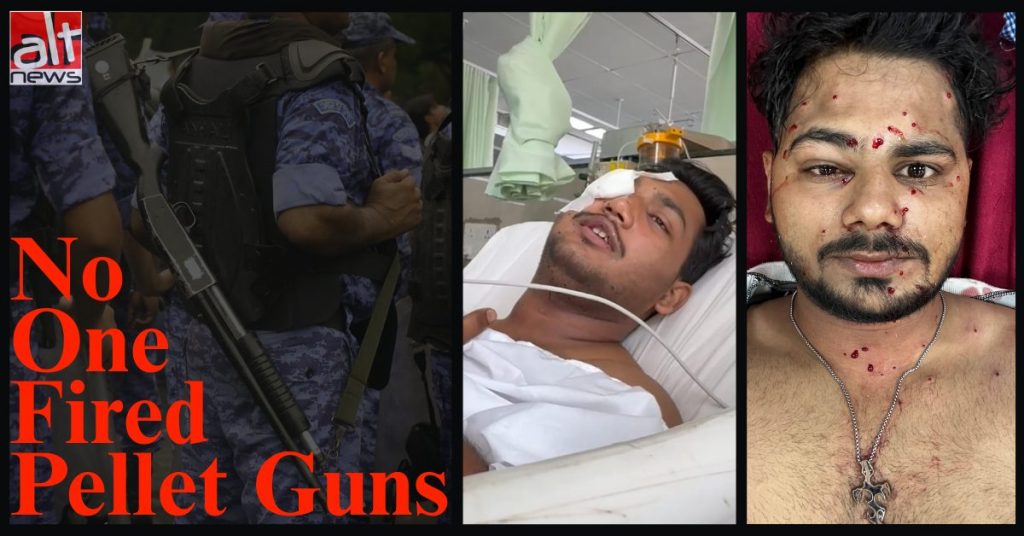
Someone owes 25-year-old Irshad Mansoori an explanation. He lies in a hospital bed in Delhi with a pellet lodged near a blood vessel in his neck even after undergoing a surgery on July 21. Someone should also explain to 19-year-old Sahil Lochab, recovering from a surgery on July 22, how he received a grievous eye injury and multiple pellet wounds across his body.
Delhi Police has repeatedly insisted that it did not use pellet guns during the July 20 march. No other security agency has acknowledged deploying them either. Over the past two days, Alt News met both young men, spoke to their families and friends, and traced a chain of evidence that raises a simple question: If no pellet guns were fired, how did they end up in hospital with pellet injuries?
The July 20 Mayhem in Delhi
On July 20, thousands gathered at Delhi’s Jantar Mantar after the Cockroach Janta Party (CJP) called a march to Parliament over the alleged NEET paper leak and irregularities in examinations conducted by the National Testing Agency. The march followed a month-long sit-in protest and Sonam Wangchuk’s hunger strike.
As protesters attempted to march towards Parliament, Delhi Police erected barricades while personnel from the Rapid Action Force (RAF) and Central Reserve Police Force (CRPF) were deployed in large numbers. Police used lathi-charge and tear gas as the situation escalated. By evening, CJP spokesperson Saurav Das alleged on X that some protesters had been hit by pellet guns. Delhi Police rejected the allegation, stating that it does not possess such weapons.
Alt News began investigating the claim the following day.
Irshad Mansoori at Lady Hardinge Hospital
On July 21, acting on a tip-off, Alt News reached Lady Hardinge Medical College (LHMC), where Irshad Mansoori was undergoing treatment. We met his friend outside the hospital, who said he was Mansoori’s only support at the hospital.
Mansoori, 25, is originally from Jabalpur and works at a private company in Gurugram. The friend told us that Mansoori was near Connaught Place on July 20 when he was struck by pellets allegedly fired from a distance of around 40 to 50 metres.
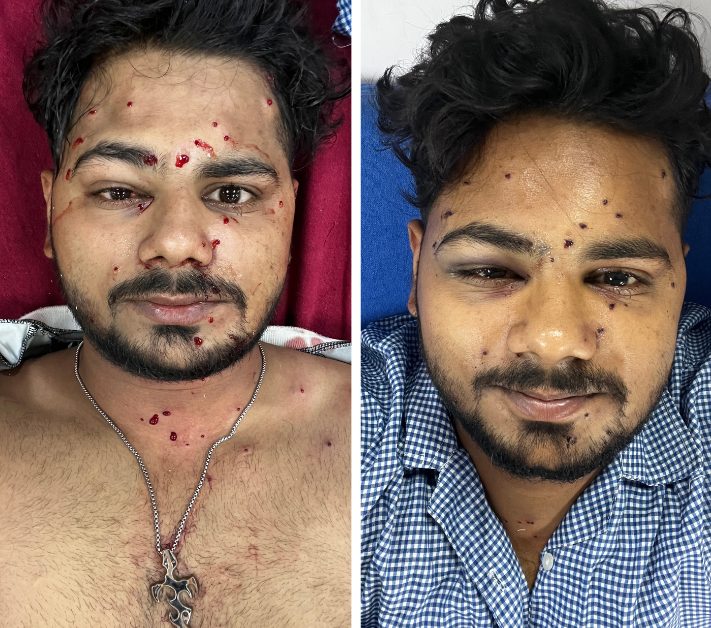
A selfie taken from Mansoori’s hospital bed shows multiple small wounds across his face and neck. Three pellets — one beneath his eye, another lodged close to a blood vessel in his neck, and a third in his facial cavity — caused particularly serious injuries. His friend told Alt News that he had signed the consent form before surgery but that neither he nor Mansoori had been given information about the treatment. He also alleged that hospital authorities refused to hand over even the CT scan report.
When Alt News approached the doctor who had come out of the operation theatre after Mansoori’s surgery, he declined to comment and directed us to the institute’s director instead. Around the same time, Mansoori’s friend, who had gone inside to see him after surgery, messaged one of the Alt News correspondents saying he would step out shortly. Minutes later, he wrote that he was not being allowed to leave the ward. He described an incident in which someone had arrived to meet another patient in the same ward, prompting what he said was a commotion involving the hospital administration and eventually the institute’s director. According to him, security personnel were posted outside the ward after that. By around 10 pm on July 22, Mansoori told Alt News he still had not been allowed to access documents relating to his own treatment.
Speaking to Alt News from his hospital bed, Mansoori further said, “I am in no position to press the hospital over my rights as a patient at the moment, especially because I do not have any real support system here. My only focus is on recovering properly and quickly. Right now, I am in a lot of pain in the eye, face and upper body because of the surgery and the pellets.”
“I am really worried about how the injuries will affect my life. I think there needs to be some compensation for my loss,” he said, while almost breaking down.
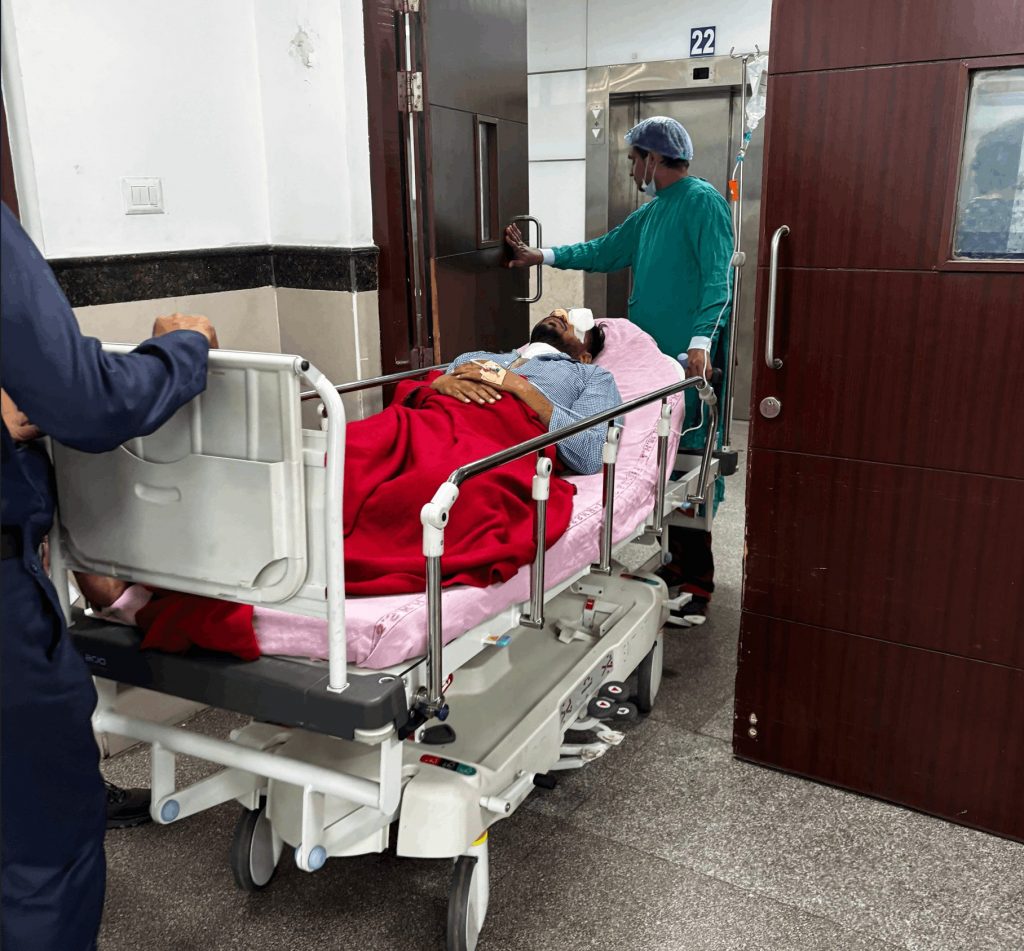
Mansoori was conscious and alert when he arrived at the hospital. He told us he was aware that another protester had also suffered pellet injuries and asked about his condition. When we informed him that 19-year-old Sahil Lochab, admitted to another hospital, could permanently lose vision in one eye, he was shocked.
According to a source at LHMC quoted by The Hindu, surgeons removed pellets lodged below Mansoori’s eyes, but a pellet near his neck could not be extracted because it was dangerously close to a blood vessel, leaving open the possibility of another surgery. Mansoori was also among the injured protesters visited by Union health minister J P Nadda at the hospital, which establishes the fact that the Union government knows that there are pellet gun victims being treated in Delhi hospitals.
Sahil Lochab at AIIMS Trauma Centre
While investigating Mansoori’s case, Alt News learnt that another pellet victim had been referred to the All India Institute of Medical Sciences (AIIMS) because of a severe eye injury.
On July 22, after speaking to multiple AIIMS staffers, we traced Sahil Lochab to the AIIMS trauma centre. He had been earlier treated at the Dr R P Centre for Ophthalmic Sciences at AIIMS.
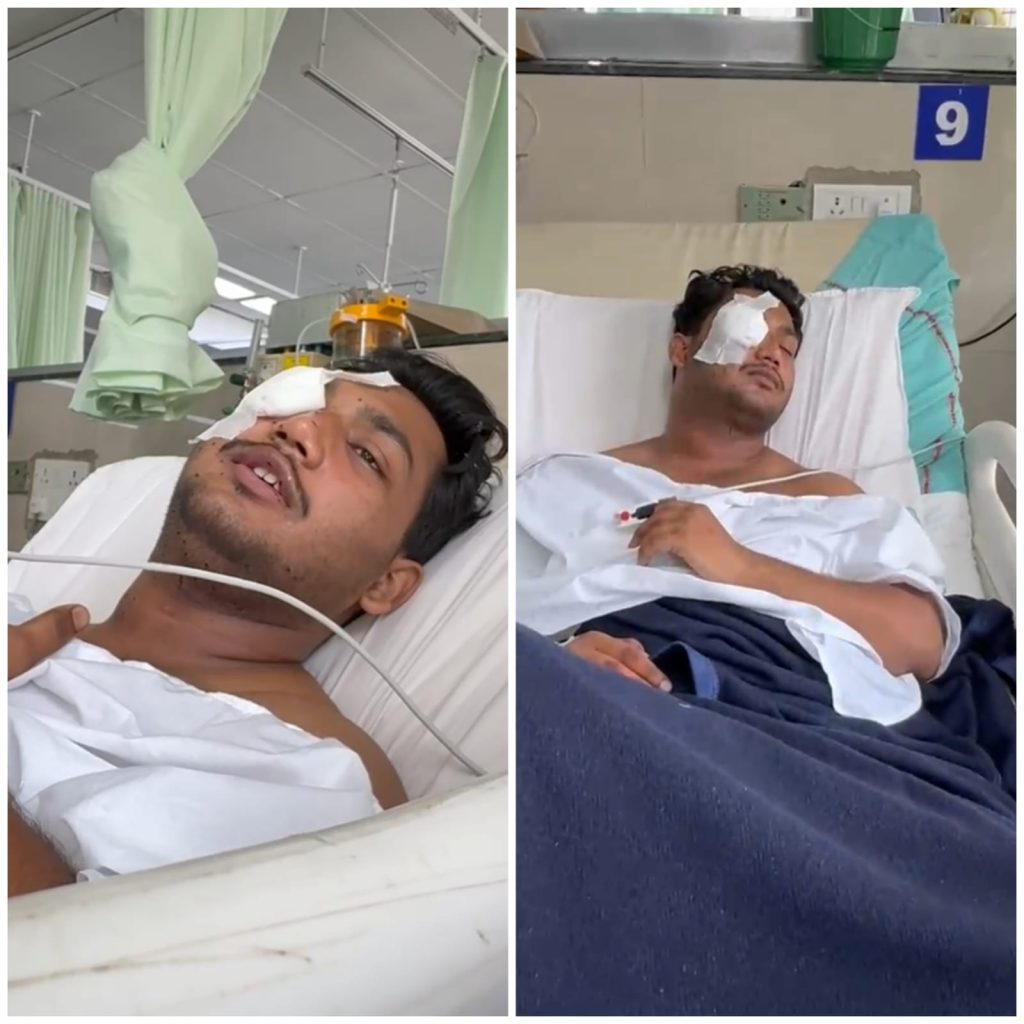
Sahil, 19, a resident of Najafgarh, told us, “I had gone to the protest, and was somewhere around Jantar Mantar when I was hit with the pellets. I do not remember the exact time right now. I was looking in another direction when the pellets hit me.”
He sustained injuries to his right eye, face, chest, back, arm and the right side of his body. “I was first taken to LHMC by two fellow protestors. My mother along with my maternal uncle came to LHMC. After keeping me there for sometime, I was taken to Safdarjung Hospital and then to AIIMS. I have not been able to see from my right eye since the injury took place.”
His mother, Jyoti, told us, “The hospital authorities at LHMC informed us that Sahil cannot be treated here for the lack of facilities required in this case, and thus Sahil is referred to another hospital, but here during admission process (at AIIMS), they did not accept the reason of referral and I was made to sign on papers which did not mention the reason for referral from LHMC at all.”
His maternal uncle, Sultan, said Sahil waited for several hours before undergoing surgery after midnight on July 21. “Most of his outer portion of the eye, the white portion has been destroyed and the first surgery was about this white portion. The second surgery will take place in seven days, when the middle layer will be operated upon. Doctor told us that there is only 1% probability of him regaining vision in the right eye.”
When Alt News met the family around 6 pm on July 22, they said they had still not received any document relating to Sahil’s treatment.
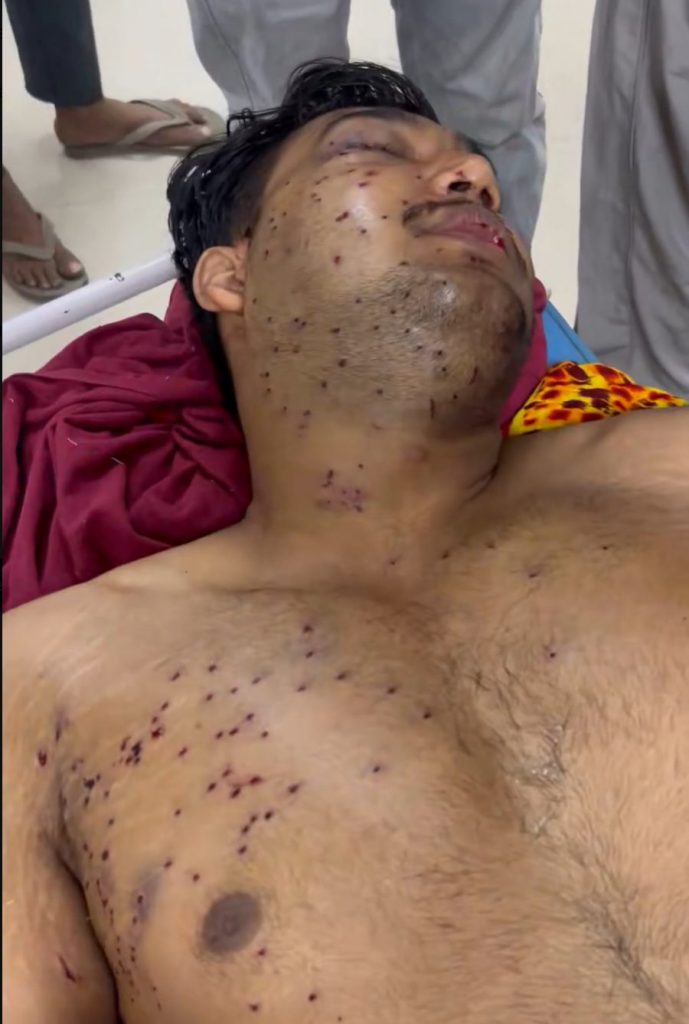
Sahil is the eldest of three brothers. His mother told us he had been preparing for the Delhi Police recruitment examination while supporting his family through part-time jobs. His father, she said, was partially disabled and worked only intermittently. His younger brother, Deepanshu, said Sahil admired Bhagat Singh, something also reflected in his WhatsApp and Instagram profile pictures.
The family also said it was extremely disturbed by false social media posts claiming Sahil had died during treatment.
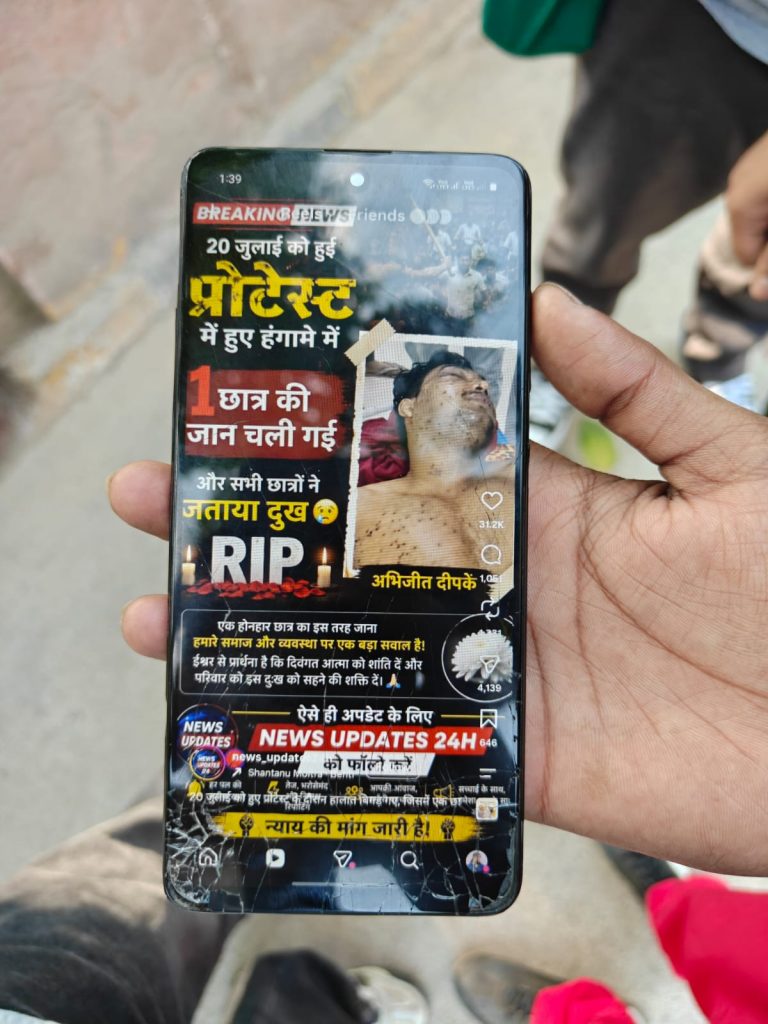
No One Fired Pellet Guns, Yet We Have at least 3 Victims
Delhi Police has repeatedly denied having used pellet guns on July 20. The Union government’s Press Information Bureau has published ‘fact checks’ refuting claims of pellet gun use.
However, the testimonies of Irshad Mansoori and Sahil Lochab — two pellet gun victims being treated at top government facilities in Delhi — are not the only pieces of evidence that pellet guns were used during the July 20 clashes in the streets of Delhi. Among those suffering pellet wounds was an Outlook reporter. “I saw it aimed at me and immediately ran… Something struck my backpack and my arm. If I hadn’t turned, it could have hit my chest or my face,” Outlook quotes its own reporter as saying. Medical documents of the victim published by the outlet confirm the wounds were caused by pellets.
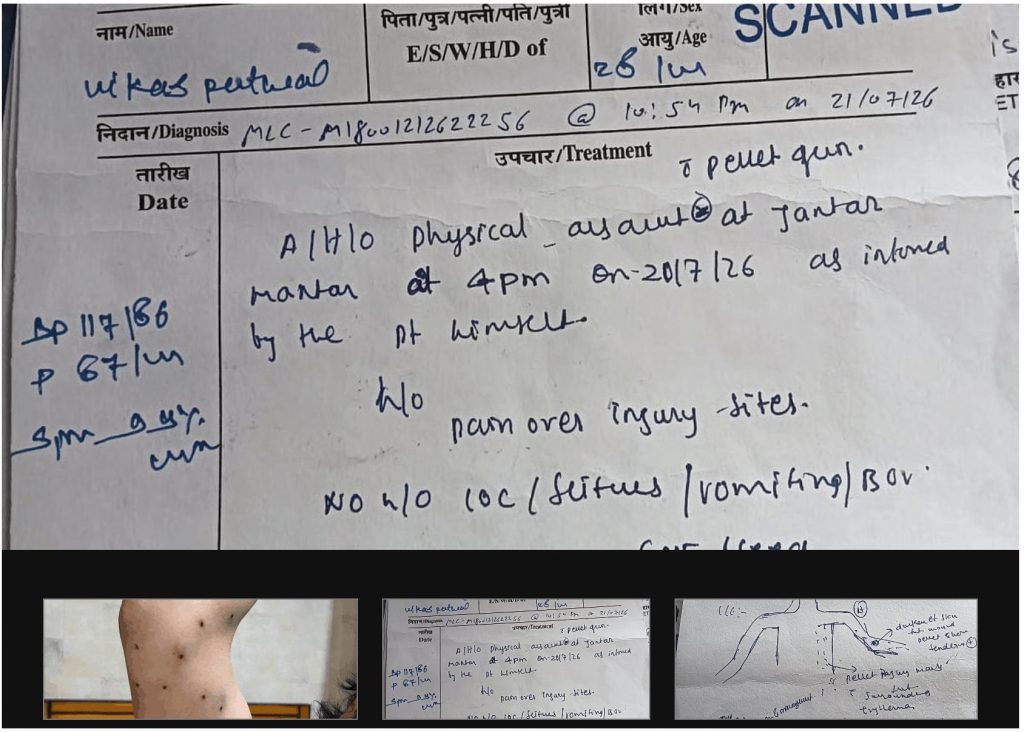
Further, we found a video posted to Facebook on 21 July, which appears to show events from the 20th. It depicts a woman pleading with security personnel, while behind her, a RAF jawan is seen moving with a weapon raised to firing position. From its profile, the weapon appears to be a pump-action shotgun.
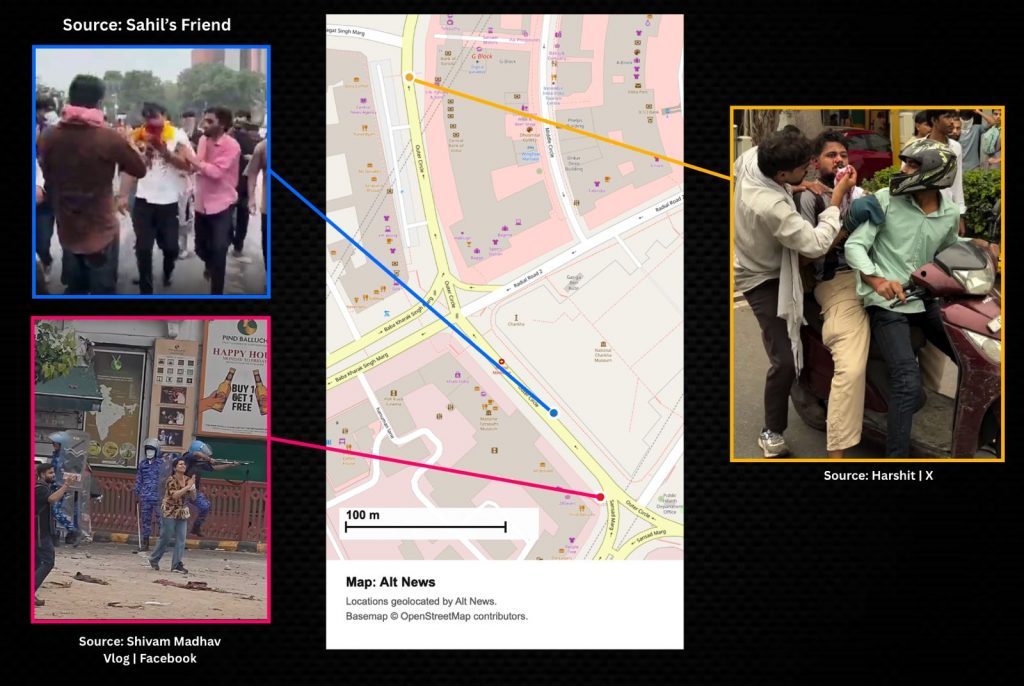
We geolocated the spot. It was filmed near the Palika Bazar entrance in Connaught Place. The camera faces northwest toward the Pind Balluchi restaurant frontage, whose signage is visible behind the scene. In the footage, the shotgun is pointed along Connaught Circus, away from the Sansad Marg junction and roughly southeast.
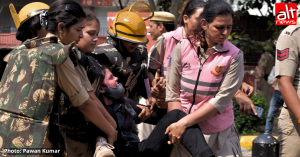
Separately, a video obtained by Alt News shows Sahil Lochab walking away after he had been struck, his face covered in blood. We geolocated this video as well. Lochab is seen moving along Connaught Circus — the direction in which the shot had been fired. He is helped by protesters, who guide him to a motorcycle on which he is carried away. The LIC Jeevan Bharti building on Sansad Marg is visible in the background.
We also located a third video consisting of a compilation of footage from the 20th, which shows an injured Irshad being helped on a scooter. We geolocated this spot as well.
All these three spots are in close vicinity, as the graphic below shows. Alt News does not claim the footage captures the moment Sahil or Irshad was struck, but the three videos together place the two victims within a few hundred metres of a position where RAF personnel were recorded with weapons raised.
An ammunition expert, speaking to Alt News on condition of anonymity, identified the weapon seen in the Facebook video as a non-lethal 12-bore gun that fires small metallic pellets. According to them, it can inflict serious injuries when fired from around 20 to 30 metres and can be fatal at very close range.
Pellet guns are part of the gear of the Rapid Action Force (RAF), which is a specialised anti-riot force under the Central Reserve Police Force (CRPF). A senior police officer explained the command structure to us. Deployment of RAF or CRPF during a law-and-order situation is requested by the senior-most police officer in charge of an area. Once deployed, those forces come under the command of that same officer, and so does the decision on what force to use. Delhi’s status as a union territory does not change this.
The rules of engagement, the officer said, rest partly on reciprocity: The rulebook does not permit opening fire on an unarmed crowd. Forces must first warn the public over loudspeakers. If the situation deteriorates further, they are required to videograph any use of force. This suggests that if RAF personnel fired the pellets, the order might have come from the Delhi Police officer commanding the area. And the use of pellet guns was videographed by security agencies, if rules were followed.
The use of pellet-firing shotguns for crowd control has long been a subject of human rights concerns because of their indiscriminate nature. Unlike weapons that strike a single target, a 12-bore pellet cartridge releases hundreds of small metal pellets that spread over a wide area, making it difficult to control who is hit. The Office of the United Nations High Commissioner for Human Rights (OHCHR) has described pellet-firing shotguns as “one of the most dangerous weapons used” in Kashmir, noting that experts consider them “inherently inaccurate and indiscriminate.” Injuries caused by pellet guns ranged from simple eye injuries to cases of permanent visual impairment. Amnesty International has similarly argued that there is “no proper way” to use pellet-firing shotguns in law enforcement because of the severe and often irreversible injuries they cause, including blindness, and has urged authorities to ban their use in line with international standards governing the use of force.
Kalim Ahmed is a former fact-checking journalist with Alt News. He is currently a research manager at Tech Global Institute.