Thirty-four-year-old Sundar lives in Tappal village in Khair tehsil of Aligarh district, Uttar Pradesh. His name was absent from the state’s draft voter list published on January 6, 2026. However, in the final list published on April 10, his name appears four times, at serial numbers 730, 738, 739 and 757 in booth 19. Each entry carries a different Elector Photo Identity Card (EPIC) number.
The official list of Form 6 applications, used for voter registration, records only two applications from Sundar, dated January 9 and 14. The office of the Uttar Pradesh chief electoral officer (CEO), however, said that he had filed four. The discrepancy aside, the CEO’s office’s response confirms a crucial point: Multiple applications by the same person resulted in the issuance of multiple voter IDs.
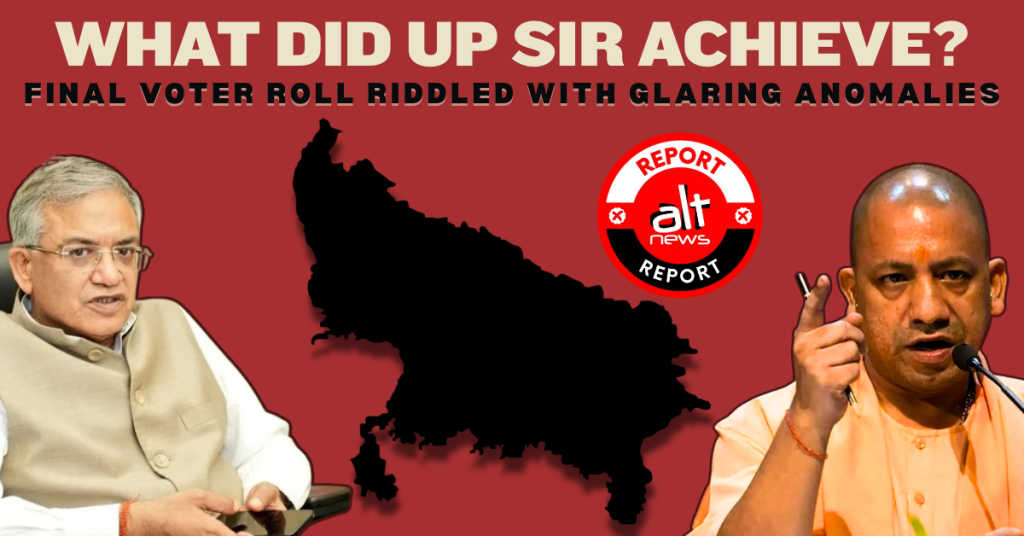
The Election Commission launched the Special Intensive Revision (SIR) of electoral rolls in Uttar Pradesh in November 2025, with the removal of duplicate and incorrect entries among its stated objectives. Alt News compared the draft and final electoral rolls across 69 booths in 20 districts, covering 60,558 voters, and cross-checked newly added names against the corresponding Form 6 application lists. The analysis found 230 people whose names appeared at least twice in the final rolls, with some listed three or four times, each against a separate voter ID. Such duplicate entries were found in booths across the political spectrum.
On October 27, 2025, the Election Commission announced the second phase of the SIR across 12 states and Union Territories, including Uttar Pradesh. The exercise, covering approximately 51 crore voters, began on November 4.
The schedule for Uttar Pradesh was subsequently extended four times. The draft electoral roll was published on January 6, 2026. Those whose names were missing from the draft had to submit Form 6 to seek inclusion. Following the fourth extension, the deadline for filing claims and objections was March 6, while the final electoral roll was published on April 10.
At present a special summary revision (SSR) of electoral rolls is going on in the state. The draft roll was published on November 17.
The Methodology
For each of 69 booths in UP, Alt News read the draft list (January 6, 2026) and the final list (April 10, 2026) entry by entry, and matched the count with the totals on each list’s cover page. We treated two entries as the same person only if the name, father’s or husband’s name, age and house number all matched.
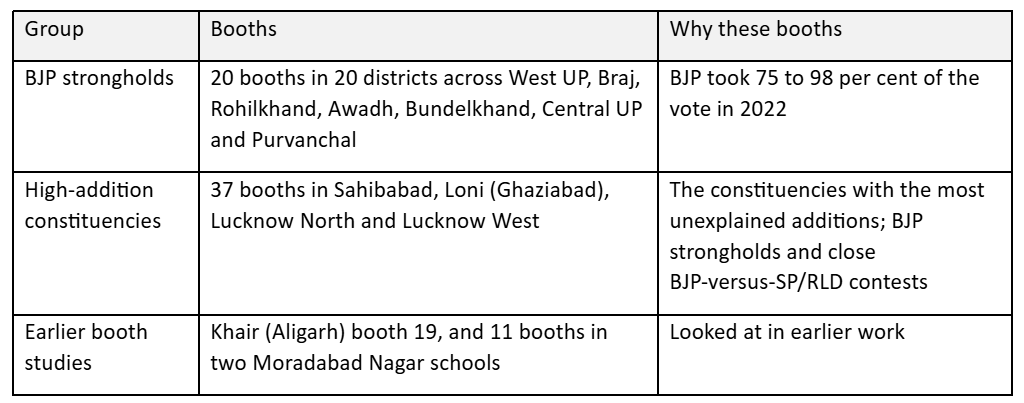
We checked every case against the scanned entry. We then looked up Form 6 applications in the Form 9 lists. The latter is a public list of every Form 6 application an election office received, with the applicant’s name, relative and address. The lists we examined cover 13 assembly constituencies. The 69 booths that we chose fall into the three following groups:
One Form, Several Voter IDs
Listed below are 11 voters (chosen randomly from the 230 to explain the nature of the anomalies) whose names did not appear on the January 6 draft list but were all added to the final list. In each of these cases, the entries share the same name, relative, age and house number, but carry different EPIC numbers. We use first names because they are private citizens.
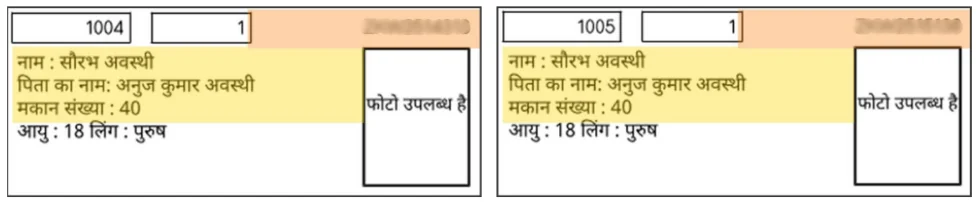
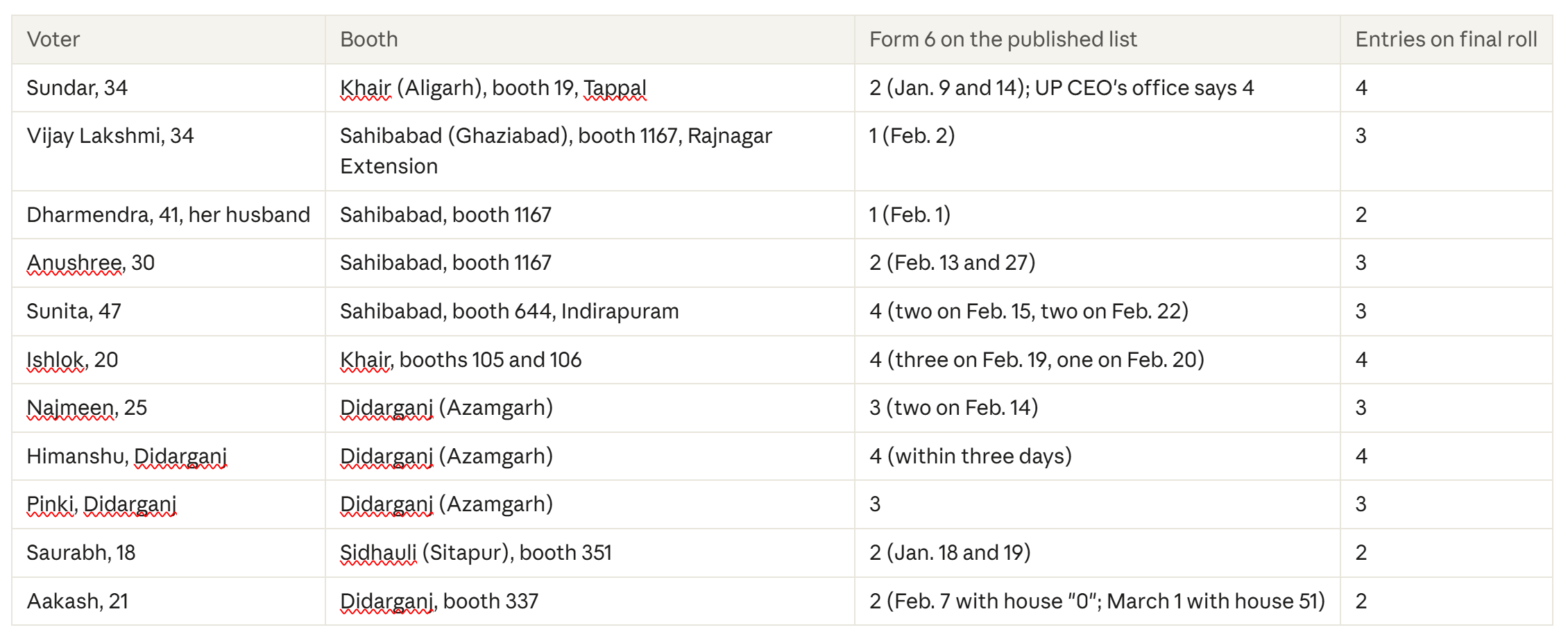 Our findings revealed two patterns: For Ishlok, Najmeen, Himanshu, Pinki, Saurabh and Aakash, every form became a voter ID, and the entries sit next to each other on the list. Saurabh’s are serial numbers 1004 and 1005.
From Sundar to Sunita, the list has more entries than the published Form 6 list has forms. Married couple Vijay Lakshmi and Dharmendra have a cumulative total of five voter IDs. Vijay Lakshmi has three, while her husband has two.

Anushree Verma, whose husband is Akshay Verma, had filled Form 6 twice and received three voter IDs.

Sundar, mentioned at the beginning, had filled the form twice (According to Form 9) and in return got four voter IDs.


The biggest single cluster of duplicate voters is booth 449 in Chachoi, Sikandrabad (Bulandshahr), where the BJP won 94% of the votes in 2022. The final list adds 69 names to this booth.
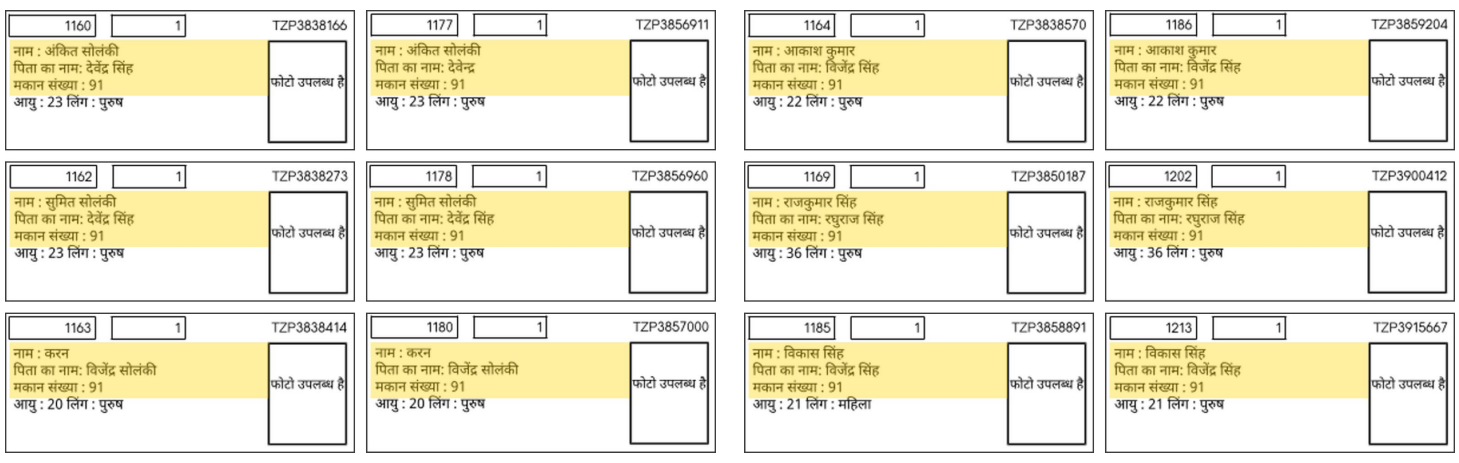
Of these, 34 entries are for 17 people, each listed twice with a new EPIC. None of the 17 names are on the January 6 draft list. Fifteen of the 17 filed one Form 6 each on the published lists. For two, Hasmuddin and Heema Devi, we found none. Six of the 17 live at house 91. One of them, Vikas, is listed once as female and once as male.
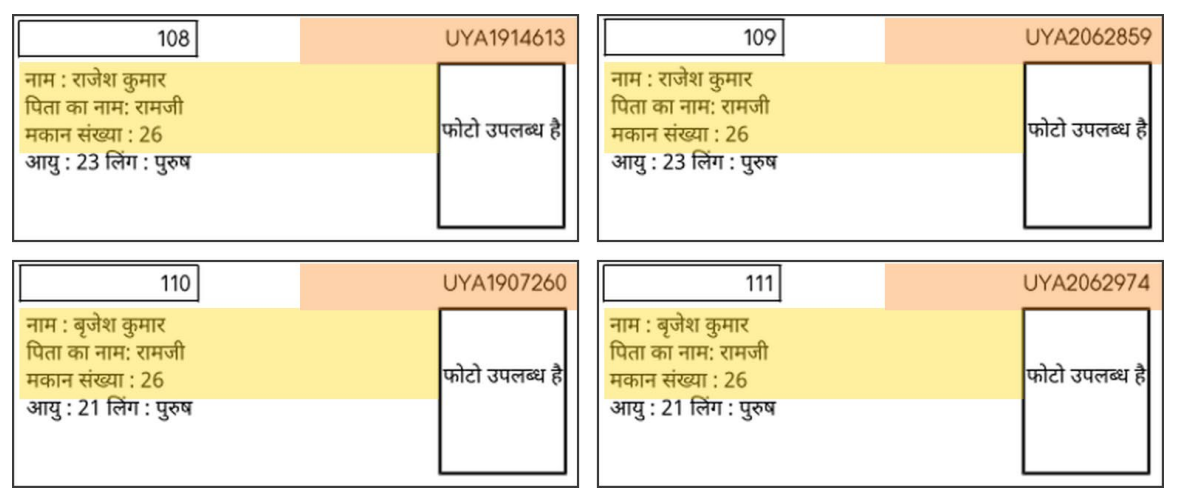
Some duplicates were already there before the revision and were not removed. In booth 330 of Husainganj (Fatehpur), two brothers appear twice each, at serials 108 and 109 and at 110 and 111 respectively, on both the draft and final lists.
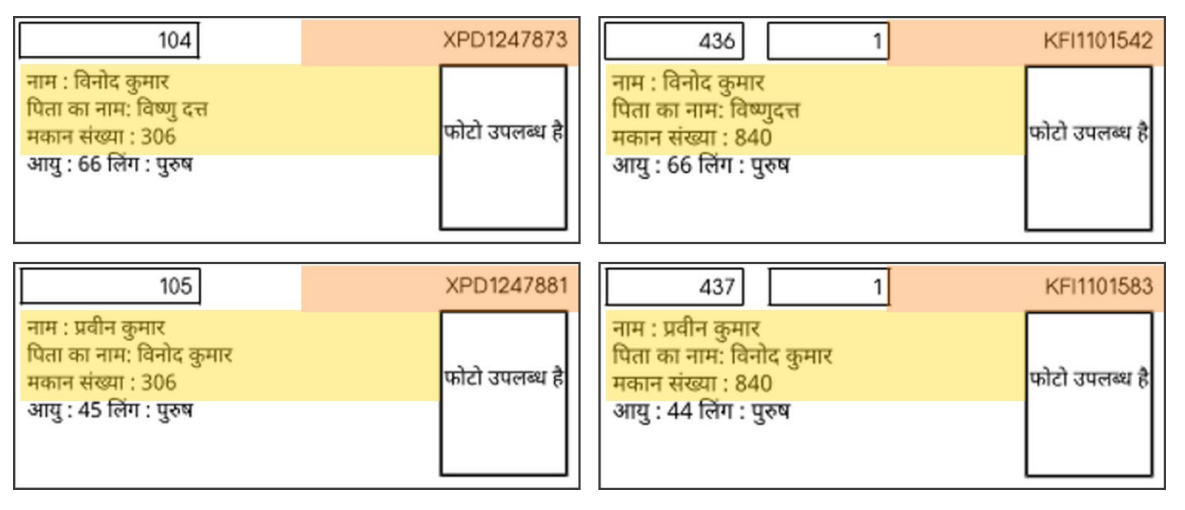
In booth 1044 of Sahibabad, a father and son already on the list at house number 306 were added again with new IDs at house number 840. We found no Form 6 for either.
The published Form 9 lists for Khair village show one applicant, Bhuvnesh, son of Sanjeev Kumar of Simrauthi village, ten times between January 31 and March 6, 2026.


Across the Form 9 lists of the 13 constituencies, 3,369 people were found to have filed Form 6 between two to 10 times.
Missing Addresses, Renamed IDs, Suspicious Deletions
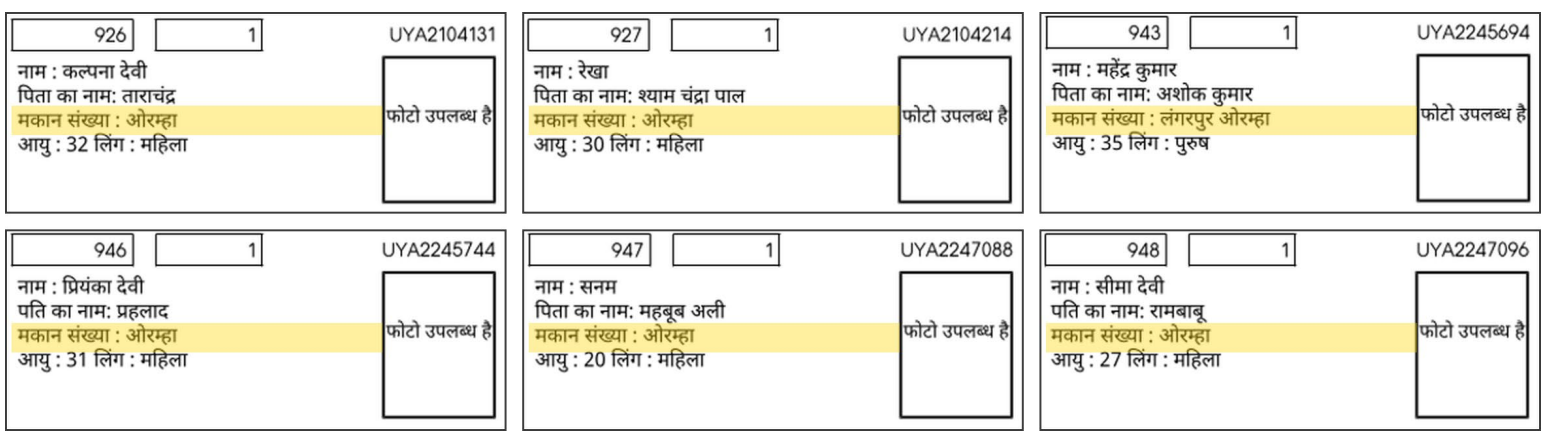
In booth 330 of Husainganj (Fatehpur), 20 of the 64 new voters have no house number. The field holds a place name, Oramha, for unrelated families.
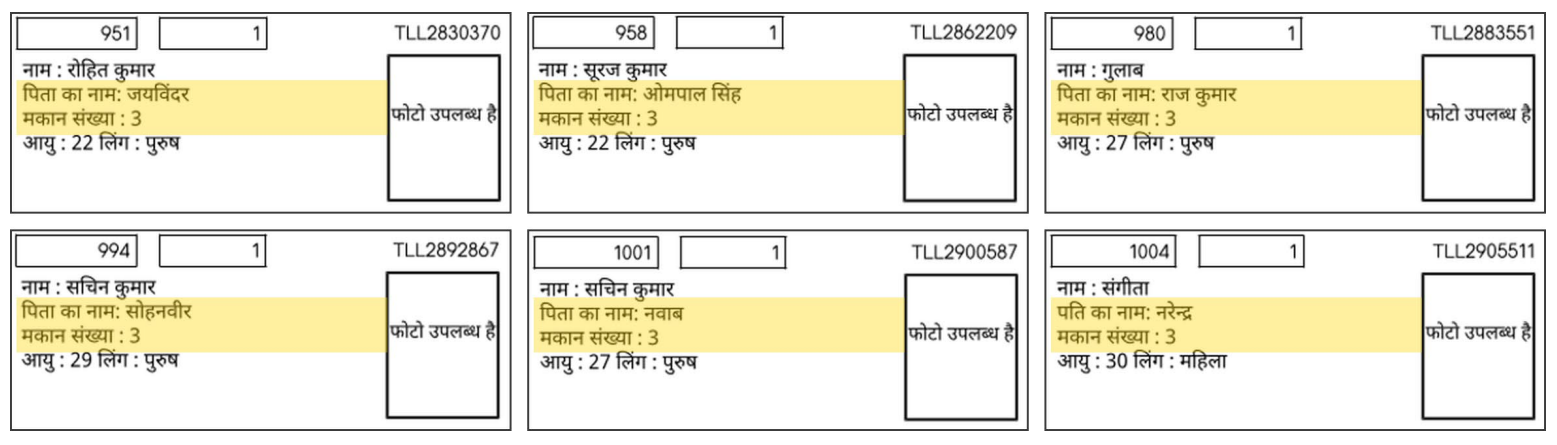
Across the 37 city booths, 62 new voters were added with house “0” or a blank. In booth 354 of Kairana (Shamli), 48 voters were already listed at “house 3” on the draft list, and eight more were added from at least seven different families.
In Khair constituency, house number 658, under which all four of Sundar’s entries are listed, is associated with 36 voters from approximately 19 families.
A shared or missing house number is not, in itself, evidence of electoral irregularity, as most villages do not have a system of house numbering. The concern, however, is how entries without a verifiable address could be physically checked during field visits.
Moreover, in booth 351 of Sidhauli (Sitapur), three women’s names appeared changed between the draft and final lists, while the EPIC number, husband’s name, house number and age stayed the same. Rekharani became Lakshmi Devi, Gayashri became Meena Devi and Shivrani became Neelam.
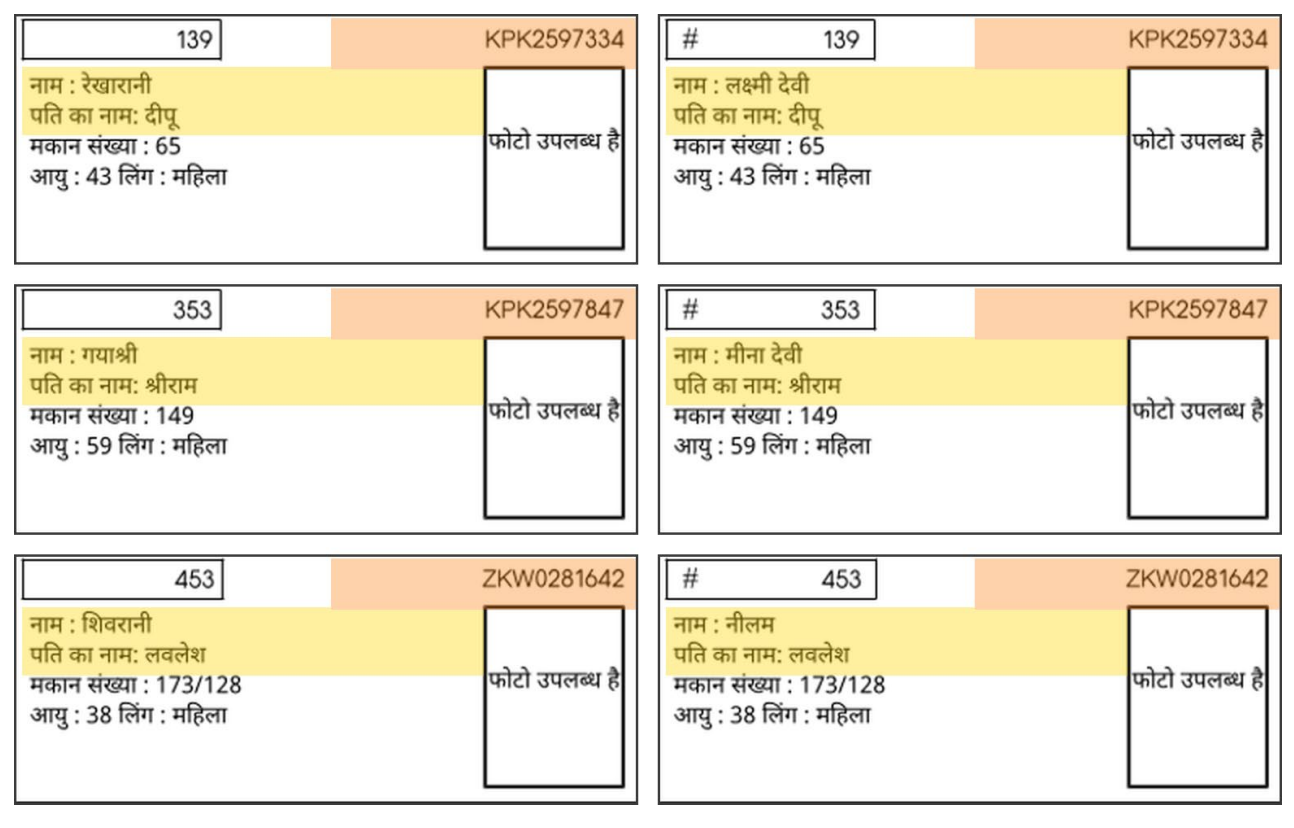 We found 15 such cases across 20 rural booths. These changes could be legitimate corrections. However, only the corresponding Form 8 applications, used to request corrections to electoral roll entries, can establish the basis for the changes.
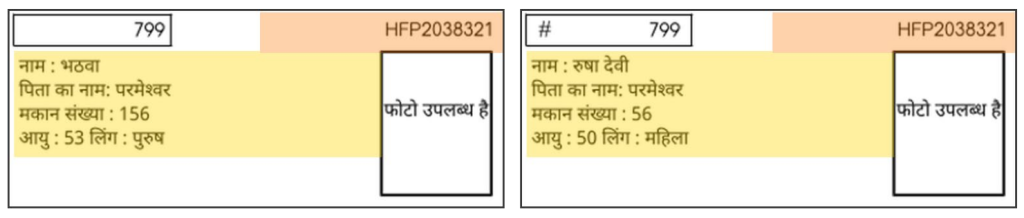
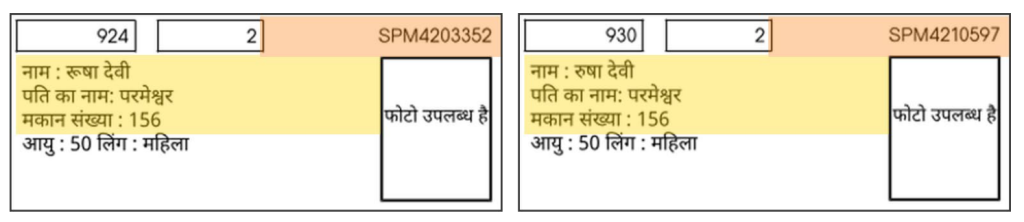
The most striking example of renamed entries is in booth 327 of Gorakhpur Rural. Serial 799 was Bhathwa, male, 53, house 156, on the draft list. On the final list, the same EPIC belongs to Rusha Devi, female, 50, house 56. Rusha Devi, husband Parmeshwar, also appears at serial numbers 924 and 930 of the addition list under two new EPICs. We found no Form 6 for her among the 23,136 applications in the Gorakhpur Rural lists.
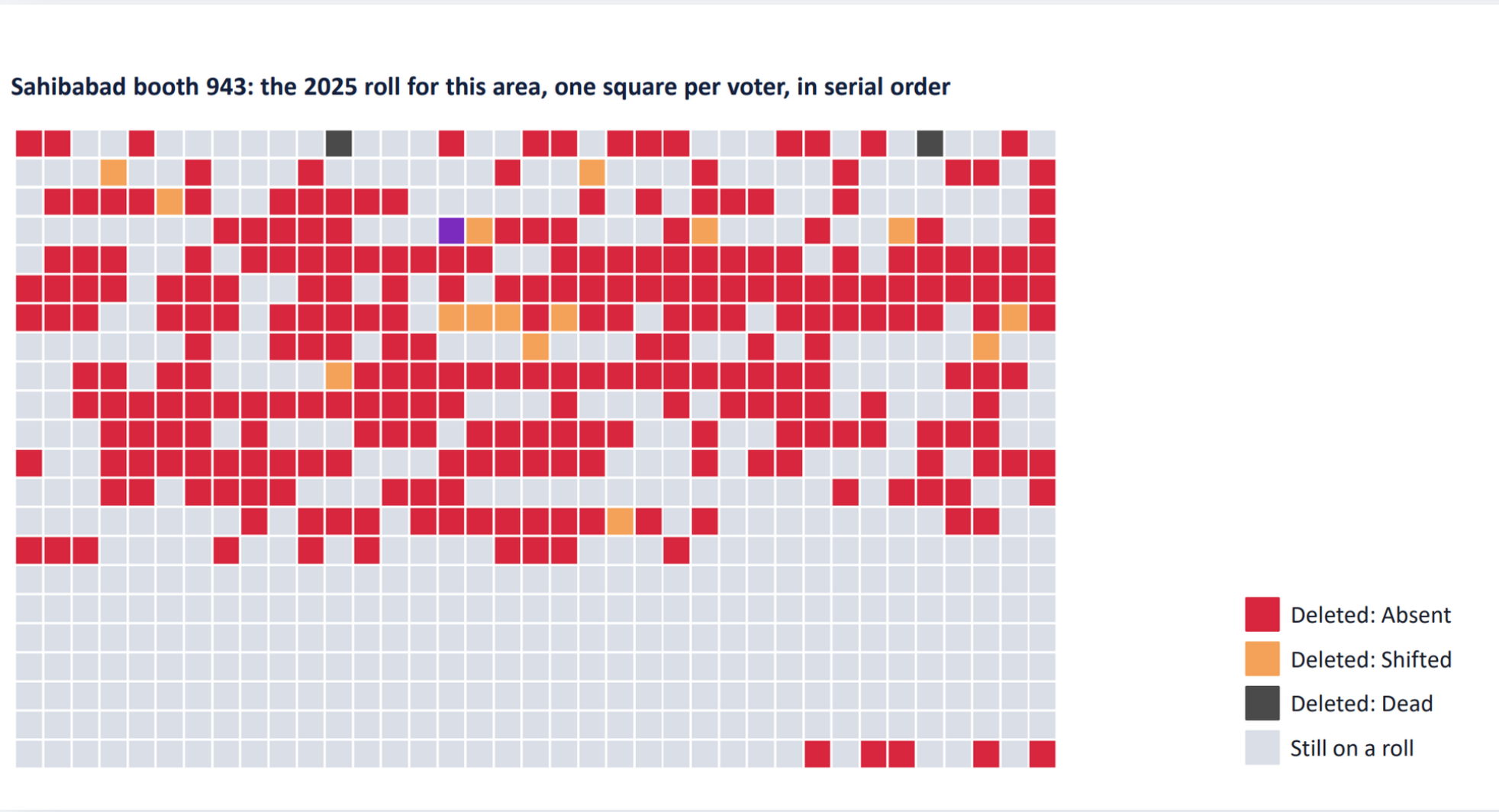
In booth 943 of Sahibabad, 298 entries from one part of the 2025 electoral roll were deleted, 280 of them marked as “absent”. The deletions occurred in consecutive chunks of 23, 17, 14 and 10 names (shown in the plot below). Since electoral rolls are arranged by house and lane, such clusters could simply indicate that an entire building or group of homes had been vacated. A door-to-door verification would establish this. Whether such visits were conducted is something the Election Commission can clarify.
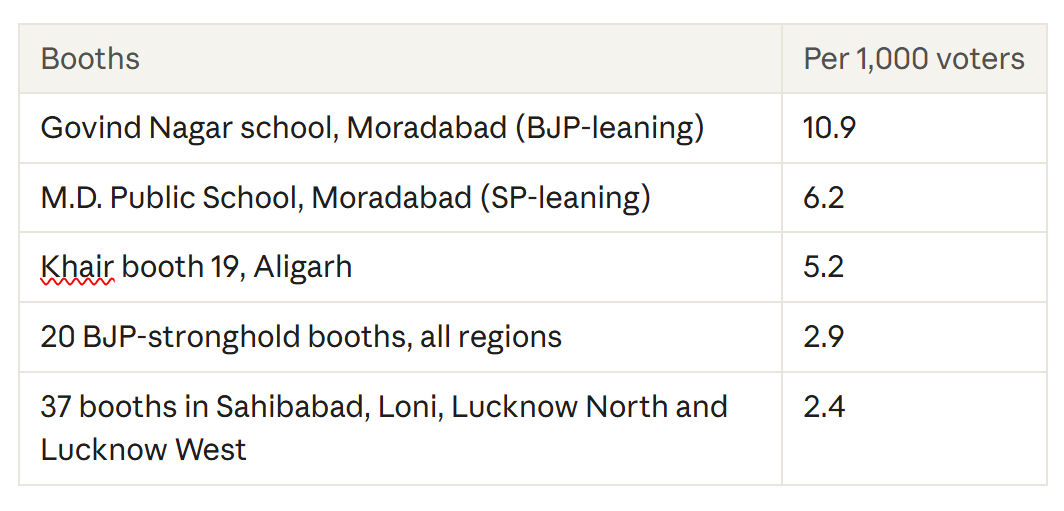
It is worth noting how many voters in every 1,000 appear twice or more on the final roll. See the chart below:
Questions for the Poll Panel
The analysis above poses several significant questions for the election commission vis-a-vis the SIR exercise in Uttar Pradesh. Some of them are the following:
- How did one Form 6 become two or three voter IDs – and how many times did this happen across UP?
- Why are repeat applications from the same person, at the same address, not merged before an ID is issued?
- How did officials verify new voters at house ‘0’, blank addresses and catch-all house numbers?
- How to explain the long runs of consecutive ‘Absent’ deletions – were these homes actually visited?
UP CEO’s Response
The Uttar Pradesh CEO initially denied findings by Alt News co-founder Mohammed Zubair, who flagged Sundar’s case of four different EPIC IDs on X. The office responded with the following post:
Mr Fact-checker please fact-check your own facts.
There is no such scheme as “Buy one Get one free” scheme by Election Commission.
As per your post, the voter had submitted only two applications and he got 4 EPIC cards.This statement is false.
The voter had submitted 4 applications.
If you want to dispute our facts then you post the reference numbers of two applications that you claim he had submitted and we will post the reference number of the remaining two.
The problem of generation of multiple EPICs on submission of multiple forms of an individual is a long standing one. We do deduplication through ECINET periodically. We are on path to achieving the objective of catching multiple forms submitted by an individual at the submission stage only. We will achieve our objective very soon.
Please do not incite people by making patently false statements about ECI and thereby trying to create disaffection among the citizens towards a Constitutional Body.
You are advised to rectify your mistake by amending or deleting your post after completing your own due diligence now that you have been informed by us about your wrong information.
— CEO Uttar Pradesh (@ceoup) October 17, 2026
The CEO claimed that Sundar had submitted four Form 6 applications, resulting in four separate entries on the final electoral roll. This contradicted the official Form 6 application list, which recorded only two applications from Sundar. However, the CEO’s response also acknowledged that “the problem of generation of multiple EPICs on submission of multiple forms of an individual is a long-standing one”.
The discrepancy over whether Sundar submitted two or four applications does not alter the central issue: the Commission itself acknowledges that multiple applications by the same voter can result in the generation of multiple EPIC numbers. Its response also indicates that the system does not consistently prevent such duplication at the application stage, necessitating periodic deduplication through ECINET.
On October 19, the CEO directed election officials to expedite the removal of duplicate entries ahead of the 2027 Assembly elections and identify cases in which individual voters had submitted multiple applications during the SIR.
Readers should note that some of the errors documented in this article were rectified by the Election Commission in the intervening period between our initial identification of these anomalies and the publication of this report.