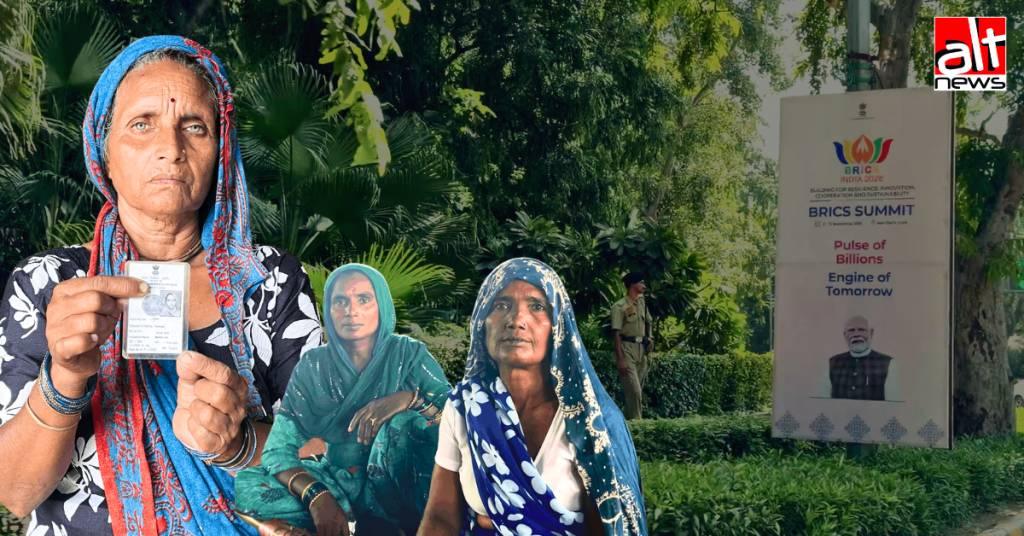
“First they destroyed our farmland. Then they demolished our homes. Now they are trying to take away our voting rights,” said 74-year-old Sheela Devi, as she stood in front of her jhuggi underneath a bridge near Delhi’s Raj Ghat. The ‘they’ she referred to comprises the Delhi Development Authority (DDA) and the state Election Commission. She was one of the over 47 lakh voters left out of Delhi’s draft SIR roll.
One hot afternoon in March 2023, the DDA’s bulldozers tore through standing crop of rice, herbs, and vegetables in Bela Estate after having demolished hundreds of houses of farmers living in the eco-sensitive Zone O floodplains of the Yamuna. The community protested and filed a petition for rehabilitation, but did not get any relief. Their livelihood taken away, the marginalized community has been living since then in tarpaulin covered make-shift shanties under the Geeta Colony bridge and nearby elevated roads.
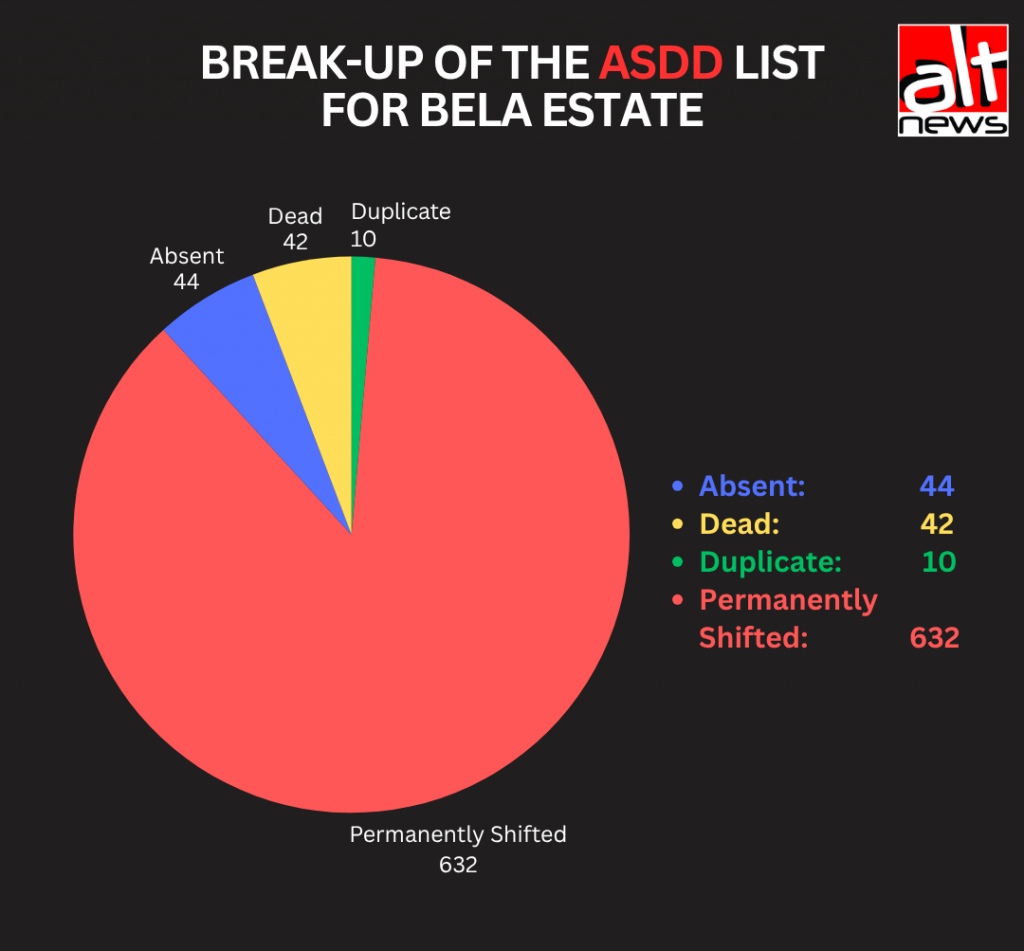
The slum cluster falls under Part No 38 of Chandni Chowk assembly constituency (Lal Quila Yamuna Bridge). Total 729 enumeration forms were generated as the first step of the Special Intensive Revision (SIR) exercise from this Part. The ASDD (Absent-Shifted-Dead-Duplicate) list threw up a shocker as it listed 728 voters, leaving just one name — that of a priest at a local temple — in the draft roll.
In other words, 728 voters out of 729 were excluded from the draft SIR roll — an unprecedented 99.8% deletion rate. The deletions include 42 deaths, and the biggest category is ‘permanently shifted’, which has 632 names. In Chandni Chowk constituency of Old Delhi district, the overall SIR exclusion rate is 38%.
It is deeply ironic that after forcing them to relocate again and again, the State has now moved to strike their names off the electoral roll, marking them as ‘permanently shifted’.
The anxiety now engulfing Sheela Devi and hundreds like her is shaped by what voter-roll deletions have meant for people elsewhere in the country. In West Bengal, for instance, being left out of electoral rolls has been accompanied by questions over citizenship and difficulties accessing government welfare schemes and other entitlements. For a community that has already lost its farmland and homes, the prospect of being deleted from the voter list raises fears that they could be pushed further to the margins, with their identity, access to state benefits and their whole existence called into question.
‘Have Lived here for Generations. This is our Home’
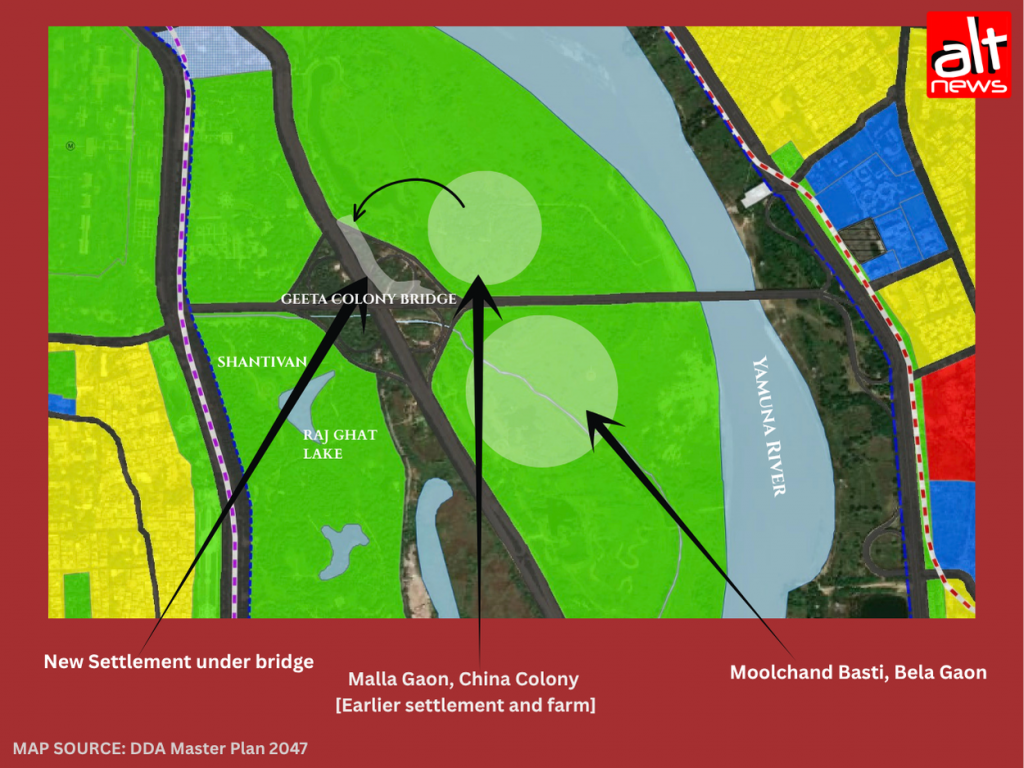
Bela Estate is a large slum cluster on the western bank of the Yamuna, comprising five sub-areas informally known as China Colony, Malla Gaon, Bela Gaon, Moolchand Basti and Kanchan Puri. Residents say the settlement has existed for more than 70 years and is home to over 700 households.
The construction of a bridge in 2009 separated Malla Gaon and China Colony from Bela Gaon, Moolchand Basti and Kanchan Puri. While the latter areas now fall under the Jungpura assembly constituency, Malla Gaon and China Colony are part of Chandni Chowk — and it is here that the mass exclusion of voters occurred during the SIR.
The entire Bela Estate falls within the first phase of the Yamuna Riverfront Development Project, under which the DDA plans to develop a biodiversity park and a lake across 189 acres.
The settlements have faced multiple demolitions over the years. In the months preceding the SIR, residential settlements along the Yamuna floodplains in several parts of Delhi also witnessed a spate of demolitions, carried out by the DDA as anti-encroachment drives.
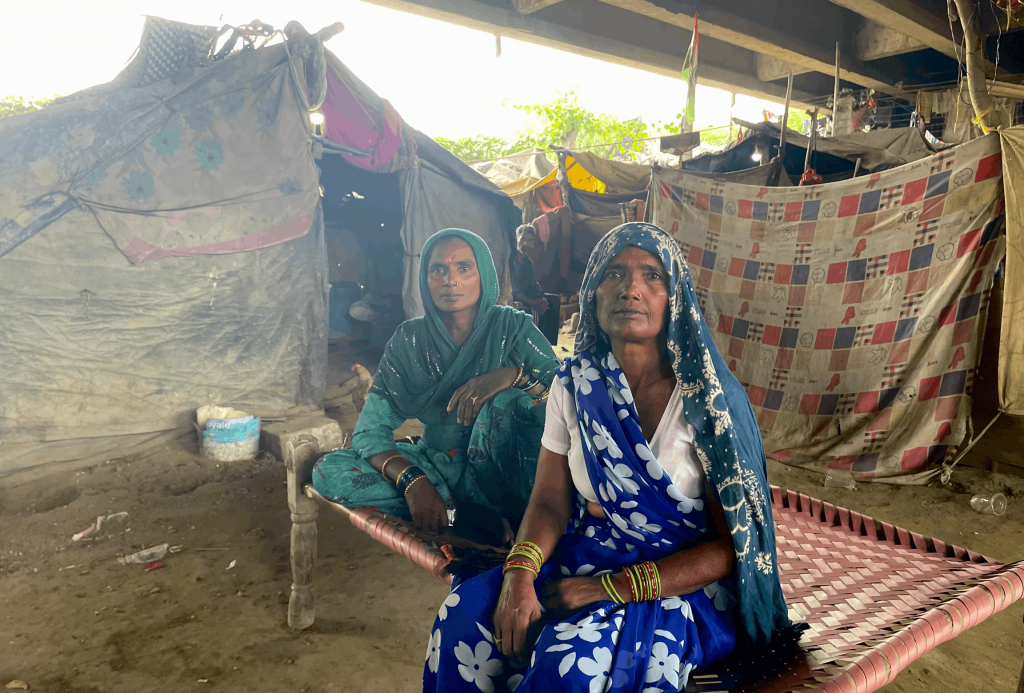
Among those excluded from Bela Estate are dozens of Sheela Devi’s family members, including her seven sons and their wives. “We have been voting from here for a long time. We have four generations of family here. Our elders lived and died here. We had a house here, we had farmland, everything is gone now,” she said, pointing to a now-grilled boundary that separates the bridge area from the green floodplains.
Janaki Devi (52), standing beside her mother-in-law Sheela Devi, said the booth level officer (BLO) came to give them forms, which they filled and submitted. “We are old voters. I don’t know why we were left out.”
“They can demolish our makeshift houses, but we still stay back here,” she said. “When we could farm, we were fine. Now we hardly get any work. Some in our family are daily-wagers, some others do odd jobs in the market. Some sell vegetables from the cart. Our children have to walk several kilometres to get to the nearest school. But we don’t want to leave. This is our home, we don’t have any village to go back to.”
Octogenarian Ram Charan, who says he arrived here as a toddler with his father, sat on a chaar-payi outside his jhuggi in another cluster of settlements, some distance from where Sheela Devi’s family lives. He cannot walk more than a few meters due to old age, but Ram Charan says he still goes to vote every year. “This is the first time this has happened,” he added.
“We have lived and farmed here in Bela Estate since pre-independence days. Earlier, we had our houses; after those were demolished, we made jhuggis; now we live under these tarpaulin sheets,” the elderly man said, adding, “Since 2004, we have been repeatedly rendered homeless. We have been beaten up by police as well. And now, they have taken away our voting rights.”
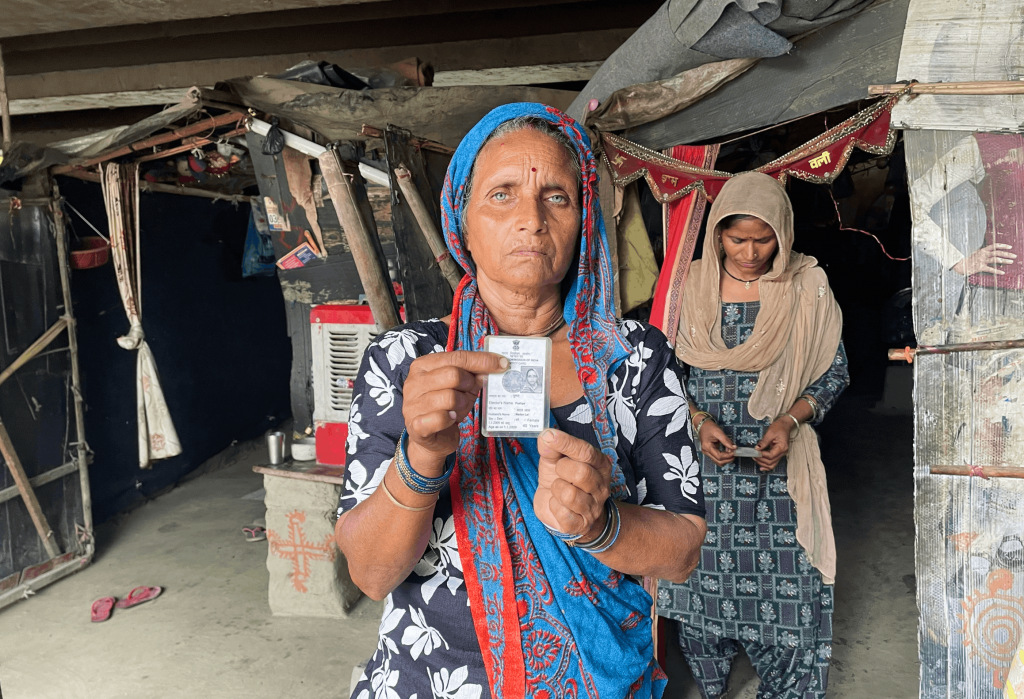
“Modi ji had said, ‘Jahan jhuggi wohi makan’. Where is that promise now?” added Pushpa as she came out of her room with her Voter ID card.
A few Jhuggis away, Dulari sits with her friend, chatting. “I have all the documents. I met the BLO here in our settlement, and also provided details of my name from the 2002 voter roll,” she said. Alt News verified her papers and found that her name was indeed there in the last revised list of 2002.
Fifty-five-year-old Kumitra Devi, who lay on a chaar-payi, had her midriff bandaged. She cannot sit or walk. She said she fell down amid the chaos and confusion over the draft roll, as people jostled to find out what had gone wrong. “I am worried my widow pension might stop since my name has been struck off. I don’t have any other source of income. That Rs 2,500 is what I live on. I also have to marry my daughter off this month,” she said in a low, broken voice.
The Fight to Prove They Live Here
Kamal Lal, a daily wage worker who is marked ‘permanently shifted’ on the ASDD list, said, “I helped the residents here fill and submit more than 500 enumeration forms. I have taken the BLO to where the voters were residing. She even acknowledged the help I provided. But she said she could not do anything about the exclusions as she was under pressure from higher authorities who wanted to delete votes here. When we went to officials, they said it was DDA’s land and our jhuggi was kachhi (temporary), it won’t be recognised. They asked us whether we had land registration papers, water or electricity bills? I told them there was no rule requiring such documents for voter enumeration.”
Kamal said most people in Bela Estate had their names, or those of immediate relatives, on the 2002 roll. Those who did not have a link to the 2002 roll, had several of the 12 documents listed by the Election Commission, including birth certificates, bank documents and Aadhaar. “We could have been included based on those. But they removed all of us,” he added.
Many residents of Bela Estate belong to the Mallah community, a notified Scheduled Caste in Delhi, who have been living on the banks of the Yamuna for generations. An ethnographic Census study from 1961 traces the Mallahs as boatmen and fishermen staying in Bela Estate and parts of Mayur Vihar, among other settlements along the Yamuna.
The National Green Tribunal banned vegetable cultivation on the Yamuna floodplain in 2015 citing the river’s toxicity, while the DDA acquired parts of the floodplain for a biodiversity zone and park. In 2019, NEERI found lead levels above FSSAI safety limits in vegetable and soil samples, while a CPCB study flagged fertiliser and pesticide use as a source of pollution. The NGT subsequently ordered the DDA to stop cultivation there. Farmers, however, disputed the findings, saying they primarily used groundwater and manure rather than Yamuna water.
“Our ancestors came here in the 1910s from Uttar Pradesh, Rajasthan and other neighbouring places. The floodplain lands were used during the British times to grow grass for horse grazing. Slowly, people started farming vegetables there. The DDA came much later,” Kamal asserted.
Several families claimed they used to have pucca houses before a 2015 DDA-led demolition. Fearing future demolitions, they stopped trying to build permanent structures and started living in huts and shanties, scattered across the floodplains near Raj Ghat, in the marshes, under bridges, wherever they could find a little space. In the same vain, they never received formal electricity and water connections. Some have gas connections, as this correspondent checked, and use solar batteries to run small fans and lights and charge their phones.
“In this round of SIR, the Election Commission had said that you should only be able to map yourself to the 2002 voter list. And you can show 12 documents including Aadhaar, that should suffice, which they all have,” said Anjali Bharadwaj, a social activist who is the co-convenor of the National Campaign for People’s Right to Information, and founding member of Satark Nagrik Sangathan.
She added, “Their settlements at Bela Estate were broken, and they are living in the same area, But the ERO apparently told them they did not have any proof of electricity and water bills and hence, they can’t be included.”
Deletion Directly Flouts ECI Provisions
According to court submissions during a hearing in August on a petition demanding special provisions for including the homeless and those living precariously in the electoral roll, the counsel for the petitioner argued that since the SIR process “proceeds on the premise that Booth Level Officers would be able to physically locate existing electors at their recorded addresses”, “persons who are homeless or have been rendered homeless or displaced pursuant to demolition drives are at serious risk of systematic exclusion from the electoral rolls, thereby infringing their right to franchise and casting doubt upon their citizenship…”
The court said the ECI’s submission sufficed to address the matter. The counsel for ECI submitted that “there is no requirement to pass a direction as sought by the Petitioner in view of the provisions contained in Manual on Electoral Rolls (“Manual”) published in March, 2023, which provides in Chapter 8 thereof the procedure for determination of ordinary residence.
Clause 8.5 of the manual provides as under:
“Homeless/pavement Dwellers – Homeless/the persons living in sheds/pavement dwellers, who do not possess any documentary proof of ordinary residence are eligible for enrolment in electoral roll, provided they are ordinarily residing there, irrespective of the fact whether that is a private property or pavement or an encroachment on government land. In such case the Booth Level Officer will visit the address given in Form 6 for more than one night to ascertain that the homeless person actually sleeps at the given place…””
The said procedure prescribes such homeless (including those rendered homeless by demolition) persons to fill Form 6 for inclusion in the electoral roll.
When Alt News spoke to sub-district magistrate Manoj Kumar, who is also the electoral registration officer (ERO) of Chandni Chowk, he claimed these voters were excluded because they had moved from their earlier residence. “These people used to do illegal cultivation there. There was a case in 2022 which they lost. After that, the illegal cultivation was stopped. After their houses were demolished, they now stay here and there. In SIR, our BLO visits the registered address. When she did not find them, she marked them on ASDD.”
However, Alt News saw hundreds of copies of enumeration forms which were signed by the BLO upon receipt.
When Alt News called the BLO, Garima Arya, to check whether she could not find the people residing in the area, a woman picked up the phone and claimed it was not Arya’s number. However, residents confirmed the number as belonging to the BLO and the Delhi CEO’s office lists the same phone number for her.
“Just because somebody does not have a residence, that cannot be a ground for remove the name of the person from the voter list,” observed Supantha Sinha, a Supreme Court advocate and member of the Delhi-based citizen’s forum Voter Adhikar Manch.
SDM Kumar also alleged that several voter cards from Bela Estate mentioned ‘agricultural land’ as their address, which Alt News found to be the case, as well. The residents explained that they lived around the land they farmed on and there has never been formal house numbers and streets there, and thus no conventional address.
He also said that his team would set up a camp soon to let the residents submit Form 6 and required declarations for re-enrolling. According to the Manual of Electoral Rolls, they will be registered from the address where they have moved, he added.
When asked whether a person needs proof of residential ownership to be included in the electoral roll, former chief election commissioner Om Prakash Rawat said, “There is no need of property and title. You should not be even asked about these documents because it is not a case of title being judged or checked, and hence proof is to be obtained for that. Electoral roll is for your ordinary residence — that you are ordinarily residing here, that’s good enough.”