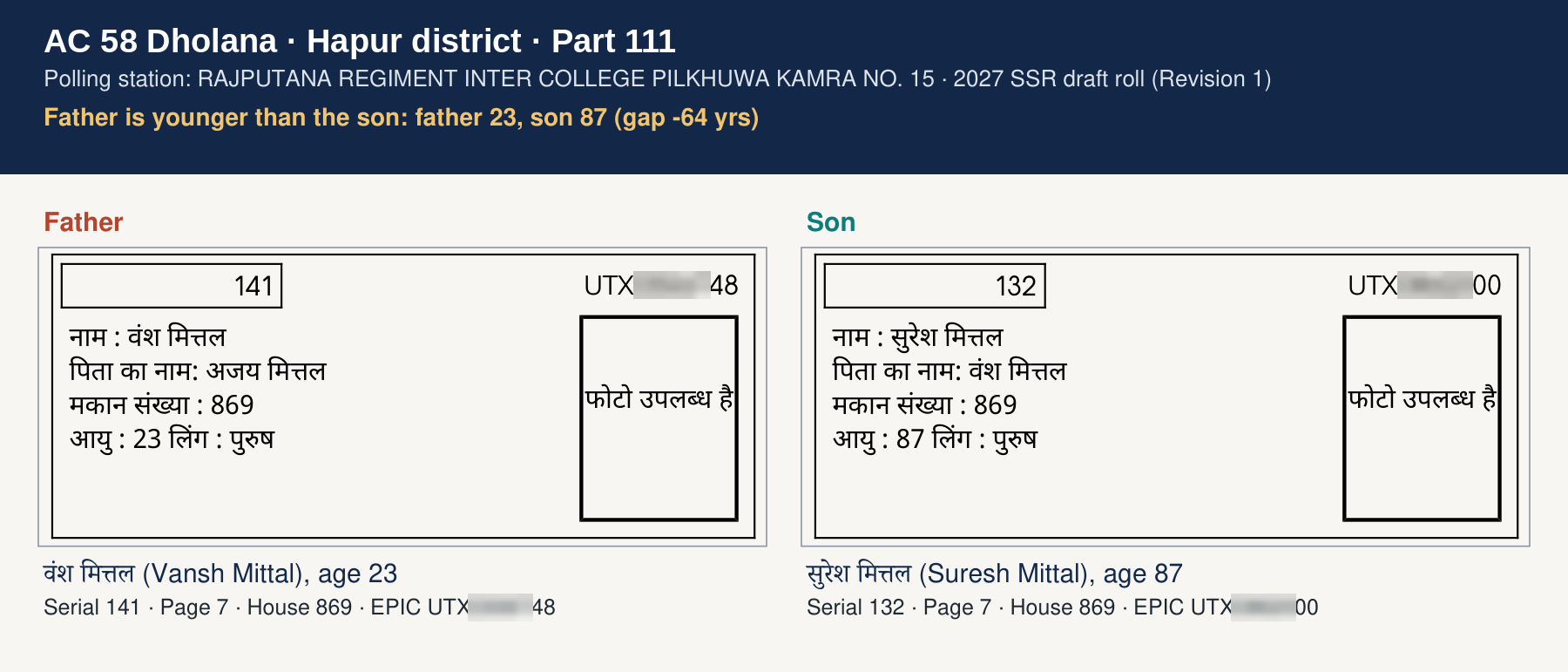
Suresh Mittal is 87. According to Uttar Pradesh’s latest draft electoral roll, his father, Vansh Mittal, is 23. Both are registered at house number 869 in booth 111 of the Dholana constituency in Hapur. The same roll lists Vansh as the son of Ajay, a 56-year-old in the same house.
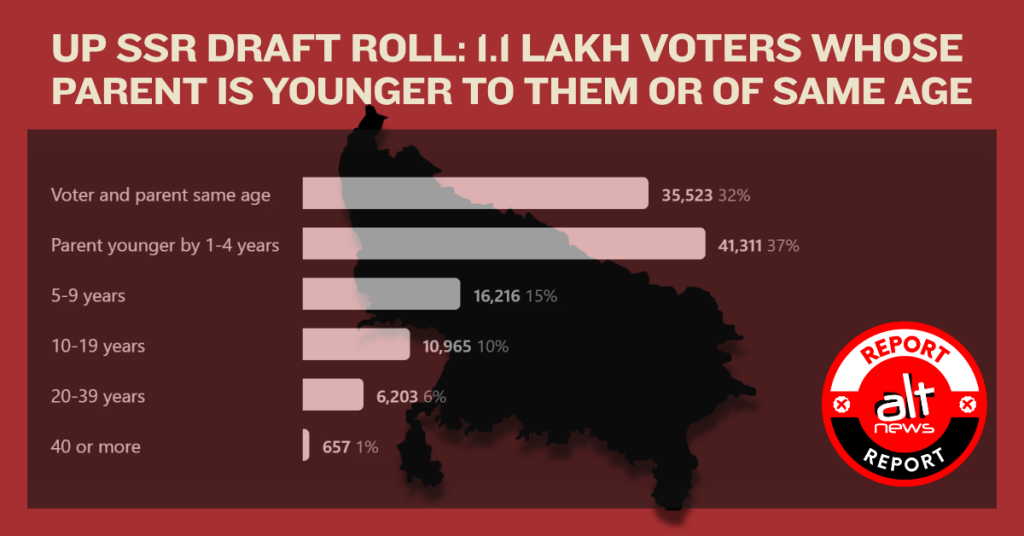
Suresh is not an exception. Alt News found 1,10,875 voters in the Special Summary Revision (SSR) draft roll whose father or mother, registered in the same booth and the same house, is recorded as the same age as them or younger. The draft was published on November 17.
A Year of Revisions: First SIR, Now SSR
The draft comes at the end of a long year for UP’s voter list. The Special Intensive Revision (SIR) of the rolls began on October 27, 2025 and ended with the final roll on April 10, 2026. In those 166 days the state’s electorate shrank from 15.44 crore to 13.39 crore.
As per the process of SIR, every voter was supposed to be issued an enumeration form, which was supposed to be collected by booth-level officers (BLOs). The Election Commission’s software then allegedly went through the data looking for what it called logical discrepancies. One of these was a parent less than 15 years older than the voter. About 2.22 crore voters in UP were sent notices for such discrepancies, and the Commission says hearings were completed on all of them.
On October 15, six months after the SIR’s final roll, the Election Commission ordered a Special Summary Revision (SSR) in 17 states and Union territories, including UP. The SSR draft roll, which merges the SIR roll with all supplementary lists, has 13.58 crore electors. Claims and objections can be filed till December 16, and the final roll is due on January 4, 2027.
What We Found and How
The SSR draft rolls are machine readable. We took every voter whose entry names a father or a mother, and looked in the same booth for a voter with that name living in the same house. If that ‘parent’ turned out to be the same age as the voter, or younger, we flagged the entry.
We found 1,10,875 such cases spread across all 75 districts and 403 constituencies.
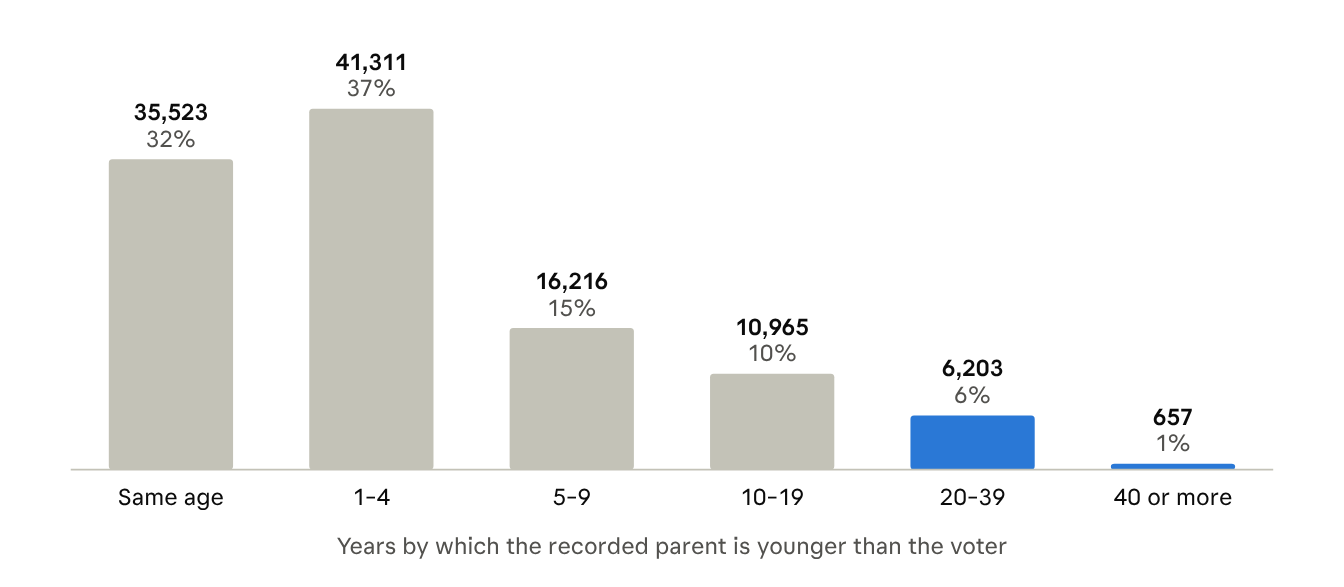
In 35,523 of these cases, parent and child are the same age. In the other 75,352, the parent is younger, and in 6,860 of them by 20 years or more.
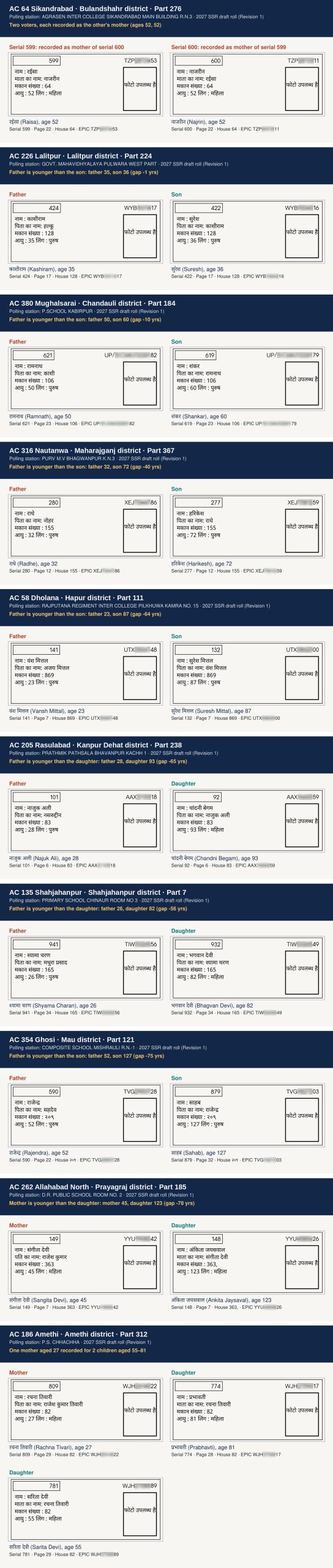
Some of the cases are shown below for representation:
What did SIR Actually Achieve?
The SIR was designed to weed out exactly this kind of error. It had enumeration forms, BLO visits, software flags and hearings. A parent who is younger than their own child is perhaps the most basic inconsistency a voter list can have. This raises a larger question: if a process this elaborate left the most basic errors untouched, what did the SIR actually achieve?
Moreover, spotting these anomalous entries is no rocket science. Each one is a contradiction between two lines of the same booth’s roll, often on the same page: An 87-year-old whose father is 23, a 123-year-old woman whose mother is 45, two women who are each other’s mother. A simple check on the roll itself would have thrown them up. Either no such check was run, or nobody acted on what it found.
As of now, all 1,10,875 are in the draft, and the window for corrections closes on December 16.
The district-wise and constituency-wise count of such cases is given below. Kushinagar district has the most cases (3,646), and Fazilnagar has the most for a single assembly constituency (711).
Skip to PDF contentIn a related report published on November 21, Alt News showed several glaring anomalies that the final SIR list for Uttar Pradesh had, including at least 230 voters listed multiple times across 69 booths, missing addresses, unexplained name and gender changes, and suspicious deletions. The report can be read here.