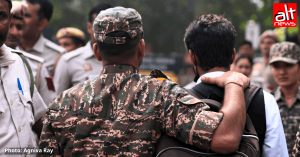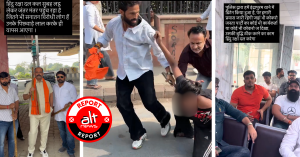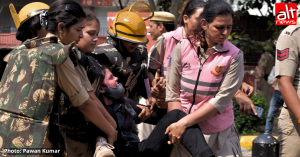
The Delhi Police crackdown on the youth protest on October 10 has drawn international scrutiny, with human rights bodies and press-freedom organisations flagging police excesses, and international media outlets reporting on the severity of force used against young protesters.
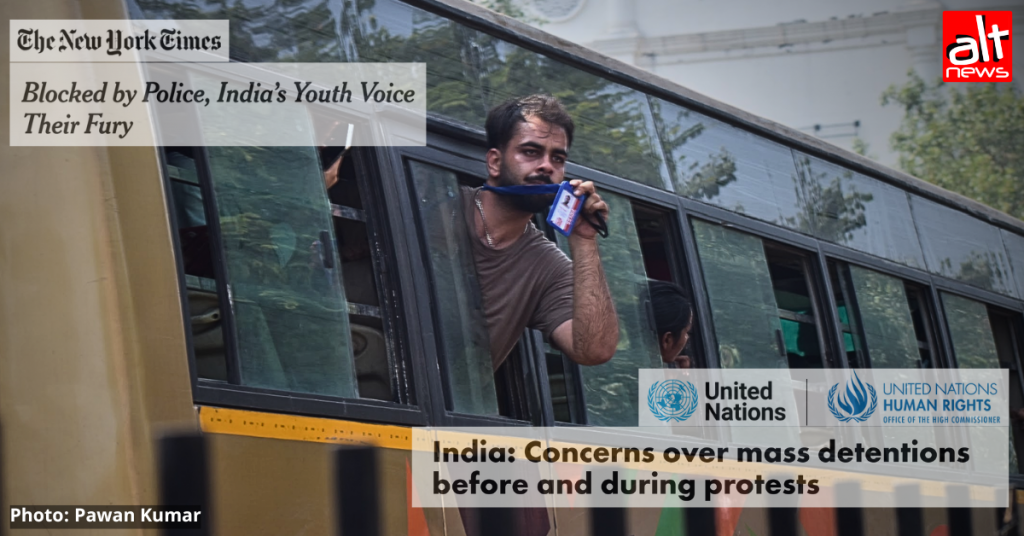
Police detained over 2,000 protesters and used force to suppress the mobilisation in the national capital. In arguably the most brutal assault on press freedom in India since the Emergency, journalists from both independent and mainstream media outlets were stopped from doing their work and detained in a display of police excess that bordered on madness. Some were dragged by their clothes, pushed and manhandled, some had their phones snatched, and pressured to delete footage of police action.
‘Restrictions Violate India’s Obligations under Int’l Law’
The global human rights non-profit Amnesty International on Friday put out a statement urging Delhi police to ensure that the fundamental right to peacefully protest is guaranteed to Indian citizens. In the statement, titled, ‘Delhi police must facilitate right to peaceful protest amid lockdown-like restrictions in capital’, Amnesty highlighted that “approximately 22,000 armed personnel from across the country have reportedly been brought to Delhi, in addition to more than 10,000 Delhi police officers expected to be deployed.”
Aakar Patel, chair of board, stated: “From denying permission for a peaceful demonstration, halting all Delhi-bound trains, and sealing the city’s borders, to issuing an internet suspension order near the protest site, and pre-emptively arresting activists – India’s authorities are leaving no stone unturned in their bid to prevent this march from happening. The right to protest is protected in India’s constitution. The authorities must immediately lift all these arbitrary restrictions, which violate India’s obligations under international law.”
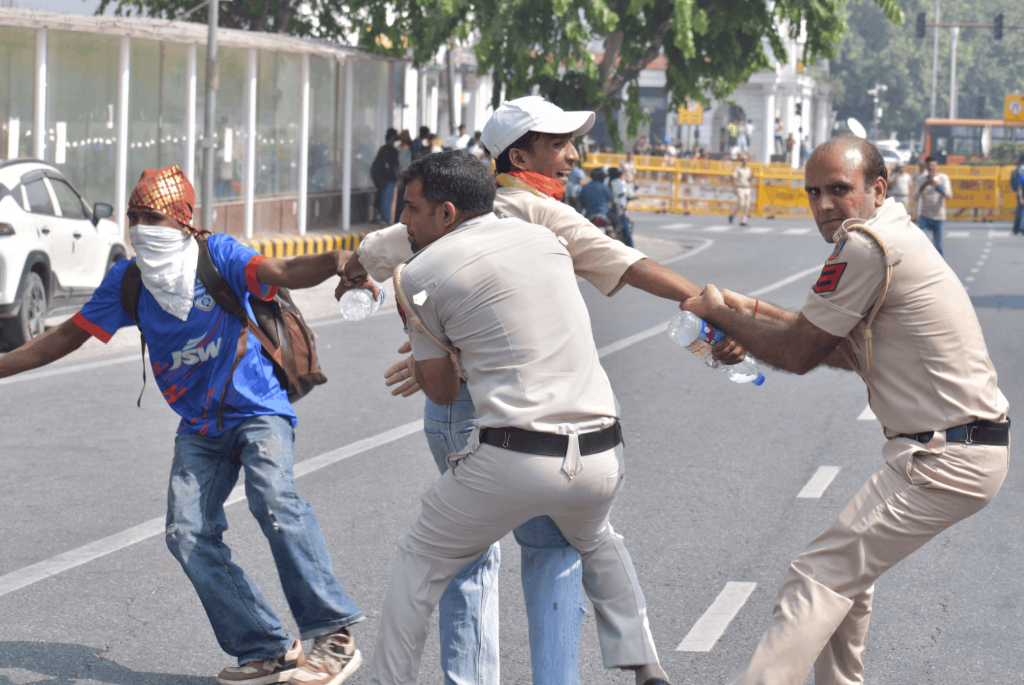
After reports of rapid mass detentions began to surface on Saturday, the United Nations Human Rights Commission published a press release: ‘Concerns over mass detentions before and during protests’. Spokesperson Thameen Al-Kheetan called for the unconditional and immediate release of all those arbitrarily detained. “We call on the authorities to ensure that the right to peaceful assembly is fully respected and fulfilled. Restrictions on peaceful protests must meet strict tests of necessity and proportionality. The Indian authorities should also ensure law enforcement forces exercise utmost restraint in response to peaceful protesters, consistent with the country’s democratic traditions and human rights obligations,” read the statement.
Similarly, the global media watchdog Committee to Protect Journalists (CPJ) urged Delhi police to “immediately release all detained journalists and media workers, return their equipment, investigate reports of physical abuse, and allow the press to cover the ongoing protests…and the police response without interference.”
CPJ highlighted the detentions of Newslaundry reporters Ashwine Kumar Singh, Astha Savyasachi, and Anmol Pritam, and Scroll reporter Ayush Tiwari. “Newslaundry has also reported that police seized its reporters’ phones, while other reports indicate that journalists were physically manhandled,” the statement read.
#India: CPJ calls on @DelhiPolice to immediately release all detained journalists and media workers, return their equipment, investigate reports of physical abuse, and allow the press to cover the ongoing protests in New Delhi and the police response without interference.
CPJ is closely monitoring the situation and has confirmed the detention of Newslaundry reporters Ashwine Kumar Singh, Astha Savyasachi, and Anmol Pritam, and Scroll reporter Ayush Tiwari. We are working to identify other detained journalists and media workers. Newslaundry has also reported that police seized its reporters’ phones, while other reports indicate that journalists were physically manhandled.
A free and independent press is essential to a democracy. CPJ urges authorities in India to respect journalists’ and media workers’ ability to report in the public interest and to ensure their safety while doing so.
https://t.co/s2lIlXebTI
https://t.co/LfKPneHe55
#PressFreedom #JantarManatar
— CPJ Asia (@CPJAsia) October 10, 2026
Putting out a list of around 20 journalists detained through out the day on October 10, global journalists’ body Reporters Without Borders (RSF) said, “Covering events of public interest is not a crime. It is their job. The police’s actions against the press are unacceptable.”
BBC Focus on Scale of Government Pushback
The BBC published at least five reports specifically focusing on the heavy security deployment, police crackdown and mass detentions. The BBC published first on Saturday, ‘Thousands of security personnel deployed as Delhi braces for ‘cockroach’ protest’. The report highlighted the sheer scale of government pushback — it stated that the BBC saw at least five people being detained near the site as “police and paramilitary personnel [were] stationed behind barricades and ropes, preventing people from entering the protest site…and drones could be seen flying overhead.”
The report stated that 30,000 police and paramilitary personnel were deployed and that the “restrictions caused major disruption across central Delhi, with traffic diverted from several key roads.” It also mentioned the “dramatic scenes” involving Leader of Opposition Rahul Gandhi and other Opposition leaders since October 6, as the police vehemently prevented them from agitating.
In a second report, the BBC reported the detention of Dipke, Das, and Ranka and hundreds of other demonstrators. In ‘‘Cockroach’ group leaders among hundreds detained in Delhi protest’, BBC highlighted the way the three were detained before they could even deboard their flight, prominent protest face, All India Students’ Association (AISA) leader Neha Bora’s detention, and how more protesters were jam packed into buses than on the streets. “The large number of protesters expected to descend on Delhi were unable to get anywhere close to Jantar Mantar due to the heavy security presence and road blocks,” the report stated.
In a third report on October 11 — ‘Delhi sees more protests as freed ‘cockroach’ group’s leaders vow to fight on’ — after the detainees were released, the BBC highlighted the 7,000 protesters who were detained and released on Saturday and hundreds were also detained on Sunday. The report led with Dipke’s promise to continue fighting. BBC also posted live updates on the detentions on its website.
The New York Times also published multiple reports on the wrath the Delhi police unleashed on the protesters on Saturday. All their reportage described the scuffle between the state agents and the demonstrators with headlines reading: ‘Indian Police Round Up Protest Leaders and Lock Down Delhi’, ‘From a Sikh Sanctuary to Chaotic Streets, Protesters Brave Police in Delhi’, and ‘Blocked by Police, India’s Youth Voice Their Fury’.
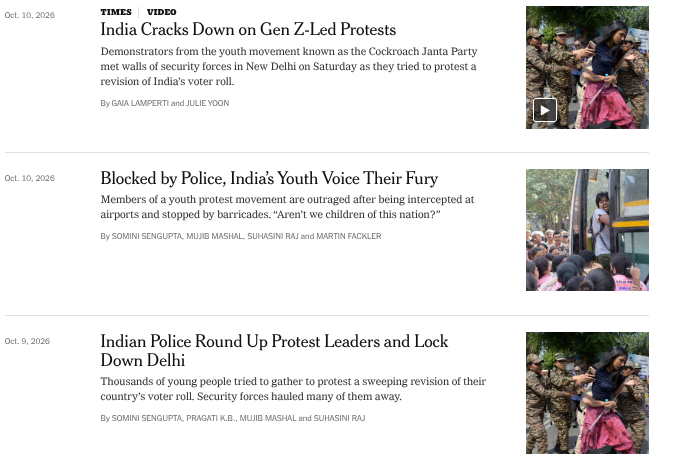
‘Indian Police Round Up Protest Leaders and Lock Down Delhi’ read the headline of a report published by US-based news outlet NPR. The report described at length how “Indian authorities deployed a sweeping security crackdown across New Delhi and detained thousands of protesters Saturday as India’s youth…sought to intensify a nationwide campaign against a contentious voter list revision that has fueled anger at Prime Minister Narendra Modi’s Hindu nationalist government and election authorities.”
Highlighting the elaborate measures taken by Delhi police to curtail the movement on Saturday, the report stated: “The scale of the crackdown underscored the authorities’ determination to disrupt a fast-growing protest campaign that has mobilised thousands of young people, drawn opposition support and intensified scrutiny of Modi.”
The British news outlet The Guardian also extensively covered the police action on Saturday. Alongside Dipke’s video from when he was being arrested inside the aircraft, where he can be heard saying, “You can see where the nation is heading…this is dictatorship,” the outlet published a report ‘‘Cockroach’ leader among thousands detained in Delhi protest crackdown’, wherein it describes the police lockdown as “severe”.
‘Modi is in Trouble’
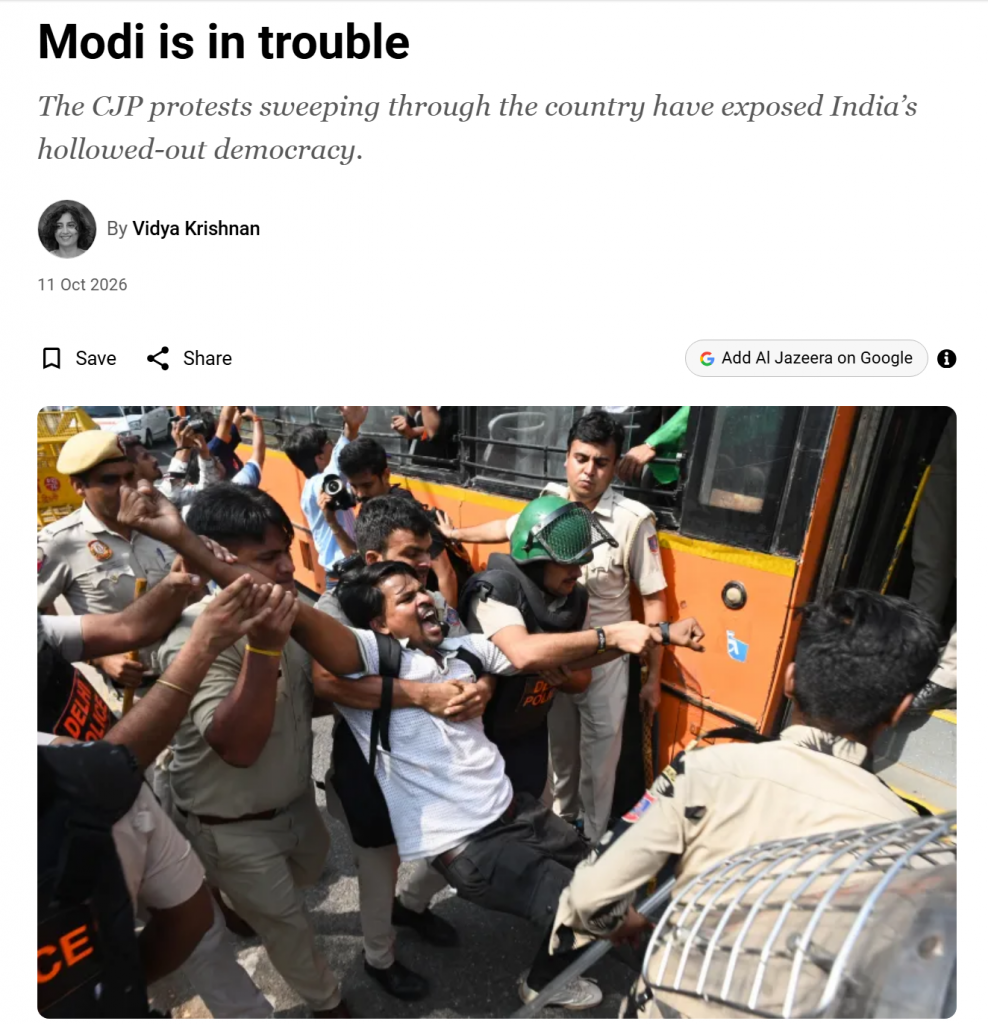
Qatar-based Al Jazeera reported on the mass detentions on Saturday, and published a feature headlined ‘Meet the man helping India’s detained protesters get home’ and an opinion piece ‘Modi is in trouble’ on Sunday.
The former video report featured 25-year-old Rajiv Choudhary who built an AI-powered app to help the detainees get home safely after police drop them off at the city’s outskirts; the latter opined that the protests “exposed India’s hollowed-out democracy.” “These acts further erode the tenuous position Modi is in, prompting more rebuke from critics who now question his fitness to occupy the office of the prime minister. On Friday, the opposition parties, led by Rahul Gandhi, met President Draupadi Murmu and submitted to her that the government had subverted India’s democratic framework…Under Modi’s watch, problems have accumulated like barnacles on the side of the ship. Every time he has been challenged, he has gone farther away from the democratic principles on which this nation was founded,” the article read.
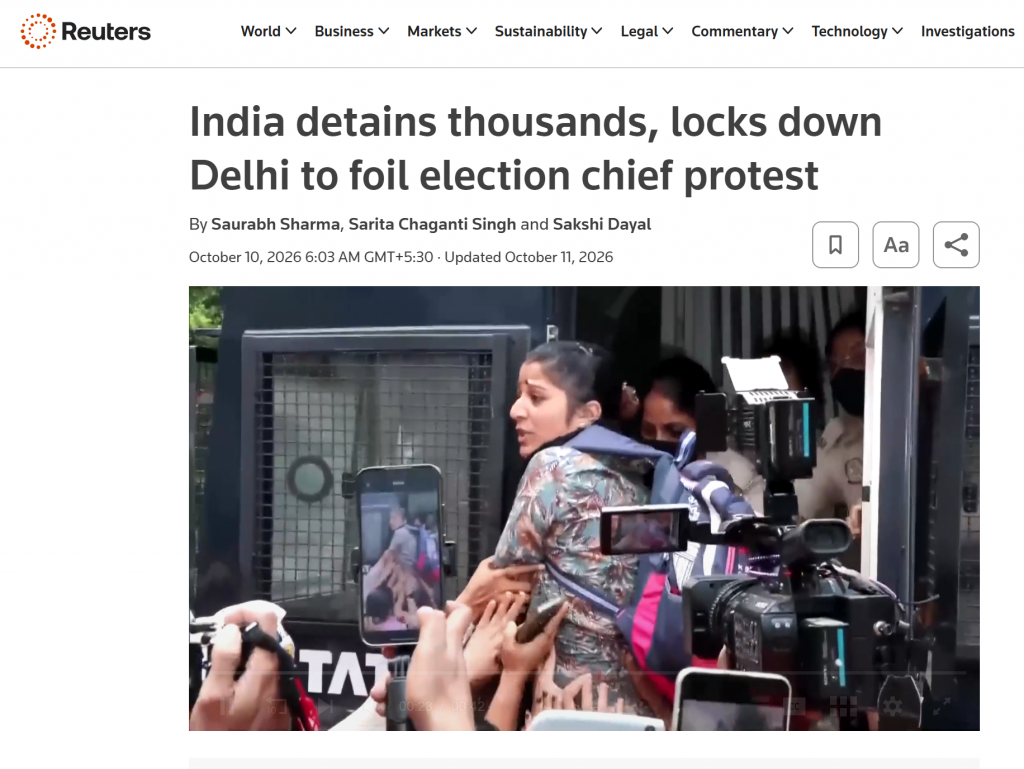
British news agency Reuters published at least six reports on the protest since Friday. The first report, ‘Why India’s tens of millions of voter deletions have led to widespread protests’, discussed the contentious SIR deletion which have led to the mass outrage and protests.
“The BJP and the Commission deny allegations of manipulation, although opposition parties say Muslim voters and other minorities, who are unlikely to support the Hindu nationalist ruling party, are disproportionately impacted by the deletions…They say the deletions have affected the outcome of some recent state elections that the BJP won, and have cast a shadow on the electoral process in the world’s biggest democracy,” explains the report.
On the day of the protest, another report details the preemptive measures and subsequent police action. With the headline, ‘India detains thousands, locks down Delhi to foil election chief protest’, the report describes the frequent protests as a “new challenge to Modi”. “The demonstrations represent one of the most serious tests yet for Modi…The unrest also comes ahead of a series of important state elections beginning in early 2027,” it states.
While various other articles report on the CJP leaders’ detention and eventual release, the police excesses faced by thousands, a news feature by the agency spotlights Neha Bora’s rise “as one of the most visible faces of a protest movement in India that has mounted the most serious challenge to Prime Minister Narendra Modi’s government in years.”
Germany-owned international broadcaster DW published four reports on why the protests were taking place, the dramatic detention of CJP leaders ahead of the protest, the police crackdown on Saturday, and the CJP leaders’ vow to continue protesting despite the heavy police action, respectively.
In the report, ‘Indian authorities crack down on ‘Cockroach’ protest’, which was accompanied by a 24-minute-long video carrying footage of the police excess, DW describes the crackdown as “extraordinary”. “Indian authorities launched an extraordinary security operation in Delhi on Saturday to prevent a major demonstration…Roads across India’s capital were sealed, police checkpoints established and public transport heavily disrupted before demonstrators could gather,” the report read.
UK-based Financial Times published two reports on Saturday and Sunday, ‘Police arrest leader of India’s ‘Cockroach’ movement as protesters take to streets’ and ‘India’s ‘Cockroach’ movement plans more protests after release of leaders’, respectively. Both focused on the police crackdown and the protesters’ predicament.
While the global news hub CNN published multiples features on he CJP movement through May-July, on Sunday, it reported the release of the CJP leaders and the excessive police clampdown. In ‘India’s ‘Cockroach’ movement founder and leaders released from detention after Delhi protest crackdown’, CNN stated that the movement’s “target” this time around is the “62-year-old chief of the Election Commission that holds the keys to India’s democracy – the world’s largest – and who the CJP alleges is responsible for disenfranchising tens of millions of citizens.”
CNN witnessed, the report mentioned, that “despite the capital turning into a fortress to keep out protesters and mobile internet blocked, supporters gathered Saturday — as security moved swiftly to crack down on the unrest with many people at the protest site detained by police.”