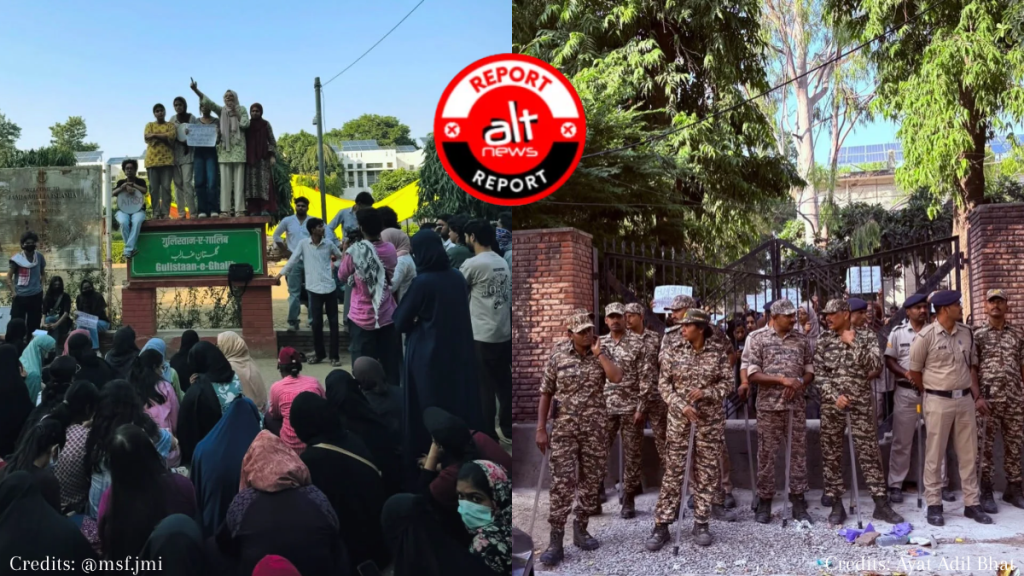
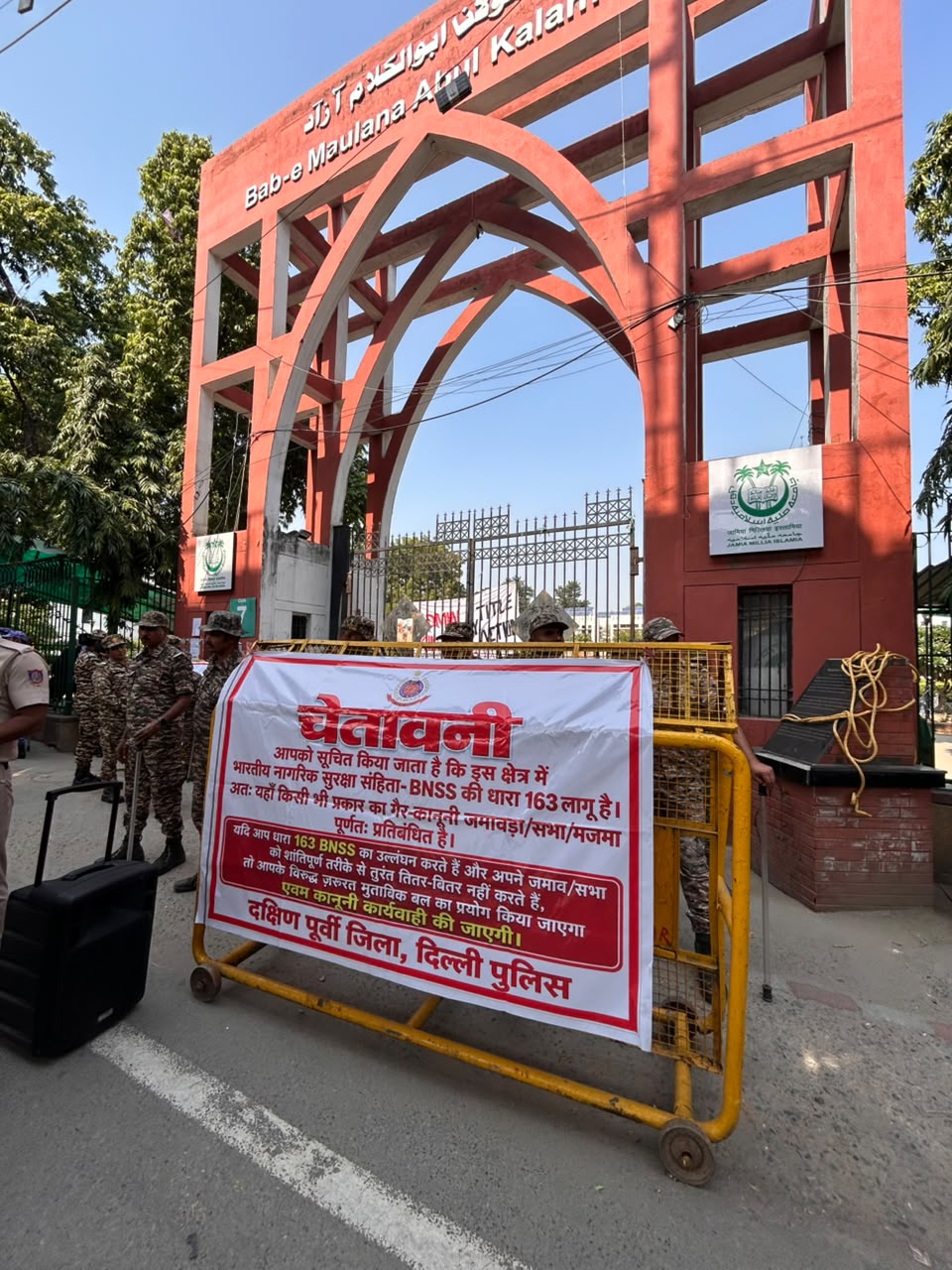
As the protests and hunger strike continues to unfold at Delhi’s Jamia Millia Islamia, students on October 27, Tuesday, reported a near-complete shutdown of normal university activities with the campus has being turned into a fortress surrounded by police personnel and tear gas vans deployed outside the main gate.
Additionally, Section 163 of the BNSS has been invoked, criminalising gatherings of more than four people. A warning sign erected by South-East District of Delhi Police mentions that unlawful gathering or assembly will be dispersed using physical force and legal action will be initiated.
Why are the Students Protesting?
On October 12, two students, Jasim Ali Khan and Ebin Basil, began an indefinite hunger strike to demand the resumption of the student union elections, which have not been held for two decades. The last elected union was dissolved in March 2006 amid allegations of campus violence and disruption. The university has not had a restored, university-wide elected Jamia Millia Islamia Student Union (JMI-SU) since then.
View this post on Instagram
Representatives from various student organisations submitted a memorandum to the vice-chancellor, demanding that necessary facilities, space, and support must be provided to students for their democratic right of free expression and protest. Within the next few days, six more students, Rehan Khan, Rehan Haider, Faizan Ali Khan, Rida Nausheen Khan, Ritik, Altaf, and Abuzar, joined the hunger strike and several students joined the sit-in demonstration around the Mirza Ghalib statue on campus. What followed is severe police crackdown, administrative retaliation, and a state-sanctioned attempt to curb what students described as a peaceful protest for their rights.
‘Students Beaten, Dragged & Detained’
Five days into the protest, around 5:30 am on October 17, Delhi Police personnel arrived in large numbers outside the university gate, and allegedly detained at least 10 students with the aid of the campus security guards. Students alleged that authorities turned off the lights, beat and dragged the protesters out of the campus in the break of dawn in the presence of the chief proctor of the university.
CPI(ML) Liberation alleged that Jamia Millia Islamia administration forcibly removed students on hunger strike from the campus around 5:30 am on Saturday while they were demanding the restoration of the students’ union. In a post on X, the party alleged that campus lights were switched off and students were beaten, manhandled and harassed before being handed over to Delhi Police. It said all detained students had since been released. The students are demanding the restoration of Jamia’s students’ union and the holding of union elections. CPI(ML) Liberation condemned the alleged action and urged the administration to stop what it called repression and restore the union.
— The Observer Post (@TheObserverPost) October 17, 2026
Footage surfacing on social media showed clashes between authorities and the students protesters on the morning of October 17, with videos showing police dragging and pulling students away from the campus.
View this post on Instagram
A video also showed Ebin Basil, writhing in pain, alleging that he had been brutally assaulted by the security guards.
Subsequently, as scenes of utter chaos kept emerging through the day, a large group of students were seen breaking the gate and storming inside the campus even as the police reportedly denied detaining anyone and only removing those attempting to break the gate.
View this post on Instagram
Admin Condemns Slogans, Shifts Classes Online
On October 18, a high-level committee comprising seven university professors was formed to mediate between protesting students, and to convince them to call the demonstration off. During this meeting certain slogans that were painted on walls by students also came under the administration’s scrutiny. These slogans included ‘Restore JMISU’, ‘Reclaim Jamia’, ‘Inquilab Ayega’, ‘Free Palestine’, ‘Free Sharjeel Imam’, and ‘RSS Se Azaadi’ among others.


In a press release published by the official handle of the university on X, the slogans were labelled “highly condemnable and detrimental to the nation’s integrity, security and sovereignty.” The release further stated that the administration has adopted two resolutions. First, to urge the protesters to vacate the protest site and call off their agitation, particularly at the Ghalib statue lawns, which they claimed had been “illegally occupied by the protesting students despite Gate No. 18 being the designated protest site at JMI”. Second, “to repaint the defaced walls and cover the slogans”.
The press release added that the administration had been compelled to issue a notification to shift all classes online allegedly due to the protesters’ resistance to call off the demonstration. “After two hours of efforts to persuade the students to call off the protest…the students continued chanting slogans, shouting that the faculty should “go back” and suddenly began pushing security guards, staff and teachers…even after their demands had been met earlier this week,” the release stated.
Further, the university administration took disciplinary action against Ebin and Jasim. Ebin was rusticated for one academic year and barred from campus while Jasim Khan was barred from campus for six months.
Following the administrative action, students held a press conference on October 18 and expanded their demands beyond the restoration of the JMI-SU — they demanded the withdrawal of disciplinary proceedings against protesting students and an end to further punitive measures. They also demanded the resignation of the chief proctor and security advisor.
Students Vow to Continue Strike, Clampdown Increases
Even as certain hunger strikers gave up due to declining health, the remaining students vowed to continue their hunger strike and sit-in protests. Solidarity for the protesting students poured in from within and beyond the campus, however, the police deployment outside the campus and administrative clampdown also intensified.
“The irony lies in the fact that the same administration that condemned unauthorised police clampdown on students during the CAA-NRC protests in 2019 is deploying that very body against its students in 2026 to suppress the constitutionally safeguarded right of free and independent expression,” Ateerah, a post-graduate student, told Alt News.
On October 23, Congress MP Imran Masood was detained by Delhi Police after he arrived at the university to express solidarity with protesting students.
Water, Electricity, Basic Amenities Cut Off
On October 24 — the 13th day of the hunger strike — through another notice the administration shifted all classes to online mode, shut its gates, suspended canteen services, and restricted access to the Central Library. In what students viewed as an attempt to discourage the protest, electricity and water supply were also cut off in the campus space, students told Alt News. “They have essentially converted our dissent into a question of law and order, to justify police action on a peaceful protest,” said Abdul, another student.
On the same day, a large number of Delhi Police personnel and paramilitary forces were stationed outside the university premises. The protesting students told Alt News that in the afternoon, the proctor’s team, along with university professors and non-teaching staff, had rounded up students who had gathered for a sit-in demonstration within Gate No. 7 of the university premises, at the Ghalib Lawn.
Students alleged use of force on both male and female protestors by the security guards. The protest site was allegedly dismantled, which compelled the protesting students to take shelter within the Political Science building and continue their hunger strike, they added.
View this post on Instagram
Mantasha, a post-graduate student, told Alt News, “The whole affair was an unpleasant reminder of what had transpired within the university premises in 2019. This time, our own professors joined in with the security guards. Some just watched, while others proceeded to manhandle us. Until our 13th day of protest, a solitary female washroom was kept open at night. However, after the protest site was dismantled in the afternoon of October 24, we found that it had been sealed off, leaving us no option but to share the male washroom.”
Students Reject Admin’s Notification
The next day, on October 25, the administration released a notification that said that a student election would be held after 15 days from the date of approval of the constitution of the JMI-SU.
It stated that show cause notices and suspension orders against students during the period of protest would be revoked, and a committee would be constituted to enquire into the actions of the security staff. It also added that students should issue a public apology for any defamatory statement, action, or posts made during the protest against the administration.
However, students expressed their apprehension regarding the notification, pointing out that the date of constitution of the union was unspecified. Those on hunger strike continued their fast, deeming the notification an incomplete victory as all of their demands had not yet been addressed.
They demanded an assurance on the resignation of the chief proctor and the security advisor, and the revocation of all disciplinary actions on protesting students, besides declining to issue a public apology. “The Constitution of the union is to be drafted by December 20, after which it is subject to approval from the V-C. This allows a lot of scope for administrative inaction and complacency, since the approval itself can be indefinitely stalled by the administration,” alleged Abdul.
On October 26, two gates — one in front of the Ibn-e-Sina reading library, and another which serves as a key access point to the campus for residents of the Boys Hostel — were sealed off by the administration, with the suspension of offline classes still effective.
A student protestor, speaking on terms of anonymity, told Alt News, “The gate provides access to facilities serving not only students and hostel residents but also members of the general public, including an Indian Post Office, a public sector bank, an Aadhaar centre, a university health centre and a dental hospital. Restricting access to such essential public services, including medical care for patients with scheduled appointments, warrants immediate reconsideration.”
Less than 24 hours after the administration released the notice, Delhi Police however went on to detain several students for merely attempting to enter the premises of their own university, students told Alt News. Video footage showed police personnel pushing students onto a detention bus.
Speaking to Alt News from the protest site, students alleged that they are not being able to leave the campus given the heavy police and paramilitary deployment in front of the gates. Food and water deliveries are allegedly being intercepted by security guards at the gates, cutting off the basic means of survival for students who have remained within the campus.
“We had earlier put out a message asking for people in solidarity to send in drinking water, but the guards would not let it through. Is this how a university treats its students?” a student, requesting anonymity, asked.