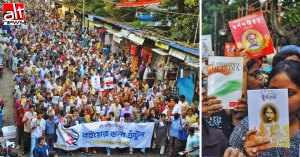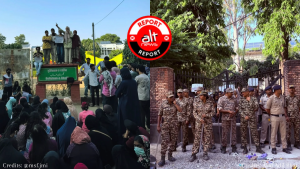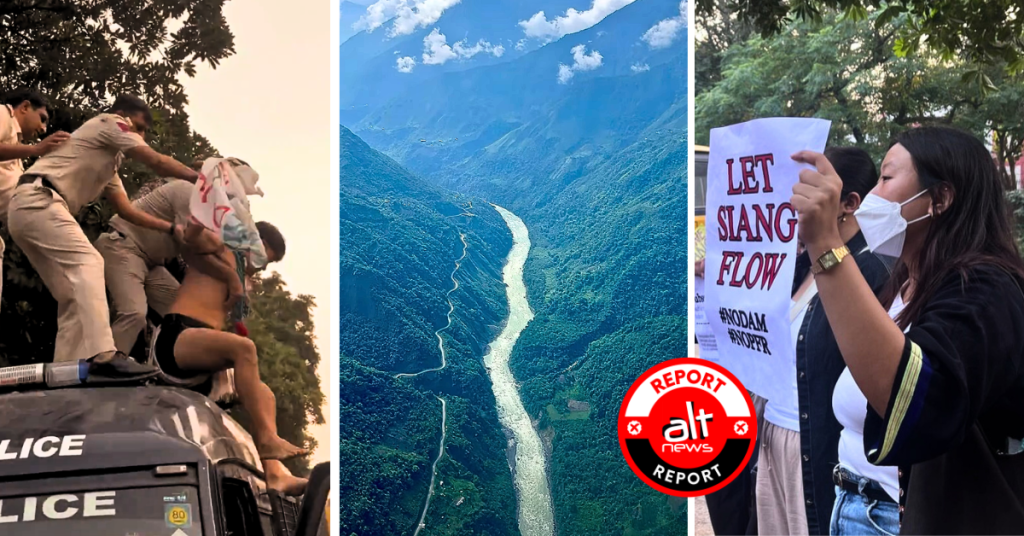
After protests in Arunachal Pradesh against the proposed Siang Upper Multipurpose Project (SUMP) turned violent on October 23, the state has unleashed a massive crackdown on the movement. The response has included the use of force by armed forces and law enforcement agencies, internet shutdowns, a paid PR campaign, censorship of social media content, and action against journalists and lawyers.
A 12-hour Arunachal bandh was called by local bodies and youth groups, including the Siang Indigenous Farmers Forum (SIFF), Adi Baane Kebang United and the Adi Galo Welfare Society, on October 23. The bandh was followed by large-scale arson in Pasighat, East Siang district, targeting an office of the National Hydroelectric Power Corporation (NHPC), a police station, and the homes of two MLAs and the BJP’s state president.
The proposed SUMP, with an estimated capacity of 11,200 megawatts, is planned on the Siang River across the Upper Siang and Siang districts. First proposed in 2008-09 by the UPA government, it was initially conceived as two smaller projects, with memorandums of understanding signed in 2013. On September 26, 2017, following a meeting between chief minister Pema Khandu, state delegates and NITI Aayog, the plan was changed to a single 250-metre-high dam, which would be the country’s largest in terms of installed capacity. However, stiff local resistance forced survey teams to withdraw, bringing the project to a temporary standstill.
The BJP-led governments at the Centre and in Arunachal Pradesh revived the project in 2020, following reports of China’s plan to build a dam on the Yarlung Tsangpo River, known as the Siang in India. In April 2022, the Centre directed the National Hydroelectric Power Corporation (NHPC) to conduct a pre-feasibility survey to assess the project’s technical, economic, social and environmental viability. The exercise involves geological investigations, including drilling, and identifying villages that may require relocation.
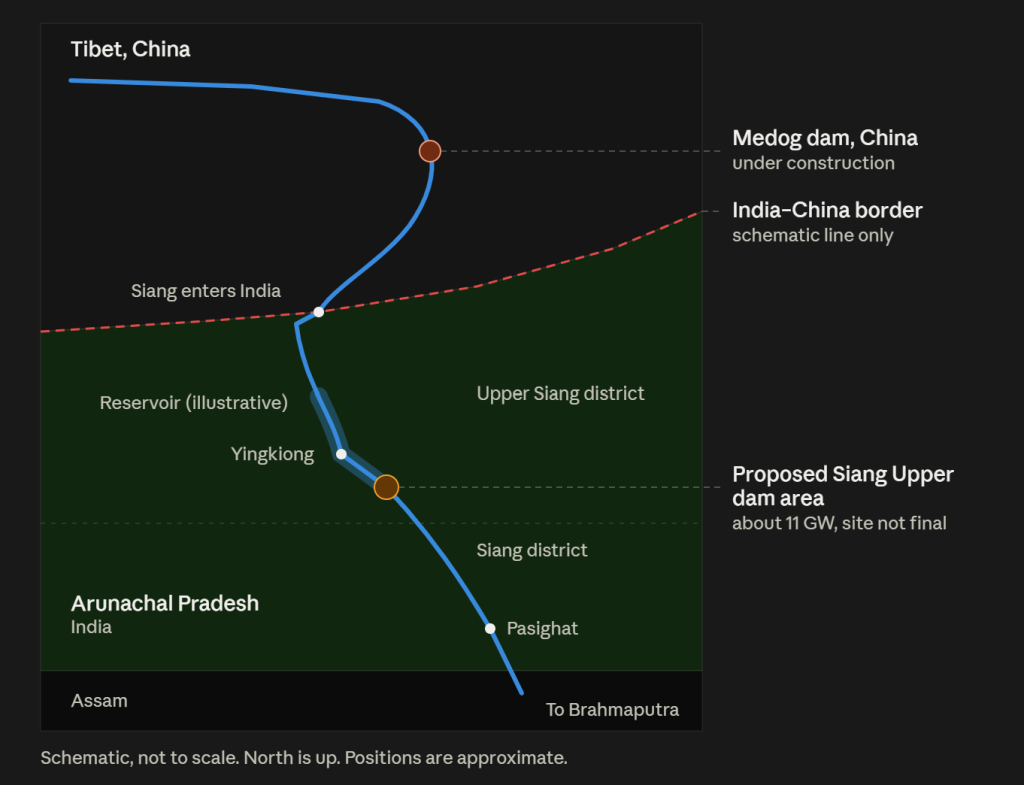
Chief minister Pema Khandu and other state representatives have maintained that the survey does not amount to a decision to build the dam. NHPC has said that preliminary topographical, geological and geophysical work is complete, but core drilling to assess rock characteristics remains on hold because of local opposition.
However, the manner in which the survey was pursued has fuelled distrust. In May 2025, Central Armed Police Forces were deployed at several locations. Police maintained that the deployment was necessary to maintain law and order and that the required clearance had been obtained months earlier.
In September 2026, the state Cabinet approved an empowered committee to oversee the survey, alongside a significant deployment of central forces. Villagers, however, fear that the survey is a precursor to the dam’s construction and have accused the government of using security forces to suppress their opposition.
Questions over consent have further deepened the mistrust. Activist and politician Tadak Nalo alleged that many consent forms cited by the government were false, with endorsements largely coming from villagers whose lives would not be directly affected by the project.
Several indigenous communities, including the Adi, Galo, Nyishi, Apatani and Idu Mishmi, inhabit the Siang valley and depend heavily on the river, not only for their agricultural practices but also for their cultural identities and religious beliefs. They call the river Ane Siang, or Mother Siang. According to independent fact-finding reports, the SUMP would completely submerge nearly 27 villages across the Upper Siang and Siang districts and displace an estimated 1.5 lakh people, almost 11% of Arunachal Pradesh’s population.
With their homes, livelihoods and cultural heritage at stake, people in the Siang valley have only intensified their resistance over the past two weeks. The BJP government’s response, however, has been one of force and intimidation rather than dialogue. It bears resemblance to the way dissent has been dealt with elsewhere under BJP rule — in Delhi, for example, against ongoing protests demanding accountability from chief election commissioner Gyanesh Kumar.
Use of Force, Detentions and Internet Shutdown
One of the issues against which the October 23 bandh was called was the detention of anti-SUMP protesters since October 9. According to reports, The state government invoked the Arunachal Pradesh Unlawful Activities (Prevention) Act (APUAPA) and detained at least 10 protesters. Four of them — Adum Tayom, Omak Paron, Okut Paloh and Oson Paron, picked up from Pasighat — were reportedly held under APUAPA. Among those detained was the president of the Siang Indigenous Farmers Forum (SIFF) Youth Wing, a vocal opponent of the mega project.
The crackdown intensified after the October 23 violence. A further 69 people were arrested and four detained in connection with the violence. A total of 55 cases were reportedly filed: 26 criminal cases in Upper Siang, 21 in Siang and six in East Siang district. Arrests and detentions were also carried out under the APUAPA. Those arrested reportedly face charges relating to rioting, the torching of vehicles and the vandalism of office buildings and residential houses.
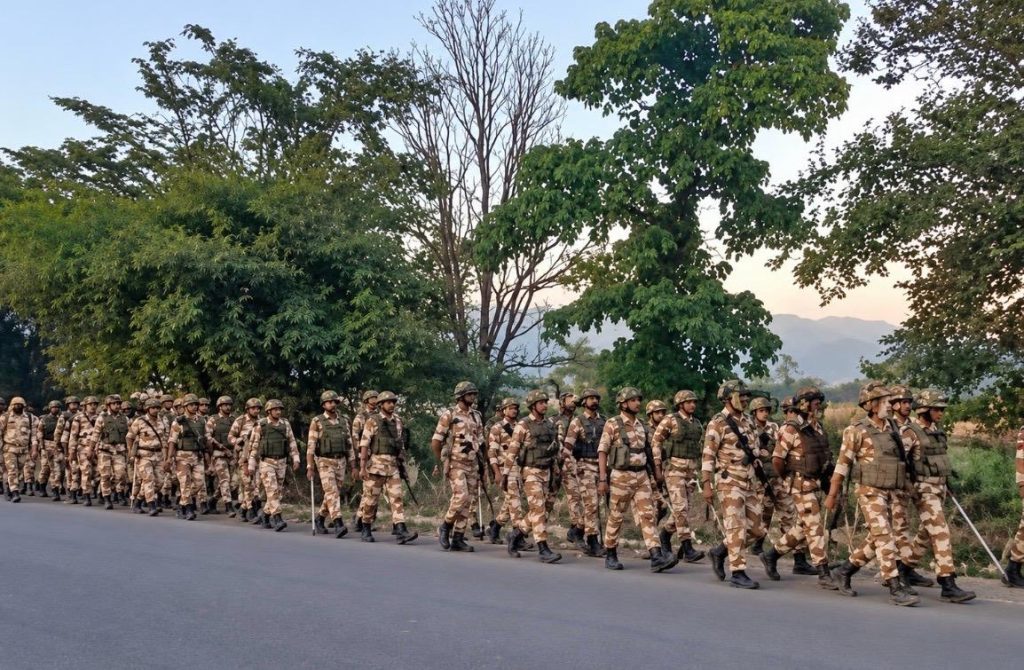
The state has also significantly increased its security deployment in the region. At least 30 companies of Central Armed Police Forces and three companies of Assam Police have been deployed, in addition to Arunachal Pradesh Police personnel. The Centre also flew in two additional companies of the Rapid Action Force (RAF).
There were also reports of police using tear gas and batons against protesters on October 23. Five women were reportedly taken to hospital after experiencing breathing difficulties. The police, meanwhile, maintained that some protesters had allegedly attempted to breach barricades and attack security personnel.
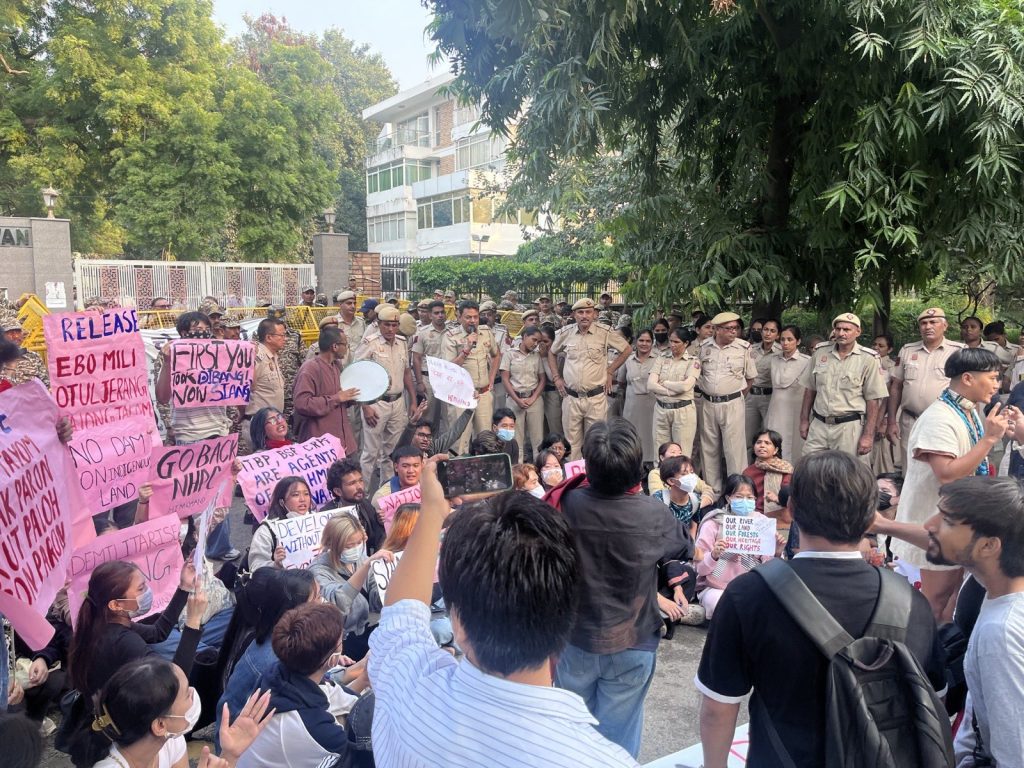
The crackdown has not been confined to Arunachal Pradesh. On October 31, a solidarity protest against the SUMP outside Arunachal Bhavan in New Delhi, organised by Youth for Change (YFC) Arunachal and Himkhand, also ended in the detention and alleged manhandling of protesters by the Delhi Police.
Peaceful protestors were brutally detained by Delhi Police Against 11,200 MW SIANG DAM
📍Arunachal Bhawan, Delhi
🙏 We are United in This https://t.co/nkLHBL3u6X— CJP Gems | (@GameonNewbie) October 31, 2026
The protesters alleged that the Delhi Police used brute force and even subjected some of them to sexual assault during the detention. A member of Himkhand alleged that they were pinched in their private parts and their shirts were lifted. Around 40 protesters were detained during the protest in Delhi, including female protesters who reportedly were detained after 9 pm.
All of the detainees were later released after the intervention of senior Congress leaders.
As of November 2, internet services were suspended in Upper Siang as the Siang Indigenous Farmers Forum (SIFF) and the SUMP Affected Area Youth Association (SAAYA), with the support of various student unions and community-based organisations, enforced a 36-hour bandh in parts of the Siang and all Upper Siang districts from 5 am. Protesters demanded the release of the detainees under APUAPA.
Censorship of Social Media Content
The crackdown on the anti-SUMP movement has also extended to the online space, with social media accounts of activists, journalists and news outlets being restricted or taken down. The censorship is part of a wider pattern in India, where government orders and platform restrictions have increasingly curtailed the circulation of content critical of those in power.
Tadak Nalo, founder and president of the political party Arunachal Frontier Tribal Front (AFTF), released a video statement after his Facebook account was restricted. Describing the situation in Arunachal Pradesh as “emergency-like”, he said fundamental rights, including the right to freedom of speech and expression, were being suppressed.
“My Facebook page, ‘Tadak Nalo for Revolution’, has been misused under the Information Technology Act and restricted completely within India today. If you want to view my page, you will have to go outside India. That is how they have set it up,” he said in the video.
Nalo alleged that his commentary on the SUMP was among the reasons behind the restriction. “A project this big is being built in our Arunachal, and it will cause displacement and render the indigenous inhabitants here landless. I had made some commentary on this and written some posts,” he said.
Several journalists and news pages have also reported having their Facebook pages disabled. Shaan Jijong, managing director of Upper Siang News 24*7, released a video statement saying that the outlet’s official Facebook page had been disabled. He also named two others, Ebo Mili and Katon Moyong, whose Facebook pages had allegedly been taken down.
“We are journalists, and we have been covering the SUMP from the ground also. But our news channel was disabled. Is this okay? We are journalists; we are the fourth pillar of democracy,” Jijong said.
The #Facebookpage of Upper Siang 24X7, a social media-based news channel, has been #blocked by the Government of India. The channel extensively reports on people’s resistance to the government’s proposal for the #SiangUpperMultipurposeProject, a 10,000 MW-plus #hydropower project on the #SiangRiver. Shan Jijong, the reporter behind the popular news platform, says he will continue to report on the issue. Several other Facebook accounts critical of the government’s action have also been withheld.
— The Arunachal Times (@arunachaltimes_) October 5, 2026
Katon Moyong, popularly known as Aborman Anbo, also found his Facebook page had “disappeared”, Northeast Today reported. He created a new account and published a post declaring that the censorship would not silence his opposition to the SUMP and that he had not lost his voice. However, we could not locate the new account on Facebook either, suggesting that it may have been taken down as well.
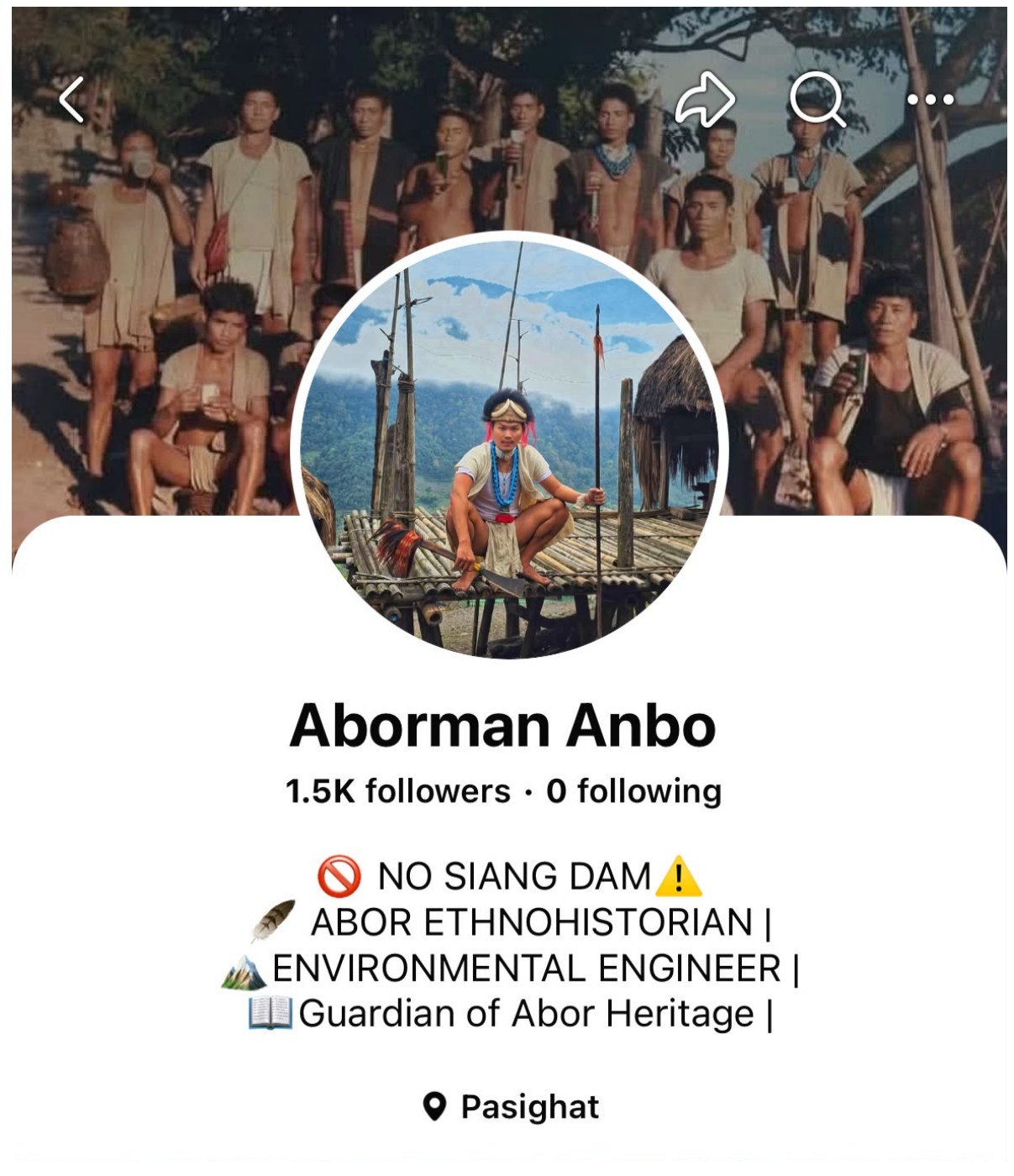
Two news reports published by Arunbhoomi News were also made unavailable for viewing in India. The outlet’s editor-in-chief, Takam Sonia, released a video statement condemning the move.
Human rights lawyer and activist Ebo Mili, whose Facebook account was also restricted, reportedly described the action as “deliberate and linked to his use of social media to raise public awareness about the project”.
The Facebook page Save Aborland and the general secretary and spokesperson of Adi Baane Kebang United, Datik Ratan, have also faced restrictions.
The Arunachal Press Club (APC) and the Arunachal Pradesh Union of Working Journalists (APUWJ) have condemned the restrictions on news reports and videos relating to the SUMP on social media platforms in India, and demanded transparency and their immediate restoration.
Targeting Arunachal Times Deputy Editor and Lawyer Defending Activists
Arunachal Pradesh Police have also moved against a journalist covering the anti-SUMP movement, seeking a search warrant against Tongam Rina, deputy editor of The Arunachal Times, in connection with the violence in Pasighat on October 23.
Police have also sought a search warrant against her lawyer, Sunny Tayeng, along with youth leader Otul Jerang, who has been arrested, and activist Tajong Talom, who was previously detained and allegedly harassed.
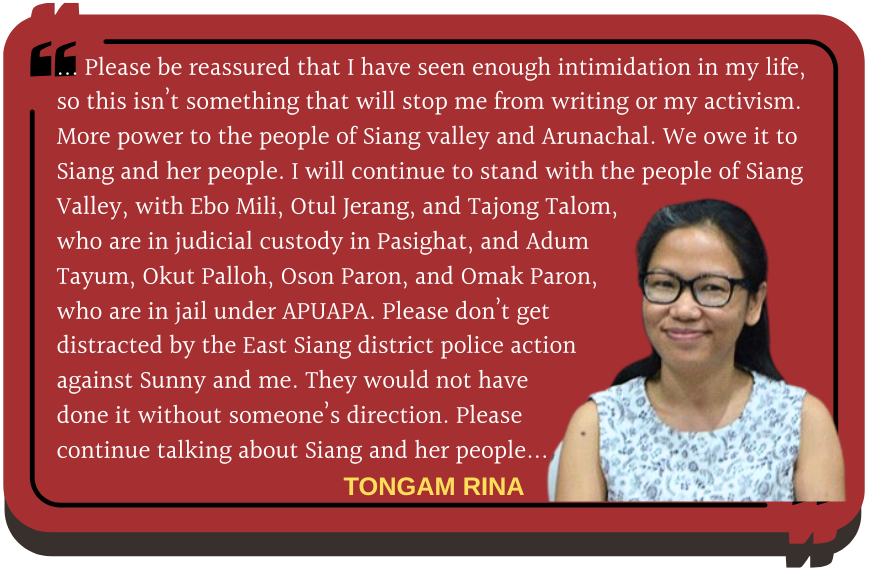
Rina took to X to assert that the police action would not deter her from her journalism or activism. “…I have seen enough intimidation in my life, so this isn’t something that will stop me from writing or my activism. More power to the people of Siang Valley and Arunachal. We owe it to Siang and her people…” she wrote.
She also criticised the move against Tayeng, pointing out that the lawyer was representing several activists, including Ebo Mili, Tajong Talom and Otul Jerang. Rina said she wanted Tayeng to be able to “focus on her practice rather than be burdened by extra work”.
The application for the search warrant, as reported by The Wire, describes Rina and the three other individuals as “accused persons”. It states that searches were “necessary to establish the individual roles of the accused, ascertain their alleged involvement in the offences and collect relevant material evidence”. However, the application does not specify how Rina or the other three individuals were linked to the violence.
The application states: “It is reasonably suspected on the basis of the facts and material collected during the investigation that certain articles and material connected with the commission of the alleged offences including clothing worn during the incident, mobile phones and digital devices containing relevant photographs or video recordings and other case-related articles may be found at the residences or premises…”
The Press Club of India also issued a statement expressing solidarity with Rina and condemning the Arunachal Pradesh Police’s move.
Paid PR Campaign
Actress Taba Reema, who has been vocal against SUMP, has posted a video alleging that PR firms were reaching out to content creators to speak about the construction of the dam in a positive light. “A few months ago, I also got an email from PR teams and agencies… they said they would pay this much for one reel and a list of pointers of advantages of building a dam. And now every reel or content like this I see… same to same…”
According to Reema, they tried to reach out to a lot of content creators from Arunachal, but they all declined. “And not that Arunachali creators have refused; they are using outsiders for this kind of content….”
View this post on Instagram
According to an Indian Express report, Mumbai-based Concept Public Relations was awarded a one-year contract in July 2025, which was subsequently extended until November 2026, to build opinion in favour of the project, at a total cost of Rs 10.91 crore.
Asked about the agency’s appointment, an NHPC official told the newspaper that it had been hired to put forward “their side” and help supporters within the community speak out, despite “the pressure from violent elements”.
Alt News located several X posts which appear to be part of a concerted effort to delegitimise the protests by portraying protesters as Chinese stooges and calling for them to be “dealt with an iron fist”. While these posts do not, by themselves, establish any link with the PR campaign, they illustrate how opposition to the project was being framed in online discourse.
A short video on Instagram by user @creaatingchaaos has her saying, “You people in Arunachal, have you gone mad? China is making a dam of 60000 megawatts; India also has to do it…” In another video, she can be seen dancing while the text reads, “Arunachal does not have a problem with the dam; the convertereds do”. Several other reels show her making fun of anti-dam protesters, including their accent.
View this post on Instagram