An RTI response from Northern Railway has revealed that there is no official data to substantiate media reports claiming that over 5,000 passengers missed their trains at New Delhi railway station due to traffic restrictions imposed during an Opposition protest rally in the national Capital on October 8.
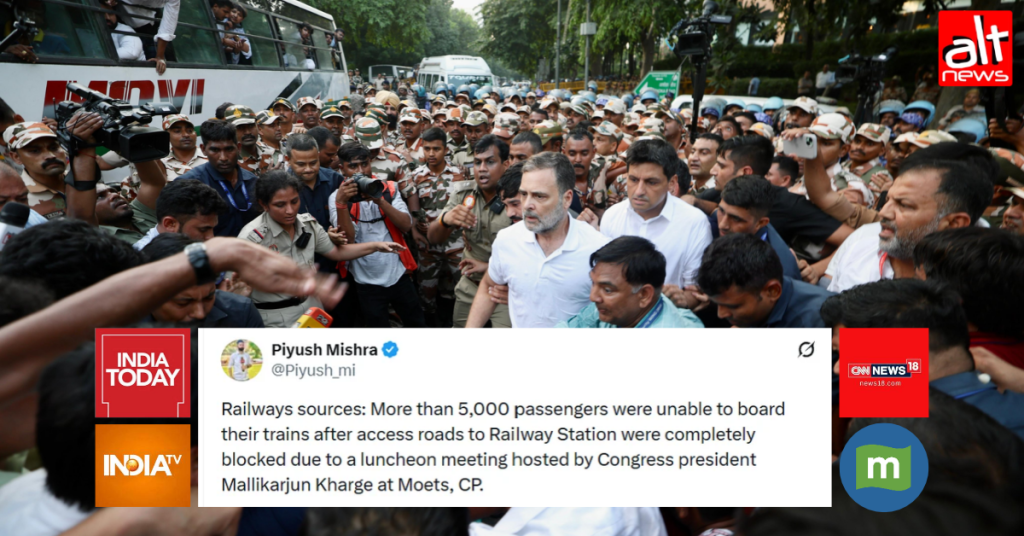
The reports emerged following the Opposition protest on October 8 against chief election commissioner Gyanesh Kumar. Congress leaders Rahul Gandhi, Priyanka Gandhi Vadra, Mallikarjun Kharge and other Opposition MPs arrived at Rajghat after attending a lunch at Moets Restaurant in Delhi’s Connaught Place. Police had erected barricades and diverted traffic as part of security arrangements. Moets Restaurant is located a short distance from Minto bridge.
Citing Railway sources, a number of mainstream media outlets claimed that around 5,000 passengers had missed their trains as several major routes in Central Delhi experienced traffic congestion, with Minto Bridge — a key thoroughfare leading to New Delhi Railway Station — being among the worst affected by the demonstration. However, the reports did not cite any supporting official documentation or statement.
Now, replying to an RTI application by Alt News, the Indian Railways has revealed that it does not have any system or mechanism to maintain station-wise records of passengers who miss their trains.
Who Made the Claim?
India Today journalist Piyush Mishra, citing railway sources, wrote on social media that the routes leading to the railway station were completely blocked due to a lunch meeting hosted by Congress president Mallikarjun Kharge at Moets Restaurant in Connaught Place. As a result, more than 5,000 passengers were unable to board their trains.
Railways sources: More than 5,000 passengers were unable to board their trains after access roads to Railway Station were completely blocked due to a luncheon meeting hosted by Congress president Mallikarjun Kharge at Moets, CP.
— Piyush Mishra (@Piyush_mi) October 8, 2026
India Today also published a report on this, in which a similar claim was made, citing a railway official.
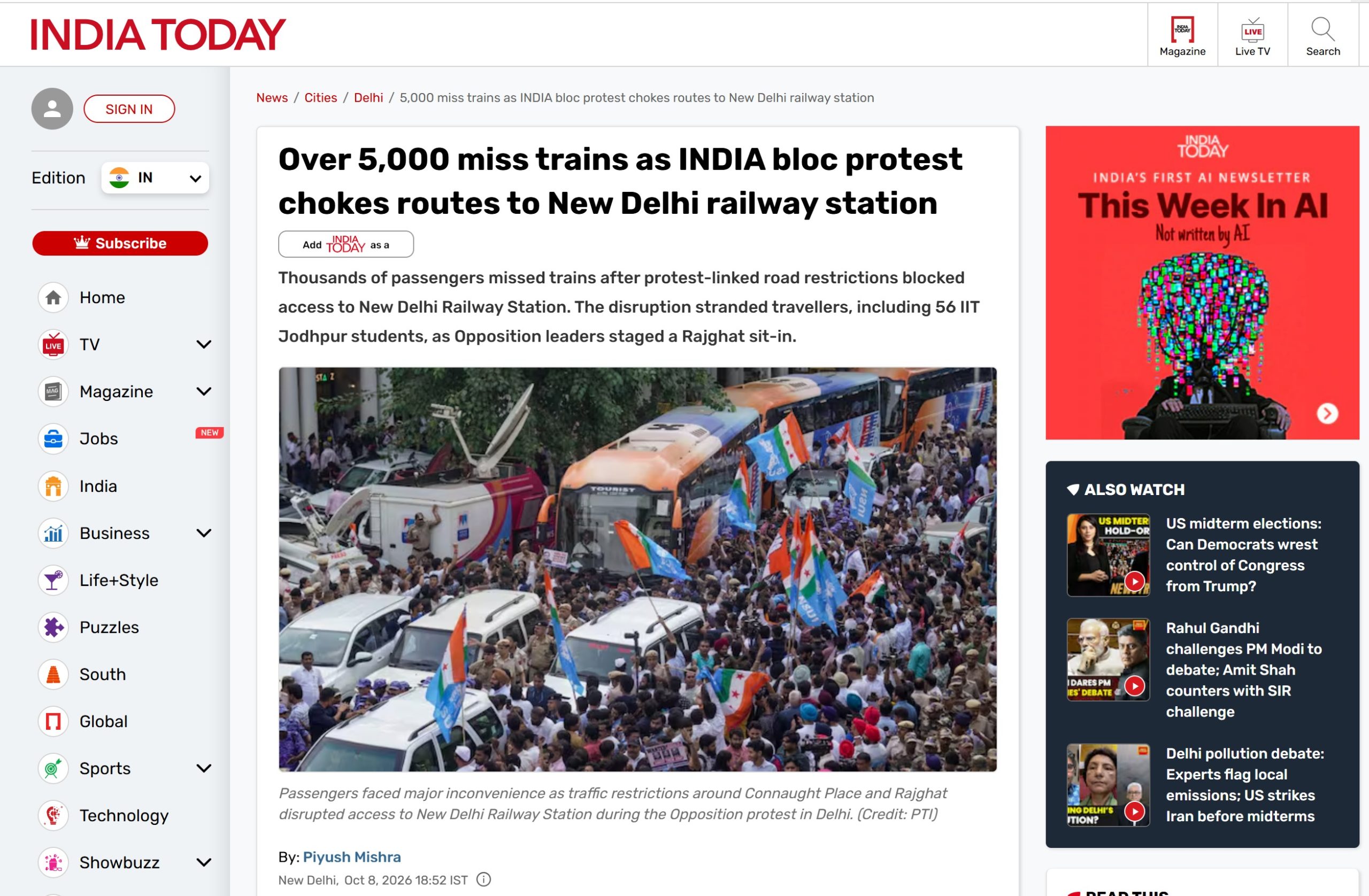
Subsequently, news websites such as CNN-News18, India TV, and Moneycontrol also made the same claim in their reports, citing railway sources and railway officials. However, these reports provided no information on the methodology or process used to arrive at the figure of 5,000 passengers who missed their trains remains unexplained. These articles neither presented any documentation nor made any reference to an official statement.
Alt News Filed RTI Plea
We sought information from Northern Railway regarding this under the Right to Information Act, 2005. Alt News asked whether the Railways maintained a daily record of passengers who booked tickets for travel from a station but did not board their train (i.e., ‘no-show’ passengers). If so, we requested date-wise data for New Delhi Railway Station (NDLS) for the period between October 1 and October 8, 2026.
Northern Railway responded by stating that no such tool exists within their system. Therefore, the requested information cannot be provided.
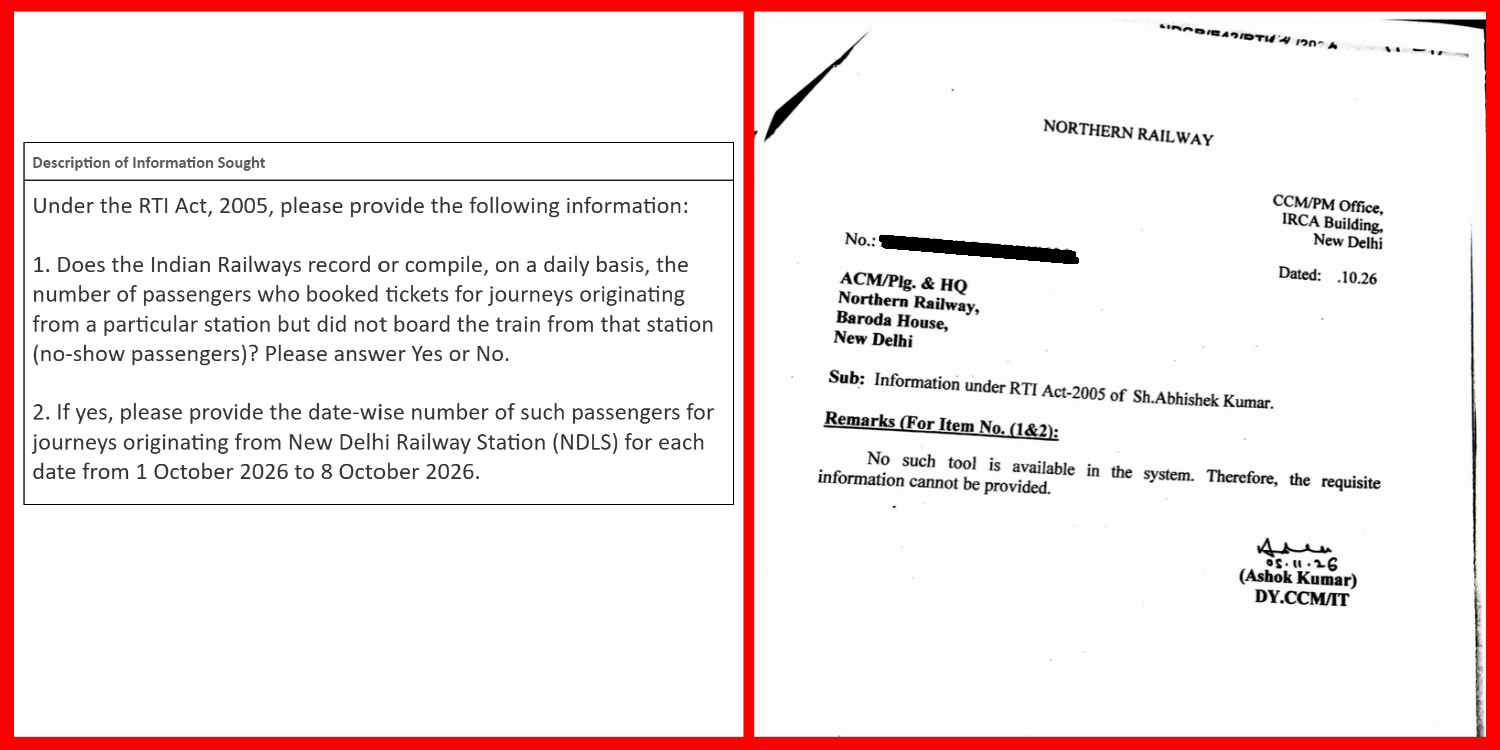
The RTI response raises a crucial question: if the Railways has no system to maintain station-wise records of ‘no-show’ passengers, on what basis was the figure of over 5,000 passengers who allegedly missed their trains reported? In the absence of official records, the figure cannot be treated as an established statistic. It could, at best, be an estimate or an individual’s tally, neither of which would constitute verified data.
This, however, does not mean that passengers faced no inconvenience. Alt News is not suggesting that no one missed their trains due to traffic restrictions during the Congress party’s protest on October 8. The distinction is between acknowledging such disruptions and presenting an unverified figure of 5,000 as an established fact.
Besides, the claim was circulated at a time when another major Opposition protest was scheduled for October 10, amid an already charged political atmosphere. The narrative that a Congress procession had caused over 5,000 passengers to miss their trains effectively served the ruling party’s political interests. When media organisations publish such figures on the basis of unsubstantiated claims or statements attributed to unidentified sources, it raises serious questions about the rigour and neutrality of their reporting.