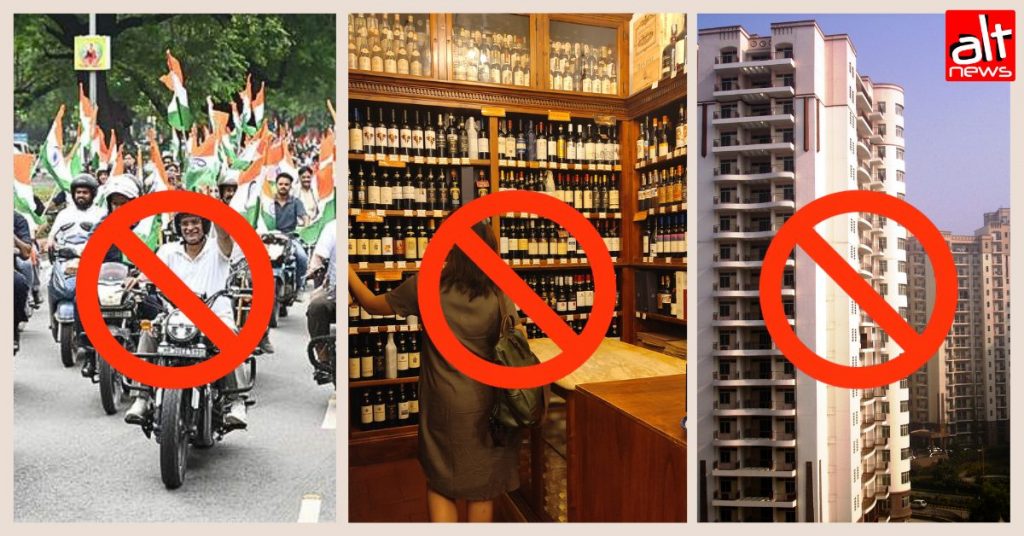
When the Election Commission of India deployed 2.4 lakh Central Armed Police Forces across West Bengal — three times the number sent during the 2021 assembly elections — it sent an unambiguous signal: These polls would be different. What followed was a cascade of directives that, while aimed at ensuring a free and fair election, left ordinary citizens, gig workers, tourists, and hotel owners scrambling to understand what exactly they were allowed to do.
Phase 1 of the Bengal assembly elections saw 152 of 294 constituencies go to the polls on April 23, registering a record voter turnout of over 92%. Phase 2 is scheduled for April 29. But the weeks leading up to voting day were marked by confusion over a set of extraordinary election-time rules.
The Motorcycle Maze & the HC Rap
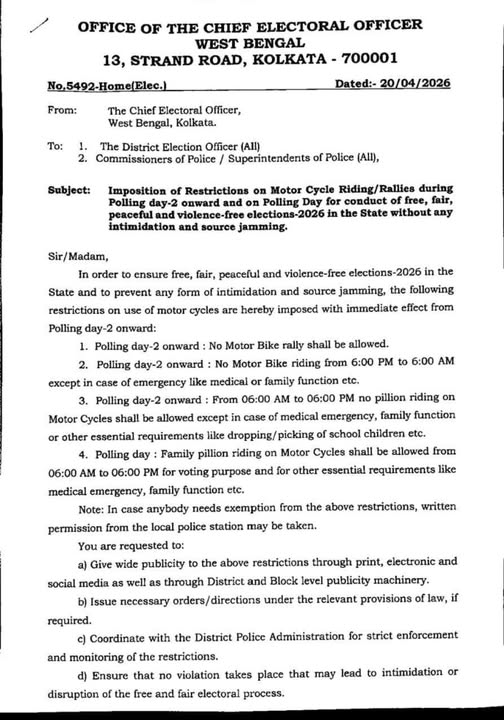
The most contentious directive came from West Bengal chief electoral officer Manoj Agarwal on April 20. Effective from two days before each polling day, that is April 21 for Phase 1 and April 27 for Phase 2, the order imposed sweeping restrictions on motorcycle use: A blanket ban on riding between 6pm and 6am except for medical emergencies or family functions, a prohibition on pillion riding during daylight hours, and a requirement that anyone needing an exemption seek written permission from their local police station.
For hundreds of thousands of gig economy workers, delivery riders for Swiggy, Zomato, Blinkit and Zepto, and drivers on platforms like Uber Moto, Rapido and Ola, the order created an immediate crisis. Their motorcycles were not a lifestyle choice; they were their livelihood. The directive offered no clear guidance on how to distinguish a delivery rider from a political mobiliser.
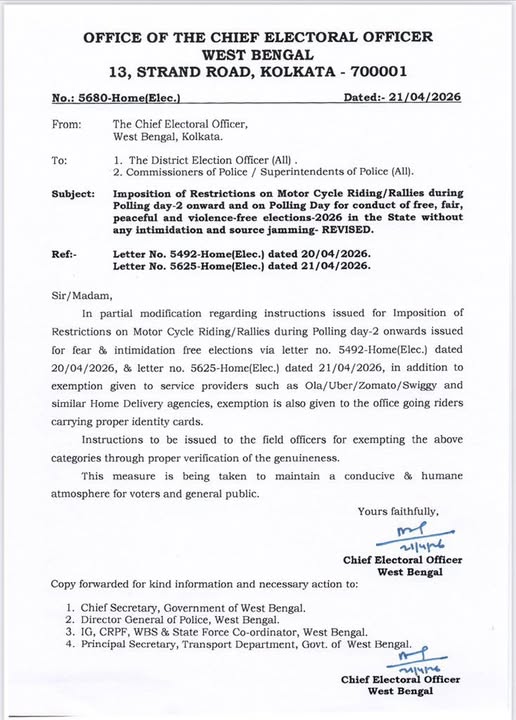
Facing public outcry, the CEO revised the notification to grant exemptions to gig workers and office-going riders who could produce valid identity cards. The damage, however, was done.
The matter then moved to court. On April 23, Justice Krishna Rao of the Calcutta high court heard an appeal challenging the restrictions on Phase 2, and what followed was a sharp dressing-down of the Election Commission.
“Has an Emergency been announced in the state? Then how come such restrictions have been imposed on common people? This is being done to hide the failure of the authorities,” Justice Rao told the EC’s counsel. He asked the commission to show how many cases had been registered against motorcycles for causing trouble during elections in recent years — and went further, pointing out that by the same logic, cars too could be banned, since they could equally be used to transport arms or explosives.
The bench was equally critical of what it termed the EC’s “overreach”. “Just because you have power does not mean you can do whatever you want. Had it been for 24 hours, that would have been understandable. But 72 hours is causing harassment of the people,” Justice Rao said. He suggested the commission had less drastic options available, like naka checking, CCTV installation, and deploying forces to intercept bike gangs, without bringing daily life to a halt.
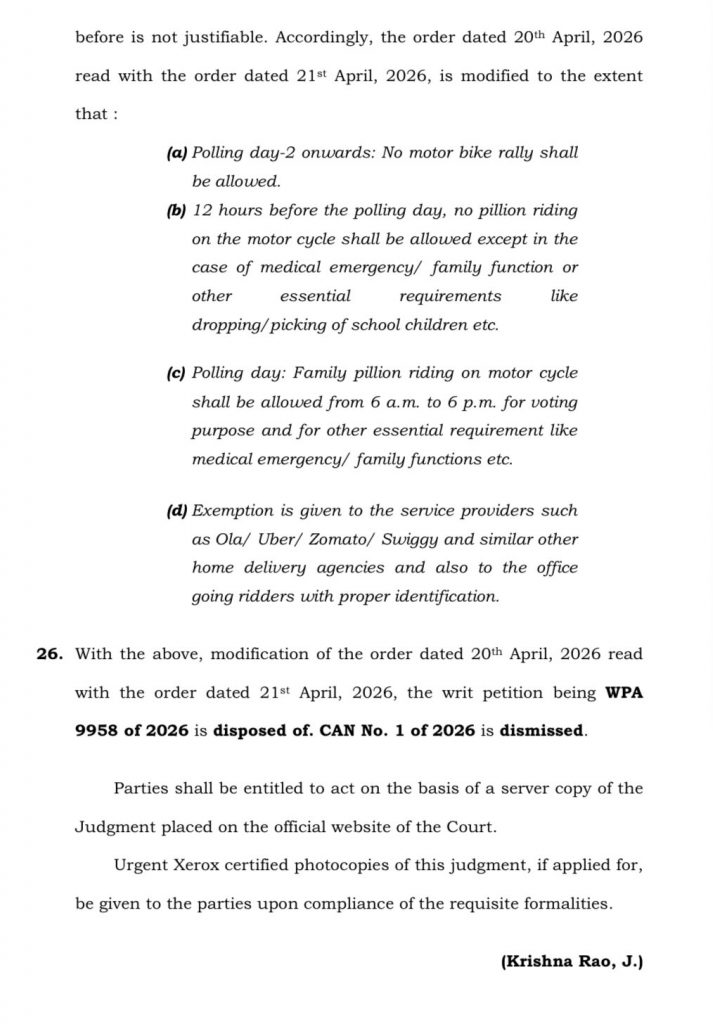
The EC’s counsel defended the order as a “precautionary” measure. The court directed the commission to file an affidavit explaining the rationale and citing specific instances of motorcycle-related election disturbances. The motorcycle ban was subsequently struck down on April 24 by the high court, which made it clear while rallies could be restricted, the general movement of bike could not be prohibited. It also announced exemptions for app-based transport service providers, food delivery agents, and office-goers with valid identification.
The crux of the HC order can be read below:
The 96-hour Dry Run: Who Ordered It?
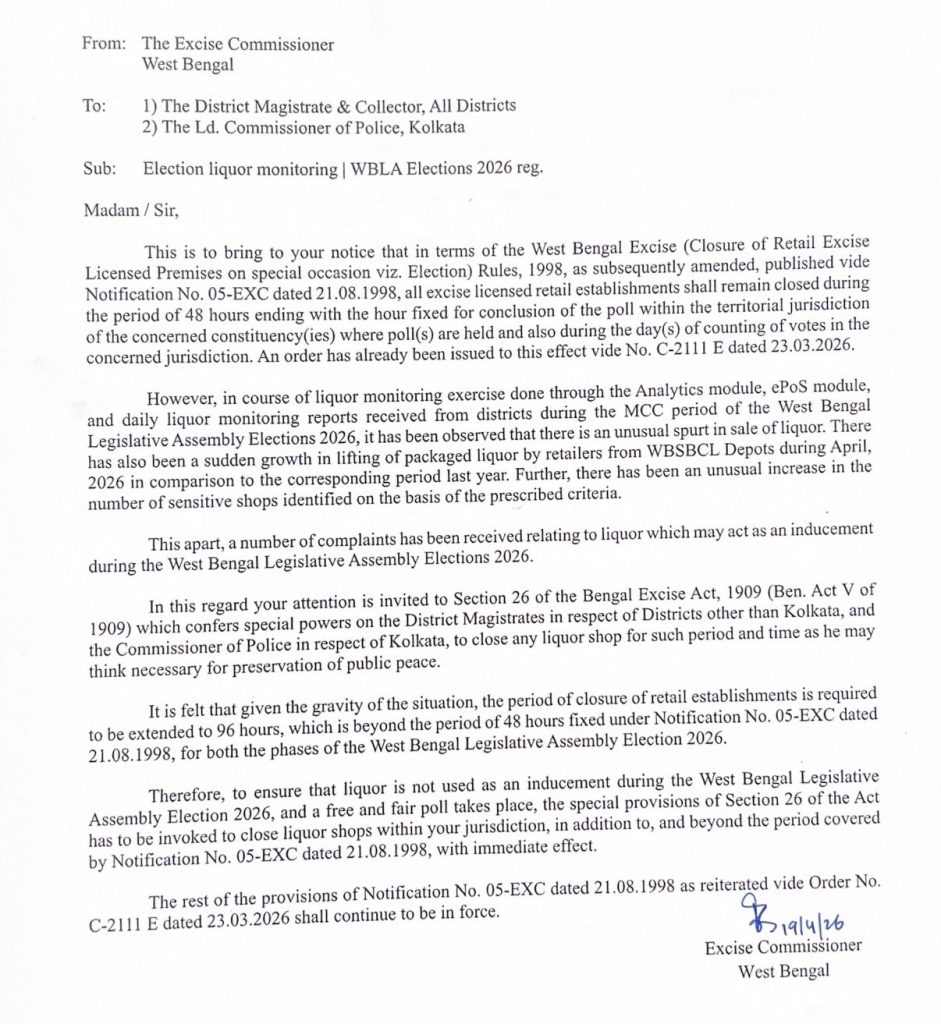
In an unprecedented move, the state excise department extended the pre-poll liquor ban from the standard 48 hours to 96 hours, i.e., four full days before polling, citing an “unusual spurt” in liquor sales and a rise in the number of “sensitive shops”. The concern was that alcohol could be used to influence voters.
In practice, the directive’s timing created an almost unbroken 10-day shutdown of liquor shops across the state. With Phase 1 polling on April 23 and Phase 2 on April 29, the bans overlapped in a way that left traders with only a one-and-a-half day window to operate in between (April 24 and the morning of April 25) before shutters had to come down again.
What made this year’s ban doubly unusual was its geographic scope. Typically, the 48-hour dry period applies only to constituencies where polling is actively taking place. This time, the ban was imposed across the entire state. Districts not going to the polls were also subject to it, and liquor shops in areas with no election activity whatsoever were forced to shut. In Kolkata, for example, liquor shops were closed on April 21, eight days before polling was scheduled.
The ECI distanced itself from the decision, saying it came from the state government. At the same time, it is a fact that all state departments are reporting to the Election Commission since the poll schedule was announced on March 15. Bengal’s chief electoral officer Manoj Agarwal went further. He not only denied the poll panel’s involvement but expressed complete ignorance of the order. He appeared bewildered when reporters told him about the closure of liquor shops across the state.
View this post on Instagram
The Trinamool Congress blamed the EC for the unusul directive, leaving citizens with no clear answer on who had ordered the longest dry spell in recent poll memory.
The Non-local Problem
Perhaps the most legally complex of the three directives was the CEO’s order barring non-local party functionaries, workers and supporters from entering constituencies after the close of the campaign period. Citing Section 126 of the Representation of the People Act, 1951, the ECI argued that parties often mobilized workers from other constituencies during the silence period to unduly influence voters.
The directive called for thorough checks of hotels, lodges and guest houses to identify and verify non-local party workers. It raised an immediate practical question: how would police or CAPF personnel determine whether someone was a party worker or simply a visitor? The directive itself acknowledged the rule applied only to party functionaries, not ordinary citizens. On the ground, the distinction proved difficult to maintain.
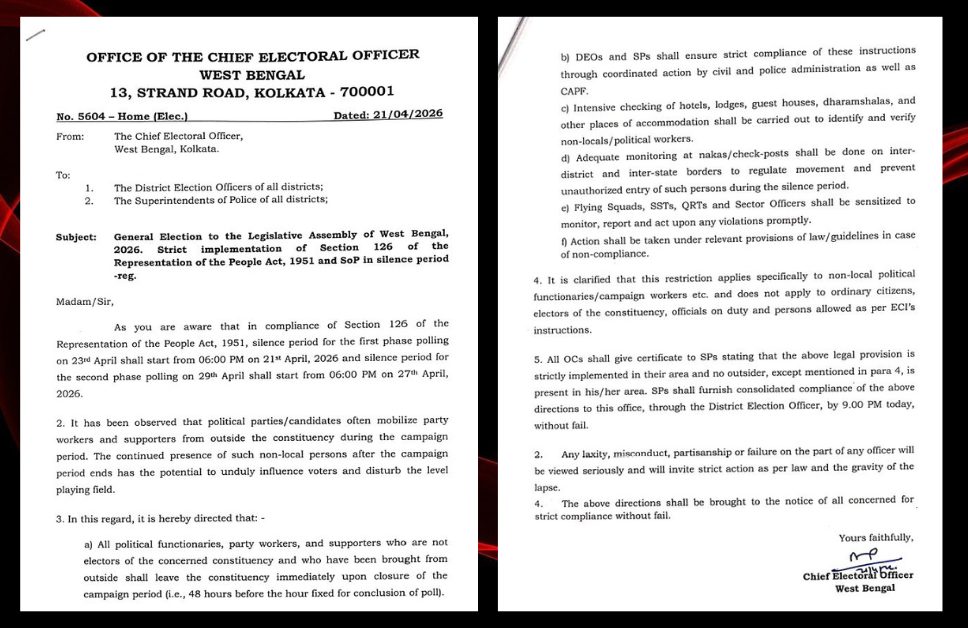
Hotels in coastal areas including Digha and Mandarmani reportedly received instructions not to accept tourists from 48 hours before Phase 1 polling. A hotel manager in Digha confirmed the same to Alt News. Announcements were made by microphone from the local police station directing hotels not to take in any tourists from April 21, 5pm until April 23. However, when Alt News contacted the Digha police station OC, he clarified the ban was intended only for party workers, not visitors in general.
What made matters worse was another directive by the EC barring “outsiders” from staying in housing complexes that host polling booths. The Times of India quoted state CEO Manoj Agarwal as saying, “No outsiders who are not electors of that constituency can stay as guests in residential complexes where booths are located.” The restriction will be in force from 6 pm on April 27 till the end of polling on April 29 and was being effected under Section 126 of the Representation of the People Act, 1951, Agarwal said.
A total of 78 housing complexes will have polling booths on their premises in the second phase of election on April 29. Six of these are in Kolkata. There are hundreds of instances where people have moved from ancestral homes into such condominiums but continue to be registered as voters at their previous addresses. With no publicly available order or circular to clarify its scope, the order led to extreme confusion for residents and tenants of housing complexes, and even family members who may not be registered voters in that constituency but legitimately live in or visit such complexes.
The gap between the stated intent of the directives and their implementation on the ground encapsulated a broader problem with the ECI’s approach in Bengal: sweeping orders, imprecisely communicated, leaving local officials and ordinary citizens to fill in the blanks. As Phase 2 approaches on April 29, confusion is worst confounded for the common man in Bengal. They do not really know what’s allowed, what’s not.