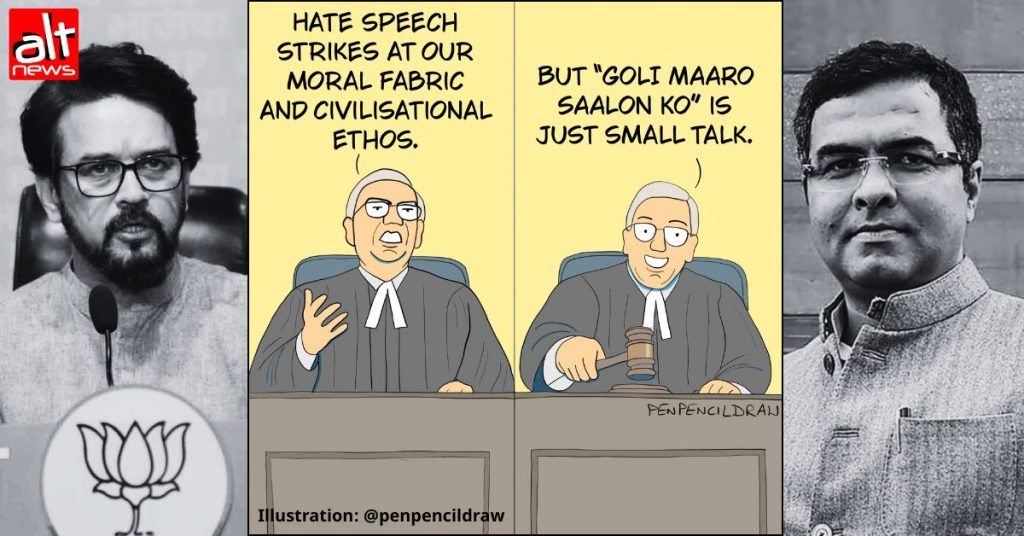
During the protests against the Citizenship Amendment Act in Delhi in January 2020 which coincided with the 2020 Delhi legislative assembly elections, Anurag Thakur and Parvesh Verma were accused of delivering provocative speeches. In one widely circulated instance at an election rally, Thakur was heard leading a chant of “Desh ke gaddaron ko…”, to which the crowd responded, “Goli maaron saalon ko.” The slogan went viral and drew widespread criticism. Weeks later, Delhi witnessed large-scale communal violence that claimed 53 lives, with allegations raised that such speeches contributed to the charged atmosphere.
3] Anurag Thakur spreading hate in election campaign rally
“Desh Ke Gaddaro Ko, Góli Maaro **** ko” 🫡 pic.twitter.com/ymDOKyYe3d
— Amock_ (@Amockx2022) March 24, 2025
Brinda Karat subsequently sought legal action, demanding that an FIR be registered against Thakur and Verma. She first submitted a complaint to the Delhi Police Commissioner on 29 January 2020 and, after no action followed, approached the trial court. On 5 February 2020, she moved the Rouse Avenue Courts seeking directions for registration of an FIR under Sections 153A, 295A, 504, 505 and 506 of the IPC. However, the additional chief metropolitan magistrate dismissed the plea on 26 August 2020.
#WATCH: BJP MP Parvesh Verma says, “…Lakhs of people gather there (Shaheen Bagh). People of Delhi will have to think & take a decision. They’ll enter your houses, rape your sisters&daughters, kill them. There’s time today, Modi ji & Amit Shah won’t come to save you tomorrow…” pic.twitter.com/1G801z5ZbM
— ANI (@ANI) January 28, 2020
Karat then approached the Delhi High Court, which on 13 June 2022 upheld the lower court’s decision. The high court noted that under Code of Criminal Procedure, prior sanction from the government is mandatory before courts can take cognizance of offences under Sections 153A, 295A and 505 of the IPC, stating: “Section 196 of CrPC expressly bars any Court from taking cognizance… without previous sanction of the Central or the State Government, as the case may be.”
Following this, Karat and K M Tiwari moved the Supreme Court in 2023. In its Wednesday order, the apex court upheld the earlier findings and ruled that no cognizable offence was made out, effectively closing the case against the BJP leaders.
The Bench noted, “The High Court has, on an independent assessment, held that the speeches in question do not disclose the commission of any cognizable offence, observing that the statements were not directed against any specific community, nor did they incite violence or public disorder”.
The Supreme Court judgement can be read here.
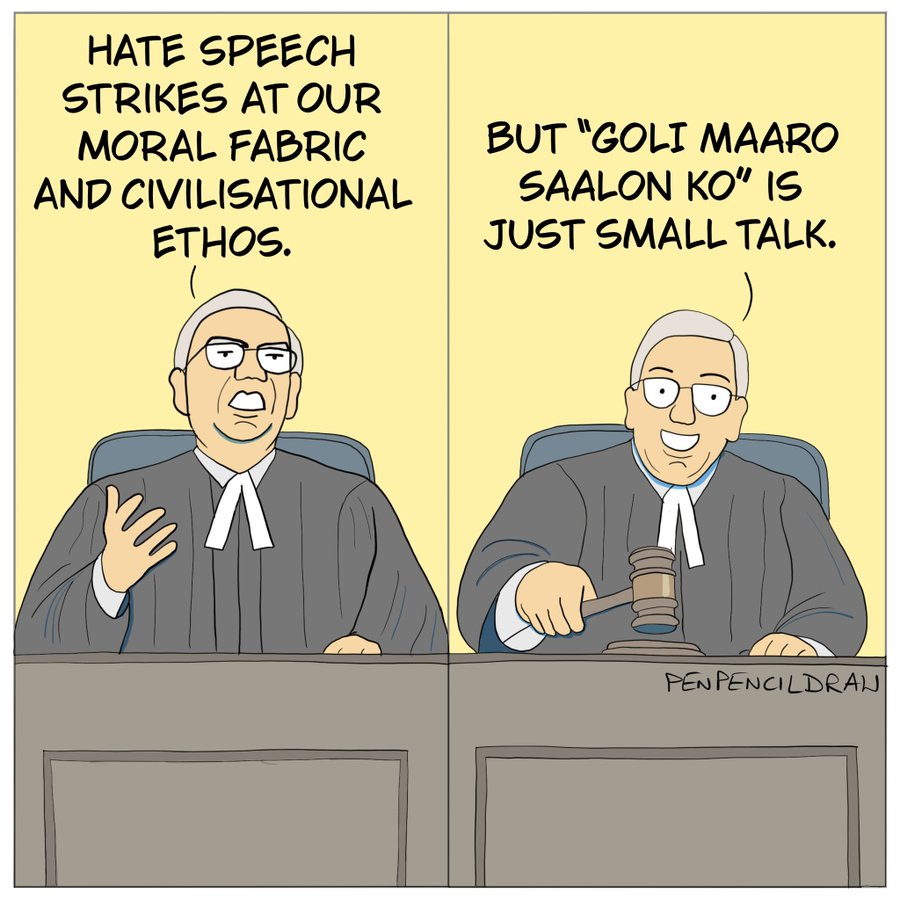
Hate Speech Antithetical to the Constitutional Value of Fraternity
Commenting on whether additional judicial intervention is required to curb hate speech, the Supreme Court of India observed that such relief falls outside the judicial domain, even as it underscored that the very notion of hate speech is “antithetical to the constitutional value of fraternity.”
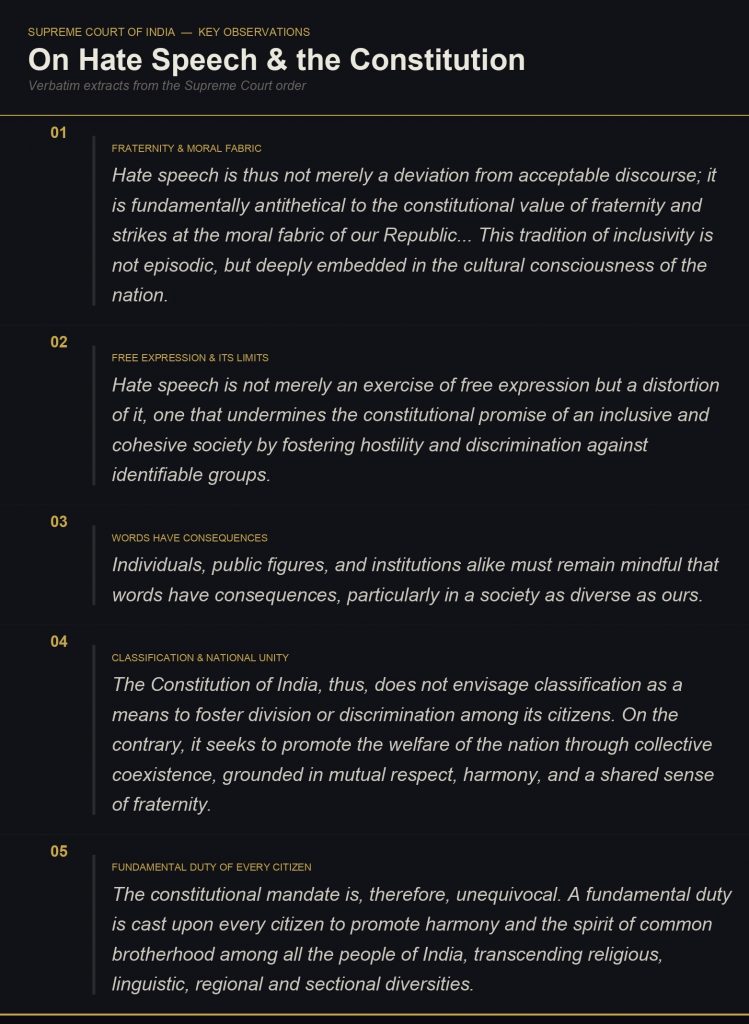
In its judgment, the Court said, “Hate speech is thus not merely a deviation from acceptable discourse; it is fundamentally antithetical to the constitutional value of fraternity and strikes at the moral fabric of our Republic. It also runs counter to the deeper civilisational ethos of India.”
Emphasising this principle, the Bench further noted, “It is in furtherance of this constitutional vision that the Preamble incorporates the principle of fraternity, mandating a sense of common brotherhood among all citizens. The idea of belonging to one nation cannot be made contingent upon selective inclusion or exclusion; rather, it requires a collective commitment to shared constitutional values. Fraternity, therefore, demands that every citizen recognise and respect the equal dignity of others, irrespective of differences, and consciously eschew conduct that undermines social harmony.”
The Court added that, “Once this constitutional ideal is internalised by citizens, both individuals and those in positions of influence, the very impulse to engage in ‘hate speech’ would stand diminished.”
The Supreme Court also made it clear that the power to define and penalise offences lies strictly within the legislative domain, not the judiciary. In its order, the Court observed, “The creation of criminal offences and the prescription of punishments lie squarely within the legislative domain. The constitutional scheme, founded upon the Doctrine of Separation of Powers, does not permit the judiciary to create new offences or expand the contours of criminal liability through judicial directions.”
Rejecting the argument that hate speech remains inadequately covered by law, the Court stated, “The contention that the field of hate speech remains legislatively unoccupied is misconceived. The existing framework of substantive criminal law, including the provisions of the IPC and allied legislations, adequately addresses acts that promote enmity, outrage religious sentiments, or disturb public tranquillity. The field is, therefore, not unoccupied.”
In its observations, the Bench of Justice Vikram Nath and Justice Sandeep Mehta noted that the concerns raised by the petitioners stem more from gaps in enforcement rather than absence of law. “The material placed before this Court indicates that a greater extent of the concerns highlighted by the petitioners arise not from the absence of law, but from deficits in its consistent and effective enforcement. Such concerns, however significant, cannot justify the judicial assumption of legislative functions,” the Court said.
The Court also outlined available legal remedies for individuals seeking action against hate speech, including avenues to approach appropriate authorities if an FIR is not registered.
Summing up, the Bench reiterated that it is ultimately for the legislature to determine whether additional legal or policy measures are required. “While we decline to issue directions of the nature sought, we deem it appropriate to observe that issues relating to ‘hate speech’ and ‘rumour mongering’ bear directly upon the preservation of fraternity, dignity, and constitutional order. It would be open to the Union of India and competent legislative authorities to consider, in their wisdom, whether any further legislative or policy measures are warranted… or to bring about suitable amendments as suggested by the Law Commission’s 267th Report dated 23rd March, 2017,” the Court said.