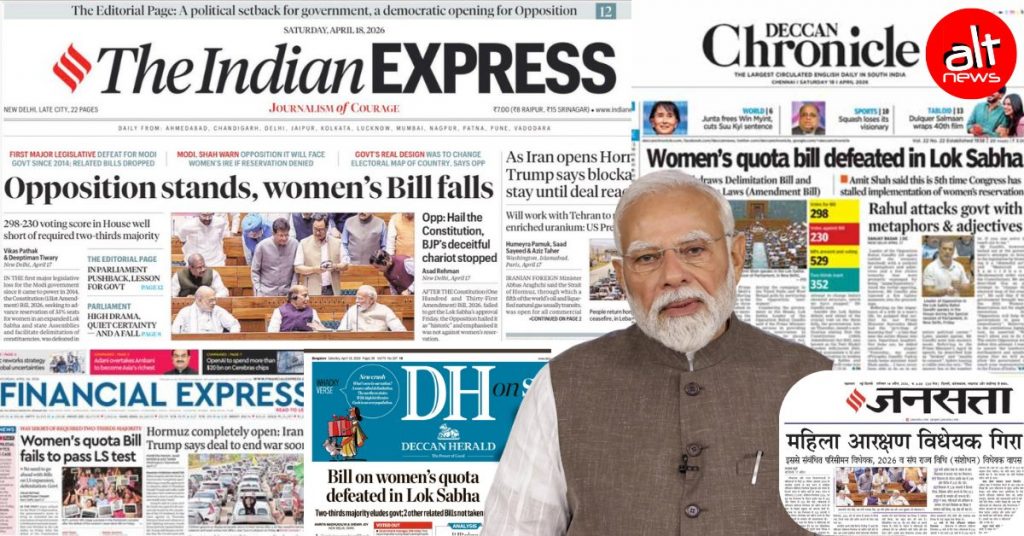
A day after a Constitution amendment bill seeking to redistribute Lok Sabha seats on the basis of the 2011 Census was stalled in Parliament, Prime Minister Narendra Modi, in an emotional address through Mann Ki Baat, accused the Opposition of blocking women’s empowerment. However, parliamentary records and the legislative history of the issue show that the Prime Minister essentially misrepresented facts and misled the nation.
On April 17, the Opposition in the Lok Sabha voted against the Constitution (131st Amendment) Bill, which sought to redistribute Lok Sabha seats based on the 2011 Census to expedite implementation of women’s reservation. The Bill received 298 votes in favour and 213 against, falling short of the two-thirds majority (352 votes) required for a constitutional amendment, and was consequently defeated.
It was the first time in its 12 years in power that the Narendra Modi government failed to secure the passage of a constitutional amendment in Parliament.
Following the vote, Union ministers and senior leaders of the Bharatiya Janata Party accused the Opposition, particularly the Indian National Congress, of being “anti-women” and obstructing the implementation of the Women’s Reservation Bill.
The Congress, however, termed the move a “nefarious attempt” by Narendra Modi and Amit Shah to push through delimitation under the cover of women’s reservation.
What Modi Said
In his prerecorded address on April 18, Modi lashed out at opposition parties, saying they had “stalled the flight of India’s Naari Shakti” and that their actions had “shattered” the dreams of women. He further accused them of opposing the women’s reservation bill out of political self-interest, alleging that “dynastic” parties feared losing their grip over power if more women entered legislatures.
Framing the issue as one of intent, he argued that the opposition had “gravely sinned” by opposing women’s welfare and empowerment and insulted the vision of the Constitution’s framers.
“The opposition has committed a sin by opposing women’s reservation, and they will surely be punished for this. Opposition parties have insulted our Constitution by defeating the bill,” the Prime Minister said, adding, “the Congress and its allies committed foeticide of this honest attempt in front of the whole country. They have committed foeticide.”
Modi further said, “I was greatly pained to see that when the proposal of women’s welfare failed, dynastic parties like Congress, DMK, TMC, SP started clapping in joy…”. His voice quivered in apparent disbelief as he presented the vote as a rejection of women’s welfare.
The full speech can be heard here:
My address to the nation. https://t.co/2Vyx15A4rx
— Narendra Modi (@narendramodi) April 18, 2026
What the Record Shows
The claim that the Opposition opposed women’s reservation is simply a misrepresentation of facts. In 2023, Parliament passed the Nari Shakti Vandan Adhiniyam providing for 33% reservation for women in Parliament and state assemblies with near-unanimous support.
A total of 454 Lok Sabha members voted in favour of the amendment, including members from the Indian National Congress, Dravida Munnetra Kazhagam, All India Trinamool Congress, and Samajwadi Party. Only two MPs opposed it, citing the absence of sub-quotas for Muslim and OBC women. In Rajya Sabha, the Bill was passed by a 214-0 vote.
At the time, Modi himself welcomed the Opposition’s support, making the present claim that these parties are against women’s reservation inconsistent with earlier positions.
Delighted at the passage of The Constitution (One Hundred and Twenty-Eighth Amendment) Bill, 2023 in the Lok Sabha with such phenomenal support. I thank MPs across Party lines who voted in support of this Bill.
The Nari Shakti Vandan Adhiniyam is a historic legislation which…
— Narendra Modi (@narendramodi) September 20, 2023
The 2023 amendment makes the reservation contingent on the completion of a fresh census and a subsequent delimitation exercise. As clarified in Parliament by Amit Shah, this effectively delayed implementation until after 2029.
Opposition leaders, including Rahul Gandhi, had then argued that the reservation could be implemented immediately without waiting for delimitation. The government, in response, maintained that a delimitation exercise was necessary to determine which constituencies would be reserved and to avoid allegations of political bias.
Interestingly, the Act was notified by the government only on April 16, 2026, two and a half years after it had been passed.
Why Modi’s Charge Against the Opposition was Misleading
Delimitation is not a neutral procedural step in the current political context. Under the Constitution (84th Amendment), the redrawing of constituencies based on population has been frozen until 2026. Once this freeze is lifted, a fresh delimitation exercise is expected to alter the balance of parliamentary representation among states. States with higher population growth, such as Uttar Pradesh and Bihar — considered the BJP’s political support base — are likely to gain seats, while several southern states which have arrested population growth to some extent have raised concerns over a potential decline in their relative share.
This has made delimitation a politically sensitive issue with federal implications, separate from the question of women’s representation.
The bill defeated in the Lok Sabha on April 17 was not the women’s reservation law passed in 2023, but a proposal to advance delimitation by redistributing Lok Sabha seats using the 2011 Census. This was projected as a step to fast-track the implementation of the 33% quota for women.
Opposition parties argued that this linkage was unnecessary. They pointed out that the 2023 law already mandates that reservation will come into effect only after a fresh census and delimitation, both of which are yet to be completed. Instead of waiting, they contended that the government could amend the law to implement reservation immediately within the existing strength of 543 seats.
They also questioned why the government chose to modify the timeline for delimitation by proposing to use older census data, but did not consider removing the delimitation requirement altogether if its stated goal was to expedite women’s representation.
Leader of Opposition and Congress MP Rahul Gandhi said, “The first truth is that this is not a women’s bill. This has nothing to do with the empowerment of women. This is an attempt to change the electoral map of India.” In an interview, Trinamool MP Mahua Moitra described the defeated bill as “delimitation wrapped in a saree”.
By presenting the Opposition’s stance as being against women’s reservation itself, the Prime Minister’s remarks collapsed a more complex constitutional and political disagreement into a binary narrative.
The legislative record shows consistent support across parties for increasing women’s representation. The disagreement has been over whether that reform should be delayed and made contingent on a contentious delimitation process. In that context, Modi’s insistence on portraying the vote as a betrayal of women’s welfare was misleading and not borne out by facts, as it conflated opposition to a delimitation-linked mechanism with opposition to women’s reservation itself.
Media Distorts Facts, Echoes Govt Line
A significant section of the media amplified the government’s framing without reflecting the legislative nuance. Several outlets carried prominent, banner headlines claiming that a “women’s reservation bill” had been defeated in the Lok Sabha — an assertion that is factually incorrect.
This mischaracterisation was particularly significant given the scale and placement of the coverage. Many newspapers ran large, front-page headlines in 64-point font reinforcing the claim, completely misrepresenting the facts of the April 17 Parliamentary proceedings.
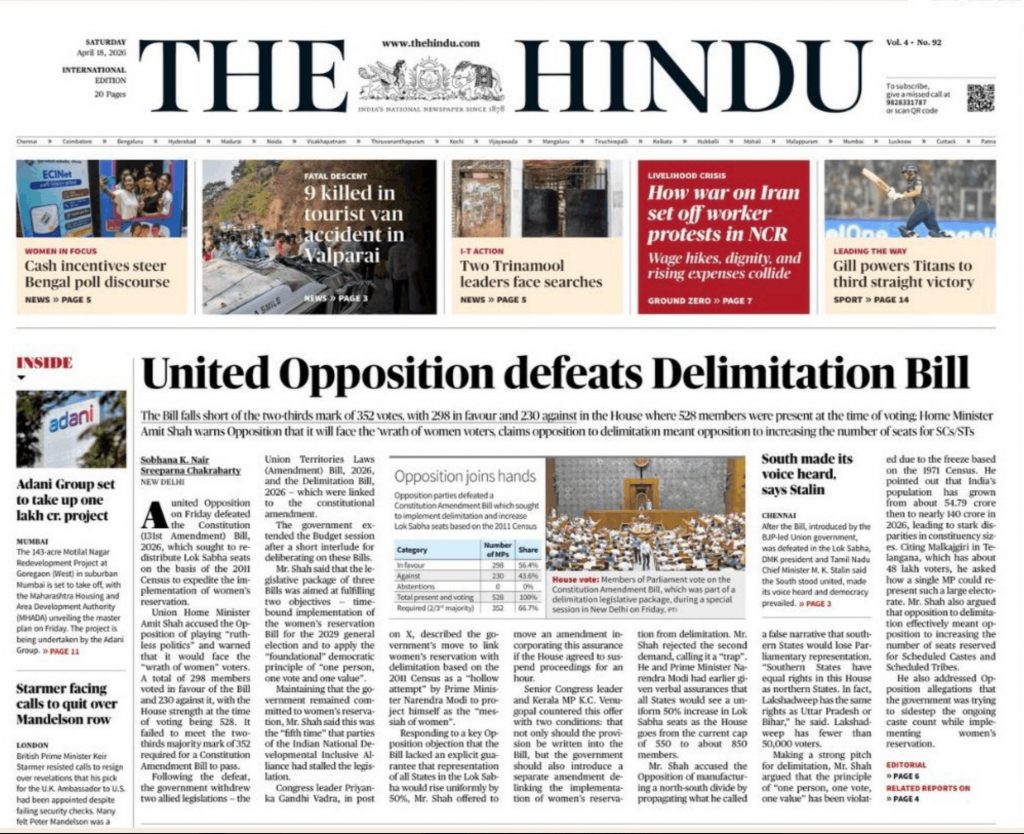
Among major national dailies, The Hindu stood out as a notable exception, accurately reporting that the defeated proposal related to delimitation and not women’s reservation law itself. The Hindu’s page-one headline was: United Opposition defeats Delimitation Bill.
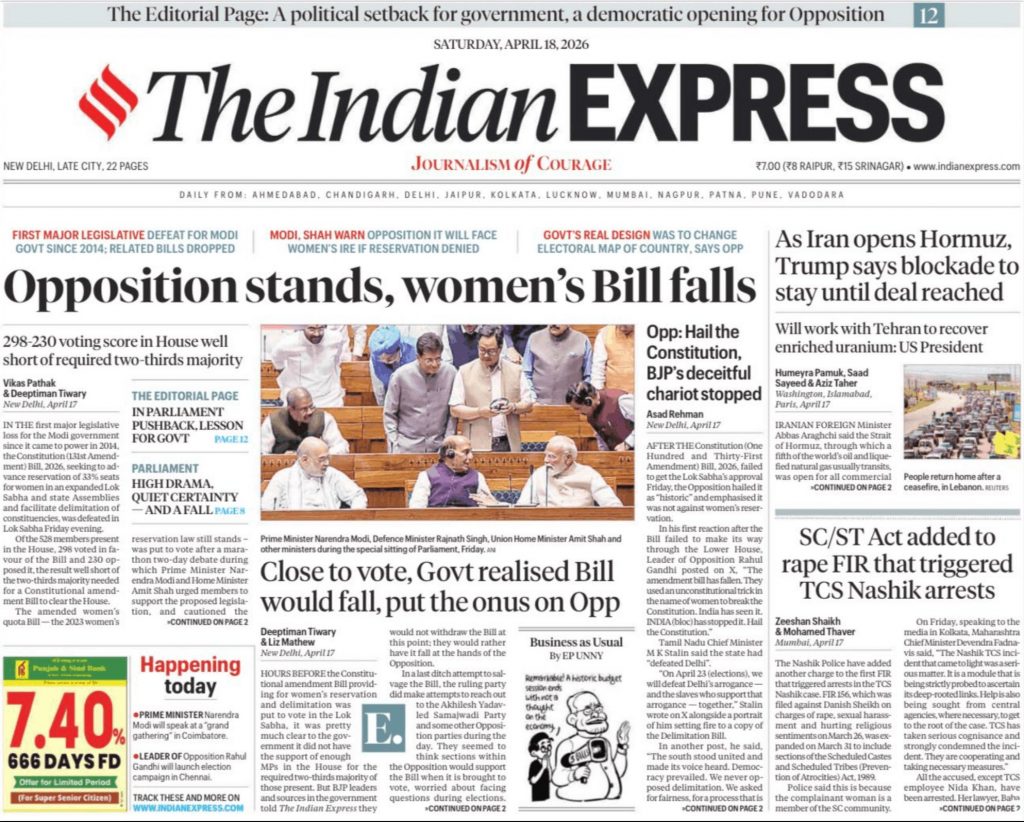
Among papers which got their page-one headline completely off the mark was The Indian Express. It said, Opposition Stands, women’s bill falls. The headline was misleading because it conflated two distinct legislative developments. As pointed out earlier, the April 17 vote was not on the women’s reservation law — already passed in 2023 — but on a separate Constitution amendment linked to delimitation. The Indian Express headline effectively conveyed that Parliament had rejected women’s reservation itself, which was simply not true.
Many on social media called out the newspaper and pointed out that the headline was off the mark.
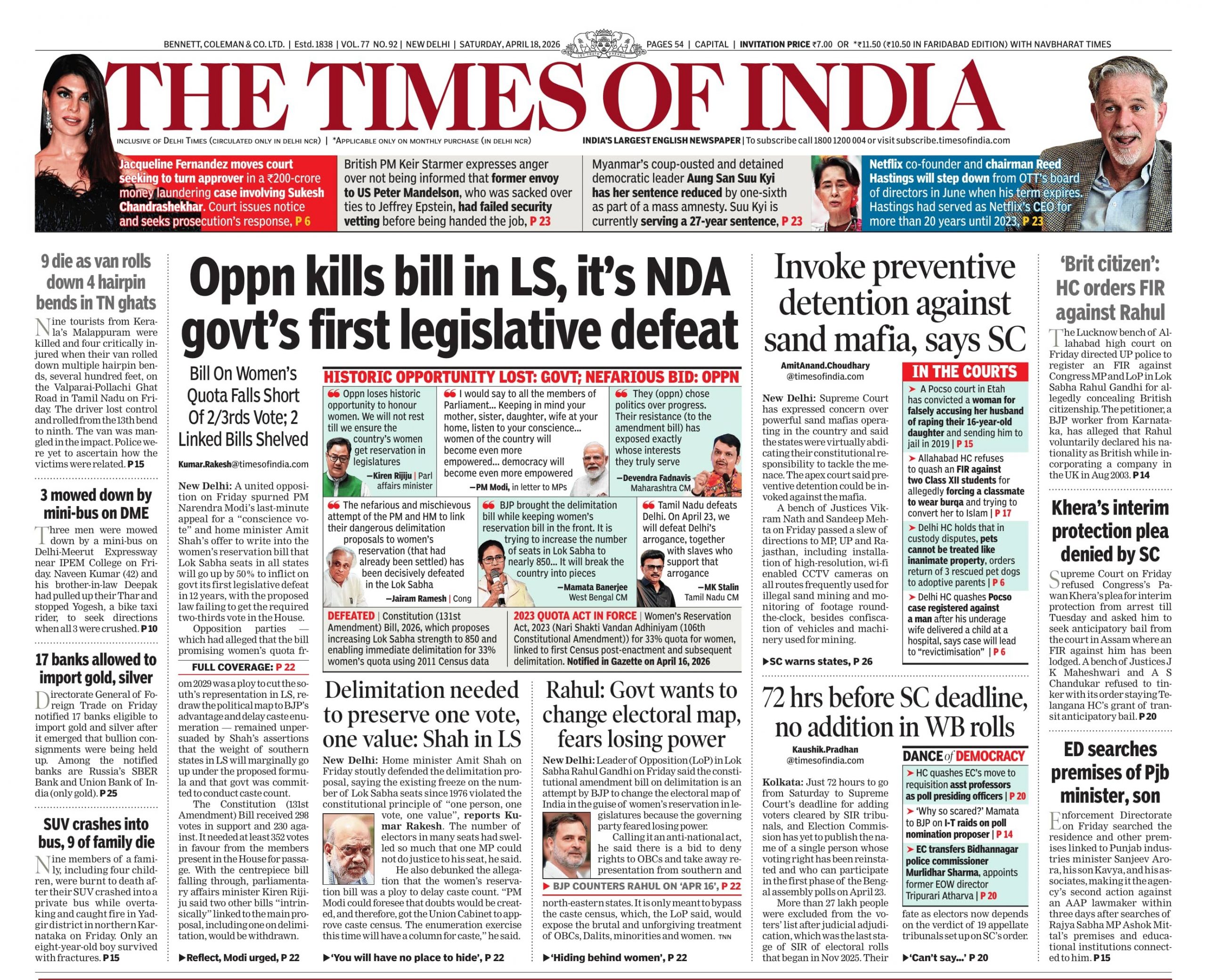
The reporting by The Times of India also blurred this distinction. While its main headline referred to the government’s legislative defeat, the subhead described the development as a “bill on women’s quota” falling short of the required majority — an assertion that is not factual at all.
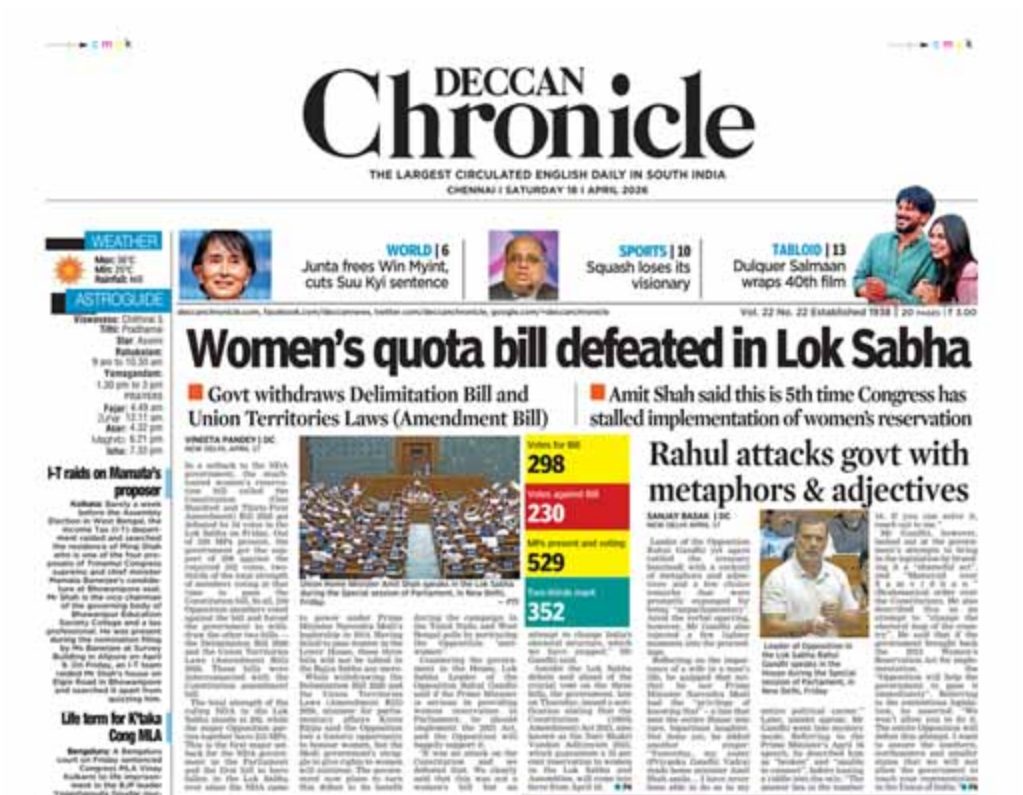
The headline by Deccan Chronicle — Women’s quota bill defeated in Lok Sabha — was not just inaccurate but fundamentally at odds with the legislative record. The women’s reservation law it referred to had been passed in 2023 and has since been notified. The headline suggests a reversal of a law that is already in force, and raises concerns about basic journalistic rigour.
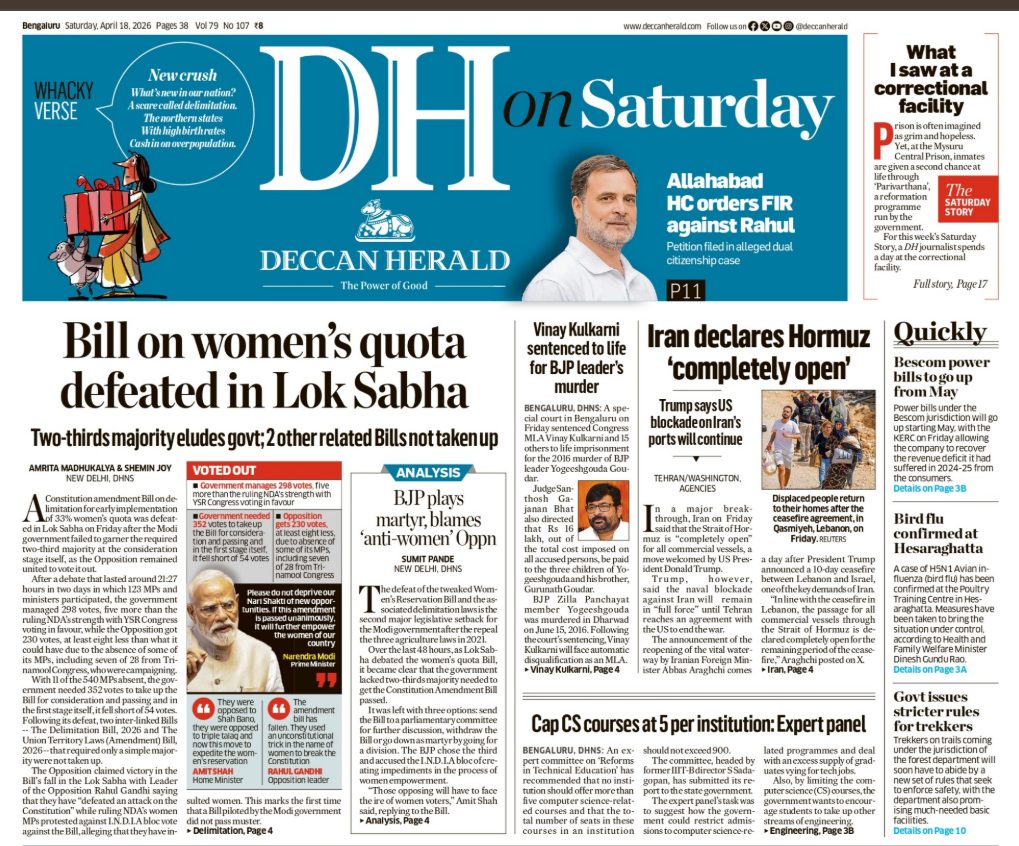
Same with Deccan Herald. On front page, in large font, the lead story headline said, Bill on women’s quota defeated in Lok Sabha — a statement which is simply not true.
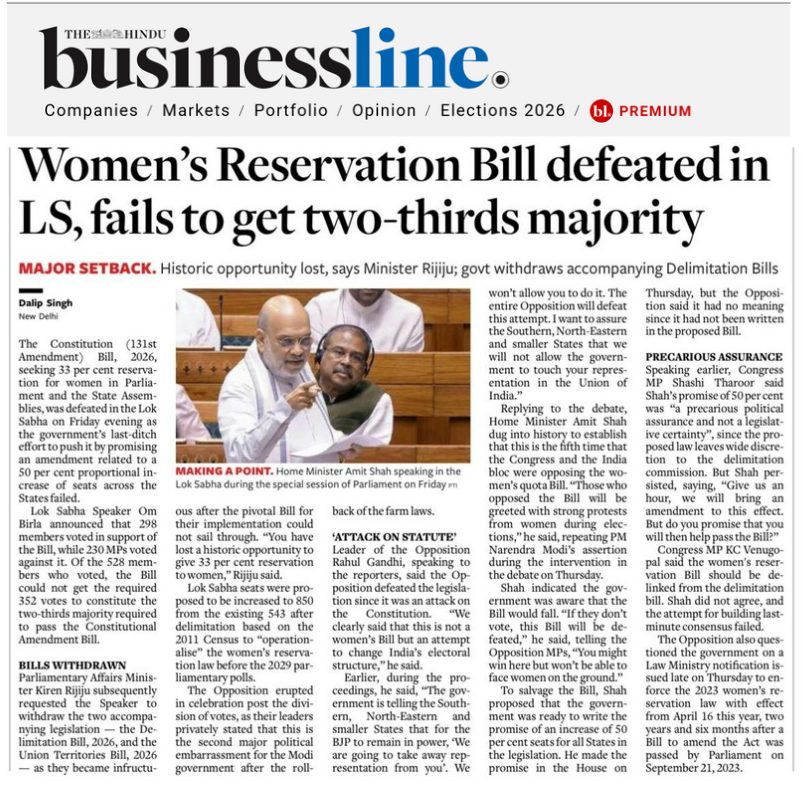
Curiously, while The Hindu got the nuance right, The Hindu Business Line, from the same group, ran a headline that was inherently misleading. The opening sentence of the story — “The Constitution (131st Amendment) Bill, 2026, seeking 33 per cent reservation for women in Parliament and the State Assemblies, was defeated in the Lok Sabha on Friday evening…” was factually incorrect.
Other papers which carried misleading or factually incorrect headlines include Hindi daily Jansatta, and English dailies The Pioneer, The Asian Age and The Tribune, among others.
News channels and digital news outlets, too, carried similar incorrect headlines, describing the April 17 proceedings as the defeat of women’s quota bill or women’s reservation bill in Parliament. Among them were Times Now, NDTV, Republic, ANI, News X, News18, Latestly, The Print, Clarion India, and News 9.