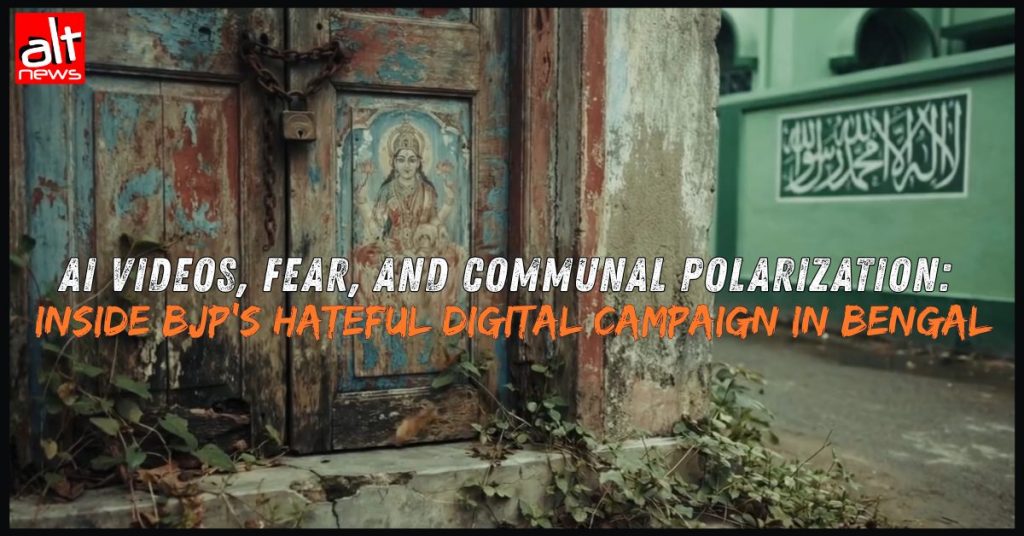
The battle for West Bengal has, this election cycle, been defined less by governance and more by an unrelenting churn of communal politics. What was once one strand among many has now become the central axis of contestation reshaping political messaging and public discourse into sharply polarized camps.
This divide is not new, but it has hardened significantly since 2021. The Trinamool Congress secured 75% of the Muslim vote in the last assembly election, while the BJP managed about 7%. In the years since, that polarization has only deepened arguably to a point of no return, reshaping the electorate into rigid political and religious blocs with little room for crossover.
The recent Special Intensive Revision (SIR) of electoral rolls has added fresh impetus to these anxieties. Multiple reports and studies have indicated that Muslims have been disproportionately targeted during the exercise, reinforcing fears of exclusion and further entrenching communal suspicion. In this climate, institutional processes and political messaging appear to converge, sharpening a campaign where polarization is not incidental, but foundational.
In the run-up to this election, BJP’s social media campaign has been driven by AI-generated videos that push this divide further. Many of these clips rely on crude, harmful stereotypes portraying Muslims as violent outsiders and existential threats to Bengal’s cultural fabric. These narratives echo and amplify a long-standing political line: that the state is being overrun by “illegal infiltrators,” and that its identity is under siege.
Stripped of nuance, the messaging is blunt: Vote one way, or risk losing Bengal as you know it.
For example, the X post shared from BJP West Bengal’s official handle on March 30, less than a month before the state went to the polls:
This election will decide whether we speak Bangla or Urdu!! https://t.co/hYpITyxIyR
— BJP West Bengal (@BJP4Bengal) March 30, 2026
It is a classic dog whistle from the BJP that taps into deeper communal anxieties, subtly recasting Muslims as cultural outsiders whose very presence endangers Bengal’s identity. The insinuation is that a vote against the BJP is a vote for displacement of language, culture, and by extension, the majority community itself.
Vote for Us or Perish, BJP’s Message to Bengali Hindus
The official handles of the BJP have rolled out multiple AI-generated videos as part of their social media campaign, foregrounding the viral slogan: “Paltano Dorkar, Chai BJP Sorkar” (Change is necessary, we want a BJP government).
One such video (embedded below) from the Bengal unit’s Instagram handle constructs a dystopian political narrative around a potential Trinamool Congress victory. It deploys an AI-rendered version of Firhad Hakim, shown announcing the creation of “mini Pakistan” clusters across the state, a phrase tied to a decade-old controversy involving the Kolkata mayor. The video then cuts to visuals of large groups of Muslim “infiltrators” crossing barbed borders into India through Bengal, followed by scenes of widespread violence and unrest in Kolkata, depicted as overrun by aggressive Muslim mobs.
The messaging is unambiguous and carefully constructed: A vote for the TMC is framed not just as a political choice, but as a trigger for demographic upheaval where Hindus are displaced and the state’s identity is fundamentally altered. The video presents the election as an existential battle fought on fear, identity, and communal division.
View this post on Instagram
In another post on X, originally shared on April 2, the party deploys AI-generated visuals to construct a stark contrast. The video opens on scenes of Hindu households engaged in everyday religiosity, offering puja, participating in bhajan gatherings, and sharing prasad — projecting calm and cohesion. This tranquility is then violently disrupted by the sudden arrival of skull-cap wearing Muslim men, who are shown storming through the neighbourhood at night and setting homes ablaze.
The narrative is underscored by the line: “All they wanted was Peace and Prosperity, Safety and Security.” The juxtaposition is deliberate and loaded, casting one community as inherently peaceful and the other as a destructive force. The video leans heavily into communal stereotyping, using AI to visually encode fear and victimhood.
All they wanted was Peace and Prosperity, Safety and Security.
But the @Aitcofficial government believes in Appeasement and Division. The victims of Murshidabad anti Hindu riots want their homes back. They want their lives back. That is why, they are saying #BanchteChaiBJPTai pic.twitter.com/cB8XLejcYO
— BJP West Bengal (@BJP4Bengal) April 2, 2026
Another video shows how voting for TMC would lead to the loss of identity, property, and employment prospects. A woman, on pressing the vote button for TMC, finds her saree replaced by a hijab.
If you press the wrong button
👉Your identity
👉Your property
👉Your job prospects
DISAPPEAR⚠️So for the sake of you, your family, and the entire state of West Bengal, make the right choice. Because #PaltanoDorkarChaiBJPSorkar pic.twitter.com/OVPadsbx0W
— BJP West Bengal (@BJP4Bengal) April 10, 2026
In both these videos, the visual grammar does much of the ideological work. The AI-rendered frames are suffused with warmth and abundance when depicting Hindu households: Soft lighting, ornamentation, and a sense of cultural continuity. In contrast, the aesthetic shifts abruptly when Muslims are introduced: The palette darkens, the setting turns stark, and even markers of individuality, like jewellery, disappear, as a saree is replaced by a hijab. Muslim figures are rendered faceless, chaotic, and disruptive, stripped of identity and reduced to a collective threat.
Another video uploaded on the Facebook page of BJP Bengal sharpens this narrative further by advancing the idea of a “silent demographic invasion” by Bangladeshi Muslims. The clip repeatedly suggests that Bengali Hindus are being outnumbered, while the Trinamool is either complicit or indifferent. It then features Right-wing commentator J Sai Deepak, who frames the alleged influx as unprecedented, warning that “the childhoods that you grew up with, the neighbourhoods that you grew up in — everything is changing.”
Below are a few frames from the clip:
On March 10, BJP’s West Bengal youth wing circulated an AI-generated clip that reworks the imagery of Dakshinaranjan Mitra Majumder’s beloved Bengali folk tales. The video recasts Mamata Banerjee as an “Evil Queen,” depicted as systematically erasing Bengali identity with the help of lungi-clad supporters. Through a series of symbolic transformations, it portrays a cultural overhaul– kheer turning into sewai, জল becoming পানি, and men in dhotis morphing into bearded figures in lungis — suggesting a wholesale replacement of language, food, and attire.
The visual metaphor is blunt: Bengali identity is shown as under siege, with Muslims cast as its antithesis. By reducing an entire community to a set of coded markers and positioning them as agents of cultural loss, the video leans heavily into communal stereotyping. It culminates in a staged restoration where the “Evil Queen” is overthrown and made to flee, alongside her Muslim supporters, across a barbed border into Bangladesh.
মমতার রাজনীতির মূল মন্ত্র তোষণ আর ভোটব্যাঙ্ক। উন্নয়ন নয়, চলছে বিশেষ সম্প্রদায়কে খুশি করার প্রতিযোগিতা। বাংলা চায় ন্যায়সঙ্গত শাসন, তোষণের রাজনীতি নয়।এভাবে চলতে পারে না! দরকার পরিবর্তনের। বিজেপির হাত ধরেই হবে সেই পরিবর্তন #PaltanoDorkarChaiBJPSarkar pic.twitter.com/UohFwhooHD
— BJYM West Bengal (@BJYMinWB) March 10, 2026
BJP’s social media campaign has also turned to cultural nostalgia, generating AI content around the iconic duo of Goopy and Bagha created by Upendrakishore Ray Chowdhury and immortalized on screen by Satyajit Ray. In this clip, the two travel into the future to glimpse what lies ahead for West Bengal, only to find a neighbourhood overtaken by Muslims.
The imagery is loaded with cues: Walls plastered with Trinamool Congress flyers bearing Firhad Hakim’s face, accompanied by Urdu text, visually signalling the erasure of Bengali language and culture. The use of beloved cultural figures to stage this imagined future is a deliberate strategy to anchor fear in familiarity. By projecting a scenario where linguistic and cultural identity are supplanted, the video frames political change as synonymous with ethnic displacement.
View this post on Instagram
Another AI-generated video shows Mamata Banerjee surrounded by skullcap-wearing Muslims. The caption accompanying the video implies that the West Bengal chief minister is comfortable with allegations of defending Bangladeshis, and being “anti-national”, for the vital reason that they constitute her party’s vote bank.
View this post on Instagram
Similarly, this video alleges that West Bengal is on its way to become “West Bangladesh.” A Muslim man, caricatured through the same visual iconography of skullcap, beard, lungi, disrupts an event, and proclaims that it is not allowed to utter the names of Maa Durga and Maa Kali.
View this post on Instagram
In yet another Facebook video, it is implied that the TMC wins elections by using the illegal votes of Bangladeshi Muslims and Rohingyas. Now that these voters have fled, Mamata Banerjee is shown to be taking help from CPI(M) veteran MD Salim. Moreover, the courier who is tasked with transferring the money in exchange of the votes, wears a lungi, implying he is also Muslim. This assumes the existence of a deep nexus in West Bengal , working at the behest of Muslims to keep the TMC in power.
What the Leaders Said
What circulates online as AI-generated spectacle finds a direct echo in statements made by BJP leaders. In a talk show on Republic Bangla, BJP candidate from Baranagar, Sajal Ghosh framed the election as the “last train” for Hindu Bengalis, warning that missing it would mean a future where “Bengalis have to add Sheikh or Mohammed before their names.”
Suvendu Adhikari, the Leader of Opposition in West Bengal, has repeatedly invoked the issue of Bangladeshi “infiltrators,” alleging that the Trinamool Congress government facilitates their participation in elections through fake identity documents. Similar claims have been amplified by leaders like Yogi Adityanath and Himanta Biswa Sarma, who have cast the polls as an existential battle to “save” Bengal’s identity.
The throughline is clear: the spectre of the “illegal infiltrator” anchors both the digital campaign and on-ground rhetoric of the BJP. Vote for the party, or risk being overrun by the ‘other’, seems to be the message. But the framing does not stop at “infiltrators”; it broadens into a sweeping portrayal of Muslims as a whole as demographic, cultural, and security threats.
What emerges is a starkly communal campaign, explicitly geared toward polarisation. Consequently, the election is depicted not as a contest over governance or policy, but as a manufactured existential crisis. As Bengal heads to the first phase of the polls, BJP’s Bengal campaign narrative seeks to turn a state election into a referendum on identity, blurring the line between political persuasion and fear-driven mobilisation.