The May 4 results of the West Bengal assembly elections delivered a landslide for the Bharatiya Janata Party (BJP), which won 207 of 294 seats, while the Trinamool Congress (TMC) secured 80. A party needs 148 seats to form a majority in the state. Results have been declared for 293 constituencies so far, with repolling in Falta scheduled for May 21.
Behind the headline result, however, is a significant pattern tied to the revision of voter rolls. Ahead of the elections, the Election Commission (EC) carried out a months-long Special Intensive Revision (SIR) exercise which led to the deletion of over 90 lakh electors. Of those excluded, appeals of 27 lakh individuals deleted after adjudication (UA) due to ‘logical discrepancy’ are pending with court-appointed appellate tribunals. The elections were held with over 99% of these applications pending disposal.
The issue drew attention from the Supreme Court on April 13, when a Bench comprising Chief Justice of India Surya Kant and Justice Joymalya Bagchi heard petitions from voters whose appeals were still pending. During the hearing, Justice Bagchi pointed to a critical concern about the relationship between excluded voters and electoral outcomes.
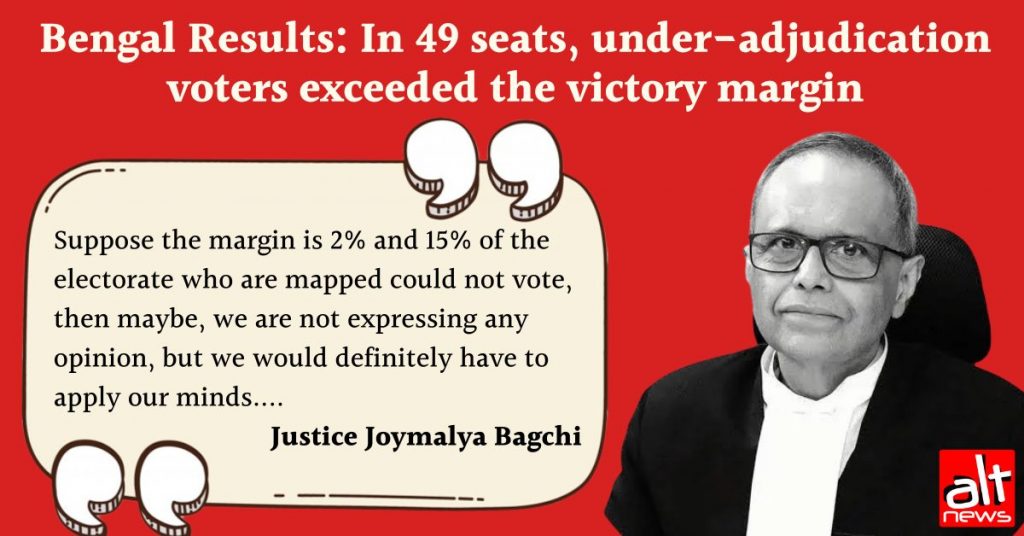
Having pointed out that in Bengal, the ECI deviated from the SIR process that had been followed in other states and introduced a new category of ‘Logical Discrepancy’, Justice Bagchi observed, “If 10% of the electorate does not vote and the winning margin is more than 10%…what will happen? Suppose the margin is 2% and 15% of the electorate who are mapped could not vote, then maybe, we are not expressing any opinion, but we would definitely have to apply our minds. Please keep this in mind that the concern of a vigilant voter whose name correctly or incorrectly is not in the list is not in our minds.”
An analysis of the 293 declared seats shows that this concern materialised in 49 constituencies, where the number of voters deleted after adjudication was greater than the winning margin. In some constituencies, the gap was humongous. For example, in Rajarhat New Town, the BJP won by 316 votes, while 24,132 electors in the constituency had been deleted after adjudication. In Samserganj, the TMC won by a margin of 7,587 votes, but 74,775 voters were still awaiting decisions on their inclusion.
Below is a chart listing all such constituencies with winning margins and number of deleted voters, and their winners:
| S. No. | Assembly Constituency | No. of voters deleted after adjudication | Winning Margin | Winning Party -2026 |
| 1 | Amdanga | 15387 | 2995 | TMC |
| 2 | Asansol Uttar | 14531 | 11615 | BJP |
| 3 | Ashoknagar | 10483 | 9408 | BJP |
| 4 | Bhatar | 17481 | 6528 | BJP |
| 5 | Burdwan Uttar | 11217 | 6460 | TMC |
| 6 | Champdani | 7610 | 3026 | BJP |
| 7 | Darjeeling | 9460 | 6057 | BJP |
| 8 | Farakka | 38222 | 8193 | INC |
| 9 | Harirampur | 13463 | 1986 | TMC |
| 10 | Hemtabad | 18215 | 12361 | BJP |
| 11 | Hingalganj | 7520 | 5421 | BJP |
| 12 | Howrah Dakshin | 14701 | 7828 | TMC |
| 13 | Jagatballavpur | 10273 | 6671 | BJP |
| 14 | Jangipara | 5432 | 862 | BJP |
| 15 | Jangipur | 36581 | 10542 | BJP |
| 16 | Kakdwip | 6238 | 4760 | BJP |
| 17 | Kaliganj | 12660 | 10172 | TMC |
| 18 | Kamarhati | 5765 | 5646 | TMC |
| 19 | Karandighi | 31562 | 19869 | BJP |
| 20 | Kashipur-Belgachhia | 3369 | 1651 | BJP |
| 21 | Khandaghosh | 9976 | 8284 | TMC |
| 22 | Kharagpur | 6168 | 2872 | TMC |
| 23 | Kumarganj | 20680 | 6685 | TMC |
| 24 | Kushmandi | 13581 | 9063 | BJP |
| 25 | Lalgola | 55420 | 18960 | TMC |
| 26 | Madhyamgram | 14842 | 2399 | TMC |
| 27 | Mandirbazar | 8390 | 1995 | TMC |
| 28 | Manikchak | 23726 | 13938 | BJP |
| 29 | Mongalkote | 21061 | 12723 | BJP |
| 30 | Monteswar | 23423 | 14798 | BJP |
| 31 | Mothabari | 37255 | 10496 | TMC |
| 32 | Nabagram | 9469 | 5919 | BJP |
| 33 | Nakashipara | 21890 | 17327 | BJP |
| 34 | Palashipara | 12613 | 11454 | TMC |
| 35 | Pandabeswar | 5898 | 1398 | BJP |
| 36 | Pandua | 11494 | 5228 | BJP |
| 37 | Patharpratima | 5086 | 4873 | TMC |
| 38 | Raghunathganj | 46100 | 40555 | TMC |
| 39 | Raidighi | 7538 | 5957 | TMC |
| 40 | Raina | 11284 | 834 | BJP |
| 41 | Rajarhat New Town | 24132 | 316 | BJP |
| 42 | Raninagar | 17140 | 2701 | INC |
| 43 | Ratua | 35573 | 32562 | TMC |
| 44 | Samserganj | 74775 | 7587 | TMC |
| 45 | Satgachhia | 8785 | 401 | BJP |
| 46 | Sitai | 20213 | 2721 | TMC |
| 47 | Sreerampur | 10445 | 8685 | BJP |
| 48 | Suti | 37965 | 12357 | TMC |
| 49 | Uluberia Uttar | 6193 | 4177 | BJP |
Source: Election Commission of India
Of these 49 seats, the BJP won 26, the TMC secured 21, and the INC won 2.
The results also reflect a broader electoral shift. Forty-eight of these constituencies had been held by the TMC in the 2021 assembly elections, with only one, Darjeeling, held by the BJP. In 2026, the BJP retained Darjeeling and won 25 seats previously held by the TMC, while the INC’s two victories also came in constituencies that had been with the TMC. Overall, 27 of the 49 seats witnessed an anti-incumbency swing.
Geographically, these constituencies are spread across 15 districts. Murshidabad, a Muslim-majority district according to the 2011 census, accounts for eight of them, followed by North 24 Parganas with six, and South 24 Parganas and Purba Bardhaman with five each. Hooghly has four such seats, while Howrah, Nadia, Malda and Dakshin Dinajpur have three each. Uttar Dinajpur and Paschim Bardhaman account for two each, and Darjeeling, Kolkata North, Paschim Medinipur and Coochbehar have one each.
Taken together, the data shows that in 49 constituencies, the pool of voters under adjudication exceeded the margin that decided the winner, linking unresolved voter roll disputes directly to electoral outcomes in a significant number of seats.