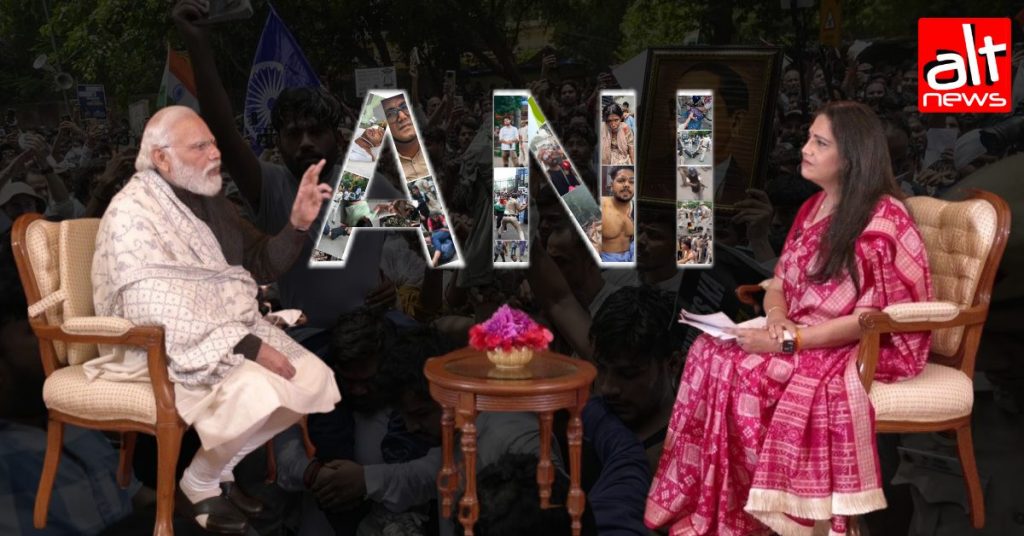
For decades, Asian News International (ANI) has occupied a near-monopoly in India’s television news ecosystem. With a business reportedly worth hundreds of crores, the agency supplies video footage and sound bites to news channels across the country and abroad. Its reporters are seemingly everywhere, often making ANI the only visual source for breaking news.
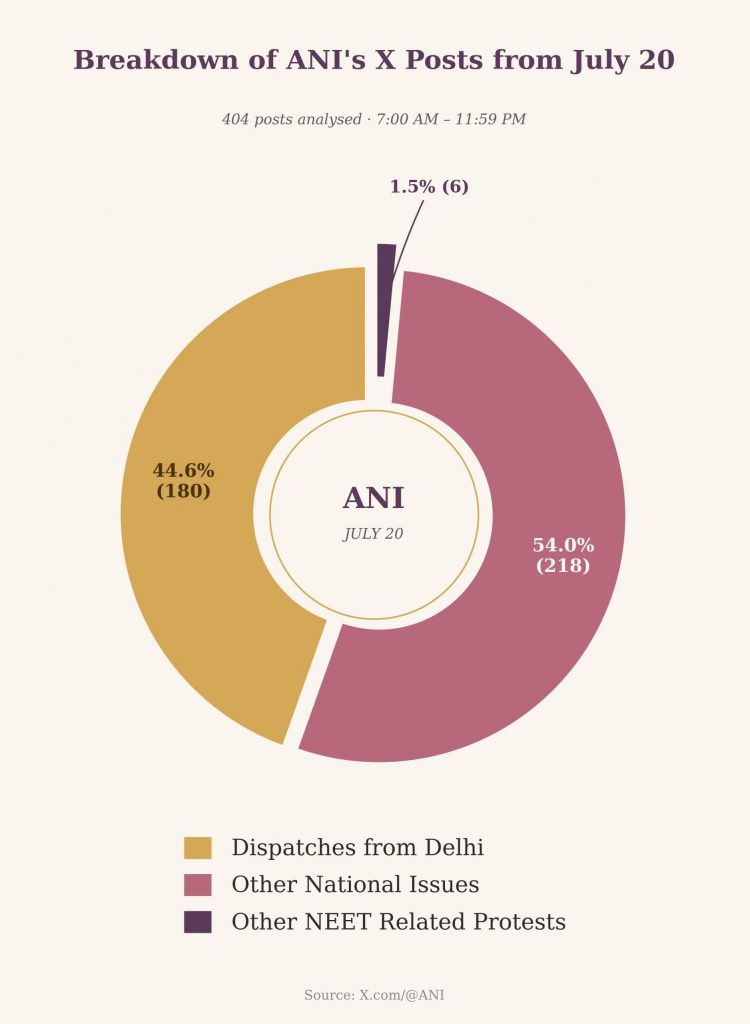
Yet on July 20, when Delhi Police launched a brutal crackdown on thousands of students protesting in Delhi, ANI had nothing to say. An analysis of ANI’s output shows that of the 404 X posts shared by the news agency that day, not a single one mentioned injury to protestors.
Headed by editor-in-chief Smita Prakash, ANI has long faced criticism for echoing government narratives. It has been accused in the past of “producing blatant propaganda for the state.” Its complete silence on the assault on students in the national Capital is likely to reinforce those criticisms.
July 20 in Delhi
The Cockroach Janta Party had called for a Chalo Sansad march on July 20, the opening day of Parliament’s monsoon session, after more than a month of continuous protests at Jantar Mantar demanding the education minister’s resignation.
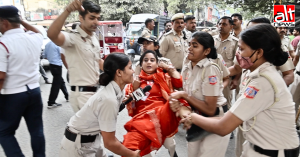
Authorities responded with sweeping security measures. Section 163, prohibiting the assembly of five or more people, was imposed in the area. More than 5,000 police personnel were deployed, and five Delhi Metro stations near Parliament were shut. As protesters attempted to march towards Parliament in defiance of the restrictions, Delhi Police used lathis and tear gas to disperse the crowds.
By afternoon, videos of clashes from Connaught Place, Patel Chowk, Raisina Road, outside Parliament, India Gate, Ashoka Road and APJ Abdul Kalam Road had begun flooding social media.
The visuals were striking: protesters with pellet injuries, batons embedded with nails, tear gas shells being fired, minors allegedly being assaulted, and scores of young demonstrators being detained by the police. By sundown, parts of central Delhi resembled a war zone.
The scale of the injuries became clearer the following morning when The Indian Express reported that Dr Ram Manohar Lohia Hospital had treated more than 100 CJP protestors, with patients requiring stitches, tetanus shots and wound dressings.
Despite the abundance of video evidence, Delhi Police denied using excessive force. In a post on X, it claimed that “no such incident has taken place” and urged the public not to “fall prey to any rumour.” The denial came even as footage showed plainclothes men wielding lathis alongside uniformed police personnel, several of whom were not wearing name badges.
Analysis of ANI’s Tweets from July 20
Alt News analysed all X posts by ANI on July 20, shared between 7 am and 11.59 pm. Of the 404 posts in this window, 218 (54%) covered national news, weather, crime, politics and other affairs. Of the remaining 186 (46%), 180 referenced Delhi. These posts were on whatever was happening in Delhi — the protest at Jantar Mantar, the students’ march, updates related to the beginning of the monsoon session etc. Six posts were about NEET-related protests from the rest of India. The entire dataset can be accessed here.
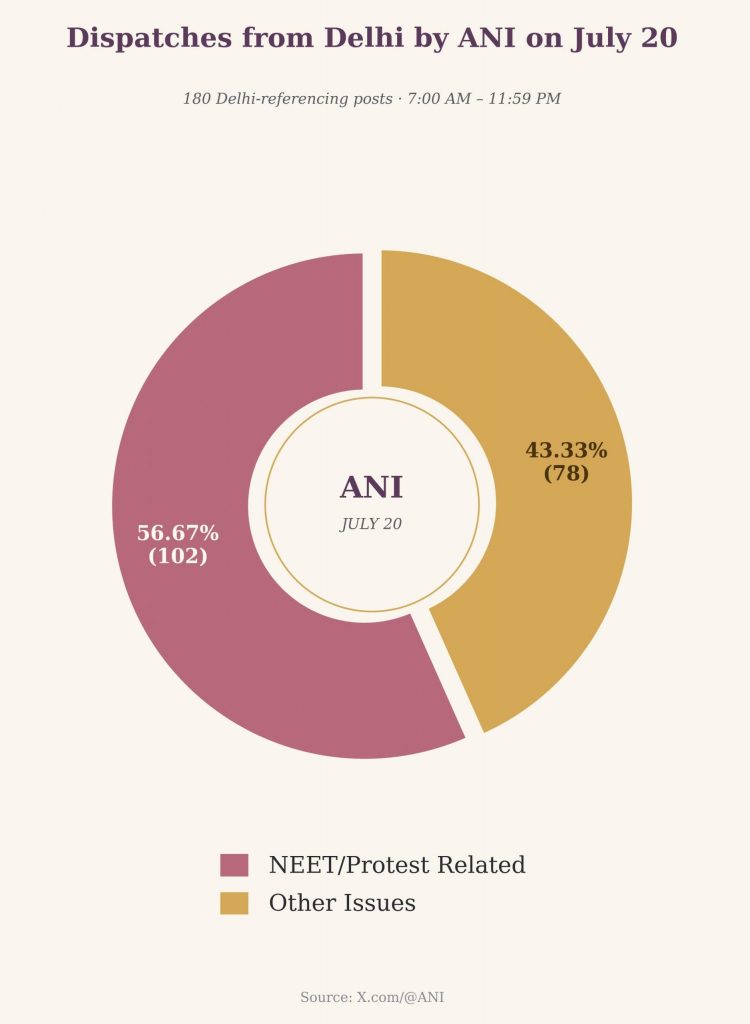
Of the 180 news updates from Delhi, 102 posts (56.66%) concerned the NEET issue or the protests, covering developments at Jantar Mantar through the day and statements by political leaders in Parliament on this. The remaining 78 (43.33%) covered other Delhi-based news — statements on Ram Mandir donation theft, restoration of Jammu and Kashmir’s statehood, external affairs minister S Jaishankar meeting the foreign minister of Panama etc.
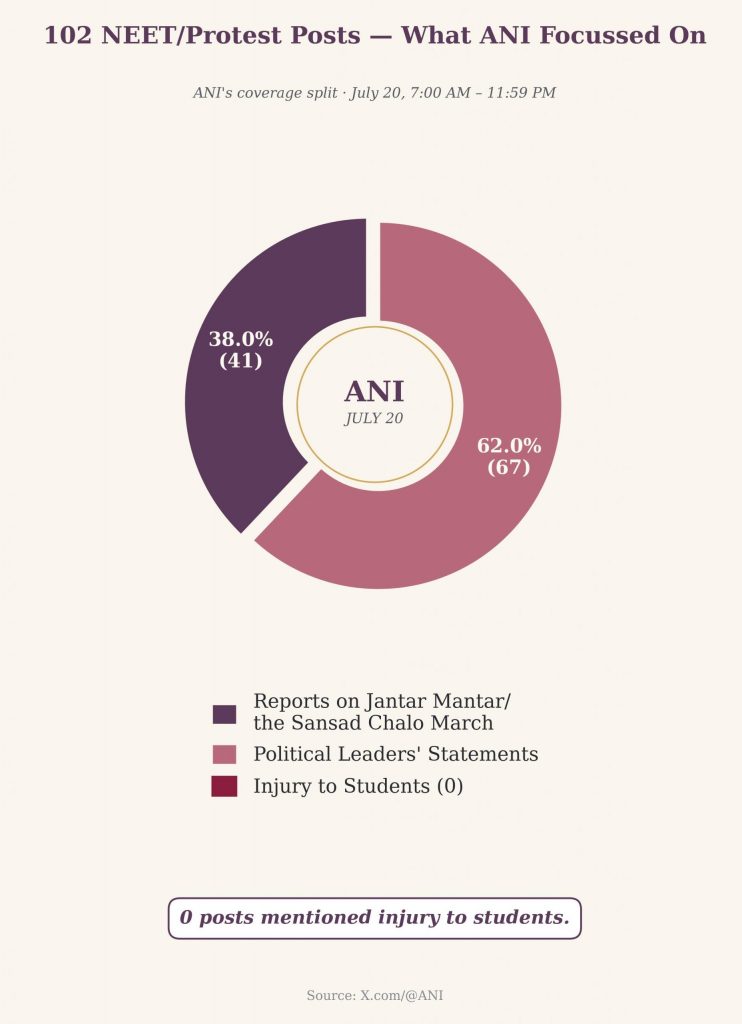
Of the 102 NEET and protest-related posts, 41 reported developments from Jantar Mantar and the Chalo Sansad march, and 67 carried statements from political leaders. Not a single one mentioned the police and RAF action against students or injury to the protestors.
What did ANI (not) Report?
As the analysis above shows, ANI published 41 posts that dealt directly with protest. A review of its coverage reveals a clear pattern.
The morning’s reportage focused largely on the security build-up: Deployment of the Rapid Action Force, the closure of Metro stations near Parliament, heightened security arrangements, updates on Sonam Wangchuk’s health, and his wife Gitanjali Angmo’s legal challenge to the Delhi high court’s refusal to shift him from Safdarjung Hospital.
The first indication of unrest came at 10:20 am, when ANI reported that protesters had “clashed with RPF personnel” and that police had “used lathis for crowd control.” Between 10:48 am and 10:54 am, it also reported on a meeting between CJP spokesperson Saurav Das and a deputy commissioner of police.
But as the confrontation intensified — with rampant lathi charge and use of tear gas being documented by eyewitnesses, journalists on ground and numerous videos circulating online — ANI’s coverage fell silent. There was a gap of nearly an hour and a half, from 12:50 pm to 2:18 pm when there were no posts related to the protests on the streets. When the agency resumed posting, it merely reported that the protesters had “dispersed”, without describing the events that had led to their dispersal.
During this same period, that is between 12:50 pm and 2:18 pm on July 20, the official X handle of the CJP posted several videos of police using force against protestors. (Check here, here and here)
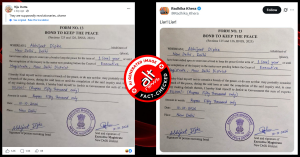
During the day, ANI also amplified two Delhi Police ‘fact checks’ denying claims that CJP leader Abhijeet Dipke had been detained and that a 12-year-old girl, along with dozens of others, had been assaulted.
As the day progressed, the focus of ANI’s coverage shifted almost entirely to injuries sustained by police personnel. At 2:56 pm, it reported that a sub-inspector had been injured. By 11:38 pm, the agency was carrying detailed figures stating that more than 118 police personnel had been injured, complete with a rank-wise breakdown. There was no mention of the number of students injured.
During today’s violent protests, more than 118 police personnel from Delhi Police and Central Police Forces, including Special Commissioner, Joint Commissioner, Additional Commissioner, and Deputy Commissioner rank officers deployed on duty, sustained injuries.
Delhi Police… pic.twitter.com/DF5re1OtK2
— ANI (@ANI) July 20, 2026
ANI also published at least seven posts highlighting damage allegedly caused by protesters. In one post captioned “Aftermath of the clash between police and CJP protestors”, the agency showed damaged police vehicles and debris strewn across the road. All along, it chose not to document the injuries sustained by protesters or the force used on them.
#WATCH | Delhi | Aftermath of the clash between police and CJP protestors; visuals from Hanuman Mandir Road pic.twitter.com/qrrXt3BTFs
— ANI (@ANI) July 20, 2026
Two ANI posts attempted to show protesters throwing stones at Delhi Police personnel.
#WATCH | Delhi: Protesters pelt stones at Delhi Police personnel at Feroz Shah Road.#CJPProtest pic.twitter.com/CSCibKGpfT
— ANI (@ANI) July 20, 2026
Footage of police personnel allegedly throwing stones also went viral during the day. ANI did not cover it.
Why are the Police pelting stones at protesters? Was the brutal lathi charge not enough?
Shocking visuals coming from Delhi pic.twitter.com/8QF2SyG7gP
— Cockroach is Back (@Cockroachisback) July 20, 2026
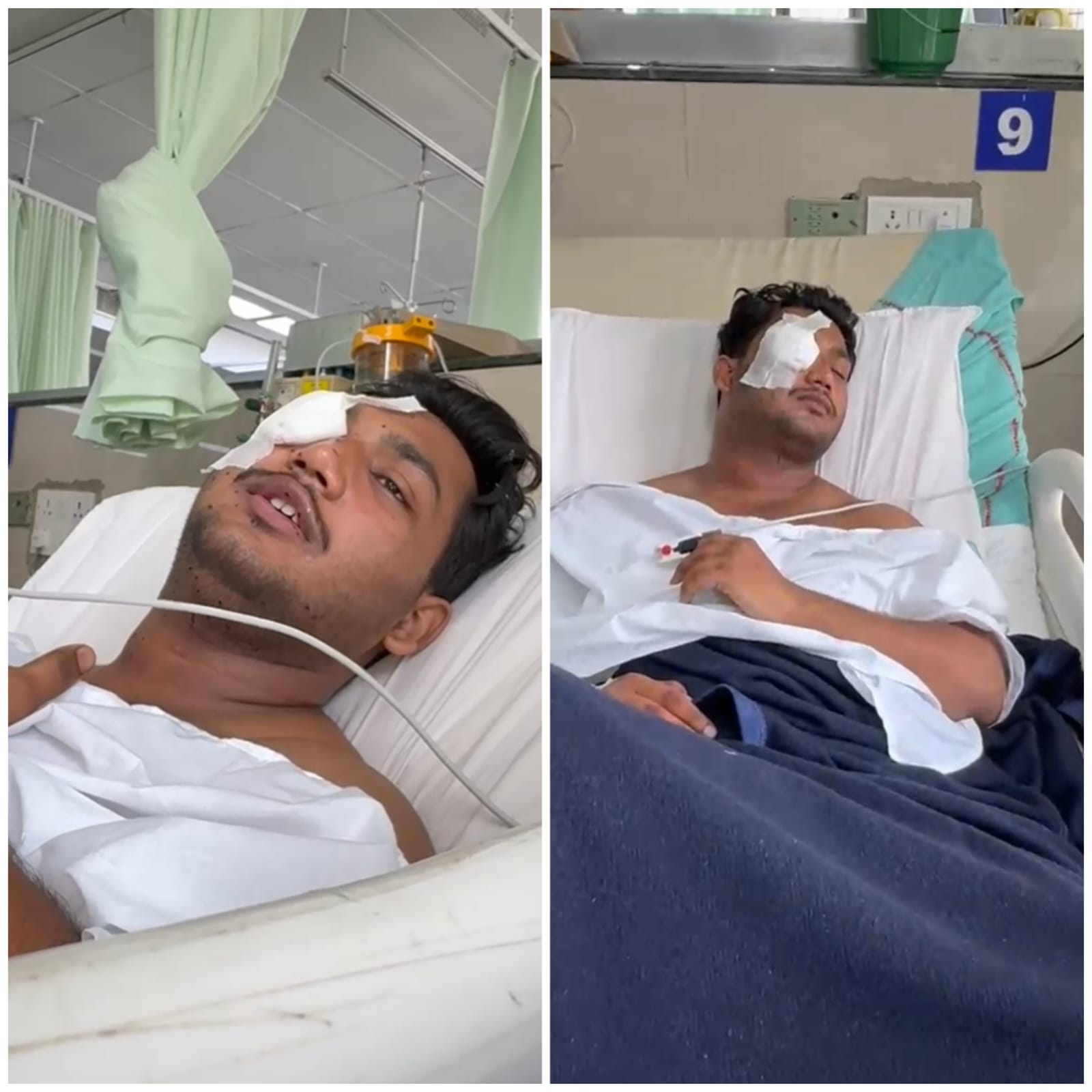
Several outlets, including Alt News, reported the use of pellet guns by security personnel on youngsters. One of the injured may even lose an eye. As of July 28, ANI has still not put out a single report on the use of pellet guns or injuries caused by them on July 20, except for statements by Opposition leaders on the same. They did cover Rahul Gandhi’s press conference where one of the pellet gun victims was present, but they did not carry a single original report on the use of projectile action guns (PAGs).
Several photos of injured police personnel were shared by ANI, starting from 3 pm.


Throughout the day, ANI focused on reporting from the Parliament, posting statements from various political leaders on various issues. Several politicians, including Samajwadi Party supremo Akhilesh Yadav, SP MP Dimple Yadav, Congress leader Pawan Khera, and Rashtriya Janata Dal MP Manoj Jha, spoke about the protest. They condemned the government’s alleged suppressing of dissent.


There were comments from BJP MPs like Hema Malini, who insisted that a problem should be discussed properly and “protesting in this manner won’t achieve anything”.
There were updates from outside the Capital too, including reports like the Unjha Cumin and Fennel receiving GI Tag, “strengthening Gujarat’s global spice identity” at 1:24 pm.
Unjha Cumin and Fennel receive GI Tag, strengthening Gujarat’s global spice identity pic.twitter.com/pMOMA6llQC
— ANI (@ANI) July 20, 2026
At 12:55 pm, ANI posted about devotees gathering on the fifth day of the annual Rath Yatra in Puri, Odisha, to “witness the auspicious Hera Panchami ritual of Goddess Mahalaxmi and have darshan of Lord Jagannath, Lord Balabhadra, Devi Subhadra and Sudarshan at Sri Gundicha Temple”.
#WATCH | Puri, Odisha: Devotees gather on the fifth day of the annual Rath Yatra to witness the auspicious Hera Panchami ritual of Goddess Mahalaxmi and have darshan of Lord Jagannath, Lord Balabhadra, Devi Subhadra and Sudarshan at Sri Gundicha Temple. pic.twitter.com/Tg2XEWdgep
— ANI (@ANI) July 20, 2026
At 3:09 pm, they reported on the Bihar government’s launch of the ‘Somnath Yatra’ under the Somnath Teerth Yatra Scheme to “facilitate devotees’ pilgrimage to the Somnath Temple in Gujarat”.
#WATCH | Bihar Government launches ‘Somnath Yatra’ under the Somnath Teerth Yatra Scheme. The initiative, spearheaded by the Department of Art, Culture & Youth, aims to facilitate devotees’ pilgrimage to the Somnath Temple in Gujarat.
Bihar Chief Minister Samrat Choudhary will… pic.twitter.com/nwhBAqBtuI
— ANI (@ANI) July 20, 2026
These posts appeared even as videos of police action against protesters flooded social media. ANI refused to report on that.
Its coverage that day raises a broader question: Where does editorial judgment end and narrative-building begin? Because the agency supplies much of the footage used by television news channels, its omissions can be as consequential as its reporting. By largely leaving out allegations of police excess during one of the biggest protest movements in years, the country’s dominant video news agency tried to define what the mainstream audience sees, and what it does not.