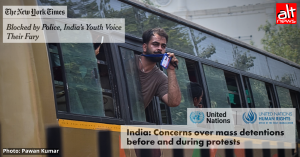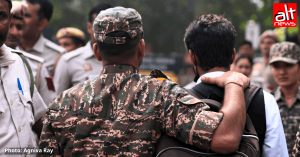
The anger was impossible to miss.
As television reporters walked into Delhi’s Jantar Mantar and adjoining protest sites to cover the Cockroach Janta Party (CJP) movement, many were greeted with chants of ‘Godi Media Haye Haye’. Several journalists carrying microphones or wearing lanyards bearing the logos of prominent television channels — including NDTV, News X, ABP News, and Times Now — found themselves surrounded by protesters questioning their coverage of the movement. In some instances, reporters were heckled. In some instances, the confrontation turned physical: Times Now reporter Dev Kotak was roughed up by the crowd at Jantar Mantar, and video of the aftermath circulated widely. A Zee News reporter was filmed in Mumbai standing in the rain as youth protesters around him jeered.
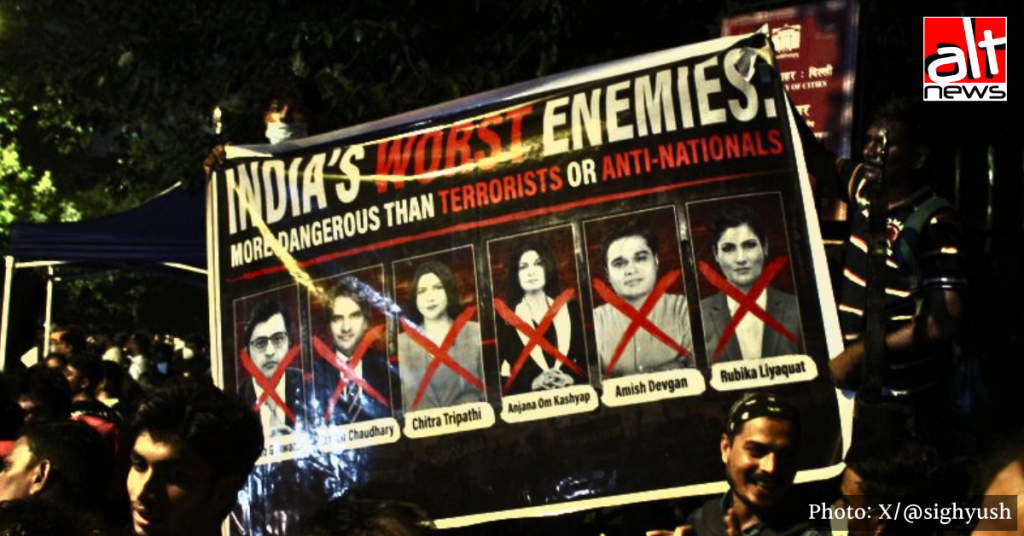
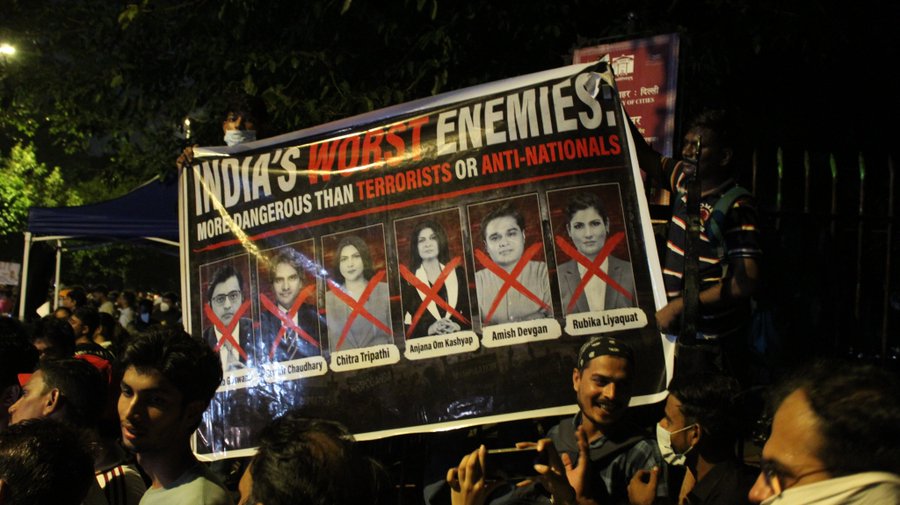
The mood was most poignantly captured, perhaps, by a banner at the protest site. It contained the mugshots of six senior mainstream media journalist-cum-anchors: Arnab Goswami of Republic, Sudhir Chaudhary of DD, Chitra Tripathi of ABP, Anjan Om Kashyap of Aaj Tak, Amish Devgan then of News 18, and Rubika Liyaquat of Times Now Navbharat. Above their photos, the banner said, “India’s worst enemies — More dangerous that terrorists or anti-nationals”.
Taken together, the scenes that unfolded in Delhi raise the important question: Why did a large section of young protesters reserve some of their sharpest criticism not for politicians or police, but for television news channels?
Television Crew Faces Public Anger
The protests that erupted in Delhi in June-July brought together thousands of students and young people from across the country, turning a satirical political collective called the Cockroach Janta Party (CJP) into the nucleus of a wider youth-led movement. What began as a mobilisation around the NEET-UG paper leak and concerns over the examination system expanded into a broader expression of anger against the government, with protesters demanding accountability from those in charge. The demonstrations grew in scale over weeks, drawing sustained public and media attention and eventually contributing to Union education minister Dharmendra Pradhan’s resignation.
As the protests grew, major television networks deployed reporters to cover the events. Instead of the routine interactions that often accompany live reporting, many ground reporters encountered open hostility from sections of the crowd.
Slogans of “Godi Media” were raised during a gathering in the national capital Delhi. pic.twitter.com/oyZpCVz0EY
— The Nawakadal (@thenawakadal) July 20, 2026
Videos shared widely on social media show protesters chanting ‘Godi Media Haye Haye’ — a phrase originally coined by journalist Ravish Kumar, roughly translating to ‘lapdog media’ — as reporters prepared to go live. In one video, a protester says he stopped a News18 vehicle from being damaged despite his own anger towards the channel. “I am a Muslim myself. I protected their vehicle from being damaged. Though I know this evening, they will again do a Hindu-Muslim debate,” he said.
GODI MEDIA IS DEAD!
Yesterday’s Massive Student Protest Delivered The Final Verdict:
Traditional Mainstream Media has COMPLETELY LOST Gen Z’s Trust!Lakhs of Students who hit the streets got EVERY piece of Real Information from Social Media — not your Biased Propaganda Boxes.… pic.twitter.com/zLIOM5GXP1
— তন্ময় l T͞anmoy l (@tanmoyofc) July 21, 2026
As reporters started being identified by the brands they represented, some began using unbranded microphones instead. NDTV’s Shiv Aroor and Vishnu Som, and India Today’s Preeti Choudhry were among those.
The outbursts were not confined to a handful of isolated incidents. Numerous videos from different locations captured similar confrontations, while comments beneath those videos echoed the protesters’ criticism of mainstream television news. Smaller outlets perceived as pro-government were heckled as well, suggesting the hostility was directed at a type of coverage rather than at legacy television alone.
At the same time, several incidents crossed the line from protest into intimidation. Videos also emerged showing journalists being pushed, chased or physically heckled by sections of the crowd.
This andhbhakti of CJP is now crossing all limits. You can tell godi media to walk away, raise slogans, but you can’t physically push, grope or beat them.
Wonder whether these are genuine protestors or lumpen elements.https://t.co/Xo4bTJ1DgX
— 🍉 (@DelhiIsNotFar) July 21, 2026
In Kolkata as well, reporters of mainstream media outlets were allegedly pushed and shoved after a march on July 24 in solidarity with the Jantar Mantar protest.
Why Were Protesters Angry?
The central allegation against sections of legacy media seemed to be that they had stopped acting as the voice of the people and had instead become the voice of the establishment.
For many of the demonstrators, the resentment did not begin with the July protests.
Television news channels have failed, over the years, to hold the Union government to account over a wide range of issues that affect ordinary citizens’ lives — from examination paper leaks and irregularities in recruitment exams to unemployment, price rise, public health etc. This is precisely the role the media is expected to play as democracy’s fourth pillar. Most television news channels that have ample airtime for communal debates and polarising studio confrontations show far less urgency when the failures of the government directly affect the lives and futures of citizens.
The dissatisfaction was not simply about what television channels were reporting during the protests, but what they had consistently chosen not to report. For a generation facing an increasingly precarious education and employment landscape, the perceived reluctance of mainstream television to question those in power became a source of deep distrust.
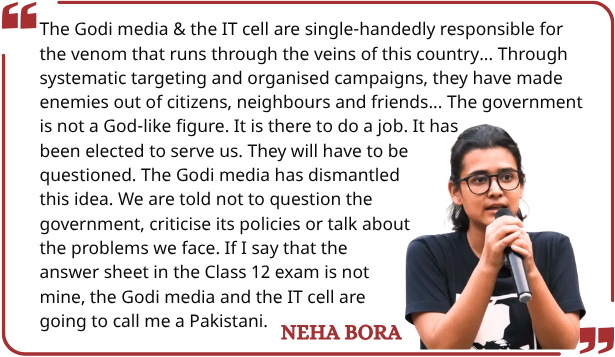
Explaining the reasons for the anger against the mainstream media, AISA leader and student face of the Delhi protests Neha Bora said, “The hate that the government peddles comes to our drawing rooms, our WhatsApp groups and our very personal lives, within the four walls of our homes, through the Godi media. The Godi media and the IT cell are single-handedly responsible for the venom that runs through the veins of this country presently. Through systematic targeting and organised campaigns, they have made enemies out of citizens, neighbours and friends.”
Elaborating on how they had failed in their duty, she added, “The government is not a God-like figure. They are there to do a job; they have been elected to serve us. They will have to be questioned. The Godi media has systematically dismantled this idea. We are told not to question the government, criticise its policies or talk about the problems we face. If I say that the answer sheet in the Class 12 examination is not mine, the Godi media and the IT cell are going to call me a Pakistani.”
In May, Doordarshan anchor Ashok Srivastav called Class XII student from Delhi Vedant Srivastava a Pakistani. After receiving unexpectedly low marks in Physics, Vedant had applied for photocopies of his answer sheets through CBSE’s reevaluation process. When the copies arrived, he discovered that the Physics answer sheet uploaded by the Board was not his. He made an X account to post about his grievances.
“The disrespect that the youth has for Godi media stems from the recognition that the mainstream media and its anchors, who scream at the top of their voices on TV screens, have fractured the democratic, secular fabric of this country,” Neha added.
Asked for her response to ground reporters being heckled, Neha said, “We recognise that there are ground reporters in Godi media who do honest work, and that is why we urged our people not to disrespect them. Our differences need not be expressed through violence. We don’t believe in mobs. But there is no denying that the mainstream media has become a BJP propaganda cell, it seems.”
The protesters’ criticism was also shaped by how they believed the movement itself was being portrayed.
Arnab Goswami, for example, in an apparent bid to discredit the protest and question its legitimacy, mentioned China, US, Bangladesh, Pakistan, BitChat, the deep state, Greta Thunberg, Jeremy Corbyn, and even John Cusack as conspirators behind the CJP protest.
In a podcast hosted by Navika Kumar, lyricist and screenwriter Manoj Muntashir Shukla called protesters anti-nationals.
As clashes broke out between protesters and police on July 20, ANI did not post a single news update throughout the day which mentioned injury to protesters.
In Kolkata, Zee reporter Ayan Ghoshal said while interviewing BJP leader Dilip Ghosh, “For the last 3 days efforts are on in Delhi to break India. PM has shown restraint. We know how Pak or Indonesia curbed students’ protest. Dead bodies were strewn on sreets. But no tough action here. They’re getting encouraged.”
The mainstream media drew criticism on social media for what protesters described as coverage that closely mirrored the official version put forward by the Delhi Police and the government. The channels, on the other hand, maintained that they were reporting developments on the ground.
You are the most vile, most pathetic, most disgusting person @sudhirchaudhary
I always agree to disagree, never hate anyone but you are really a bad person.
You are now labelling innocent students for your propaganda.
Shame on you! pic.twitter.com/lYj5cNlURk
— Arpit Sharma (@iArpitSpeaks) July 21, 2026
Rahul Shivshankar, editorial director of CNN News 18, amplified a video where RSS leader Atul Limaye called the CJP protest anti-national and “a weapon against the Constitution”.
It is worth noting that coverage of this kind carries risks beyond the newsroom. Framing a protest movement as anti-national, foreign-funded or a security threat can shape how the protesters are treated on the ground, by the state and by ordinary citizens alike. The Zee reporter’s on-air remarks, for example, were arguably not only biased, but amounted to incitement. Seen against this backdrop, at least some of the heckling and intimidation directed at reporters on the ground could be a reaction to this pattern of coverage.
A Widening Trust Deficit
The outpouring of anger at journalists points to a broader crisis of credibility confronting sections of India’s television news industry.
Alt News’s years of fact-checking work and media-watchdog journalism point to a pattern rather than isolated lapses: In the recent past, large sections of mainstream television media have functioned as an echo chamber for the government. The clearest symptom is the collapse of verification standards and rampant amplification of misinformation. During the India-Pakistan military escalation following the Pahalgam attack, several major channels aired unverified and outright false claims — old and unrelated videos and fabricated visuals presented as live combat coverage.
ALSO READ: Op Sindoor: As Indian media made false, outrageous claims, PIB looked the other way
Further in the past, we documented instances of mainstream media broadcasting misinformation targeting protesters and protest movements. During the 2024 farmers’ movement, Republic, News 18, India TV, Zee News, India Today, Navbharat Times — all ran a doctored video of farmer leader Jagjit Singh Dallewal without any context and amplified the misleading claim that he said Prime Minister Narendra Modi’s popularity graph had skyrocketed after the Ram Mandir inauguration and reached an all-time high.
More examples of such misreporting related the farmers’ protest can be found here and here.
It is worth noting that during the farmers’ movement of 2020–21, too, several mainstream television channels faced sustained criticism over their coverage, including banners at protest sites slamming Godi Media. Farmers accused sections of the media of portraying the agitation as foreign-funded or sympathetic to Khalistani groups rather than engaging with their demands. However, the scale and frequency of confrontations witnessed during the CJP-led protests appear significantly greater than what was seen during the farmers’ movement.
ALSO READ: The fictional strikes on the Karachi port and what it says about Indian media
A second, related failure is the normalization of communal debates on prime-time shows. On almost a daily basis, senior journalists host panel debates that are structured for conflict, with the anchors allowing and sometimes encouraging inflammatory rhetoric against minorities — perhaps because it drives engagement, and suits the Right-wing ideology.
Check the thumbnails in the compilations from 2022 below. Each and every bulletin represented by these thumbnails was on communal issues. All on News 18:
Hosted by Aman Chopra:
Shows hosted by Amish Devgan:
The cumulative effect is to cloak hate-mongering as news content night after night. Several prominent channels have faced punitive action in the last few years for peddling communal propaganda on shows hosted by ‘star’ anchors. Related reports by Alt News can be found here, here, here, here and here.
After Operation Sindoor, when several mainstream channels aired unverified and absurd claims, including reports that India had attacked Karachi, the BJP’s official X handle shared a monologue by anchor Sushant Sinha defending the media’s coverage as part of a broader “information war” in national interest.
पाकिस्तान कभी नहीं सुधरेगा और हो सकता है कि युद्ध भी हो, लेकिन क्या ऐसे लड़ेगा भारत?
ऐसे भारत विरोधी तत्वों को पहचानिए, जिन्होंने #OperationSindoor के समय अपने देश, देश की मीडिया और देश की सेना का मजाक बनाया था…
हमारे जवान तो जंग के लिए तैयार हैं, लेकिन क्या आप मन से तैयार… pic.twitter.com/spQrwxqbTm
— BJP (@BJP4India) May 14, 2025
There could be no clearer indicator of the alignment of the mainstream media with the BJP government.
In a functional democracy, the public square is a space that should be open to everyone, equally, without fear, intimidation or violence. Whether that principle still holds in India is increasingly open to question. If sections of society — minorities, independent journalists and critics of the government — cannot live and function without fear of harassment, vilification or even incarceration, the mainstream media has played a significant role in creating and reinforcing that climate. And there appear to be few meaningful avenues for holding these media organisations accountable.
Structural Questions: The Nexus among Media, Corporate Power & the BJP Government
Structural factors help explain this pattern. Both the ownership and revenue models of India’s mainstream media organisations constrain their capacity for critical journalism. Several major outlets — including NDTV, IANS and News18 — are owned by large business conglomerates such as the Adani and Ambani groups, which have close ties to the Union Government.
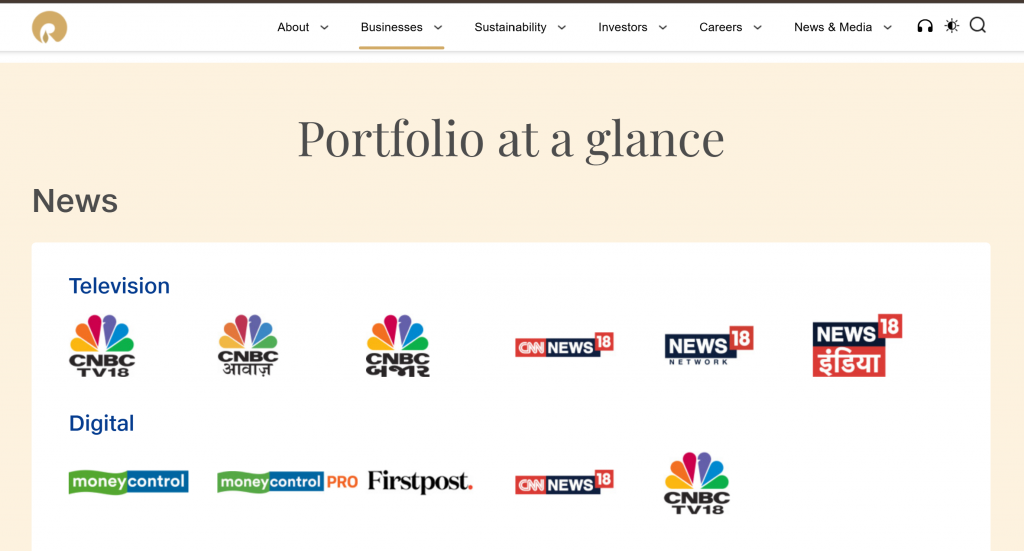
The journalism produced by these organisations reflects those ties, more often than not. Television news, being capital-intensive, is also heavily dependent on government advertising and large corporate advertisers, who are often reluctant to fund critical journalism.
The incentive to toe the government line shows up not always as an explicit directive but more as a pattern of editorial choices: Aggressive coverage of opposition-ruled states, muted coverage of the same failures under the Union government or in BJP-ruled states; extensive coverage of minor opposition controversies, minimal coverage of major stories embarrassing to the ruling party. See here, here and here.
The closeness between media and corporate power was captured vividly when India Today anchor Rahul Kanwal was filmed tasting food meant for elephants at the Ambanis’ Vantara animal sanctuary, alongside Anant Ambani. For many viewers, the spectacle reinforced the perception of a media establishment more comfortable warming up to power than challenging it.
This was in March 2024. Exactly one year later, Vantara was in the news again. This time, after a South African wildlife coalition urged its government to investigate the transfer of wild animals to the Reliance-owned facility. A handful of Indian outlets reported the concerns, but within days, many of them took down their reports, leaving readers with ‘Error 404’ or ‘Page Not Found’ messages. The reasons for the removals remained unexplained. At least three media houses told Alt News that they had received threatening calls or emails.
In 2018, ABP News managing editor Milind Khandekar and anchor Punya Prasun Bajpai had to resign after Bajpai’s show ‘Masterstroke’ fact-checked a claim made during a public interaction involving Prime Minister Modi. Chandramani Kaushik, a farmer from Chhattisgarh, had told Modi her income had doubled after she switched from paddy cultivation to processing custard apple. When ABP interviewed her, she said she had been coached by officials to make the claim. Senior anchor Abhisar Sharma was taken off air days later after e juxtaposed a Modi speech in Lucknow praising Uttar Pradesh’s improved law-and-order record with a shootout in the state on the same day.
Efforts to counter this nexus have had limited success. The Independent and Public-Spirited Media Foundation (IPSMF), set up with funding from Azim Premji and Nandan Nilekani to support independent journalism, has faced funding constraints in recent years and has been the subject of income tax investigations.
These dynamics are reflected in India’s global press freedom rankings, which have declined in the last two decades.
Reporters, like people in every other field of work, must be able to do their job without harassment or fear of violence. And physical retaliation can not become an acceptable response to disliked coverage. Once it is, it can easily be turned against any journalist doing legitimate reporting — not only those seen as compromised. But condemning those attacks should not foreclose an examination of the reasons behind the hostility.
The chants of ‘Godi Media Haye Haye’ were directed not merely at individual reporters standing in front of television cameras, but at institutions that many protesters believe have repeatedly failed to hold those in power accountable. Whether or not that perception is fair, the scenes from Delhi point to a widening gap between a section of India’s youth and parts of the country’s mainstream television news industry — a gap that did not emerge overnight, and is unlikely to close soon.
With inputs from Ankita Mahalanobish.